
by Megan Dohm | Apr 22, 2019 | April 2019, Do
Cheerful, brightly colored books line the shelves, there’s a three-legged dog named River and two scrappy women are at the helm—it’d be easy to idealize a place like Dog-Eared Books.
Tucked away from the buzz of Atlantic Avenue, the store is a hidden gem for reading enthusiasts, where (leashed) dogs are welcomed, workers make a policy of getting to know their customers and local authors are invited in regularly for signings. How could you help but envision bookshop life as anything but cozy, like a mug of warm tea on a rainy day?
“A lot of people think that owning a bookstore is a romantic [thing],” says co-owner Caitlynne Garland. “That is not the case. That is not the case at all.” The work to maintain a sustainable, growing bookstore is highly logistical, she explains; it is dirty and back-breaking, a worthwhile but long climb up a steep hill.
Garland and Dog-Eared’s other co-owner, Stephanie Stegemoller, met at Appalachian State University, in a genetics lab. Stegemoller plopped down at Garland’s table and launched a campaign to win the reserved Garland over. They formed a fast friendship which lasted through graduation and a move to Raleigh, where they spent time working at a local bookstore and, unintentionally, learning the mechanics of selling books along the way. When that store closed, they began selling books online from Garland’s spare bedroom, with $200 in cash for capital. The business and books spread rapidly throughout Garland’s home, landing the duo with a house full of excess books—perfectly good books, but with little to no online value—and no elbow room. They decided it was time to expand to a brick-and-mortar location, and their labor of love began. Garland’s stepfather built sturdy bookshelves, mothers and grandmothers pitched in with sorting and the two owners worked into the wee hours for six weeks straight.
On April 29 of 2017, Dog-Eared Books opened to the public.
Two years in, the bookshop routines are comfortably settled. Fridays and Saturdays are devoted to selling $1 books out of the store. Sunday is a day off. Mondays through Thursdays are spent in the warehouse portion of the building, processing books out of gaylords, the name for those giant cardboard boxes that you would otherwise find produce in.
“It’s always a state of chaos,” Garland says. “Organized chaos,” she clarifies.
“It’s organized to us, and we know what’s going on,” Stegemoller adds.
The warehouse is not actually chaotic or messy; these are just two orderly people. To process books, one of them clambers inside a gaylord. They sift through volumes damaged by mold or water and miscellaneous bonus items, such as candles, posters, and Christmas cards, pulling books to inspect and scan. Each book has potential; it could be sold online, as part of a restored set, in the store or as a part of a customer’s wish list. All of these options run through their minds as they sort through books big and small.
“Every single book that comes through this building, one of us has our eyes on it,” Garland says. She adds that they never know what they’ll find in a given box; some books look destined for the recycling pile and go on to sell on Amazon for $80. Others have value simply because they know there are people eager to read them, if only for a buck.
When the shop portion opens on Friday, everything is in order. Shelves are full just to the brim, never more. They are tidy, sorted, exactly right, revealing nothing of the hurricane aesthetic of Saturday nights following the ebb of the weekend traffic. Customers filter in and there is a palpable camaraderie among them—these are Book People who know the promise of print, and know that, inside each book, there are worlds, persons and ideas far beyond their own lives and experiences.
Stegemoller and Garland know their customers, too, who they are and what they’re looking for. But no, it’s not romantic. The shop is not full of characters. The work does not feel like a cozy cup of tea. It’s not a life of romance that’s in pursuit here, but something more simple—a life, like a dog-eared book, that’s simply good.
Dog-Eared Books celebrates its two-year anniversary on Saturday, April 27th, with books, cupcakes and revelry. The store is open Fridays and Saturdays from 10 a.m. to 6 p.m.
by Megan Dohm | Mar 10, 2019 | Do, March 2019
Vice President Mike Johns and President Clif Kelly
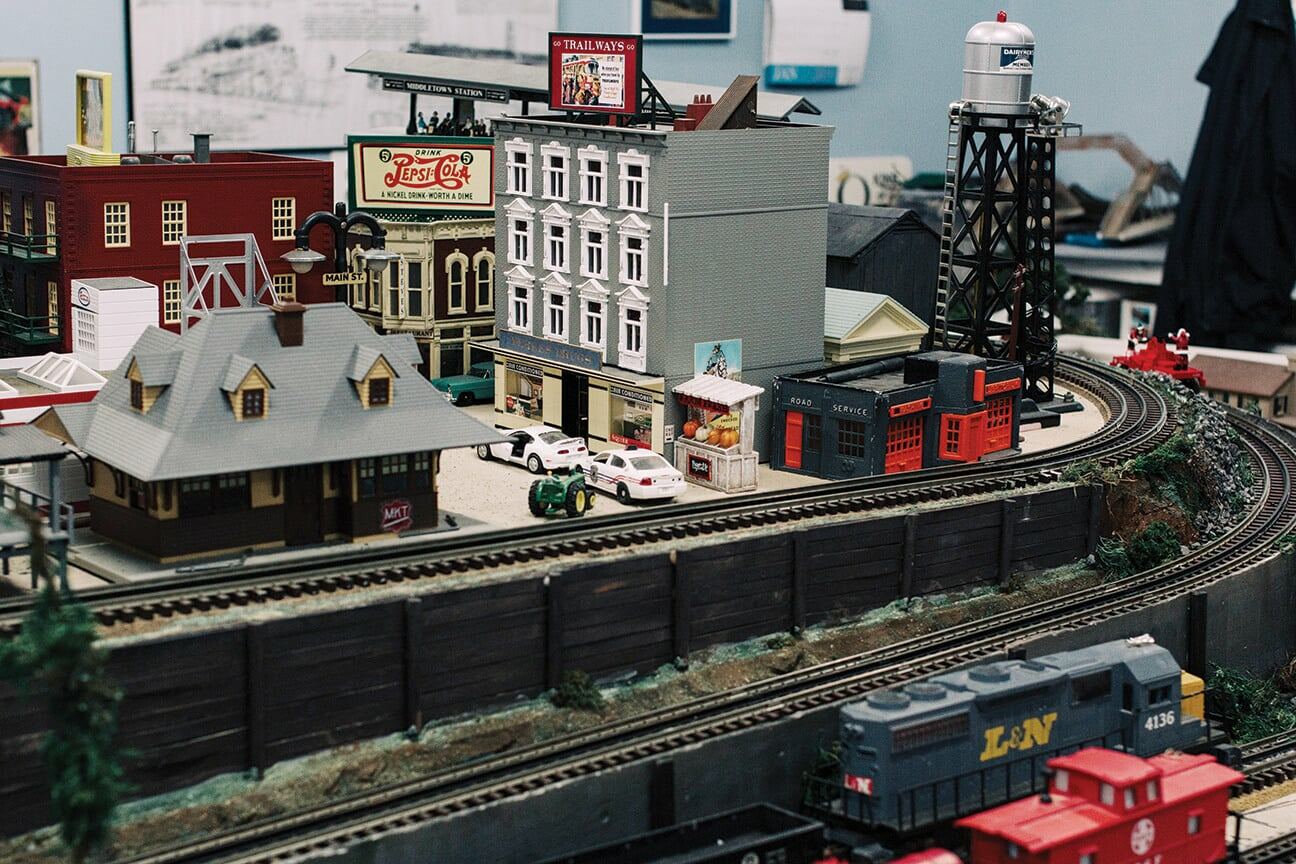
Sunshine warms members of the Neuse River Valley Model Railroad Club as they migrate from breakfast in City Market to their almost-downtown clubhouse for a couple hours of building. The club is roughly 2,000 square feet, and features a common area, a library with model railroad resources dating to the 1930s and work rooms marked by the scale of their railroads. The miniature locomotives emit a quiet, mechanical buzz as a backdrop to their conversations—plans being made, tasks being divvied up, puzzling through technical issues with relish.
In a circle of chairs, members gather to discuss the history of the club. There is a common propensity to lean back, hands folded over bellies full of Big Ed’s. Club president Clif Kelly says that the members in the circle and beyond come from “all around the Triangle. North, west, east and south.” A broad swath of experience is also represented, ranging from civil service and time in the Pentagon to handymen, time in the medical field, a Boy Scouts executive and a stained-glass maker. They’re not all grey hair and suspenders; in their club of roughly 40, there are some youth members, an under-40 crew and some women members, all brought together by a fascination with trains, model or otherwise. They know which trains run across the state and when, where they used to run and where to get a good hot dog close to the Burlington station. The curiosity extends to everything train-related; if it has wheels and ran on a track, someone has a general knowledge about it.
In new members, all that’s required is a discernible pulse and, “an interest in a flanged wheel on steel,” according to the club’s last remaining charter member, George Lasley. The others have a reverence for Lasley, for his wealth of knowledge and stories. They have bestowed upon him the official title of “Grand Poobah” (which they pronounce “poppha”); it’s fitting for the mustached man in charge of the club train shows at the fairgrounds (running this year in May and November). After 50 years of helping others with designing their layouts, Lasley is beginning one of his own, all built around a model of the Virginian Railway train EL-2B. All of the members listen to his plans with curiosity, leaning in to hear an expert’s plot before dispersing to their own work.
In the biggest room, the club’s vice president, Mike Johns, is finessing a digital command center on the HO (1:87) scale layout. Measuring at least 25 feet long, it’s filled with neighborhoods you would swear you’ve walked past somewhere. In the library, a member fiddles with the wiring beneath a square of layout, while two others putter in the common room. At the back of the building in the O (1:48) scale room, a fictitious mountain scene is beginning to unfold, complete with scrubby trees, pools of water, and a fossil in the side of a rock. Floating from the corner, a bass voice sings short ditties narrating the work going on in between drilling. Club member Shelton Bass is shaping the landscape, and is excited about discovering the perfect pig for the corner farm scene. Although the layout’s location is fictitious, he says he has seen each piece somewhere. He employs whatever manages to make the scene look realistic—sawdust mixed with food coloring, dollar store moss, small branches with sealer, painted styrofoam, Elmer’s glue for water—he has a bag of tried-and-true tricks to pull from.
As members bustle around the club, they’re solving problems with work they generally enjoy, with people they generally enjoy. Although every bit of a layout is a labor of love, they each have their preferences and specialties, along with a space to flesh their visions out.
“As a friend of mine used to say, at the end of the day, it’s still playing with toy trains,” says Lasley. “And there’s nothing wrong with that.”
“It’s also, there’s a human aspect about us that is really magnificent and wonderful, and that is that we’ve made friends,” says Johns. “We can count on each other, we can discuss things; it’s a school here.”
For more information, visit the club’s website at nrvclub.net or stop in at its upcoming open house on March 23. Doors open from 10 a.m.–4 p.m.

by Megan Dohm | Feb 11, 2019 | Do, February 2019
It’s a coolish morning, and rain beats a gentle pattern on the craftsman’s tin roof. In the front of the shop, finished products are on display, and the trim is lined with bright award ribbons. In the back room, detailed work is in process. All of the tools at the workbench—wire brushes, vices, scalpels, even the stool he sits on—are worn from years of use. Jake Rouse swings his next project up into the vice, tightens it into place. He looks it over, then begins. Getting a deer ready to hang on someone’s wall takes time and precision.
Rouse shuffles around the shop, unhurried, but efficient. He has the round, eastern Carolina accent of his native Kinston, where he first learned to hunt. Inspired by an unpleasant taxidermy experience about 10 years ago, he took a basic course through Johnston Community College, which catapulted him into the broader world of taxidermy. He found early work from friends and family, entered competitions and received one-on-one training from a world champion. As his craft improved and word spread, his business developed roots. These days, the shop off Ten Ten Road seems to be constantly refilling with fresh assignments, from white-tailed deer (North Carolina’s most taxidermied animal) to ducks, bears (roughly 20 a year), fish, and an occasional piece of African wildlife. Looking around the workroom, there is little in the way of the blood and gore one might expect—this is a place of construction.
On Mondays, Rouse prepares foam mannequins for the rest of the week. There is a waxy surface that has to be sanded off, and he must create space between the lips and in the nostrils before skin can be placed over the models. He decisively carves out an anatomically correct nostril (a priority when competing in the big leagues of the world of taxidermy) with a drill, guided by muscle memory. Placing antlers atop the mannequin, Rouse scrutinizes their position until he is satisfied, and can drill them into place. With each project, he is keenly aware of “the story of the hunt,” and with telling the truth of the animal in its natural habitat. For instance, he points to a mount over his shoulder. It’s a buck, with scars across his nose from a bullet graze that had healed.
“That’s part of that deer, and part of what gives him his character: That’s his scars,” Rouse says. For each deer, there is a difference in build, in coloring (from gray to reddish), in the length of the white patches on the chest. “Kinda like people, they’re all different,” April Rouse, leaning comfortably over the workbench, adds. She is Jake’s wife and the shop’s manager; she’s frequently in and out, as she wrangles the logistics of a small business.
To the Rouses, the job seems to be as much storytelling as it is an exact science—and there is exact science. A good taxidermist must have a solid grasp of anatomy, hide measurement, mannequin selection, hair pattern tracking and the animal’s natural movements. On the other hand, one needs a creative eye to pose the animal and to paint details like eyes (Rouse says they are “the soul of the mount”) to find the beauty in it.
“That’s part of the art—making it back to what it’s supposed to be. You’re not gonna reproduce God. We’re just trying to get as close as we can,” Rouse says. For fine-tuning, he checks reference images and anatomical molds. For inspiration, he goes hunting.
Rouse is out in the shop seven days a week, doing work that is routine to the family. Hunting season (September through early January) is referred to simply as “The Season,” and has as natural a place on his calendar as the holidays may have on yours. The Season means long hours, organized chaos, and hunters tromping in and out of the shop, delivering their trophies and the stories that go with them. The hunters vary by position and location; some are 15-year-old kids, some are CEOs, some are from out of state, some from just down the road.
The common thread is that they all have a story to tell. When they leave the shop months later, finished mount in hand, Jake Rouse has helped them tell it, with all the truth and beauty he can muster.

by Megan Dohm | Dec 10, 2018 | December 2018 / January 2019, Eat
“Is that a timer?”
Joshua Bellamy cocks his head. It’s a Friday morning at Boulted Bread, and timers are going off every 10 minutes or so. The sky is still pitch black, but the bakery has been quietly bustling for hours. In contrast to the dark chill of the outdoors, the bakery’s kitchen is warm, filled with a rich, grainy aroma and a work playlist bumping with a driving beat. Flour permeates the place—it is ingrained in the fabric of aprons, in comfy baker’s shoes, doughy handshakes, even in Bellamy’s ball cap.
 “So much of bread is flour, over 50 percent is flour, so we wanted access to the freshest ingredient possible,” he explains, leaning against the small room where the in-house mill rests. The mill, built by co-founder Fulton Forde, is a centerpiece of both the kitchen and the customer’s area. It works in the background, emitting something between a hum and a grind, as th top millstone rotates steadily. Between the mill and the newly acquired sifter, 70 percent of the flour the bakery uses is milled in-house. Bellamy says the process of milling is essentially the same here as it has been since time immemorial; his team has the luxury of plugging its mill into the wall, but the basic process follows tradition.
The mill is characteristic of the mix of old and new in Boulted Bread. The space is full of young bakers honing a craft reminiscent of the Old World. The decor in the bakery is minimal, not in the intimidating white-on-white-on-white way, but in a way that sorts priorities in the interest of service and craft, rather than unattainable aesthetic. The bakers sort out collaborations by vibe and promote on Instagram, but they also foster community, working hard at a job that requires much heavy lifting and patience.
When Forde, Bellamy and Sam Kirkpatrick plotted out the idea for Boulted Bread around five years ago, they dreamed of a simple, sturdy bakery. To “boult” is simply to sift, and, Bellamy says, Boulted represents their sifted-down vision: to “do a small variety of things very well.” They drew up a menu reflecting this, with around five types of bread. They found their location off of West South Street, and renovated it, DIY style, financing the last three months of work through weekend bake sales. In August of 2014, Boulted Bread (staffed only by Bellamy, Kirkpatrick and Forde) opened its doors. Demand required the bakery to expand quickly to include a capable crew, but the work remains the same.
Since it is Friday, the bakeries are making more pastries for the weekend crowd. Chief pastry-maker Brittany Ansel will have a rotation of croissants, apple turnovers and sweet cinnamon spirals flying in and out of the oven throughout the morning. Up in the front half of the kitchen, Emily Dittmar and Dawn Keyser work on the bread. In both sections of the kitchen, everything but the oven is on wheels, to allow for the constantly shifting needs of the workspace. The team works well together, toeing the line of an industrious matter-of-factness with dedication to each task, and enjoyment of each other’s company. Ansel theorizes that the collaborative environment makes for better, more enriched bread. Hearty, full-sized loaves and bagel-esque bialys appear from the oven, the hefty door squeaking every time it’s opened for a quick check on the bread.
“When I first started baking bread, a lot of it was pretty mystical,” Bellamy explains of his baker’s mindset. “There’s a lot going on that you don’t quite fully understand. Then, because you learn more and more, the science kind of takes over for a phase—maybe for a couple of years. And then, at a certain point, you kind of forget about the science and it becomes mysticism again, or intuition.” That hard-won intuition guides the team as it adjusts to the daily variables in flour, temperature and humidity to create a product that is consistent but not mechanically uniform.
When you’re busy working in the bakery, sunrise sneaks up on you. One minute it’s dark, the next, streaks of pink fill the city sky and turn golden as a steady stream of quiet customers file in through the front door. Raleigh has much to offer this little bakery, both in terms of a solid, supportive set of fellow bakers and a community built of friends, collaborators and relatives.
“It’s really awesome for me that my grandparents come here on Sunday,” says Bellamy. “They go to church, and they come here.” Forde’s parents also stop in about once a week, to say hello and to administer a round of hugs, even though he retired from the bakery earlier this year.
“This place just beckons to all of us,” Bellamy continues. “It was a nice opportunity to not only be supported by a loving community that we grew up in and we know, but also to, in some small way, nourish that community, too.” Bellamy acknowledges that it sounds sentimental but, surrounded by people who genuinely care about the trade, and the people who pass through the shop each day, it rings true.

by Megan Dohm | Dec 1, 2018 | December 2018 / January 2019, Do
Ten years ago, W.S. Hobgood had a terrible idea.
He was newly retired, still an avid church organist, and had just completed an orchestral conducting class at UNC. A knack for the craft is nothing without musicians to practice on, so he assembled a group of like-minded aficionados, people who wanted to learn (or re-learn) music with great enjoyment and little expectation.
Thus, the Really Terrible Orchestra of the Triangle was born.
At first, RTOOT—yes, the acronym was purposefully chosen to bring to mind a certain bodily function—was comprised of only a handful of musicians and their conductor. For the first five years, the group was cheerfully nomadic, rehearsing and performing wherever they could find space, at Duke, in Chapel Hill and in Raleigh. These days, the orchestra is more or less settled in Cary, with roughly a hundred players, ranging from middle school students to retirees.
Concertmaster Steven Wiggins says that when the group gathers to rehearse, the entire Triangle is represented. Musicians trek from Chapel Hill, Garner, Raleigh, Apex, Morrisville and Durham to create terrible music together.
“It’s so hard to play alone and get that experience, but when you can hear people playing around you, you’re not just playing off a sheet,” Wiggins explains. “You are responding to other people. You literally are playing as part of a whole, and you can feel that whole in addition to yourself.”
Although Hobgood passed away in 2016, his wry, larger-than-life spirit is still a palpable presence in the orchestra, which is now conducted by the former head of NC State’s music department, Dr. Robert Petters.
For six months out of each year, rehearsals take place from 2 to 4 p.m. on Sundays. Wiggins says the sessions usually start with a laugh when the first piece falls flat on its face. They take a moment to crack up, regroup, and begin again, and for two hours, the group chips away at its piece, with short interludes to poke good-natured fun at the conductor. The gleefully irreverent nature of rehearsals extends to the orchestra’s twice-yearly performances, where no composer or composition is safe. Patrons receive earplugs, crayons and a crossword puzzle at the door, and are instructed to turn their cellphones on at the beginning of each concert.
The crowds that fill the concert halls have also changed over the last decade, shifting from exclusively duty-bound relatives to include a pool of delighted strangers. Wiggins credits this development to their skilled bassist, Ray, who has a knack for drawing people in (he also tows his instrument to rehearsals behind his motorcycle in a trailer made out of a casket). Audiences may come for the spectacle, but they stay for the heart and the music. In an inverted bait-and-switch, it turns out, the Really Terrible Orchestra puts on a decidedly good show.
For RTOOT’s 10th anniversary concert on December 4 at the Cary Arts Center, the group will put forth its very best efforts at pieces ranging from Tchaikovsky to the Star Wars theme. Rumor has it that audience participation and kazoos will also feature. In keeping with the orchestra’s mission, Wiggins says the performance will have “something for everyone,” making music accessible to terrible musicians and terrible listeners alike.
To purchase tickets to the 10th anniversary concert, visit rtoot.org.



