by Mandy Howard | Mar 2, 2016 | Buzz, March 2016
The Raleigh St. Patrick’s Day Parade and Festival is in search of more green—not shamrocks or leprechauns, but dollars: sustainable, predictable cash that can fund the second largest St. Patrick’s Day Parade in the Southeast.
Since 1983, families and visitors of all heritages have flocked downtown to celebrate all things Irish, but after some recent changes in city policy, the St. Patrick’s Day Parade is running out of gold at the end of its rainbow.
In 2012, the city council started charging downtown event organizers, including the St. Patrick’s Day Parade, for the additional police and security forces.
Frank Mellage, former chair of the St. Patrick’s Day Parade and Festival is uncertain why the city started charging parade organizers when for so long there was an agreement in place.
“Not only could we provide the parade and bring business to downtown, but there was money leftover that we donated to charities like Helping Hand and Wounded Warrior Project,” Mellage said.

John Boyette, senior public affairs specialist for the city, said, “It was a change for everyone. The parade was not singled out.”
Despite the reason, parade organizers have tried to come up with creative ways to ensure the road rises to meet the lovers of all things Celtic.
Mathew Burke, treasurer of the Raleigh St. Patrick’s Day Parade and Festival, the 501c3 that organizes the event, said outside help will ensure the parade takes place as scheduled, Saturday, March 12.
“Shanahan law group and other sponsors have really stepped up their commitment to make sure the parade will go on,” Burke says.
But according to Mellage, “It’s going to need a major media sponsor, or the city will need to reverse its decision for the parade to have a definite future long term,” he said.

Burke said he’s confident people will work together to make sure the parade doesn’t disappear.
“It isn’t about green beer,” says Burke. “It’s about community and families and celebrating St. Patrick and what he did for an entire country and culture. I know I will fight hard to make sure my daughter has the experience of coming out and celebrating.”
Check out these other events o’ the Irish in March
SATURDAY, MARCH 12
Wearin’ ‘O the Green Festival
Directly following the parade, this City Plaza festival includes rides for the kids, a bounce house and Celtic arts and wares from local vendors as well as dancing and live music. Parade starts at 10 a.m. and the festival is immediately following until 7 p.m. Raleighstpats.org
SATURDAY, MARCH 12
Hibernian St. Paddy’s Festival

It’s a party at the 300 Glenwood South block, featuring Irish dancing and food and drink specials all day. From noon-11 p.m., no cover. A portion of the proceeds will benefit Shop Local Raleigh. Hibernianpub.com
THURSDAY, MARCH 17
Saints & Scholars

Fill up on Irish fare, including Bangers and Mash, Corned Beef & Cabbage, Fish & Chips, Soda Bread and Irish stew—an all-you-can-eat buffet for $14.99. Wash it down with $6 Irish whiskeys and $4 Irish pints. Live music from 6 to 11 p.m. Seats are first come-first serve. Saintsandscholarspub.com
by Mandy Howard | Mar 2, 2016 | Do, March 2016
Irish dance has jigged its way into Raleigh’s heart.
Throughout March, you’re likely to see curly-haired young lasses leaping through parades, twirling in pubs and showcasing their dancing everywhere from preschools to retirement communities.
Katie Olson, 16, started Irish Dancing when she was in second grade. She tried ballet but found it a little ‘slow.’ Her mom, Nancy, had been taking a beginner adult Irish Dancing class at Inis Cairde School of Dance and thought her daughter would like to try it.
“My mom signed me up for a summer camp, and I was hooked.” Katie is now a five-time Worlds qualifying Irish Dancer, most recently qualifying for the World Championships this month in Scotland after placing 5th at the Southern Regional competition in Dallas, Texas. “I loved the music and how fast-paced it was,” she says.
Irish Dance became a national sensation with the 1998 Riverdance tour and has grown in popularity ever since.
In 2006, Inis Cairde and the Danny Tighe School of Irish Dance were the only two active certified schools in the Triangle. At that point, there were two TCRGs, or certified Irish Dance instructors. In the past decade, that number has quadrupled to eight certified instructors and several options for schools.
Irish dance is steeped in traditions from the Emerald Isle and is multi-faceted. It’s a performance art, a group activity for Irish gatherings (think square dancing) and a competitive sport similar to figure skating or a gymnastics floor routine.

On the competitive side, dancers are judged for style and skill at a competition called a “feis” (pronounced fesh). As dancers place into more advanced competition levels, they can qualify to compete at the regional competition called oireachtas (pronounced Oh-Rock-Tas). From there, the top dancers in each age group advance to regional and world competitions.
Here’s the look—from head to toe:
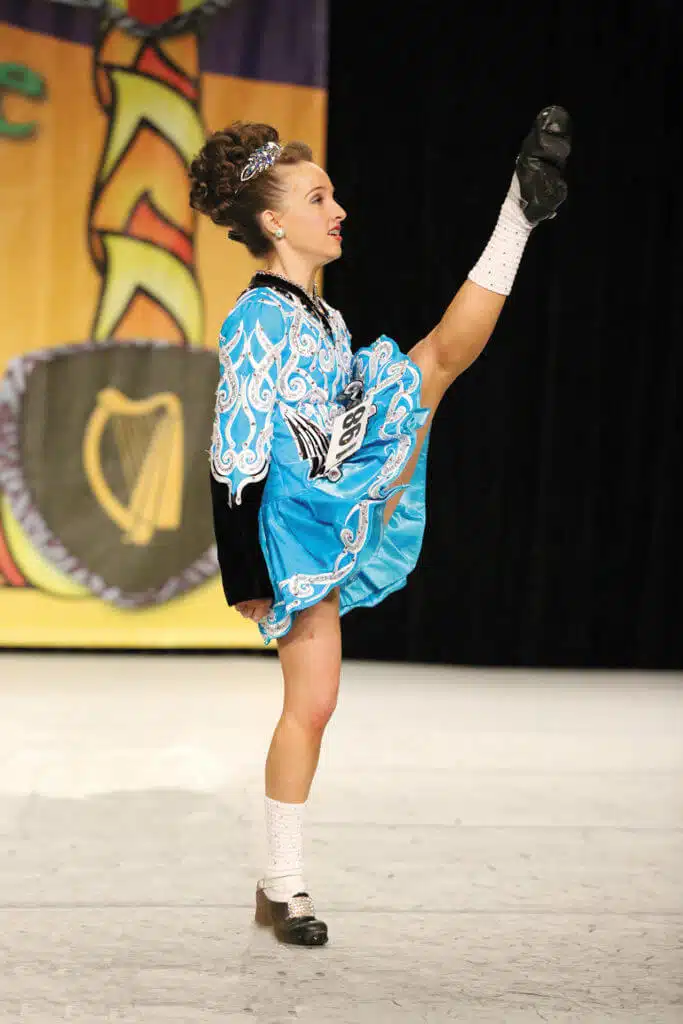
Ghillies: Soft shoes similar to ballet flats, almost always black, with long laces that wrap around the shoes and ankles.
Treble shoes or hard shoes: Also called Riverdance shoes (as an homage to the show of the same name), these hard-bottomed shoes are similar to tap shoes or clogs; their purpose is to create beats to complement the music’s rhythm.
The dresses: Each Irish Dance school has a school dress that is simple in design for beginning dancers. As a dancer progresses through competitive levels, she earns a custom dress called a “solo dress.” It’s an honor to make it to this level. Each dress is completely unique.
The hair: While they’re leaping, it’s hard to ignore those perfectly curled coifs on every dancer’s head. The secret: wigs. The tradition is rooted firmly in Ireland when dancing was a special and rare event reserved for days that girls wore their Sunday best and curled their hair. Dancing often meant meeting people from other villages for the first time or celebrating a wedding. They slept with rags in their hair to create ringlets. Over time, rags became rollers and, simply for convenience, dancers traded their rollers for wigs.
Get Started in Raleigh
You don’t have be Irish to dance like the Irish; age isn’t an obstacle either.
Remember, Nancy Olson took a beginning adult class; she never competed but did it for exercise and fun.
Her daughter Katie Olson says she sees girls of all ages start and, even if they want to compete, they can be successful.
“I met a girl who came to camp for the first time when she was 13. She had never Irish danced before. Three years later, she has been to Worlds on a team and has been to Regionals. So it doesn’t matter when you start, you can pick it up at any time,” says Katie.

by Mandy Howard | Mar 2, 2016 | Do, March 2016
From the inspirational to the surgical, Raleigh residents celebrate the ACC tournament with traditions that rival any national holiday. These traditions spread from the classroom and office break room to the living room and, yes, even to the urologist’s office. Here are some of our favorites:
The Manifest
(In The Livingroom)

(Left) Aaron Henderlite and his buddies gather for their ACC MANFest tourney.
Aaron Henderlite is one of many Triangle men who have coordinated a MANFest in conjunction with the basketball tournament. The men get the day off work, kick the women and children out and create themes around the day. One year, facial hair was the symbolic “uniter,” and all the men who grew a beard shaved between games into varying styles of mustaches.
Henderlite’s wife, Tara, recalls that year with mixed emotions.
“It was great for the guys to bond, and it was funny to get pictures of Aaron’s ever-changing hair issues from beard to mutton chops to—to mustache. But, I also remember my son falling asleep in the car and having to sit in the Target parking lot for hours because we had nowhere else to go.”
When asked how a marriage survives such traditions. Tara laughs, “compromise or, really, you could call it bribery. That’s the year I got a deck on the back of the house as part of the deal.”
The Classroom:
Former 6th grade math teacher Leslie Taylor says when she was a student in North Carolina public schools, teachers would wheel televisions into the classroom or allow them to gather in the media center.
“It wasn’t a big deal; it’s just what you did,” she says.
Inspired by this, and her love for her alma mater, UNC-CH, Taylor says she used to “conveniently align my unit on fractions, decimals and percents to coincide with the ACC tournament.”
She taught to the tourney.
Students chose two players from the team and tracked field goals and shot attempts. As statistics popped up throughout the game, Taylor tallied what those statistics meant and how they were calculated. Integrating the tournament into class was somewhat inspirational, too.
“What opened my eyes was how many of my students did not get the connection between these games and the academic institutions associated with them,” says Taylor.
“It was a stark realization that their idea of what happened after high school was very limited, so hopefully this opened their eyes to possibilities,” she says.
The Office:
Offices around the Triangle accept the notion that there is likely to be an uptick in paid time off surrounding the tournament, but some offices like Wasserman, a Raleigh media group, embrace the day as a greater work tradition that creates moments for team building. Michelle Duff of Wasserman says the company works with the ACC often anyway, so really it’s a part of work to pay attention to the tournament.
“We do Friday pizza and watch the games. As an office, it’s an event. We have a lot of ACC alums, so there’s a lot of rivalry, a little team building and pure enjoyment.”
It’s more than a perk.
“It goes deeper than that,” says Duff. “It’s so ingrained in how people grew up. It’s almost an expectation, and it’s something we all look forward to.”
The Waiting Room:
Then there’s the most bizarre tradition: vasectomies—as in scheduling them a few days before the tourney begins. Dr. Jerome P. Parnell II, MD, a urologist with Capital Urological Associates, says it’s a real thing.
“People realize they’re going to be down for a while [after the procedure]. They can’t move; they can’t take care of the kids,” says Parnell. “They may as well do it when they can sit and watch the games,”
Parnell sets tournament Friday aside every year knowing that men ready to say goodbye to the reproductive portion of their lives will be calling.

by Mandy Howard | Feb 2, 2016 | Buzz, February 2016
If you’ve ever gotten mad and “unfriended” someone on Facebook due to politics, the social network just made it easier.
Simply type in “friends who like_____” and it will sort them so you can friend (or unfriend) en masse.
But can’t we find a way to get along, regardless of our feelings for Donald Trump or Hillary Clinton? Can’t friendships be bipartisan?
 Democrat James Carville and Republican Mary Matalin could give us all a few pointers, bantering back and forth in their Maker’s Mark bourbon commercial: “It isn’t about the Republican party, it isn’t about the Democratic party, but it is about the cocktail party.”
The politically divided house of Democrat Carville and Republican Matalin has made a career of exhibiting how much fun disagreeing can be.
If you were raised here, though, you were probably taught it was bad etiquette to discuss religion or politics. Now, on social media you see that courtesy is often thrown out the window, run over by a truck and set on fire. And with the North Carolina primaries on March 15—and a presidential election less than a year away—politics will likely dominate our airwaves, twitter feeds and conversations.
But if Carville and Matalin can do it…can’t we? Or will we suffer the fate of Maria and Arnold? Though that may have had more to do with housekeepers than politics…

by Mandy Howard | Feb 2, 2016 | Buzz, February 2016
Governor Mccrory recently joined 31 other governors from around the United States to sign a letter urging President Obama to suspend plans to resettle Syrian refugees until security measures vetting the refugees can be tightened and improved.
So where do we, Raleighites, stand?
According to Scott Phillips, Ph.D., field office director for the North Carolina office of the United States Committee For Refugees and Immigrants (USCRI NC), we’re actually one of the most welcoming places in the country.
Welcome
North Carolina ranks in the top 10 states with relocated refugees in America, which makes Phillips proud.
“I’m a native North Carolinian. We have always been a state known for being hospitable. It makes me happy we are standing by that; we are a welcoming place, and we are compassionate,” says Phillips.
Recent headlines and calls to suspend refugee placement has led to an earnest desire to understand this complex issue.
“I’ve been able to have more conversations about refugees and explain the refugee process; it’s been a great time for education,” Phillips said.
Phillips said Raleigh’s altruistic and hospitable nature is emerging.
“People contact us to say, ‘We want to make sure that you understand that we know you are doing important work,’” he said.
Often refugees leave their homes only with what they can carry. Some residents have stepped up efforts in recent months with increased giving through clothing and food drives.
For every negative phone call or reaction Phillips receives, he says there are at least 50 calls of encouragement and support.

“There were people standing on Fayetteville Street with signs that said, ‘Free Hugs 4 Refugees and Muslims.’”
Why close the doors?
Refugee settlement and acceptance is a matter controlled by the United Nations in conjunction with the federal government. After recent terror attacks and testimony by FBI Director James Comey that there will be difficulties in the screening process, Republican leaders in both the House and Senate introduced legislation that would suspend refugee settlement and give governors more power over who may resettle in their state.
President Obama promised to block any bill that would restrict Syrian refugees, and social media is flooded with strong reactions and opinions on all sides.
Graham H. Wilson, Press Secretary, Office of Governor Pat McCrory said:
“North Carolina has a proud tradition of providing a hand-up for those in need, including international refugees. North Carolina is home to more than 160,000 permanent legal immigrants who have settled in our state.
Each individual arriving here in a legal matter, following our laws in search of a better life, is a blessing to our state and a blessing to our country. However, the governor wants to make sure there are legitimate background checks done to see if there is any involvement with individuals with potential terrorist activities before they come to North Carolina. Right now he does not have confidence in the government doing that, especially in countries in which there is no embassy.”
Over 4 million: Syrians who have fled a brutal civil war
20,000: Syrians sent to the United States by United Nations Refugee Agency
2,000: Syrian refugees accepted into the U.S.*
59: Syrian refugees located in N.C.*