Raleigh is one of the safest cities in the nation—full stop. But zoom in, and that reality starts to splinter.
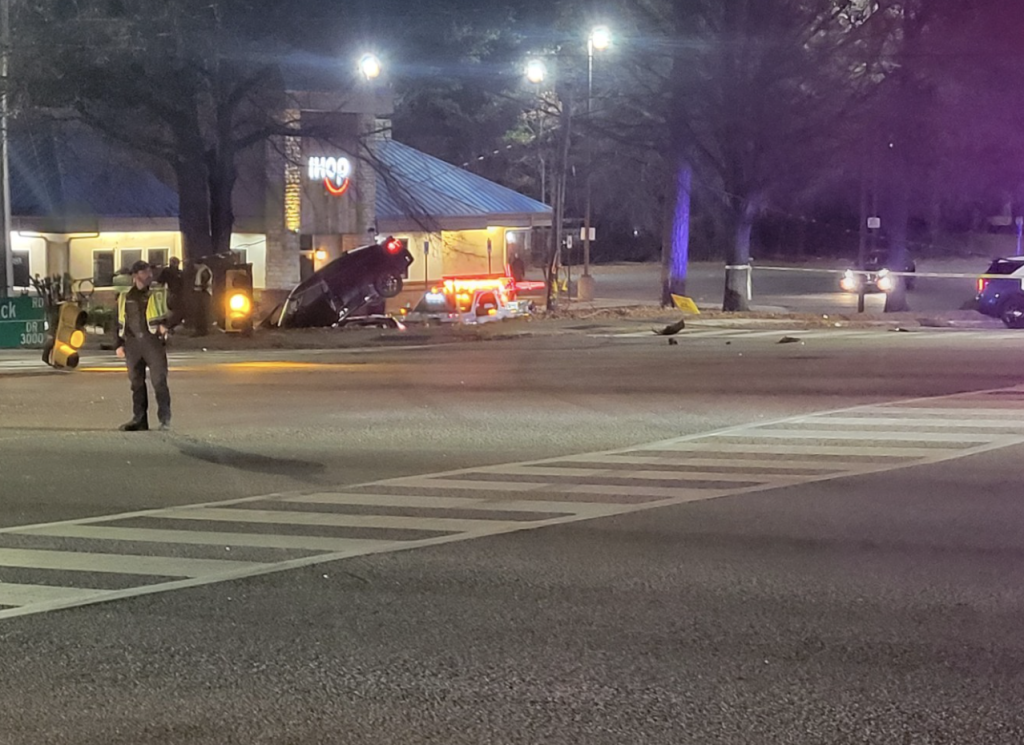
Because over a 10-day stretch this April, a cluster of violent crimes cut across the city—from DTR to North Raleigh to the northeast and southeast corridors—turning what is statistically rare into something that felt anything but. A knife fight on Fayetteville Street, multiple shootings, a homicide—different neighborhoods, same throughline: escalation.
And that’s the tension city leaders are now confronting head-on. Following the surge, Raleigh Police Chief Rico Boyce stepped to the mic with a message that cut through the usual talking points: Rankings don’t reassure people who just watched violence unfold in real time. “Recent incidents have impacted the sense of security in our community,” he said. “And that is not acceptable.”
He’s right—and the data backs him up in a complicated way. According to first-quarter figures released by RPD, overall crime is down compared to this time last year—a continuation of a broader trend that consistently places Raleigh among the safest large cities and state capitals in the country.
Raleigh is safe on paper. April challenged that in practice. Because here’s the catch: Numbers don’t always tell the full story. They measure volume—not impact. And they don’t capture clustering, visibility or how quickly a handful of high-profile incidents can reshape perception.
A single shooting in a North Raleigh grocery lot is a statistic. When it’s one of three in a week—across all sects of the city—it risks being a pattern people can feel. That distinction matters. Because public safety isn’t just about long-term trends. It’s about whether people feel secure walking to their car, leaving the bar or letting a night stretch a little longer.
Boyce acknowledged as much, all but directly stating that clusters like this can be a slippery slope if left unchecked. His focus now: making sure April reads as an anomaly—not a preview.
Already this year, RPD has removed 474 illegally possessed guns from the streets—a figure the department points to as both progress and proof of the scale of the issue. Next steps are more targeted.
Downtown and nightlife corridors are getting increased attention, with expanded partnerships between the police, Alcohol Law Enforcement and Wake County ABC, including heavier presence where foot traffic—and risk—runs highest: bars, clubs, transportation hubs and key hospitality zones.
At the same time, the department is doubling down on prevention, working with small businesses, youth organizations and community groups to interrupt problems before they escalate. Because, as Boyce put it bluntly: “Policing alone cannot solve this challenge. … We are part of this community, just as this community is part of us.”
Translation: This only works if everyone’s in it and invested. Which brings the ask back to residents—especially as the city heads into high-traffic summer months. Stay alert, he implores—and if you see something, say something. Call 911 when something feels like it’s turning. Those moments, the ones that seem small, are often where escalation begins.
“Violence escalates from moments that could have been interrupted,” he says. “That call could be the difference between prevention and tragedy.”
The numbers may be trending in the right direction. But right now, Raleigh is being reminded of something less quantifiable—and more immediate. Safety isn’t just a measure. It’s felt. Promises Boyce: “When we stand together, we are stronger and more effective.”
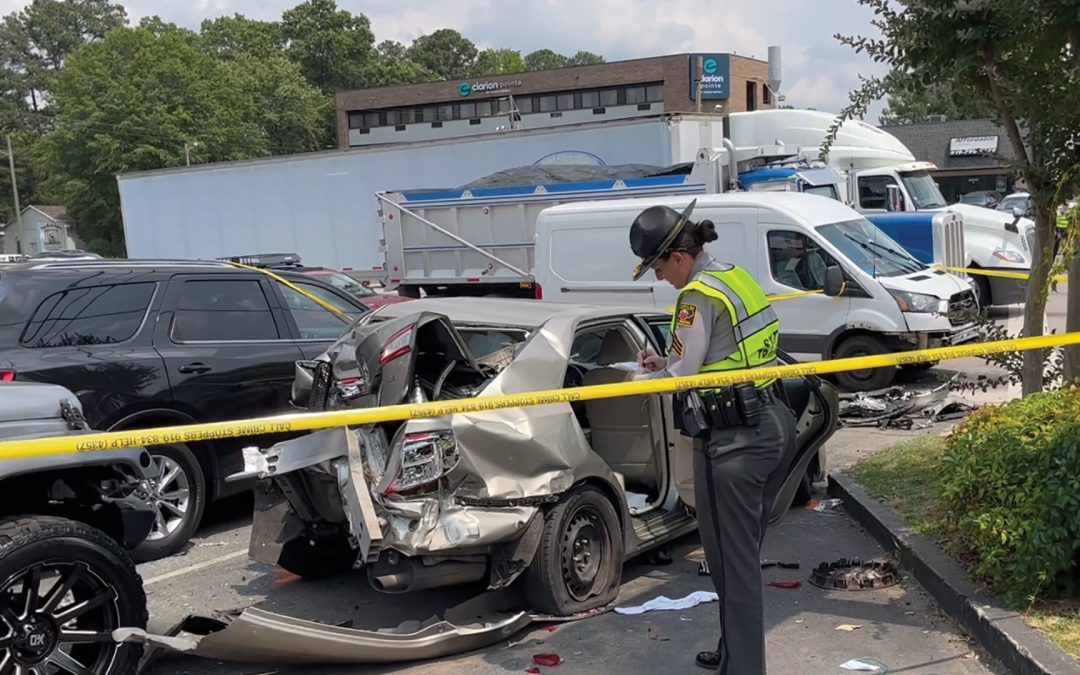
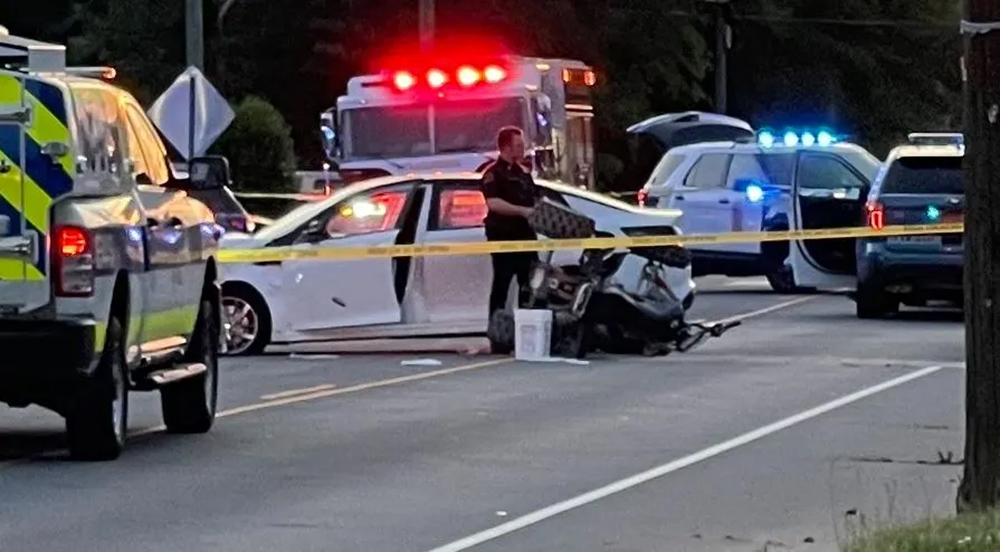
Raleigh already knows which intersections are most dangerous. The question is how quickly the City can redesign them before the next crash becomes another data point.
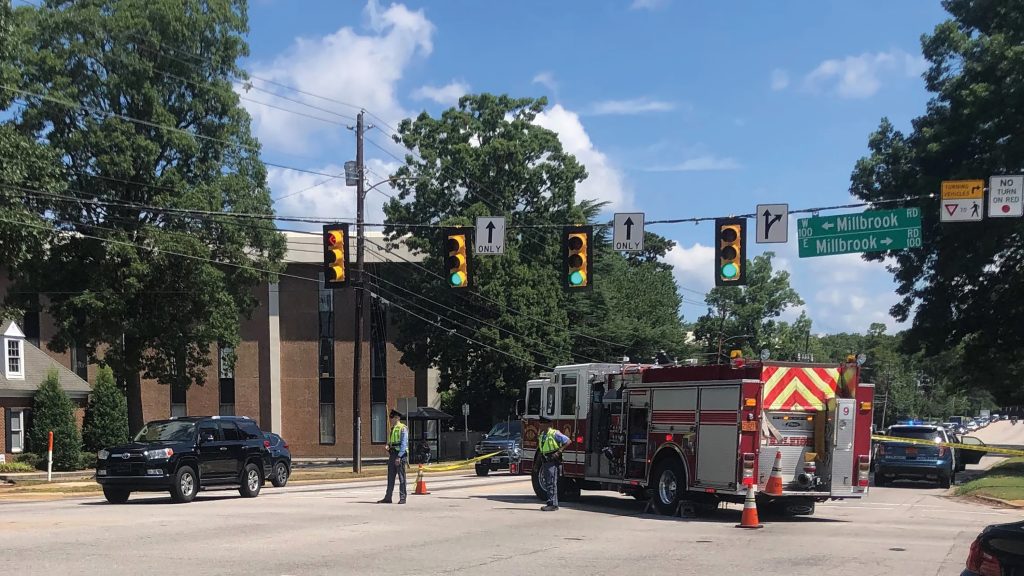
For pedestrians, Raleigh’s streets are a gamble. Six Forks and Millbrook. South Wilmington and East Davie. New Bern and Sunnybrook. These aren’t just intersections—they’re choke points.
Now, for the first time, the City knows exactly where the danger is. Raleigh has formally mapped where severe crashes cluster. The newly finalized Comprehensive Safety Action Plan identifies the intersections where fatal and serious injury crashes happen most often—and outlines the infrastructure changes officials believe could prevent future deaths and injuries. But even the City admits the scale is massive.
DTR
Of the city’s ~10,000 intersections, just 200 account for roughly half of all fatal and serious injury crashes. And while intersections like Six Forks and Millbrook, South Wilmington and East Davie, and New Bern and Sunnybrook rank among the city’s most dangerous for pedestrians, cyclists and scooters, Raleigh’s newly developed High Injury Intersection list makes clear the danger isn’t isolated to a few notorious crossroads.
This is not anecdotal—this is a decade of crash mapping. The City built a formula to pinpoint where risk clusters most heavily. Raleigh’s High Injury Intersections are defined not by fatalities alone, but by a combined crash score factoring in fatal, serious, moderate and minor injury crashes. For pedestrians and bicyclists, Raleigh used a separate 10-year dataset tracking all pedestrian-involved crashes regardless of severity.
It’s not random—it’s a formula. These wrecks happen in predictable places with predictable conditions. “Fast growth intensifies road safety challenges as travel patterns, traffic volumes and transportation modes evolve,” said Mayor Janet Cowell. Raleigh’s risk equation boils down to speed + sprawl + split attention. Heavy traffic volumes, high-speed roads, constant turning traffic, poor visibility and long crossing times all contribute to the danger. The pattern is remarkably consistent: multilane roads built for speed colliding with growing pedestrian activity, bus stops, commercial driveways and cars turning in every direction.
In many cases, the danger isn’t a single catastrophic design flaw—it’s cumulative friction: a fast-growing city layered onto infrastructure originally designed to move cars quickly, not necessarily people safely. “The City of Raleigh—both elected officials and staff—is committed to eliminating all fatal and serious injury traffic crashes and creating a safer, more resilient transportation network,” said Cowell, acknowledging their pledge to reduce traffic fatalities and injuries by 50% by the year 2040 and 100% by 2055.
CBRE
Beyond identifying where these crashes happen—the question is how fast the City can fix them. To address the problem, Raleigh is leaning into what transportation planners call the Federal Highway System’s “Safe System Approach”—a strategy focused less on perfect driver behavior and more on making roads themselves more forgiving when mistakes happen.
The strategy was formally presented to Raleigh City Council this spring as part of the City’s Comprehensive Safety Action Plan, which prioritizes projects based on crash severity, risk patterns and resident feedback.
In practice, that means protected left turns, high-visibility crosswalks, refuge islands, upgraded signal timing, curb bump-outs and lower DTR speed limits—as well as better signage on street signs, pavement markings and improved lighting. “A lot of accidents happen at night,” noted Cowell. “We can also increase things like the median so pedestrians have a safe place to stop in the middle of a really wide street.”
Projects are prioritized using more than crash history alone, says Vision Zero Program Manager Sean Driskill, including pedestrian volumes, feasibility, anticipated costs and overlap with infrastructure projects.
But redesigning dangerous intersections is rarely fast—or cheap. Many of Raleigh’s proposed improvements remain tied to larger corridor projects, state partnerships or funding mechanisms that could take years to materialize. “Roughly half of the top 200 High Injury Intersections have already had some level of safety improvement completed in recent years or planned as part of a future project,” says Driskill. Still, many remain conceptual, unfunded or tied to larger infrastructure efforts that could extend the timeline.
Since 2022, the City says it has improved roughly 40 intersections through signal upgrades, enhanced lighting, pavement markings and other safety measures. While “no single intervention has been identified as universally most effective,” says Driskill, “instead, improvements are tailored to the specific crash patterns and roadway conditions present at each location.”
In one recent successful example at Bland Road, Falls of Neuse Road and Pacific Drive, converting a southbound left turn to protected-only movement during certain times reduced total crashes by 38% and injury crashes by 83%, with serious injuries dropping from two to zero.
Raleigh doesn’t have a mystery on its hands. It has a map. The challenge now is how quickly the City can redesign its most dangerous roads before the next crash becomes another data point.
CBRE
How the City Built the Map
Raleigh’s crash rankings are based on years of traffic data—not just headlines.
Overall rankings use crash data collected between 2019–2023
Pedestrian and bicyclist rankings use a separate 10-year dataset (2014–2023)
Unlike the broader rankings, the pedestrian list includes all pedestrian-involved crashes—not just fatal or serious injuries
Rankings will be updated periodically as new crash data becomes available
CBS 17
Safety Playbook
Raleigh’s “Safe System Approach” focuses less on perfect drivers—and more on roads that leave less room for catastrophic mistakes. What the City is doing:
Protected left turns
High-visibility crosswalks
Median refuge islands
Signal timing changes
Curb bump-outs
Improved lighting
Bus stop relocation
Lower DTR speed limits
Danger Zones
Highest-risk intersections for pedestrians & cyclists—and what the City says it’s doing about them.
New Bern Ave. + Trawick Rd. New pedestrian crosswalk added; more upgrades tied to New Bern BRT corridor
Millbrook + Six Forks Rd. Pedestrian improvements planned through revised Six Forks Road Improvements project
Capital Blvd. + Calvary Dr. Crosswalks & lighting upgrades complete; redesign plans include bus stop relocations, intersection geometry & median fencing
Capital & Crabtree Blvd. Signal timing changes in place; broader pedestrian safety overhaul in development
New Bern Ave + Hill St. + Sunbury St. Planned upgrades alongside BRT project
New Bern Ave. + Shanta Dr + Sunnybrook Rd Safety improvements tied to future BRT construction
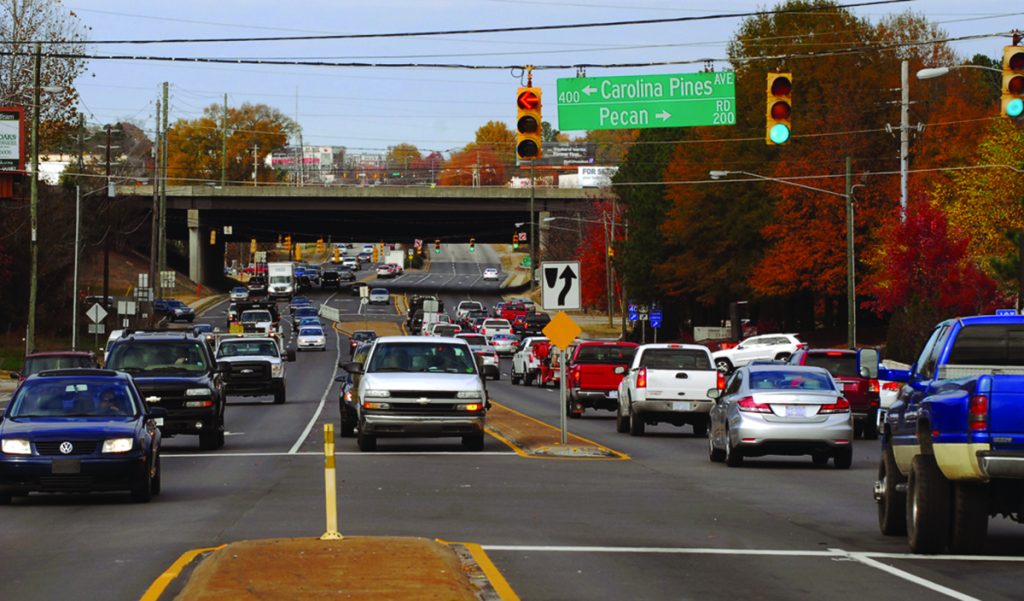
South Saunders St. + Pecan Rd. + Carolina Pines Ave. Seeking federal funding through Safe Streets for All Implementation grant application
Kent Rd + Method Rd + Western Blvd Signal upgrades complete; new pedestrian crosswalk planned after nearby I-440 work wraps
GlenwoodAve. + Brier Creek Pkwy. Future upgrades planned through NCDOT’s broader US-70 improvement project
The Raleigh Commons
Where Speed Wins
These intersections rank among Raleigh’s most dangerous overall for all modes, where speed and volume collide—literally.
S. Wilmington St. + Tryon Rd. Planned upgrades include high-visibility crosswalks, signal timing improvements, curb bump-outs & sidewalk gap fixes
New Bern Ave. + Trawick Rd. New pedestrian crosswalk installed; additional upgrades coming in conjunction with BRT corridor.
Capital Blvd. + Huntleigh Dr. Backplates, signal timing upgrades, new concrete curb ramps, additional signal heads & signal hardware upgrades planned through NCDOT partnership
CBS17
Capital Blvd. + Calvary Dr. Crosswalks & lighting upgrades complete; redesign plans include bus stop relocations, intersection geometry & median fencing
Poole Rd. + Rose Ln. Conceptual redesign complete; City exploring funding options
Forestville + Louisburg Rd. Converted into “Reduced Conflict Intersection” designed to limit dangerous turning movements, plus pedestrian crossing across Louisburg Rd.
Hammond Rd. + Rush St. Planned improvements include new pedestrian crossings, signal timing upgrades, backplates & additional signal heads
Saunders St. + Ileagnes Rd. Seeking federal funding through Safe Streets for All Implementation grant application
Glenwood Ave. + Brier Creek Pkwy. Future upgrades tied to NCDOT’s US-70 Improvement Project
Martin Luther King Jr. Blvd. + S.Salisbury + S. Wilmington St. Improvements planned as part of an NCDOT Spot Mobility Project
When Kate Moss said “nothing tastes as good as skinny feels,” she didn’t factor in a well-made cocktail. Turns out, you can have both.
The real trick isn’t drinking less (spoiler)—it’s drinking smarter. Enter skinny spirits: cocktails built to deliver the buzz without the bloat. And, no, we don’t mean your basic vodka/soda.
Let’s be real. When summer socializing ramps up, so does the running tab—on calories, sugar and next-day regret. But those ’tails that tantalize the lips and look good on the ’Gram don’t have to come with a heavy tradeoff. There’s a full roster of low-cal pours that pack a punch—with a dose of hydration and without the gut check. And they don’t sacrifice taste to deliver the hit.
Patrick Shanahan
Lighter drinking doesn’t have to mean skipping the fun—or settling for sad, watered-down pours. We’re talking clean + clear bases (vodka, tequila, gin), fresh ingredients and a hard pivot away from syrup-heavy mixers. The result? Sips that clock closer to 100–150 cals—without tasting like a compromise.
It’s not about drinking less—it’s about drinking cleaner. Think ranch waters and seltzers that hit crisp and mineral; mojitos that swap simple syrup for muddled fruit and mint—even sparkling margs are getting in on the action, serving fresh citrus, a splash of soda for a lighter bubbly twist, and just enough tequila to keep things interesting. Around Raleigh, that shift is showing up on menus—from citrus-forward builds at Rosebud Cocktail Lounge to clean, agave-heavy pours at William & Company.
“Across the board at Peregrine, Capulet and Rosebud, guests are loving these clean, sessionable cocktails wrapped in effervescence from prosecco, Champagne or soda water,” says co-owner Patrick Shanahan, “with floral or citrus expressions to brighten them up, making them light on the palate and seasonably refreshing.”
And lest we forget spritz summer, serving effervescent sips that lean bright instead of saccharine. Case in point: the spritz-forward, Italian-leaning menu at Capulet Cocktail Club—where lighter, citrus-driven builds are part of the whole vibe, not a workaround.
The play—whether home or bellied up to the bar: skipping premade mixes, leaning into citrus and herbs, and letting the bubbles do the buzzy lifting. That, and pacing like a pro: A water between rounds (hydrate or die-drate) and a lighter first pour means a night that ends feeling as good as it started—and a morning without the hangxiety.
Call it balance, call it strategy. Def call it the skinny on summer sipping.
Skinny Sips (≤120 cals)
Ranch water: Tequila, lime, Topo Chico
Skinny strawberry mojito: Rum, strawberry, mint, lime, soda water
Poolside paloma: Tequila, grapefruit, seltzer
Cherry frosé: Rosé, frozen cherries, lemon juice
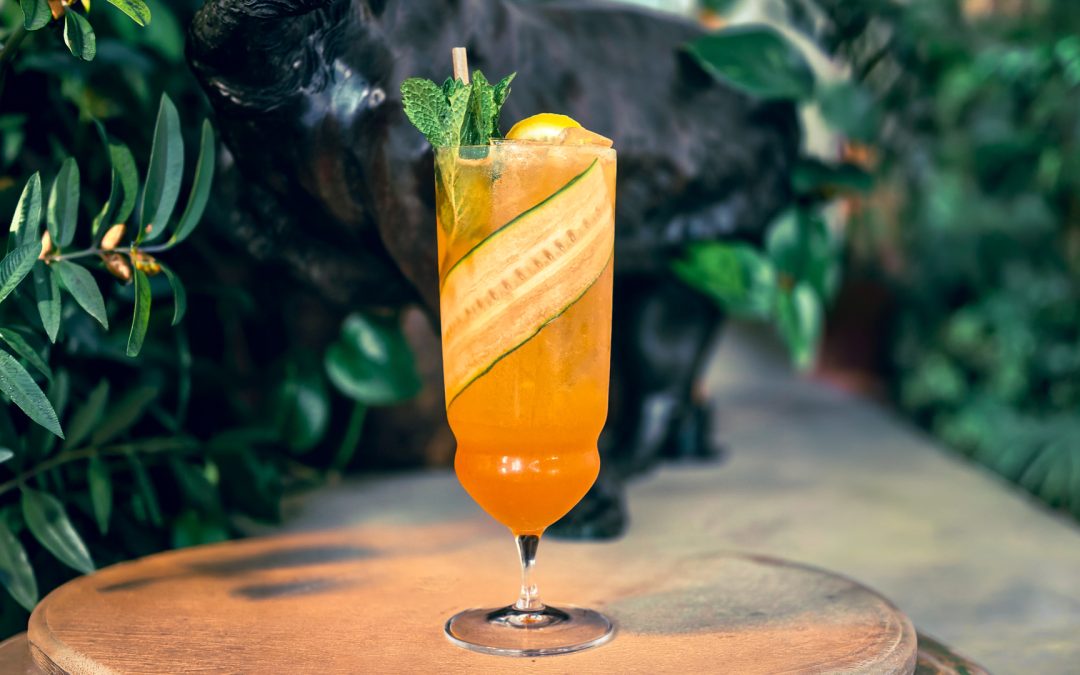
Green tea fizz: Gin, green tea, pomegranate, lemon juice
Aperol spritz: Prosecco, Aperol, soda water
Pour Decisions (That Actually Matter)
Ditch the mix: Premade = sugar bombs
Go clear: Vodka, tequila, gin
Let citrus lead: Packs taste sans sugar
Fruit for flavor: Cucumber, basil, watermelon
Oh, honey: Swap syrups for natural sweeteners or stevia.
Use bubbles: Soda water stretches the drink, not the waistband.
The drink sandwich: H2O pre + post = better next day
Buying in Raleigh isn’t the default path anymore. As prices outpace incomes, residents are redrawing the map of “making it”—buying farther out, renting longer or building a different kind of stability altogether.
Homeownership used to be a milestone. Now it’s a negotiation. For years, the Raleigh dream came with a ZIP code: buy in the city, plant a flag, watch it grow. But that map is shifting. For many residents, that path to homeownership no longer runs through Raleigh proper. The dream isn’t gone—but now often comes with a commute, delay or recalculation.
On paper, the market has cooled. Inventory has improved, homes are staying on the market longer, and buyers have regained some negotiating power. “Raleigh’s housing market has moved into a more balanced and sustainable phase after several years of extremes,” says local real estate agent Shawn Britt. But balance doesn’t mean access.
The market may be more balanced, but affordability remains the gatekeeper.
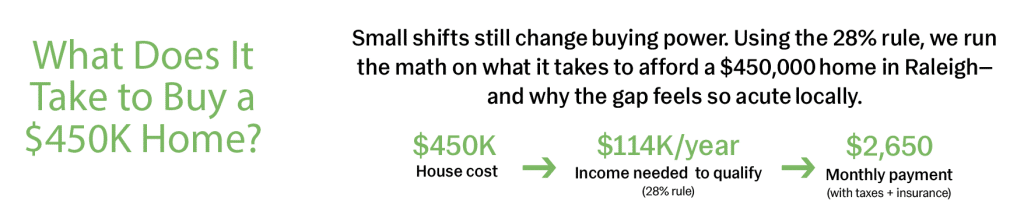
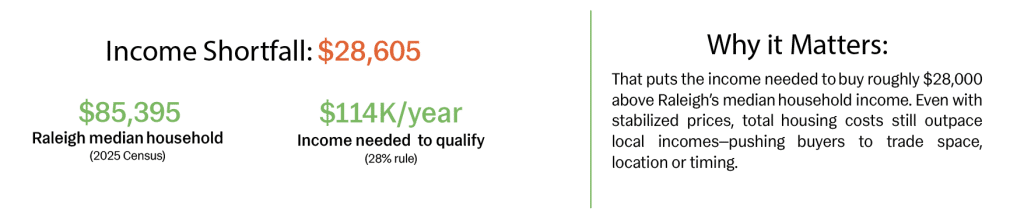
Across the U.S., the affordability gap—the difference between earnings and what it takes to buy a median-priced home—has reached a record high. That mismatch is playing out locally more sharply than many may expect, sidelining would-be buyers. Even as inventory creeps up and prices stabilize, borrowing costs remain elevated—and incomes haven’t kept pace. Affordability is still the gatekeeper.
“Inventory at affordable price points remains limited, especially in the most desirable areas of the Triangle,” says Frank DeRonja, principal broker of Corcoran DeRonja Real Estate. “Even when buyers can afford the price of the home itself, once you factor in taxes and insurance, the total payment comes in higher than they expect.”
In Raleigh, the median home price has hovered around the mid-$400,000s, while price per square foot continues to climb—meaning buyers increasingly need far more than the city’s median household income just to qualify. The result isn’t an exodus, but a recalibration: residents pushing beyond city limits within the county, delaying ownership, or questioning whether buying makes sense at all right now.
“Affordability and interest rates have shifted some demand toward suburban and surrounding areas, where buyers can get more space and value,” says Britt, adding demand within Raleigh remains steady thanks to job growth, lifestyle appeal and long-term confidence in the market.
Once seen as a given, homeownership is now a question mark. And Raleighites are responding in different ways: crossing city lines for space they can actually afford, renting longer (or indefinitely) by strategy or necessity, or reshaping what stability looks like as the market forces new math.
A year ago, many buyers were still waiting on affordability to improve, says DeRonja, “but over the past six months, we have been seeing buyers adjust their expectations. Many are looking at different price points, locations, or property types so they can move forward with their lives.”
Either way, the script has been rewritten. Affordability has fundamentally changed how buyers behave—and how, and where, they imagine building a life in Raleigh.
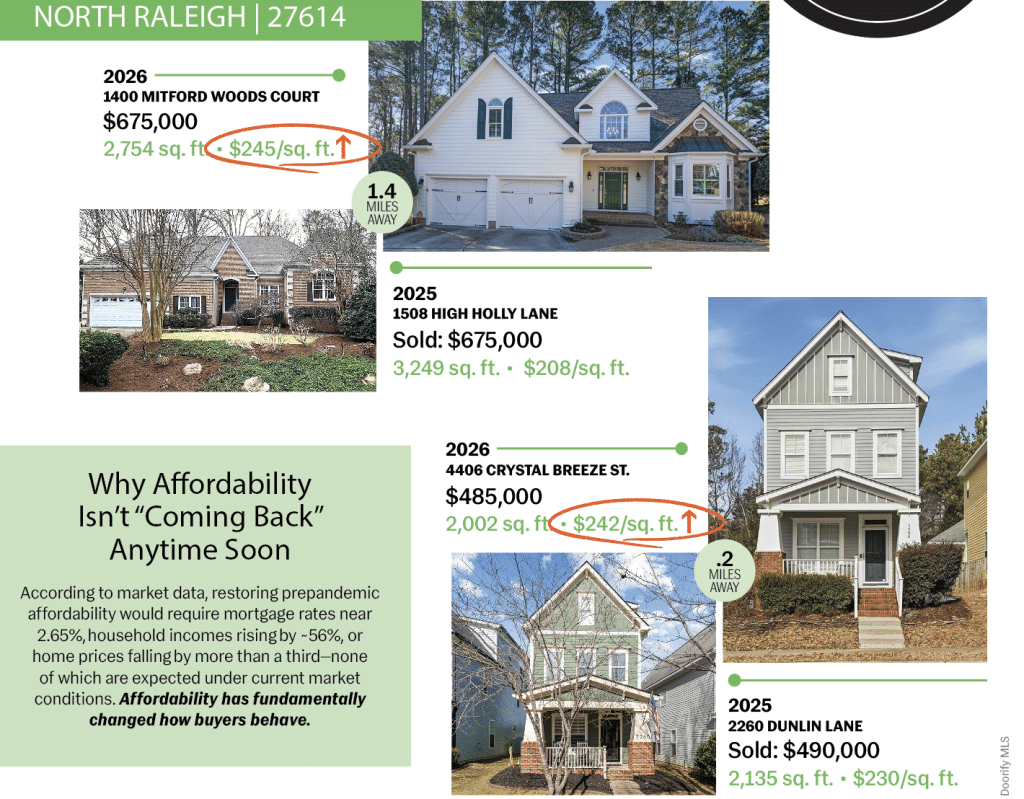
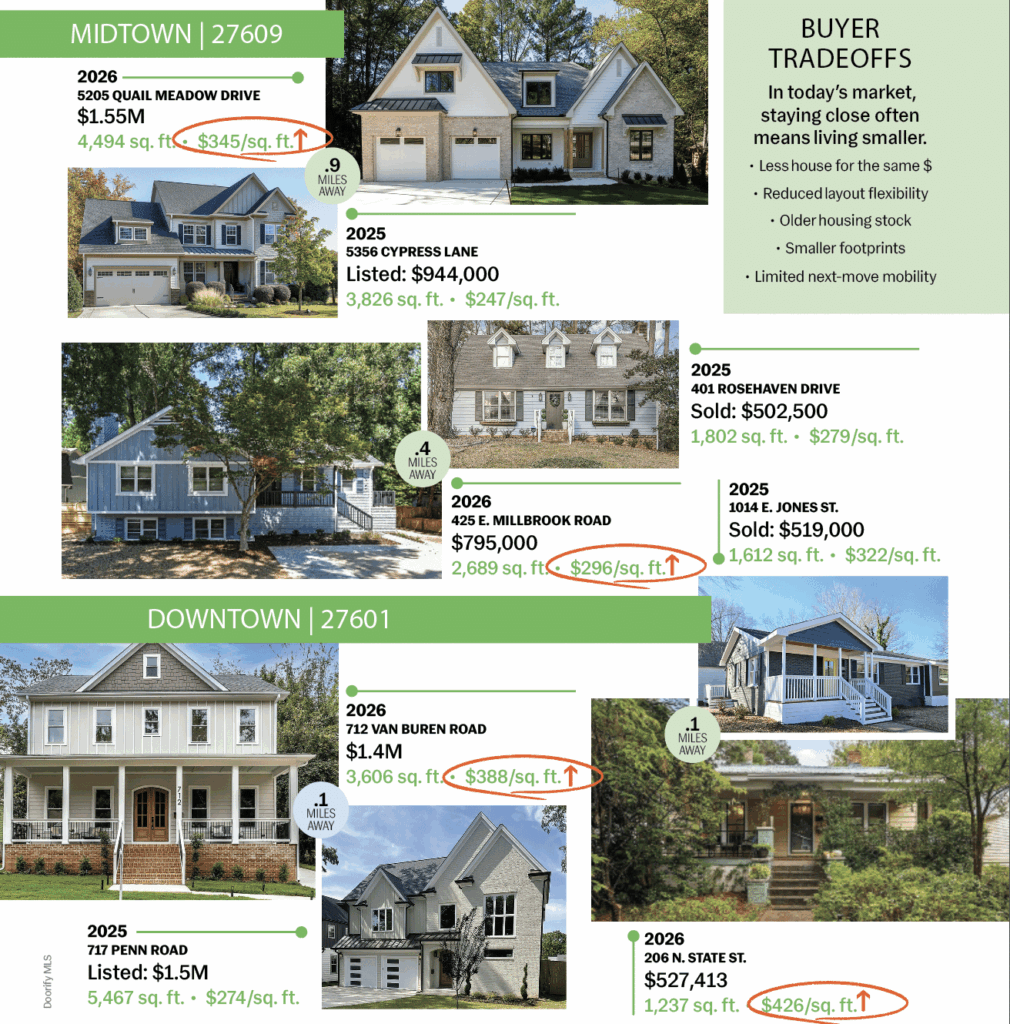
Same Budget, Different Raleigh
Prices have stabilized, but buying power hasn’t. A look at proximal Raleigh homes year-over-year shows how much space—and flexibility—buyers are trading to make the math work.
Less House for the Money Price per square foot is increasing
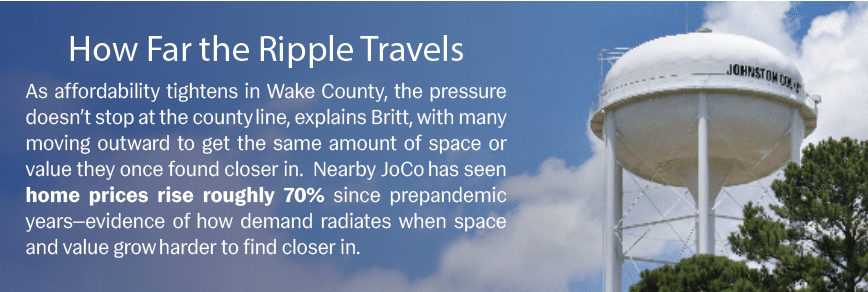
Raleigh Radiates
Raleigh didn’t empty out—it radiated. While inventory has loosened and more homes are hitting the market, access hasn’t followed suit. Prices remain elevated, borrowing costs linger, and the real question isn’t whether homes exist—it’s who can afford them.
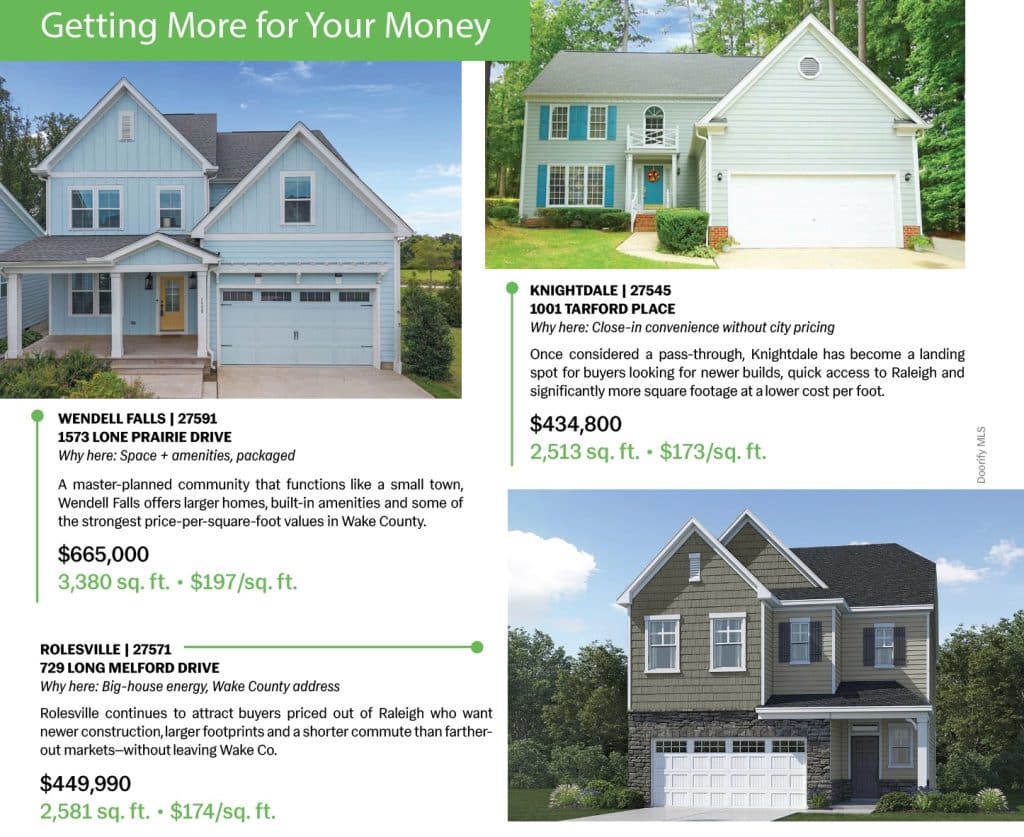
For a growing share of buyers, that math points outward: “Affordability and interest rates have shifted some demand toward suburban and surrounding areas, where buyers can get more space and value,” says local real estate agent Shawn Britt.
Demand inside Raleigh, she notes, remains steady thanks to job growth and lifestyle appeal—but for many households, ownership now means recalibrating where it’s possible. The result is a quiet outward shift, as buyers redraw the map in search of space, value and a version of ownership that still works.
Rental Renaissance
With homeownership increasingly out of reach, renting in Raleigh isn’t a fallback—it’s a deliberate choice, shaped by flexibility, predictability and changing priorities.
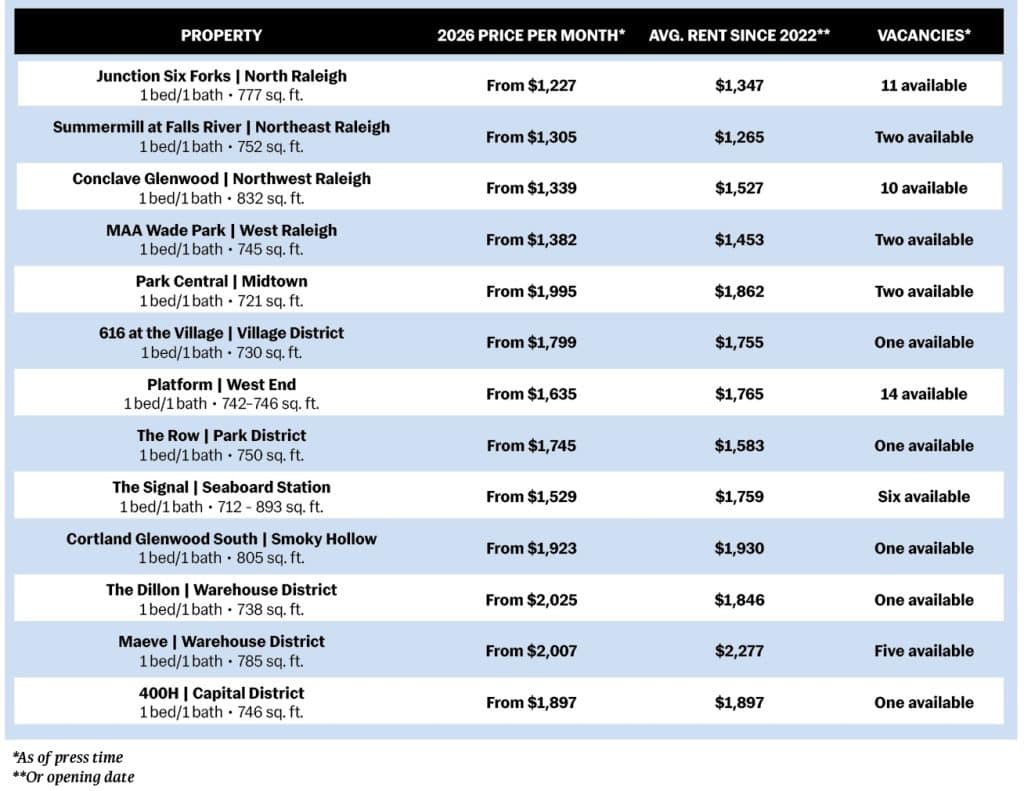
In good news for a growing sector of Raleigh renters, rent prices have largely held steady. While some units ticked up and others dipped, most one-bedroom/one-bath apartments stayed within ~$100 of last year’s price tag. As vacancies level off, property managers are still offering signing incentives—and demand remains high. The takeaway: Renting isn’t a holding pattern—it’s plan A.
Long-term renting is increasing in appeal, says local real estate agent Shawn Britt, noting that affordability pressures have reshaped how people think about stability: “That’s why you’re starting to see a lot more amenity-driven and independent living communities coming up around Raleigh.”
For many, renting offers a more lenient lifestyle—and clearer monthly budget—than owning. Predictable costs, built-in amenities and a firmly “not my problem” approach to maintenance now outweigh the promise of equity and tax write-offs for a growing segment of renters.
“A lot of times, it comes down to flexibility,” says Britt. And it’s not just younger generations opting for low commitment—older generations are making the same calculation. “What if I want to travel and I don’t want to own?” Britt explains of the mindset. “I don’t want to own anything because I want somebody else to fix it—I don’t want upkeep. I just want to not have to worry about it.”
For some, flexibility is the point. “It keeps me from feeling like I’ve put all my eggs into one basket,” he told RM. “I’m not financially obligated to stay in a particular location for more than a couple months.”
In today’s market, renting isn’t a failure—or success on hold. It’s a strategy, shaped by new math and a new question: What does “making it” look like now?
Why Some Are Choosing to Rent
PROS:
• Flexibility & low commitment • Predictable monthly costs • Maintenance isn’t your problem • On-site amenities save added expenses
CONS:
• No equity accumulation • Less control and customization • Tax benefits don’t apply • Incentives expire—and rent can rise
Cinco de Mayo may be the excuse—but this is a year-round sipper if you know where to start (first move: Skip the frozen machines).
Many of the city’s coolest cocktail bars aren’t putting spicy margs on menus at all. That’s not a miss—it’s the move. Still, a select few star on menus, and they’re worth knowing: fresh citrus, good tequila (or mezcal) and heat that builds, not blasts—more slow burn, less Hot Ones meltdown.
Insider rule: If a bar sports a serious cocktail program, stocks damn fine tequila and is squeezing citrus to order, its spicy marg game will beat the big-batch versions every time—no gimmicks, just balance. We sipped our way through the city’s tequila treats for the five worth turning up the temp on Cinco and beyond.
Fire + Dandy | Clockwork 🔥 Late-night burn Spicy, citrusy and built for when the DJ kicks in. This Glenwood-adjacent lounge keeps the marg dialed in—approachable, but far from basic. Glenwood South, @clockwork919
Spicy Green | Brewery Bhavana 🌶️ Herbal heat Cilantro, pineapple and lime soften the spice into something bright and layered—less punch-you-in-the-face, more slow, flavorful climb. Moore Square District & Fenton, @brewerybhavana
Bartender’s Choice Spicy Marg | William & Company 🌡 Balanced heat index Not always on the board—and that’s the point. Ask and you’ll get fresh lime, primo tequila and heat that shows up, not shows off. Bonus: Go mezcal for depth. Seaboard & Person Street District,@willcobar
Fuego Margarita | Peyote Mini-Bar + Mala Pata 🔥 Industry-approved heat Serrano-infused blanco tequila brings a smoother, more dialed-in spice to this pineapple-, lime- and cilantro-laced marg—no seeds, no chaos… just a clean, classic sip with heat that actually behaves. Iron District, @peyote.minibar
Spicy Blanco Marg | Dram & Draught 🔥 Smoky slow burn Known for whiskey, yes—but the bar team’s cocktail chops run deep. Ask for a spicy blanco (or mezcal) marg and expect something clean, devilishly hot and quietly dialed. Glenwood South, @dramanddraughtraleigh