Whiskey Kitchen takes holiday decorating to the next level with designer Antoine Pontón and local products.
Christmas looks a little different this year and in an effort to bring cheer to their diners, local restaurants are upping their decorating game. Special times require special care and the need to create a special experience is here.
This year, Whiskey Kitchen teamed up with designer Antoine Pontón to create its own version of a winter wonderland through ornate magnolia decorations. It’s not red ribbons, glitter balls and Santa Claus, but rather chocolate velvety browns and emerald greens representing the brand and feel of the restaurant.
“Brown velvet and brown whiskey warm you up for the holidays,” says Pontón, who has known co-owner Jeff Mickel for 15 years and felt that with this holiday season being unique, Whiskey Kitchen needed to do something different with its decorations. “I want people to come in and experience the moment. If you have to go out in a mask you might as well be smiling under the mask.”
Twinkle lights wrap the 14 upside down “trees” hanging from the beams, consisting of 28 branches all hand-cut by Pontón himself. “in the past they’ve always had a 9-foot upside down Christmas tree,” says Pontón. “i wanted to do a lot of Christmas trees and this is my interpretation of a southern magnolia Christmas tree. Why do one when you can do 14?”
Opposite the long bar lining half of Whiskey Kitchen’s space now sits a 12-foot logo of the restaurant adorned in garland made of magnolia leaves. The garland comes from Weston Farms, where founder and creative director Erin Weston strives to grow a luxurious product on her family farm.
Exactly 36 feet of specially cultivated magnolia garland now surrounds Whiskey Kitchen’s sign above the retractable garage door that opens the restaurant to a vibrant patio space. The natural colors of the garland combine with the wonder of the outdoors and the spirit of the holidays, welcoming diners to a festive dinner experience.
Two local hospitality entrepreneurs are figuring out what it takes to pivot during a pandemic.
Albert Einstein once said that that the measure of intelligence is the ability to change; never has that been more true than in 2020. We’ve all altered our realities to some degree, whether we’re staying home full-time or tweaking our careers to make sure our mortgages are paid and our kids are fed.
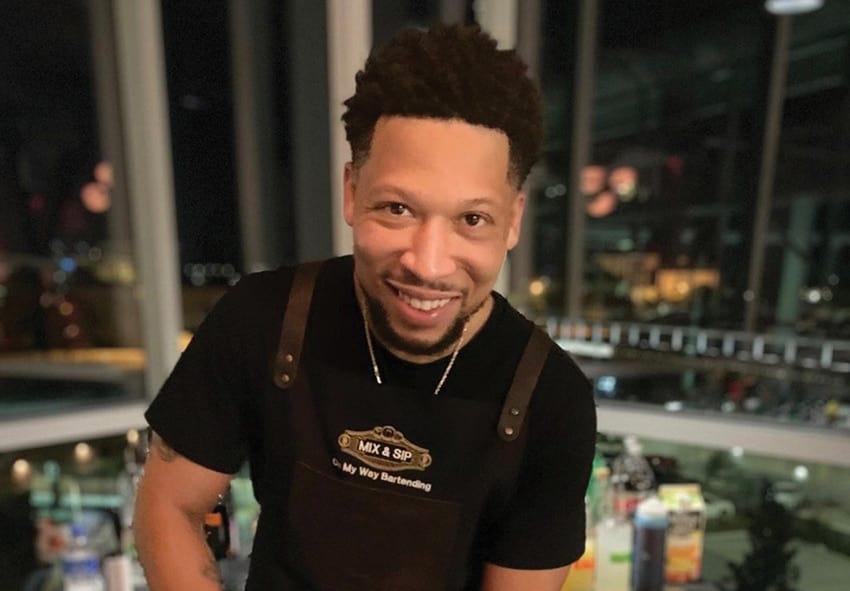
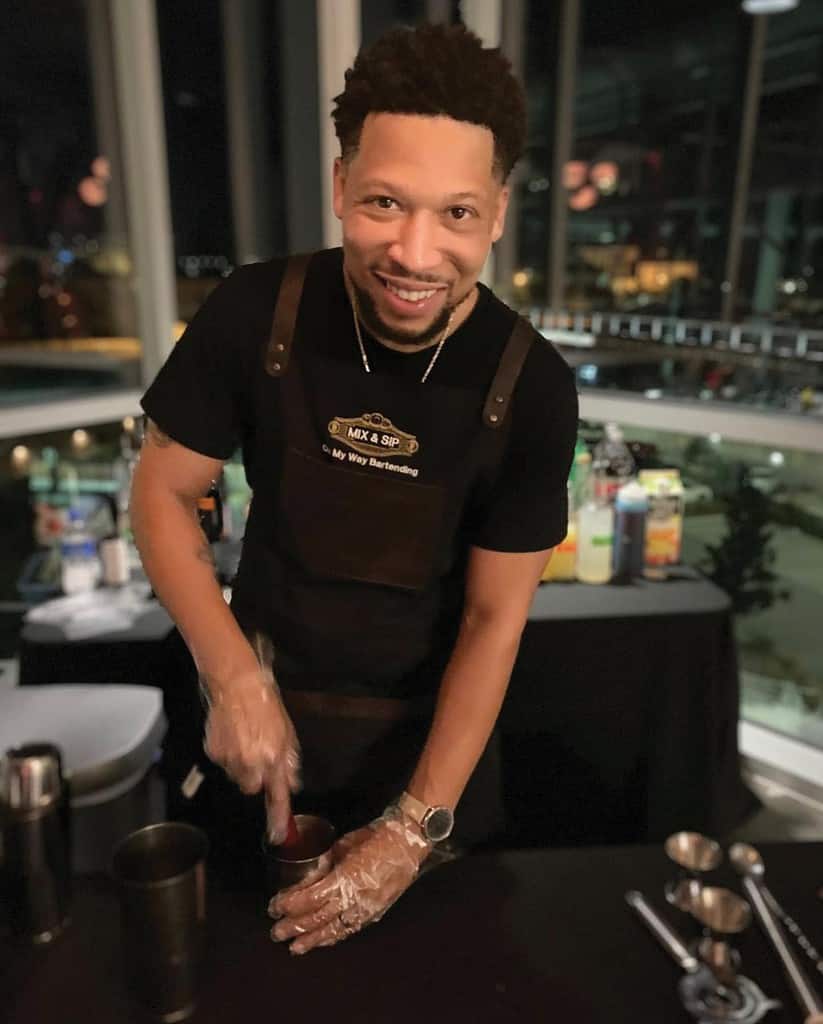
Ernest Gantz, who owns On My Way Bartending Service with his wife, Amanda, has manifested Einstein’s quote over the last 11 months, adapting his business while also growing it in the midst of a pandemic. On My Way Bartending Service specialized in weddings and private events while also hosting mixology classes in downtown Raleigh. When COVID shut down the in-person and events side of the business, Gantz had to shift his business plan. He set aside his idea of introducing himself to the community through mixology classes and focused on mixology kits instead.
“People couldn’t go to bars and restaurants and we still wanted to allow them the craft cocktail experience,” says Gantz, who has been bartending since he was 21 years old. He created mixology kits with homemade syrups, bar tools and recipes. Virtual mixology classes are included with the kits.
Gantz, like many others in the hospitality industry, has been forced to pivot his brand out of necessity. In North Carolina, jobs in the leisure and hospitality sectors have decreased by 22.5 percent over the last year, a loss of more than 116,000 jobs according to the North Carolina Department of Commerce.
When Gantz put his two weeks’ notice in for his bartending job at Cowfish to launch his company, he had no idea a pandemic was on the horizon. Through flexibility and persistence, he was able to change lanes and introduced his first mixology kit in May. The feedback he’s received has been so good that, even though the kits weren’t part of the company’s original plan, they have become a staple and will continue even though in-person classes are back up and running for now.
“We just launched in January this year,” says Gantz of his company. “With me being a certified mixologist, this has become our go-to now. ”
The highlight of the kits is three homemade syrups which rotate monthly. So far, vanilla rose, spiced pear agave and blackberry lavender have all been standouts and Gantz is planning a holiday kit for winter. Now that the world is back open (for the moment), the public can try those syrups out in cocktails at home, in a Mix&Sip mixology class, or in person by hiring Gantz for an in-home function.
For Gantz, it’s all about the experience, regardless of where it happens.
“I always hear so many people say they’ve thought about bartending before,” says Gantz. “It seems cool and it is cool and I wanted to share that with everybody. It’s a science project. We’re lighting basil leaves on fire. We’re creating edible bubbles. It’s an interactive class. It’s like chemistry meets bartending. A bartender just follows the rules. A mixologist makes the rules. We do a lot of things that aren’t supposed to be done.”
Switching Focus
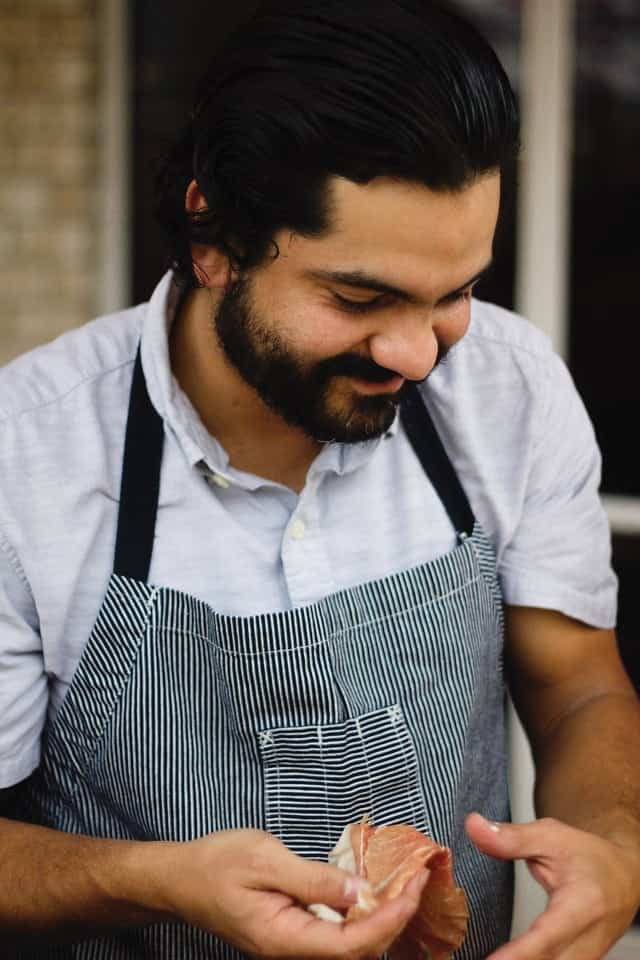
Lester Almanzar’s career pivoted in a completely different way. When he was laid off from a local restaurant in February, he knew he had to find another source of income. Almanzar took his side gig as a private chef and cranked it up a notch. By August, he was booked every weekend, sometimes more than once.
“The business for people who were already private chefs has improved,” says Almanzar. “There’s a difference between being a line cook in a restaurant and being a private chef. You are your own personal brand. You have to manage your behavior. I create the menus for people based on what they want.”
Almanzar has been cooking professionally for the past 12 years. He grew up running a catering business with his mother out of their home so is no stranger to the home kitchen. Educated in Spain, Almanzar specializes in modern European cuisine, or what would translate to New American in the United States, where local ingredients are highlighted in season.
Although Almanzar has taken catering jobs at big companies like TakeAChef, he drums up most of his business now through word of mouth. He has both regulars and new referrals and prefers catering over restaurant work.
“This kind of service is very personal,” says Almanzar. “You’re in someone’s home. You have to behave in a different way. You have to present yourself in a different manner. You have to respect people’s homes and kitchens and give them the privacy they want during dinner. It’s their home, I’m just providing a service. The part I enjoy most about cooking is bringing people together and if I can do it over an intimate setting, it’s even more rewarding.”
While catering jobs have come back in demand and helped support him throughout the summer, Almanzar has also pivoted to working as a carpenter and craftsman at a local woodshop as well, something he found through chef clients who needed some help at the shop. In fact, throughout the country, 63 percent of workers who lost jobs because of COVID have switched industries, according to a Harris Poll survey for USA Today.
For Almanzar, woodworking is a necessary career addition.
“I do the chef thing on the side,” he says, “because there’s not enough business to keep me afloat just doing that.”
Einstein also said you never fail until you stop trying; that’s something many of us will have to remember as we move into the pandemic’s second wave.
What Local Developers Are Doing to Make Sure Offices Are Safe
Feeling safe at the office is something Raleigh residents are grappling with as they leave their Zoom calls for in-person work environments. While working from home is still fairly common at the moment, the workforce is trickling back in to traditional office spaces and it is up to employers to create a more secure atmosphere than what might have existed before.
According to a recent survey by Digital.com, 70 percent of employees working from home are eager to return to their workplaces. Whether they want to interact with co-workers, miss the daily structure or just want a space outside the four walls of their homes, they’re ready to get back into the office in some form.
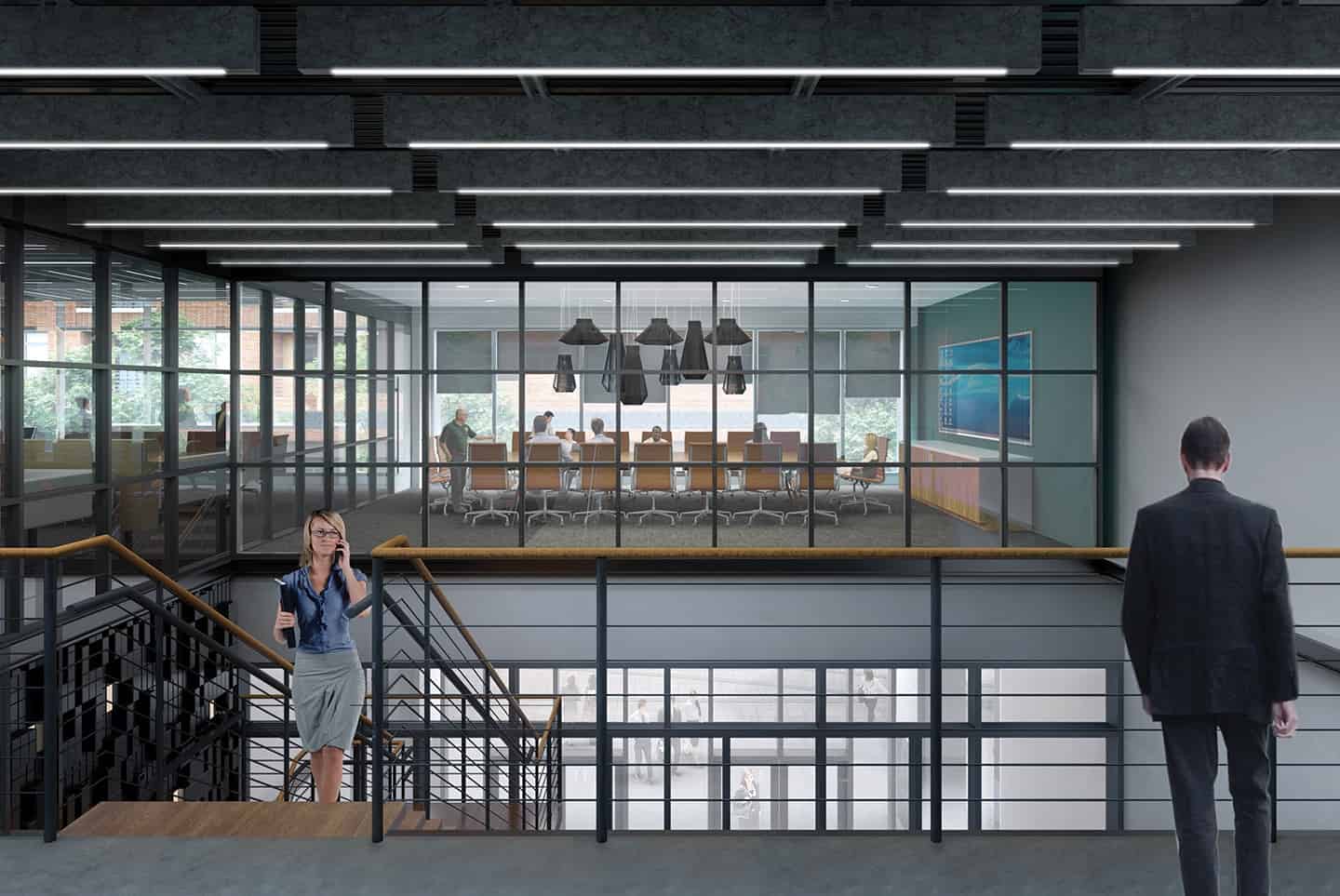
As COVID-19 restrictions lift, developers are looking at changes they need to implement to create these “safer” work environments. In Raleigh, some buildings are stepping up safety protocol, and, where possible, design. One example is Smoky Hollow’s 421 N. Harrington St. With nine stories, developers were able to make simple adjustments, like upgrading the finishes on the stairs so people who may not feel comfortable in enclosed elevators have a pleasant alternative. The stairs also have their own outdoor access points, so people can enter and exit the building without going through the lobby.
“One of the big design things we are seeing in the industry is a connection to the outside,” says Drew Yates, the senior development manager at Kane Realty Corporation. “That’s always been the focus of Smoky Hollow.
Luckily, 421 N. Harrington St. was already well-positioned for a post-COVID world in its traditional design. Generally, the second phase of Smoky Hollow was designed to be open and airy, with freedom for pedestrian movement throughout the site. This idea was also a response to Publix taking up the entire block of the first phase of construction, which also included development of Peace Raleigh Apartments. A partially covered open-air courtyard, office balconies and a terrace in the amenity space with a large collapsible door open up the building to tenants and allow for the free flow of fresh air. Air flow within the building has also been addressed with increased air filtration quality, dedicated air purification in each elevator and ionized air flow that cuts down the spread of viruses.
Developers have also focused recently on touch-less features. Automated front door openers, motion-activated doors in the lobby, foot pulls and automatic closures, touch-less bathrooms and bottle filling stations all help prevent the spread of germs on surfaces.
Like 421 N. Harrington St., 3800 Glenwood has improved its air quality features and has worked to tackle surface germs. NanoSeptic Skins cover the door handles and high traffic push points, continually oxidizing organic contaminants. Signs remind people to wear masks and follow CDC guidelines.
“We took what we had and were able to get everybody comfortable to get back to work,” says Chad Broadwell, the senior commercial property manager for Grubb Ventures, the Raleigh-based firm that developed 3800 Glenwood. “We looked at different industry recommendations and rolled out different layers to attacking COVID so people could feel safe coming in to work.”
One improvement Broadwell is excited about is Global Plasma Solutions (GPS), a bipolar ionization technology that delivers clean, indoor air with no harmful byproducts. It attacks viruses, pollen and organic compounds and is ozone-free. “It’s another layer to getting people back into the office and to working,” Broadwell says.
“People now are at a phase where they’ve been able to get comfortable coming back to work and are generally following the rules to working in a world where COVID has been more of a routine in keeping their distance and washing their hands and respecting people’s space.”
Chad Broadwell, senior commercial property manager for Grubb Ventures
As more employees share indoor space, building components like high-quality Minimum Efficiency Reporting Value (MERV) filters become important in producing clean air. While heating, ventilation and air quality used to focus on energy efficiency, the pandemic has required the focus now lean more to air quality. It is a trend that will most likely continue to weed out air quality issues in general, such as allergens and odors.
“These are things the industry is learning as things progress,” says Broadwell. “We’re at a point where we’re doing as much as we can with what we know and it will only get better from here.”
When it comes to eating, this year has offered me a lot of firsts. Grocery stores haven’t exactly been in peak supply since March, and when I couldn’t find staples like ground beef and chicken, my family decided to experiment. We indulged in lamb, ground bison burgers and pasta made out of everything from edamame to chickpeas. It was the discovery of veggie burgers, however, that led to flexitarian eating.
The name flexitarian, made popular by registered dietician Dawn Jackson Blatner more than a decade ago, is simply the combination of flexible and vegetarian. Basically, it’s about adding more vegetables to your meals and reducing meat consumption. I’m pretty sure you are also supposed to cut back on sugars, but it’s 2020, I work from home, I have a 4-year-old and I need wine.
The unintentional beginning of this diet all started when my husband, Jacob, was looking for lunch ideas. Before March, he ate his lunch at restaurants throughout the week because he liked to get out of the office. Now working from home, he needed a new plan. He stumbled across veggie burgers in the produce section, thought they looked interesting and, within a few months, a flexitarian was born. (It took me a little longer to jump on the wagon.)
Full disclosure, my husband is a scientist. Currently studying phosphorus reduction, he took this step into flexitarian eating as a way to see if this minor change to his diet would reduce his phosphorus footprint. As it turns out, he has reduced the amount of phosphorus required to sustain his diet by 50 percent, so I see our household sticking to this diet for the long haul.
By simply eating scrambled egg whites with more vegetables for breakfast and substituting his usual Chipotle or Jimmy John’s order with a veggie burger piled high with avocado, tomatoes, pickles and whatever other vegetables we had laying around, my husband felt better and lost 26 pounds in 6 months. He still occasionally ate meat for dinner, but a few months ago I decided I wanted to try his methods and suggested something drastic: a pescatarian diet for one month.
I realize that pescatarians and flexitarians are not the same, but I needed an excuse to look for more ways to incorporate vegetables into my diet and give up my daily chicken fix. I fully embraced the diet for the month, experimented a lot with cauliflower, and found some substitute meat products that I really like and still use today.
Unlike my husband, I have not lost any weight, but I do feel healthier. I like the idea that I don’t have to give up anything, but instead need to focus on adding better options, getting calories from fruits, whole grains and vegetables. I get a weekly delivery from Hungry Harvest now as well, so it’s fun to try out new recipes with food I might not have chosen in the grocery store. For example, one night I made sautéed butternut squash and kale mixed with lentil pasta and parmesan cheese because squash and kale came in one week’s delivery.
For anyone looking for a way to add something green to your daily routine without going cold turkey on the carnivorous side, I recommend looking into flexitarian eating. It’s good for you and, according to my husband, we’re helping the environment.
When Wake County voters agreed to a half cent sales tax increase in 2016 for the Wake Transit Plan, they helped change the way the city moves. Since the plan got off the ground, areas throughout Raleigh and Wake have services that would otherwise not be available. Last year alone, more than $13 million in new or modified services have been implemented in the southeast and northwest portions of Raleigh and in neighboring municipalities.
“Raleigh has grown really fast and, in the scheme of cities, its growth is pretty recent,” says Michael Moore, the transportation director for the City of Raleigh. “We know cities are places people like to be. A lot of [Raleigh’s] roadways were designed when the mindset was focused around traffic efficiency and reducing congestion and not focused around the smaller scale of human movement.”
Human movement, whether via foot, bike, scooter or larger vehicle, is something the city is addressing through the addition of greenways and greenway connectors, the creation of Bus Rapid Transit (BRT) or the improvement of existing bus lines, or through negotiating with scooter companies to allow more scooters into the city safely.
“We’re in a very interesting time where we have a balance between accommodating traffic and still trying to promote environments that are good for all users,” says Moore. “We have a desire for dense urban places that are walkable, bike-able and where you can spend your weekends without getting into your car to do something cool.”
More Scooters
In 2018, transit tech companies Bird and Lime showed up to Raleigh uninvited, deploying fleets of electric scooters mostly around downtown.
“It led to a lot of chaos and conflict,” says Eric Lamb, the city’s transportation planning manager. “That was a tough learning curve for us when that happened.”
Early last year, the city council contracted with e-scooter company Gotcha to deploy a fleet of 150 scooters but, following the election of several new members to the city council, officials wanted to revisit the city’s parameters and goals for microbility— including criteria for required insurance and types of fees (if any) that they city should be charging—and potentially, bring in additional vendors. By the end of this year, there could be three scooter companies operating in Raleigh instead of only one.
“We’re discussing the idea of creating scooter hubs so their availability is a little more accessible and less haphazard,” says Lamb. “There have been a lot of changes in the scooter industry in general. When this whole trend started, it was very Wild West, but now, the landscape is starting to stabilize and [companies are] building better partnerships with cities.”
The scooter market has changed in the last two years, with companies consolidating and being bought out. Bird acquired Scoot last year and, in May, Uber led a $170 million investment in Lime. Micromobility companies have pivoted to focusing more on profitability than on flooding the market and are more cognizant of not putting scooters on the street that are not being used.
One way Raleigh aims to prevent a flood of unused scooters on the streets of downtown is by monitoring and regulating fleet growth. A scooter provider must have a minimum fleet size of 50 scooters, though the city is proposing the providers start with an initial fleet size of 250; then, vendors can then grow their fleets by demonstrating that their scooters are being used. If utilization decreases after a monthly re-evaluation, companies must pull back scooters until the numbers increase again, helping to eliminate sidewalk clutter.
“When scooters first came in, it was a novelty,” says Moore. “We’re getting a lot better compliance with some of the rules out there. I think the market here in Raleigh has matured.”
The Popularity of Citrix Cycle
The final installation of Raleigh’s bike share system, Citrix Cycle, is now complete with 300 bikes and 30 stations across downtown, southeast Raleigh, along Hillsborough Street and at the North Carolina Museum of Art.
“The system has a pretty good footprint right now,” says Lamb. “We’ve started to look at what our second round of deployment will look like. In some stations we’ll be filling in spaces, and in others we’ll be expanding.”
Recently, there has been interest in the Five Points and North Hills areas. But Lamb says a lot of the decision making on where stations will be established depends on being able to develop good bicycle infrastructure between stations.
Last month, Citrix Cycle and the city announced a partnership with Loden Properties to buy two new stations and bikes on Lane Street in front of the Longleaf Hotel and at Gateway Plaza on Crabtree Boulevard. The city will continue looking at opportunities for public-private partnerships so it can grow the system.
“Citrix has outperformed its goals up to date, even through the pandemic,” says Moore. “It has been, to me, very rewarding to see how that system has performed and provided people an option throughout everything we’ve been going through. We’ve been pleased with how Raleigh has warmed and adopted to Citrix Cycle.”
As of mid-September, riders have traveled 146,462.30 miles on Citrix Cycles and have taken 63,925 rides. The most popular check-out and return stations are at Fayetteville Street, Tucker and Glenwood, and Citrix Station on East West Street.
Greenway Connector and Pedestrian Safety
This month, the city will finish the Downtown North-South Greenway Connector on southbound Harrington Street and northbound West Street, from North to Martin Streets, that will connect two future proposed greenways and add a bike connection from Glenwood South to the Warehouse District. The ultimate goal is to extend to Devereux Meadow Park, just north of Peace Street, when it is developed.
The greenway connector creates a dedicated bike lane with plastic posts that act as a visual cue for drivers to stay out of the area. Having some degree of separation makes the lane much more comfortable for casual cyclists who may be intimidated riding parallel to traffic.
Raleigh’s transportation department has also been working with the city’s parks, recreation and cultural resources office to develop a new east-west connection between Dorothea Dix and Chavis parks, a promising way to provide for connectivity along downtown’s southern edge.
“A lot of our downtown streets don’t have bike lanes,” says Moore. “If we could get folks to some of those more comfortable streets in a more comfortable way, we’ll see some things really come together.”
In 2016, Raleigh’s city council adopted the BikeRaleigh Plan, a citywide bike plan that serves as a framework for expanding the city’s biking network while improving safety, comfort, convenience and accessibility. Changes to the Blount, Person and Wake Forest Road corridors have been finished and more buffered bikes lanes are being installed, with some plans for vertical separators.
The city also implemented its first two-stage left turn boxes, indicated with green paint on the Person and Blount Street crossings at Hargett and Martin Streets. With a council allocation of $500,000 for more separated bikeway installations last year, there’s a lot of public interest in seeing these networks continue to grow.
The city is keeping both cyclists and pedestrians in mind as it moves forward. It is implementing 10- to 12-foot shared-use paths, leading pedestrian intervals at crosswalks to give pedestrians a head start when crossing the street and is working with the parks department to increase the use of parks as commuter corridors.
“Every day, every person is, at some point, a pedestrian,” says Moore. For 2019, Raleigh reported 250 collisions with pedestrians, 50 of them fatal. “It’s critically important to us to keep people safe regardless of their mode of transportation. It’s really alarming the rise in pedestrian crashes and fatalities we’ve seen in the last two years.”
The city is engaging with a consultant to see what a Vision Zero Plan—one that aims to eliminate all traffic fatalities—would look like for Raleigh, the resources it would take and the timeline to get there.
“We take our transportation users’ safety very seriously,” says Moore. “We want to make sure we’re doing as much as we can to protect the most vulnerable users in the transportation system. If that means changing the way something used to work, we’re willing to do that.”
Bus Frequency and a BRT Future
Raleigh’s bus system is changing for the better and, before COVID-19 hit, the city was seeing increased ridership. Between increasing frequency of current routes and the development of approximately 20 miles of transit lines along four Bus Rapid Transit (BRT) corridors, riders still have much to look forward to in terms of timing and accessibility.
Part of the Wake Transit Plan moved the city’s transit strategy away from a coverage-based system to more of a frequency-based system. Buses come more frequently and are much more reliable, which is crucial to building a ridership. The goal has been to expand the deployment of buses that operate on 15-minute headways. Up until recently, the city had only about 11 miles that met that criteria. By 2027, the goal is to get up to 81 miles.
“People get focused around BRT because it’s new and different, but some of the big things we’ve done in the transit program is adding service and adding frequency,” says Moore. “We’re trying to take down some of the barriers of use and look at frequent service so you’re not having to plan every moment of your day to catch a specific bus at a specific hour. If you have a bus or train that comes every 10 minutes, you might not want to mess with, or pay for, parking. You can catch a bus and be downtown in 10 minutes.”
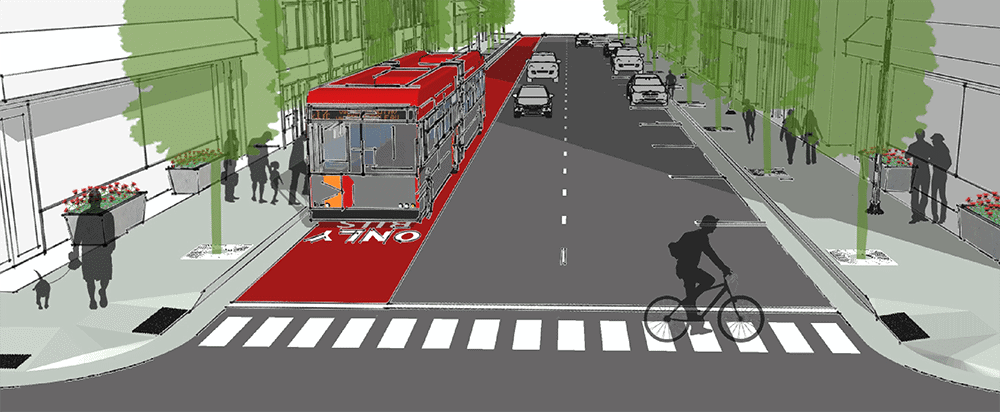
Over the next few years, the development of the BRT system will add to these initial improvements with added frequency, enhanced stations, elevated platforms, dedicated lanes, traffic signal priority and off-board fare collection.
The first in the state, with our closest neighbor being Richmond, the goal of Raleigh’s BRT system is to bring reliable and consistent service to provide more flexibility to people who have a variety of jobs. During weekdays, the service will run at 10 to 15 minute intervals for 20 out of 24 hours per day.
Fare capping, where customers will be able to purchase their bus fares as a daily, weekly or monthly pass on a stored value or virtual wallet, is also under discussion. Fare capping tracks the money you’ve spent over a week or month and automatically upgrades you to a weekly or monthly pass. Today, you’re paying more every day if you pay daily than you would if you just paid for a weekly pass.
To date, the east line along New Bern Avenue is at approximately 30 percent designed. There will be more public outreach and involvement on what the footprint looks like, where the bus stops are going to be, how the system will operate, what the stations will look like and how they are accessed. The city is targeting 2023 for service, with Western Boulevard and the Southern Corridor to follow in 2024 or 2025. Planning for the Northern Corridor has not started yet.
“The Wake transit plan is one of the region’s first efforts in trying to balance some of that growth in a way that doesn’t create more and more lanes and roads,” says Moore. “We are giving folks another choice to use a high-quality transit option.”
Triangle Bike Study
Agencies from acrossthe region are studying the idea of a 17-mile bicycle path that will link Raleigh, Research Triangle Park (RTP), Durham and Chapel Hill along I-40 and NC 54. Both of the regional transportation agencies, NC Capital Area Metropolitan Planning Organization (CAMPO) and Durham-Chapel Hill-Carrboro Metropolitan Planning Organization, allocated funds to study this bikeway in detail and, specifically, to look at how these major greenways can be incorporated into interstate highway footprints safely and functionally.
The bikeway could connect Triangle communities, accommodating those traveling for the distance of their choosing. Input from residents is encouraged, including a public comment crowdsource map available at trianglebikeway.com. The planning process is expected to take approximately 18 months.
The current planning effort includes design and construction recommendations for routes between Raleigh and RTP, and a corridor assessment for the connection west to Durham and Chapel Hill. The bikeway will connect Triangle communities making both short and long bike trips for work, play and daily errands possible. Ideas from residents will shape the plan.