Writer Tracy Jones test drives barre class—virtually.
In a world of gym closures and lockdowns, unless I run outside (six feet away from everyone else, of course), I don’t have the option to take any class that’s not virtual. So, I took this opportunity to move in a way I knew wouldn’t be graceful; when better to try something awkward than now, with no one watching? I’ve never streamed a workout but I have grooved to a few exercise DVDs—Billy Blanks, P90x and a video for pregnancy yoga to ease the discomfort of carrying a bowling ball in my abdomen.
But the coronavirus shutdown made the decision for me: I decided to test out barre.
Barre, for those unfamiliar, is a class usually done in a studio setting with a ballet barre and movements similar to practicing ballet itself. There is a lot of balance, muscle pulsing and, often, inspiration drawn from pilates or yoga. This particular class, hosted by Barre-Up Raleigh, was an express class where pilates met barre in the comfort of my garage, streamed via Zoom.
Now, there are things I know about myself when it comes to a virtual exercise class and they aren’t great. First of all, I cheat. If I get winded, I take a break, sometimes pausing the video or letting it go on without me. If I don’t like the exercise, I skip it or modify it to make it easier. I’ve also been known to fast-forward.
Secondly, I tend to not give it my all. In a physical class, there’s pressure. The instructor watches you and you don’t want to look bad in front of everyone else who always seem to know how to do everything better than you. Without that motivation to try harder, I know I’m probably only giving the class like 60 percent.
That all said, I was taking this class for journalistic purposes, so I decided to go 100 percent, or at least try to. (Full disclosure: I did miss the warmup because I had a problem with Zoom on my laptop and had to switch to my phone—but I still took the rest of the class.)
Since this was a home workout, I didn’t have a ballet bar or weights but I improvised with my husband’s workbench and some soup cans from the pantry. I also used a kitchen towel for resistance.
We started with subtle arm movements, isolating specific muscles in different parts of the arm. Barre incorporates small, pulsing movements, so while it may feel like you aren’t doing much, you’re actually targeting areas you might never hit in a larger workout.
My balance was soon tested with one leg lifted up in the air behind me, hands toward the floor. It wasn’t pretty and I was happy the rest of the class couldn’t see me on Zoom. I quickly realized that the “Elsa” yoga mat I had borrowed from my 3-year-old was too thick and not doing me any favors, so I switched to bare feet on the garage floor. My husband had it epoxy-coated when we moved in, so it wasn’t uncomfortable. The opposite leg worked better, though I was still shaky.
Then, we moved onto ballet, pliés and all. My calves burned something fierce but I liked the leg muscle isolation and really tried to engage my core and work on my form. I didn’t look quite like the instructor but I think I got close.
We finished the class with crunches and oblique circles and I felt accomplished. It was one of the most low-impact classes I’ve ever taken, similar to aerial yoga but without the hanging upside down. Though not my favorite class I’ve taken so far, if you’re looking to stretch, tone and work on your core, I would suggest taking a virtual barre class.
NC State is working to tackle the COVID-19 pandemic by creating, innovating and donating.
As the COVID-19 pandemic grips the world, Raleigh residents, businesses and institutions are all doing their parts to help flatten the curve and help those who need it most. NC State, the largest university in North Carolina and a hub for research and innovation, is no exception. From students making protective masks using 3D printers to campus-incubated companies supplying vital tools to the scientific and medical communities, the university is at the forefront of the fight against this novel coronavirus.
Every Little Bit Helps
We all want to contribute where we can but it can be challenging to know where to start.
Corbin Kling went to what he knows.
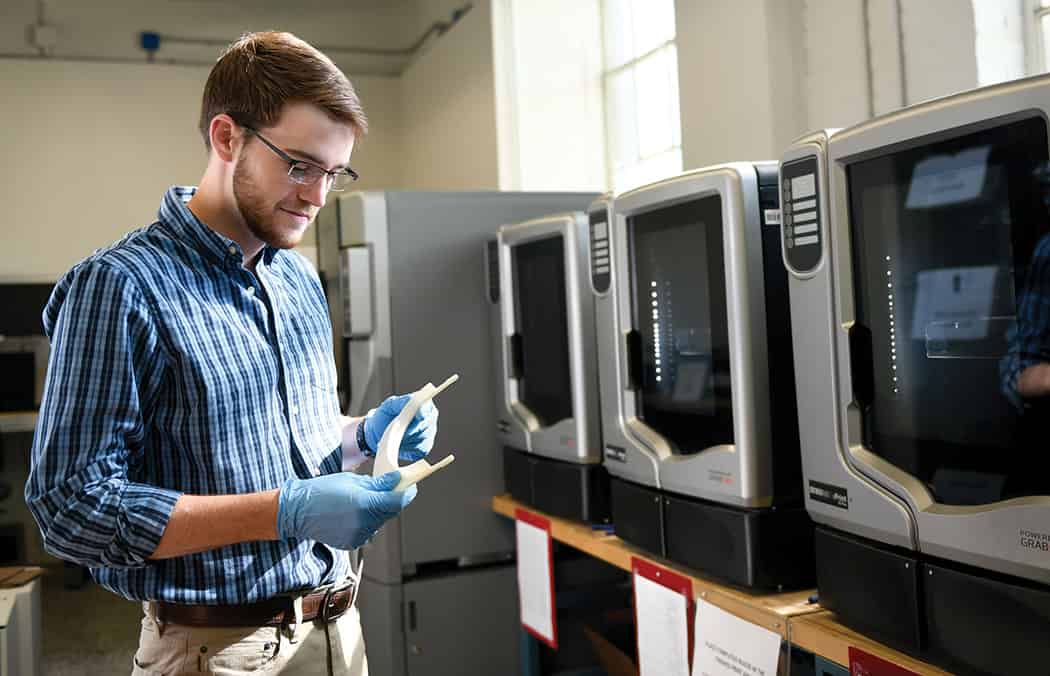
Kling—a doctorate candidate in planetary geology in NC State’s Department of Marine, Earth and Atmospheric Sciences—is one of several students creating face shields for healthcare workers on the front lines of COVID-19 relief. Using an at-home 3D printer, Kling has been creating face shields and surgical mask ear relievers since the beginning of April; when we spoke to him last month, he had made more than 200 face shields and more than 400 surgical mask ear relief pieces.
“I have a friend in Duke ER and another in WakeMed who are both very grateful for whatever I can get to them,” says Kling. “Being able to fill the stop gap in commercial shields shortage and delivery will help the medical community feel more protected.”
Kling says he noticed at the end of March that the company that manufactures his 3D printer, Prusa Research, was rapidly developing a face shield design. The company got the design approved through the government health ministry in its native Czech Republic and then posted the design online.
“At that point, I calculated that I could probably print over 100 [masks] of that design,” says Kling. “My department at NC State donated some overhead transparencies to me for the clear front part so I could get started.”
Kling has since changed designs twice as the National Institute of Health began clinical trials to rapidly approve 3D printed face shield designs submitted to its repository. Now, Kling is making sure to print only NIH-approved shield designs to ensure they will be accepted at hospitals.
“Once the approved design came out, everyone was trying to figure out how to help,” says Kling. “I have been delivering most of my stuff to friends and friends of friends, or whoever contacts me with a need. Anyone can reach out. I have myself and two friends in Fayetteville all printing shields and mask relief pieces. I can deliver them to anyone within the Triangle.”
If you are available to make supplies, check out GetUsPPE.org to find a donation center.
Production
NC State’s Center for Additive Manufacturing and Logistics is also stepping up, using 3D printing to create face shields for WakeMed. The lab is currently producing an average of 200 face shields each day for health care workers, delivered through WakeMed’s shipping and handling department. The shields and the frames are reusable; each can be used two to three times and sanitized with alcohol, clorox wipes or in a heating device.
Photo courtesy of North Carolina State University
“We have been producing the face shields 24/7, for about two weeks now,” says Matthew White, an NC State integrated manufacturing systems engineering graduate research assistant who is leading the project. “We are currently working with WakeMed to determine other devices that can support their efforts and are working directly with them to design a device that improves the seal around their respirator masks.”
The group is in talks with other hospitals in the area for delivering any surplus units they may produce. CAMAL has also received several donations through the community printing effort organized at the university.
“Our effort is helping fill the gap in the traditional supply chain,” says White. “Once the mass production of the face shields comes back online and catches up with demand, we will pivot our efforts to support the other needs from the hospitals. We have a good relationship with WakeMed and are working diligently and iteratively to design and prototype devices that will help ease the burden.”
Innovation
Originally founded by an NC State entrepreneur in residence and engineering students in the Technology Entrepreneurship and Commercialization Program in NC State’s Poole College of Management, startup Protochips is working to assist researchers studying COVID-19.
Protochips is one of only two companies in the world that manufactures a critical supply for the transmission electron microscopy market to visualize the novel coronavirus. The other supplier is located in Europe and is now months behind in being able to deliver these critical components, according to Protochips CEO David Nackashi.
In simple terms, Protochips produces devices that contain viruses, including COVID-19, while they are imaged in state-of-the-art electron microscopes. You can’t just take a virus and throw it on a microscope, Nackashi explains. His company’s devices “hold” the virus safely so people can study it.
Protochips manufactures products for biological and materials science researchers in more than 600 government labs, university research centers and corporate research and development centers in 27 countries. Many of them, including NIH, the National Institute of Environmental Health Sciences and National Institute of Allergy and Infectious Diseases, New York Structural Biology Center and the Scripps Research Institute are using their specimen support grid specifically for research on the COVID-19 novel coronavirus, specifically to understand how it attaches to and infects human cells.
“One of our customers, McLellan Lab at the University of Texas, determined the 3D structure of the SARS-CoV-2 spike protein, a critical first step towards developing a vaccine, using our specimen support in their workflow,” says Nackashi. “This reconstruction has now become widely used, including on the homepage of the CDC.”
Photo courtesy of North Carolina State University
Protochips also builds accessories for electron microscopes and is a preferred critical component supplier to Japan’s JEOL and Thermo Fisher Scientific located in the U.S. Between the two of them, those companies produce more than 90 percent of the world’s transmission electron microscopes and both have been designated by the Japanese and U.S. governments as critical manufacturers.
Protochips was incubated on Centennial Campus and the company still uses NC State’s Nanofabrication Facility and its Analytical Instrumentation Facility for research and production.
“We have a long and multifaceted relationship with NC State University that has included many successful partnerships in science and human capital,” says Michael Zapata, the company’s executive chairman.
Internal Support
Two years ago, NC State created a Student Emergency Fund in response to the number of students experiencing food and/or housing insecurity. The fund is used to assist students experiencing unexpected financial emergencies and has been deployed following Hurricane Florence, and now, during the coronavirus pandemic.
“In all cases, we work to respond to the student in a timely fashion to connect them to available resources,” says assistant vice provost and student ombuds Mike Giancola. “We have been fortunate to have so many donors from the Wolfpack family that want to support students during this challenging time so they can focus their attention on their studies.”
As of mid-April, the fund has provided more than 1,200 grants totaling approximately $600,000 to students.
“As of March 13, we have received over 1,500 applications for support from students, although there are likely many more students being impacted,” says Giancola. “About 65 percent of our applicants have lost jobs due to COVID-19.”
Most of the requests from students during the pandemic have focused on food and rent assistance, as well as technology needs to transition to online learning. Additionally, students have had transportation needs after having to unexpectedly end their study abroad experiences.
“One of the biggest challenges moving forward for students is the uncertainty of when they might be able to return to work as well as how they will continue to afford attending college in the summer and fall semesters if their families have been impacted financially by COVID-19,” Giancola says.
Upon publication, the College of Veterinary Medicine has donated two ventilators, 500 PPE suits with hoods, 450 N95 masks and 500 surgical masks to UNC’s medical school. The physics department also donated eight cases of gloves and a few organic filters for masks to UNC Healthcare.
Photo courtesy of North Carolina State University
The Department of Materials Science and Engineering provided face shields, gloves, masks, respirators and coveralls to Rex Wellness Center.
“The department got a request from somewhere within the UNC system for materials that a hospital could utilize,” says Joseph Matthews, the research operations manager for the department. “Our researchers deal with biological and chemical exposure and the same protective equipment is utilized in both situations. These researchers are conducting their own research and buying their own supplies and housing them. We liberated all of the extras that we could and left a token amount to be able to restart when we get the green light.”
NC State’s Emergency Management and Mission Continuity unit collected and donated 329 boxes of gloves, 16 boxes of disposable lab coats, two boxes of shoe covers, one box of face masks, 125 pairs of safety glasses/goggles, 2,772 N95 respirators, surface wipes and hand sanitizer to Capital Regional Advisory Committee.
For Wanett Mims, taking care of her community is just as important as taking care of her patients. Mims, the founder and CEO of Raleigh-based Logistics Healthcare Management and co-founder of A Plus Family Care, knows that focusing on a healthy community and empowering young people can help a community thrive.
“We are here to build our community in whatever positive ways we can,” says Mims, who was born and raised in Raleigh. “Everywhere you go there is going to be an underserved population. We have a great team willing to help the best we can. We’re here for the moms in shelters and anyone else who needs us. We’re really big on partnerships because there’s so much to do that not one person can do it all.”
Wanett Mims
A Plus Family Care, which has locations on Garner Road in southeast Raleigh and on New Bern Avenue in northeast Raleigh, has been open for three years and is one of the few practices in the area that actively accepts Medicaid. The clinic’s pediatrics department is open six days a week, which Mims says helps keep kids out of the emergency room—and spares families the expense.
“A lot of our community uses the ER for their primary care,” Mims says. “We want them to know we’re here. We can get you in the same day. If you have a newborn and your Medicaid is pending, we’ll go ahead and see that baby and won’t wait. We really take pride in building the community physically, emotionally and partnering them up with mentorships that are available.”
A recent investigation from the News and Observer, in partnership with the nonprofit Center for Health Journalism, found that North Carolina has one of the worst records in the country for deaths of children a year old or younger; the high infant mortality rate for black babies is a major reason, and clinics like A Plus Family Care play a significant role in reversing this trend in urban areas.
As of now, A Plus Family Care is open and taking proactive steps and preventative measures to minimize risks of potential exposure to the Coronavirus for patients and employees, according to its website.
In an effort to continue building the community, A Plus Family Care has planned an event this month to promote wellness for the entire family. The Spring Fling takes place on April 25 at the Raleigh Boys Club (the event is still scheduled to take place as of press time) and will offer family friendly activities such as live music and face painting, but will also offer blood pressure checks for parents and free vouchers for sports physicals for children.
Guest speakers will be onsite to spread the message of health and empowerment, including a doctor who will speak on health matters and adolescence, and Christopher Mims, Wanett Mims’ husband, who will speak on building the community and what programs are available to residents.
By holding the event at the Raleigh Boys Club, Mims says the health fair will offer care and awareness to many citizens who might not seek it out otherwise. The Boys Club, she says, is within walking distance for many of her patients.
“Building the mental phase of our community is important,” says Mims. “The root of it is the health and the well-being of the family. We are a medical practice but we’re a family place. The kid can be seen here, and Mom and Dad also. Our goal is to build healthier families.”
Even Mims’ 9-year-old son, CJ, will join in the event, talking to kids about staying healthy, living a healthy lifestyle and how important it is to eat your breakfast. CJ is currently the only North Carolina basketball player on the National Youth All American watchlist for the Class of 2029.
“If you take care of your body, your body will take care of you,” says CJ, who has been playing basketball since he was 5 years old. “You want to stay healthy.”
By involving her family, Wanett Mims is a walking display of how parents and children can come together to live a healthy lifestyle. Through the Spring Fling, and other events she holds throughout the year such as Easter eggs hunts, trunk or treats and a back to school event in partnership with Lost Sheep Ministries, Mims demonstrates the positive effects of a bonding community. And so far, she’s done it with no publicity.
“We’ve never been in the news,” says Mims. “It’s all been word of mouth. With the population we serve, a lot of them aren’t on the internet. They’re at community events getting the necessary resources to survive. We focus on the entire family because we know that we can’t help the child without helping the mom.”
Writer Tracy Jones test drives local boxing classes.
I’ve been taking a lot of low-impact exercise classes lately, including rowing and aerial yoga, so I thought it was time to ramp things up a bit. Aside from a few Tae Bo classes 20 years ago, I’m not familiar with boxing. I saw Hilary Swank in “Million Dollar Baby” and once tried a speed bag game after a few beers in a bar, but that’s the extent of my boxing knowledge. Also, I’ve only really punched air, not a giant bag hanging from the ceiling: Time to try something new.
Since not all boxing is created equal, I tried two Raleigh boxing gyms for comparison. While the workouts varied, the gyms were, surprisingly, quite similar and my body felt the pain at each one.
Writer Tracy Jones test drives cardio boxing
First up was TITLE Boxing Club which has multiple Triangle locations; I went to the gym in Raleigh. The staff was super friendly and took time to make sure I knew the proper boxing moves before class began. I had to buy my own hand wraps (I chose purple), but they let me borrow gloves for my trial class. They also wrapped my hands for me and put the gloves on when it was time to box since that second glove can be tricky.
The class was an hour of nonstop adrenaline. Even the warm-up was intense. I’m talking two sets of burpees, squats, jump squats, lunges, jump lunges, pushups and jumping jacks. I was completely out of breath five minutes in and I’m not going to lie, I was worried. When the boxing started, I made sure to pace myself and focus on punching the bag correctly. Form is important.
After each “round” of boxing, we could break for water but were encouraged to do an in-between-round exercise. The exercise changed between each round, alternating from jumping jacks to squats to various other exercises from warm-ups. So, basically, the goal is to never stop moving and keep that heart rate up.
When all of the rounds were over and I could barely see through the sweat dripping in my eyes, it was time to take off the gloves and relax. Kidding! It was time for 15 minutes of challenging ab work. I felt okay when I left the gym, but I made the mistake of coughing the following morning—I have never felt a burn like that in my stomach muscles. Also, everything else hurt, too.
I waited a full week before daring to try another boxing class. This time, I ventured out to BOX-2B-FITSM and tried their boxing, abs and “boot camp” class. This gym had a completely different feel, less boutique and more intimidating with an actual boxing ring in the center of class, boxers training and all. This was a night class (as opposed to my early afternoon class at TITLE) so there were a lot more people. The staff members were again very friendly and assured me they were there to help if I needed anything. I wrapped my hands, claimed a bag near the instructor and waited for the pain to come.
Writer Tracy Jones test drives cardio boxing
We started off easy, with five laps around the gym, and then things intensified with bear crawls, jumps and lunges. This was all before the cardio section started. Cardio was no joke with knee lifts, butt kicks, jumping jacks and the gamut of movements that take your breath away. Then we boxed. It was fast-paced and there were several punch combinations, but I managed to keep up. Except for a critique on my hooks (keep the thumbs up) and continual encouragement to punch harder, I was complimented on how well I was doing; that made me proud of myself.
BOX-2B-FITSM’s class also incorporated challenge rounds. For example: Five burpees (my least favorite exercise), punch the bag 100 times, then repeat all in an allotted amount of time. The sweat was flowing in this class, too, and it also ended in ab work. My instructor happened to walk by while I was cheating on flutter kicks so I had to suck it up and do them correctly. The burn!
All in all, I fell in love with cardio boxing classes. My body has never felt stronger and more beat up at the same time. I actually skinned my knuckles. But I loved it so much that I bought my own pair of gloves and plan to continue training either in a boxing gym or on my own. I’m a sucker for “boot camp” workouts and it’s fun to punch things.
If you’re interesting in getting some aggression out or just getting a really good full-body workout, try cardio boxing. Full disclosure—both gyms offer much more that just the classes I took so check out all of their options before you pick one.
If hanging upside down from the ceiling in an inverted yoga pose doesn’t sound like fun to you, you’re missing out.
Let me start off by saying that yoga has never been my thing. I’m not flexible, I’m clumsy, and I can’t even touch my toes with my legs extended. But I do like to try new things, so, of course, I signed up for an aerial yoga class this month.
It was comical, to say the least.
For those unfamiliar, aerial yoga is a variation of traditional yoga with a giant piece of cloth suspended from the ceiling like a swing. My class took place at Cirque de Vol downtown, in a room full of other newbies. Thankfully, this studio requires that you take the beginner’s class first if you, like me, have no experience. There was comfort in knowing that everyone else was as clueless, and possibly as intimidated, as I was.
We started by picking out our aerial fabric and ensuring it was adjusted to rest just below our hips. Positioning is key once you start lifting your legs off the ground, to prevent injury. Once I was situated next to my golden fabric, the class started easy. There was a little stretching, a lot of deep breathing and some traditional yoga poses like happy baby.
Then, things changed.
Photo courtesy of Tracy Jones
We placed a foot in the silk behind us and stretched in various poses. I must say that because running is my primary exercise, my hips tend to get tight. These single-foot exercises stretched me out in a way I never thought possible and I feel more flexible today, so bonus!
Now, here comes the painful part: standing in the fabric. I was surprised that it hurt my feet as much as it did, because it’s cloth, but the tightness was intense for me. The instructor said it gets better over time, so maybe with a few more classes I wouldn’t notice as much.
I wasn’t great at focusing on my core, so I was swinging all over the place, but I did complete every pose while standing. I was proud of myself for that, even if I was spinning out of control.
The fear factor came with our first inversion. With a few careful wrapping motions of the arms and feet, we were supposed to flip ourselves upside down and relax. There was nothing between me and the wooden floor, other than a thin yoga mat, so to say I was nervous is an understatement. I waited until most of the room flipped without disaster, then tried it myself—and nailed it! Inversion one, complete.
Feeling braver, I was willing to conquer the traditional downward dog pose with the silk at my hips. I immediately felt like I was going to slingshot onto my head, but our instructor urged us to relax into it and trust it. I was told to lift my legs high off of the ground, into a high “V” position. Say what?! I did it, but the fabric hurt my hips so I came down earlier than the rest of the class. Looking around, I wasn’t the only one who hesitated.
The class finished with a soothing moment in the comfortable cocoon that the fabric becomes when it’s all pulled out. We were like a room full of caterpillars waiting for metamorphosis.
The bottom line: Aerial yoga was a ton of fun to try. If you’re looking for a low-impact workout that taps into your physical awareness and helps stretch you out, give it a go. If you like it, there are more advanced classes you can take.
Cirque de Vol is located at 300 W. Hargett Street, #40 and offers aerial yoga, trapeze, aerial fabrics, fitness and dance classes.