In the race for ratings and a recent network affiliation switch, the Triangle’s local news networks position themselves for the future.
As a towering Kermit the Frog clad in a Santa hat shimmied underneath a row of traffic lights on Hillsborough Street last November, hundreds of thousands of people were watching.
But, unlike in years past, if you weren’t one of the 65,000 people lined up to see the floats roll through the streets of downtown Raleigh, you had your choice of where to watch the Greater Raleigh Merchants Association’s 73rd annual parade at home: on its longtime sponsor station, WRAL, or on the station the Merchants Association recently awarded exclusive broadcasting rights to, WTVD/ABC 11. Out of the media-stoked kerfuffle, there was, on the day, one clear winner: the Greater Raleigh Merchants Association essentially doubled its at-home viewership numbers over previous years.
The brouhaha over the Christmas parade is but one example of the myriad shakeups that local, television network-affiliated stations are experiencing in an age where the ways we consume media, including news and other programming, are changing rapidly.
Though most Americans still tune in to local TV stations to watch programs and to get their news—37 percent get news from local stations, according to a 2017 study from the Pew Research Center; higher than cable, newspapers, radio, social media and news websites—the ways in which we watch television are significantly different than they were just 15 years ago.

WRAL Morning News Team (L to R): Meteorologist Elizabeth Gardner, Anchor Jeff Hogan, Anchor Bill Leslie, Anchor Renee Chou, Anchor Lena Tillett, Anchor Brian Shrader
With DVR, options for streaming on cable and satellite, smartphone apps and online services like Netflix, Hulu and Youtube TV, we’ve never had more choice in how we watch what, where and when. The problem for TV news stations, as with newspapers struggling to monetize their digital content, is how to target viewers with advertising when audiences are no longer watching live.
“TV is not a growing business, and any time an industry isn’t growing, you’ve got to be concerned,” says Jim Hefner, a professor at the UNC School of Media and Journalism and 35-year veteran of the television broadcasting industry. He was vice president and general manager at WRAL for six years, until 2008. “You are going to have at least two players in local news in any given market, and, in many ways, that’s got to be the future.”
In the Triangle, the television news market traditionally has been dominated by Raleigh-based WRAL-TV, which, after more than seven decades, is still locally owned and operated by Capitol Broadcasting Company and currently is affiliated with the national network NBC. WTVD is headquartered in Durham and came on the scene around the same time as WRAL; its original owners sold the station in the 1950s, and, now Disney owns the locally operated ABC network affiliate. A third station, WNCN (now CBS affiliated CBS 17) launched in 1988, and its news operation launched in 1995. Nexstar Media Group bought WNCN in early 2016 and, shortly after the sale, the station became a CBS network affiliate, swapping its prior NBC affiliation with WRAL.

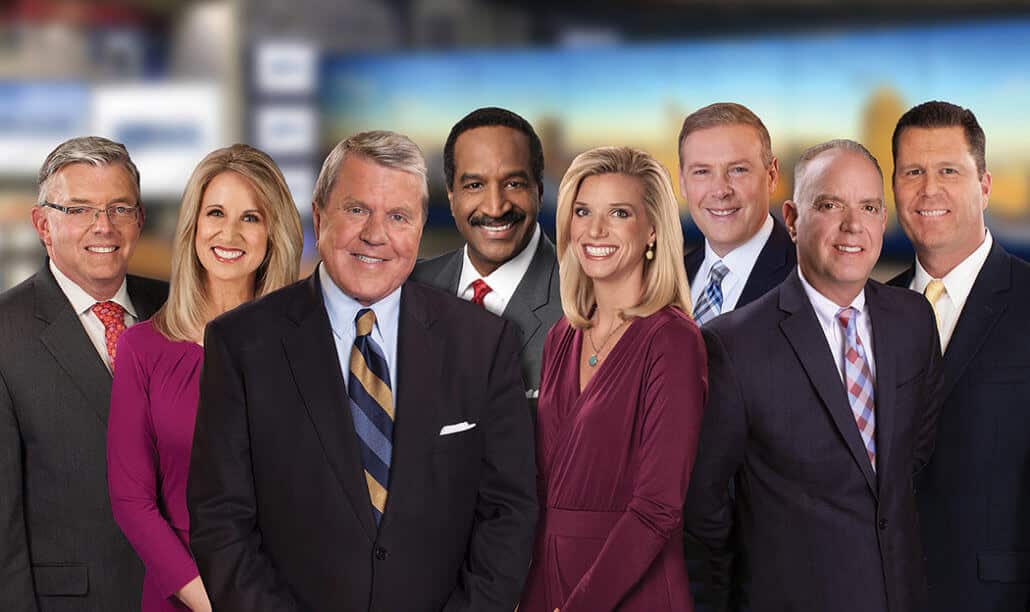
WRAL Evening News Team (L to R): Meteorologist Greg Fishel, Anchor Debra Morgan, Anchor David Crabtree, Anchor Gerald Owens, Anchor Kathryn Brown, Anchor Brad Johansen, Meteorologist Mike Maze, Sports Anchor Jeff Gravley
James Goodmon, Capitol Broadcasting Company’s CEO at the time of the switch, said the decision to switch network affiliates was a “business decision for the future.” And, though a network switch always has the potential to disrupt viewers’ habits and loyalty, the decision appears to have paid off two years in. Out of all NBC affiliate stations in the top 25 television markets, WRAL was ranked No. 2 from sign-on to sign-off last November, and several NBC programs perform especially well on the station.
“WRAL continues to be the most recognized and most trusted news brand in central North Carolina,” said Steve Hammel, the station’s vice president and general manager, in an email. “Our powerful TV ratings are just the beginning of the story.”
But that doesn’t mean WRAL hasn’t seen its share of changes recently, including turnover at the anchor desk, a retransmission dispute last fall with AT&T U-Verse, the Christmas parade debacle and losing households in the ratings for morning newscasts to ABC 11, according to ratings data from the Nielsen Company.
In December of 2016, according to Nielsen, ABC 11 started winning households in all the morning news time slots. The trend continued through 2017, and, in the last six months, data show ABC 11’s morning newscasts outperforming WRAL’s by between 3,900 households (at 6 a.m.) and 9,100 households (at 4:30 a.m.), on average. Not only is ABC 11 now winning those households in the mornings, they’re also winning key demographics in the mornings and later, including women ages 25-54, the coveted viewers most likely to be making household spending decisions.

WTVD ABC 11 Morning News Team (L to R): Anchor Kim Deaner, Anchor John Clark, Anchor Barbara Gibbs, Meteorologist Don Schwenneker
“What drives the work we do every day is serving our viewers with the best and most helpful news and information that we can,” says Caroline Welch, ABC 11’s president and general manager. “Ratings are just one measure of how well we are meeting that need. In the world of social media and new technology, we’re fortunate to have many new ways to interact with our community, meet their needs and get feedback.”
But Hammel counters that, overall, WRAL still comes out ahead, winning every newscast from noon though 11 p.m. in total households and Adults 25-54 ratings, with the exception of the of 4 p.m. slot, where ABC 11 currently has a slight advantage.
“Over the course of average weekday newscasts for the past six months, WRAL news is watched by 716,700 households, while WTVD’s news is only seen in 590,700,” Hammel said. It’s a 21 percent advantage overall, with a 10 percent advantage in Adults 25-54. “You can see the extraordinary dominance that WRAL maintains in the market.”
Part of that dominance is explained by the fact that evening newscasts, especially the 6 p.m. slot, draw the highest number of viewers overall, so there’s a much larger pool of households to compete for. Over the last six months, WRAL won an average of 105,100 households at 6 p.m. to ABC 11’s 82,300, but it’s no secret that WRAL has been contending with some recent challenges that ABC 11 hasn’t faced.

WTVD ABC 11 Evening News Team (L to R): Sports Anchor Mark Armstrong, Anchor Steve Daniels, Anchor Tisha Powell, Meteorologist Chris Hohmann
Last December, evening anchor Lynda Loveland left the station to take a job with the N.C. Farm Bureau, followed by weekend morning anchor Gina Benitez, who left in March. Both morning anchor Bill Leslie and lead anchor David Crabtree, who have worked at WRAL for 35 and 25 years respectively, plan to retire this year. Hammel, too, has announced his retirement this year, and a handful of others on staff left for new positions in 2017.
Hammel emphasized the longevity of the station’s remaining anchors, including Debra Morgan, Gerald Owens and Greg Fishel, as well as the slow phase-in of
Leslie’s and Crabtree’s replacements, Brad Johansen, who started last month, and Jeff Hogan.
“David and Bill have been a tremendous part of the WRAL family, and our viewers love them dearly,” Hammel said. “Hopefully by the end of June when Bill steps down, our audience will have spent many hours enjoying Jeff’s professional and energetic addition to the morning team.”
One could argue that CBS 17 has seen a lot of anchor turnover recently, too, with the departures of evening anchors Sharon Tazewell and Sean Maroney and meteorologist Alyssa Corfont. The anchors were replaced by Angela Taylor, who started in March, and Marius Payton, expected to begin this month; Paul Heggen and Erin Clanahan joined the weather team in November. But CBS 17 recently underwent a total rebranding effort following its sale to Nexstar, a situation where personnel shakeups are to be expected. Byron Grandy, the vice president and general manager of CBS 17 who started at the station just over a year ago, says consistency will be key going forward.

CBS17 News This Morning Team (L to R): Meteorologist Erin Clanahan, Anchor Russ Bowen, Anchor Taniya Wright, Meteorologist Paul Heggen and Anchor Felicia Bolton
“It’s important for us to get people who people can trust, that they feel comfortable with and get to know,” Grandy says. “One way to do that is to have them here for a good long period of time. Our goal is always to get the right people in the right places doing the right things for as long as we can.”
Welch agrees. “People like people they are comfortable with, that they know,” she says. “Our morning team, Barbara Gibbs and John Clark, they have been together for 17 years. It’s really comfortable watching them and they have a great relationship, as does the whole morning team. So it’s fun to be part of their morning.”
For WRAL, there was also the protracted dispute with AT&T U-Verse last fall, where WRAL and Capitol Broadcasting’s Fox-affiliated station, WRAZ, couldn’t come to a contract agreement over retransmission fees. This left an estimated 20,000-30,000 U-Verse subscribers in Wake County without access to programming, including new fall shows and NFL football. Hammel downplayed the incident, calling retransmission disputes “part of the landscape” that “have occurred with virtually every station in every market.”
In the swirl of all the changes at WRAL, and the relative stability at ABC 11, CBS 17 could prove to be something of a dark horse in the ratings game down the line.
“We are a much stronger station because of our CBS affiliation,” says Grandy. “We are a better business because of the CBS affiliation, and we have more ratings points and more audience because we are a CBS affiliated station.”

CBS17 News Anchor Angela Taylor
Indeed, though it has a ways to go before catching up with WRAL and WTVD, CBS 17 did enjoy a greater share of of TV-watching households last year, in six of 10 time slots over 2017, as well as a total increase in households, according to Nielsen data. Following the Nexstar purchase, CBS 17 not only changed its logo and identity—it’s known as CBS North Carolina no longer—but the station made a major investment in building its local news brand, hiring experienced reporters and meteorologists and creating an updated, more vibrant look or, as Grandy says, “planting a flag in the ground to say we are serious about this commitment.”
“It’s building this local news brand that matters, asking tough questions and holding public officials accountable,” Grandy says. “It’s about improving the local journalism to where we can do the kind of reporting that has an impact, that can make the community more aware and, potentially, make it a better place.”
It’s difficult to predict how the larger changes in broadcast media landscape will play out in the local market in the coming years, but Hefner, the UNC professor, says the Triangle is fortunate to have two strong stations—one that’s locally owned and operated, and one that, though owned by a large, reputable company, still operates independently—as well as one that’s strongly emerging.
“Local news revenue is the biggest single source of revenue within a well-run TV station,” Hefner says. “And local programming, like the Christmas parade, that’s the soul of a TV station, their involvement with the community. Local news is critical, but I just don’t know what local television is going to look like in 10 years.”
Hammel of WRAL believes his station will stay on top. “WRAL…will continue to lead the industry and the market in providing our audience and the community we serve news, information, and entertainment, and the innovative means to receive our product. Period.”
But the competition is out there, and it is fierce.
“We have a great team and we love it that audiences are enjoying them and valuing them as much as we do,” says ABC 11’s Welch. “We focus on doing the best job we can every day. You can always be better and we strive every day to do our best and come in the next day and ask ourselves ‘How can we do even better?’ Ours is an extremely hard working team and what matters to us most is serving our community.”