Cycle of Change
Bicycling in Raleigh has come a long way—with miles still to travel.
Riding in Raleigh can feel a little more pedal and gulp meets chain reaction and a little less woke spokes. Sure, the cap city is by no means a “bike city,” but cycling has long been gaining traction—and all the while Raleigh has been playing catchup to keep riders safe so they can cycle in stride. While the City of Oaks remains largely car-dependent, improved bike infrastructure—not to mention emerging district connections—continues to enhance resident mobility. And whether you cycle or not, as road warriors, it’s an issue that affects all of us daily—as the road is a shared space cyclists have had to make up plenty of ground on, with miles left to go.
The City of Raleigh has made strides for rides by adding approximately 53 miles of in-street bike infrastructure in the last five years alone. These efforts, in addition to a slew of other cycle infrastructure, have landed Raleigh in a unique position to have zero cyclist deaths in four out of the last five years, at a time when cyclist crashes are climbing across the state and nationwide. In NC, Charlotte claimed the No. 12 most dangerous U.S. city for cyclists in 2022 with 26.7 fatalities per 10K commuters annually, while the state saw 20.8 fatalities per 10K bike commuters. Exactly zero of those came on Raleigh’s city streets.
But our fair city still has a long way to go—especially when compared to the five U.S. cities (Austin, Denver, New Orleans, Pittsburgh and Providence) that hit the ground running with an unprecedented 335 miles of bike lanes built out in 24 months. Never mind what they’re doing in Europe.
BIKE RELATED INCIDENTS
*Data provided by Raleigh Police Department for City of Raleigh
2018–2022
• Deaths 1 (0 in 2022)
• Disabling injuries 17 (3 in 2022)
• Evident injuries 124 (23 in 2022)
• Possible injuries 90 (11 in 2022)
• No injuries 49 (13 in 2022)
As the city continues to play catchup to keep riders safe so they can cycle in stride, we take a look at where Raleigh stands.
Why Raleigh Wants to Be Biker-Friendly
“Biking in the City of Raleigh should be safe and accessible for all ages and abilities,” says Barbara Godwin, MPA, City of Raleigh Transportation Department micromobility coordinator. As the city continues to grow at warp speed, we’ll “continue to expand connectivity across the biking network, with safety and accessibility as the main priorities,” she adds.
Expanding Streets for All
In its efforts to make streets fit not just for cars, but for pedestrians and cyclists too, the city is paving the way for a functional and inclusive environment through its Complete Streets network. As part of the strategy, all street projects—think new construction, reconstruction, retrofits, repaving, rehabilitation or changes in pavement marking—undergo improvements to bike safety (conventional bike lanes, separated bike lanes, bike parking, etc.), in addition to other pedestrian safety improvements and transit infrastructure.
Cycology 101
To help minimize cost, the City of Raleigh and DOT use road-improvement projects (like resurfacing) as a strategy to integrate bike lanes and “update street configurations to match the Comprehensive Plan and the BikeRaleigh Plan,” says Godwin. Roads with poor pavement condition are resurfaced on an annual basis as part of the City’s Annual Resurfacing Program.
Why It Matters
Pedestrian and cycle traffic are essential in furthering the city’s attractiveness—not to mention its commitment to environmental stewardship, economic strength and social integrity. These biking infrastructures are just one step in the right direction for Raleigh to become a more bike-friendly city that all residents and visitors can enjoy regardless of whether they have a motor vehicle or not.
Bike Lane Breakdown
In 2022, the City of Raleigh added 10.3 more miles of bike infrastructure, according to the City of Raleigh Transportation Department, compared to 5.9 miles in 2018. As of today, DTR houses 11 miles of existing bike infrastructure.
Sore Spots
Perceived as a rolling threat by some, adding bike lanes to an existing street takes space, obviously, which can supplant parking spots businesses rely on for easy customer access. One such case, a proposal for bike lanes on already parking-sparse Person Street has seen quite a bit of pushback.
Who Pays for This?
Major street improvement projects are included in the City’s Capital Improvement Program Budget, says Godwin. A 10-year financial plan, the CIP analyzes major facility needs, projects fiscal resources, establishes priorities, and develops schedules for the acquisition and construction of capital facilities.
Streets Slated for Improvement This Year
Upward of 50 street sections are slated to be resurfaced in 2023 as of now, as part of the City’s Annual Resurfacing Program. Of these, bike lane improvements and extensions are on deck for Oberlin Road (between Roberts Street and Glenwood Avenue, slated for fall completion) and Dunn Road (between Falls of Neuse Road and Falls Landing Drive).
Project Priorities
Projects are prioritized based on connectivity across the larger bike network via the BikeRaleigh Plan, in conjunction with larger capital projects and those routine maintenance projects (think resurfacing).
Bikeable Midtown
The City of Raleigh is also working to make Midtown more walkable—and bikeable—via the Walkable Midtown plan. Part of the plan includes a greenway connection and pedestrian bridge across the Beltline and a “Midtown Ring” full of protected spaces that also connects major Midtown destinations to nearby neighborhoods.
Bicycle Superhighway
In addition to plans for an improved network of bike lanes throughout Raleigh, the city is designing a 17-mile Triangle Bikeway from Raleigh to RTP. The “bicycle superhighway” will be located along I-40 and the NC54 corridor, and connect Raleigh, Cary, Morrisville, RTP, Durham and Chapel Hill.
Total Miles of Bike Infrastructure Completed Each Year
- 2018: 5.9 miles
- 2019: 8.7 miles
- 2020: 8.4 miles
- 2021: 19.8 miles
- 2022: 10.3 miles
Pedaling Partnership
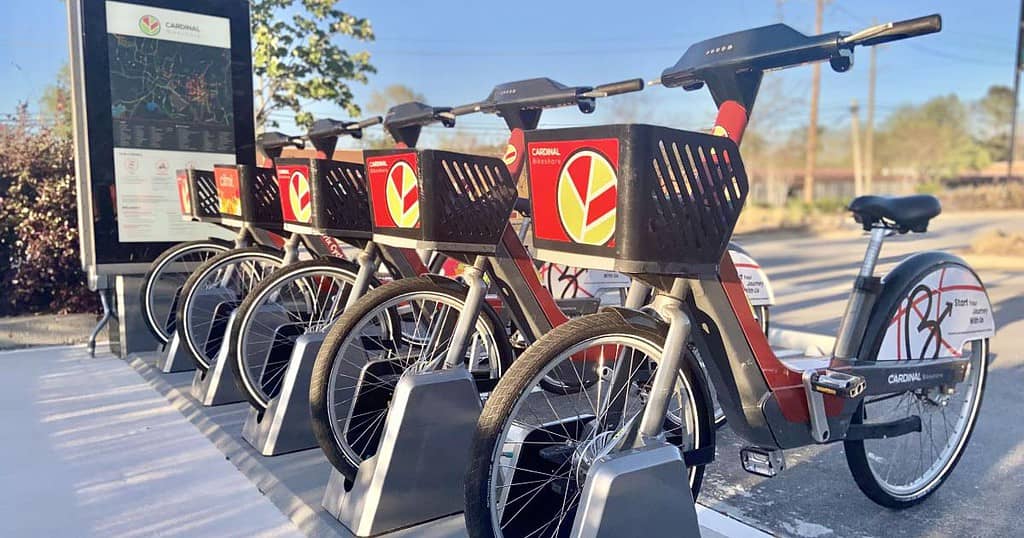
No bike? No problem. Make your way around DTR via Raleigh’s bikeshare program, Cardinal Bikeshare (formerly Citrix Cycle), a partnership between the city and Corps Logistics LLC. The program temporarily paused in April for operations and maintenance of the system, but is targeted to reopen May 16, after which users will receive 60 days of free rides (!). There are currently 32 stations spread out around the Downtown core and Hillsborough Street. Kicking bikesharing further into gear, each Cardinal bike feats. an adjustable seat, basket, bell, and front and rear lights that automatically light up when you start pedaling. To boot, two-thirds of the fleet are electric-assist bikes, making getting up those hills a breeze. Ride like the wind! (photo courtesy of Visit Raleigh)
Greenway Connectivity
Raleigh currently has 117 miles of greenway trails within its Capital Area Greenway System—112 of which are physically connected throughout the city—which links locally to adjacent communities including Clayton, Knightdale, Wake Forest and Cary. The system also provides access to longer distance trails, giving Raleighites and visitors alike the opp to explore the state and Eastern Seaboard.
- Neuse River Trail: 28 miles; part of the Mountains to Sea Trail which spans 1,175 miles from the Great Smoky Mountains to the Outer Banks in NC
- East Coast Greenway: 3,000 miles from Maine to Florida; utilizes segments of the Reedy Creek Trail, Rocky Branch Trail, and portions of the Walnut Creek Trail and Neuse River Trail
- Big Branch Trail: Proposed 4 miles; funded through the Parks Bond; will connect Crabtree Creek Trail to Sandy Forks Road
Rolling Back in History
Rolling way back, the City first studied bike-related issues in efforts to advance cycling in the ’60s via City Council-appointed bicycle committees. From there, the Raleigh Bicycle and Bikeway Ordinance of 1974 was the first organized endeavor to generate policies and systems for designing and building bicycle facilities, with bicycle plans then produced in 1979, 1983 and 1991 (though the ’83 plan was not adopted).
Fast-forward to 2008, the City of Raleigh and the North Carolina Department of Transportation Division of Bicycle and Pedestrian Transportation began to establish a citywide comprehensive bicycle plan—a long overdue update to the 1991 version, especially given the city’s rapid growth and the likewise burgeoning interest in bike-friendly cities and their advantages (think gas prices, ecoliving, fitness fads).
In 2009, the City of Raleigh and NCDOT doubled down on upping Raleigh’s bike-friendly factor via the addition of bike commuting lanes Downtown and connected greenways across the city—and beyond. At the time, Raleigh had a mere 4 miles of commuter bike facilities. Laying the groundwork for the infrastructure we see still rolling out today, enter City of Raleigh’s 2009 Bicycle Transportation Plan, which outlined ways to increase mode share and safety for bicyclists in one of the fastest-growing cities in the country. From there, the still-active-today all-volunteer advisory board Bicycle and Pedestrian Advisory Commission was a recommendation of the BTP, says BPAC chair Nick Neptune, which focuses on implementation of relevant programs, policies, regulations and funding, as well as provides leadership and guidance on all things pedal and foot.
In 2012, local bicycle advocacy group Oaks & Spokes was born with an MO of “making the City of Oaks the City of Spokes” and since has made much headway on raising awareness by “building bike culture and advocating on behalf of our community.”
Fast-forward again to 2016, by which time Raleigh had rolled out some ~70 miles of commuter bike lanes, and the city adopted the 10-year BikeRaleigh plan—which was reprioritized in 2020—further emphasizing the city’s goal of “expanding Raleigh’s bikeway network and improving safety, comfort, convenience and accessibility for bicyclists of all ages and abilities,” according to the plan.
Cycle-Paths: Bike Popularity
- 39: Raleigh’s bike score out of 100, making it “somewhat bikeable”
- NC State: Named a 2022 Bicycle-Friendly University by The League of American Bicyclists
- No. 18: Bicycle-friendly state in the U.S.
- No. 3: Bicycle-friendly state in the South
- No. 25: Most Bike-Friendly City in the U.S.
- 4.4: Bike trails per 100,000 residents, the most of any of the 50 most populous U.S. cities159%: More bike trails than the average city
Innovative Solutions in Other Cities
Cycling infrastructure ups safety for all commuters. Across the country—and world—modern bike measures on roadways are assisting cyclists in navigating the streets.
- Bike Signals: Curbing any confusion on when cyclists should stop and go at intersections, increasingly cities (think Austin, DC, Denver) use bicycle traffic lights with green-yellow-red bicycle stenciled lenses.
- Bike Boulevards: In addition to lanes, intersection treatments, signals and cycle tracks, the National Association of City Transportation Officials’ Urban Bikeway Design Guide names bicycle boulevards among its innovative solutions, aka giving cyclists travel priority on low-traffic streets and discouraging through-trips by cars.
- Underwater Bike Garage: Growing bike-dependent cities need somewhere to put all those bikes. So, across the pond, they’re going underground—even underwater (!). At the start of this year, the Netherlands debuted a massive underwater bike storage facility at Amsterdam Centraal Station. The first-of-its-kind structure took four years to build and holds ~7,000 bikes (and zero cars!). It even connects directly to the city’s metro and railway system. Also in the Netherlands is the world’s largest underground bicycle parking garage, clocking in at three stories with 12,600+ bike parking spaces.
- The Green Wave: To curb cyclist injury and death and crashes in general, cities are joining the global “green wave”—aka retiming traffic lights so cyclists can literally roll through—to prioritize riders on two wheels and make city streets safer for all bikes. Also allowing motorists and cyclists alike to predict speed, the efforts, though, don’t come without pushback. In New York, drivers complain the move worsens traffic—and in Baltimore, a recent $4.5 million study to retime traffic lights is under fire.
- New Radar Tech: No more running red lights. In 2018, Salt Lake City implemented 10 new traffic signals sensitive enough to be triggered by cyclists, allowing them the ease of not having to wait for a car to trigger a green light.
Raleigh Bike Lane Cheat Sheet
Sharrows: Sharing is caring. These street markings resembling a bicycle and two chevrons indicate where cyclists should position themselves to be visible to cars on the street—in turn reminding motorists to look out for bikes.
Buffered Bike Lanes: Demarcated by painted buffer lines between the bike lane and general travel lane or parked cars, these also signal motorists to share the road—and help cyclists avoid collisions with opening car doors.
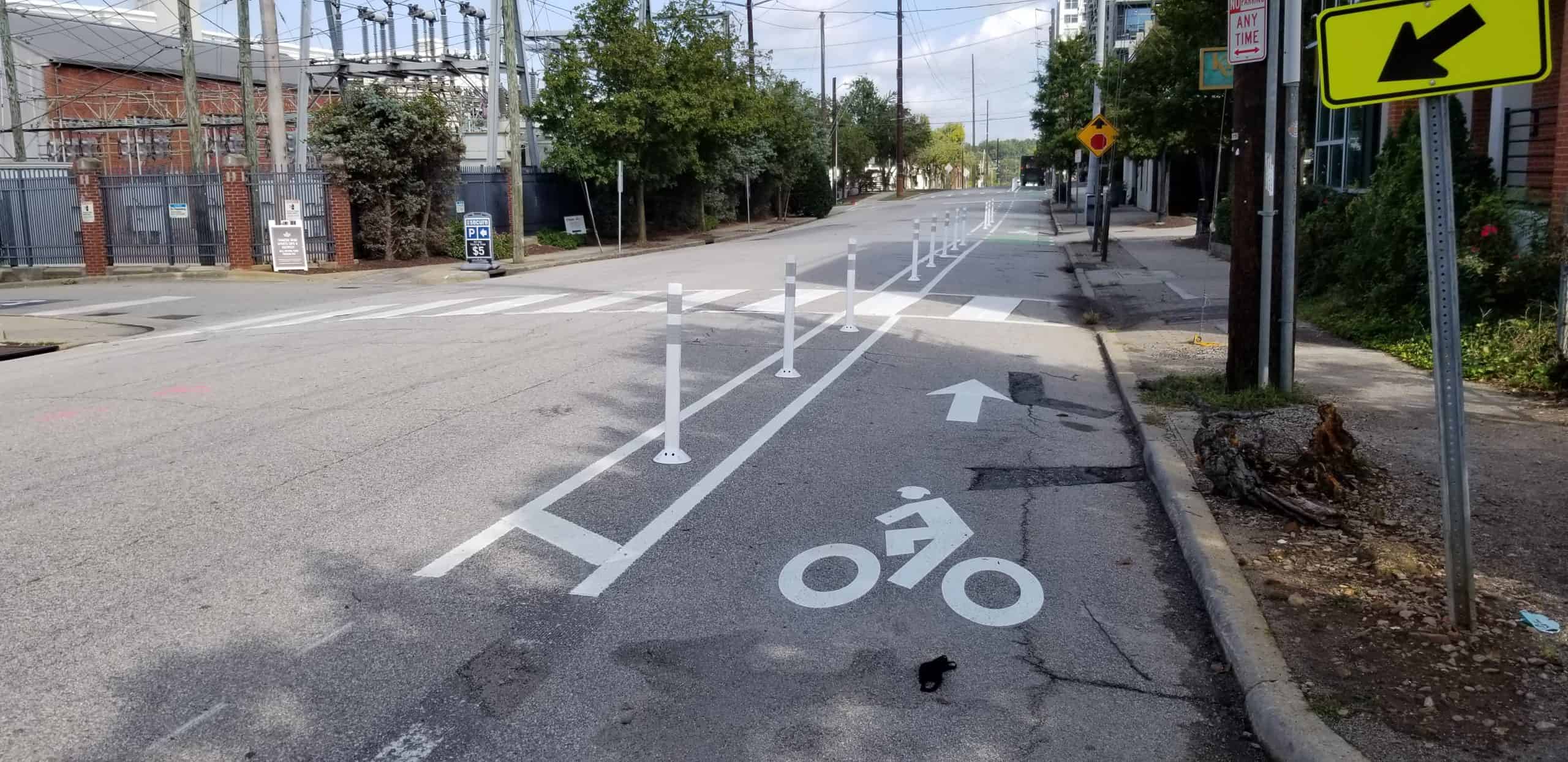
Separated Bike Lanes (aka Cycle Tracks): In a culture all about setting barriers, bike lanes are no exception. Adding a huge safety net to the standard bike lane are cycle tracks, complete with some sort of physical barrier—curbs, concrete, planters, even parked cars. The move is a boon for all motorists. Raleigh implemented a trio of these in 2020 via flexible delineators on Crabtree Boulevard (between high-traffic corridor North Raleigh and Capital boulevards), and sections of Morgan Street (between Dawson Street and New Bern Avenue) and Lineberry Drive (between Sierra and Trailwood drives)—which rolled out safer and speedier rides for all road warriors. Upcoming streets under consideration for cycle tracks include:
- South State Street, between Peterson Street and Bunche Drive
- Faircloth Road, between Wade Avenue and Clark Avenue/Hillsborough Street
- West Street, between North and Peace Street
Bike Safety Stats—How Raleigh, NC cities and the state stack up
- NC ranks 42 out of 50 in safety (20.8 fatalities per 10K commuters)
- Raleigh notably ranked 10th safest city for cyclists in 2021
- NC ranks 45 out of 50 in ridership (.18% of commuters biking to work)
- NC ranks 10 out of 50 in spending ($4.32 per capita FHWA spending on biking and walking)