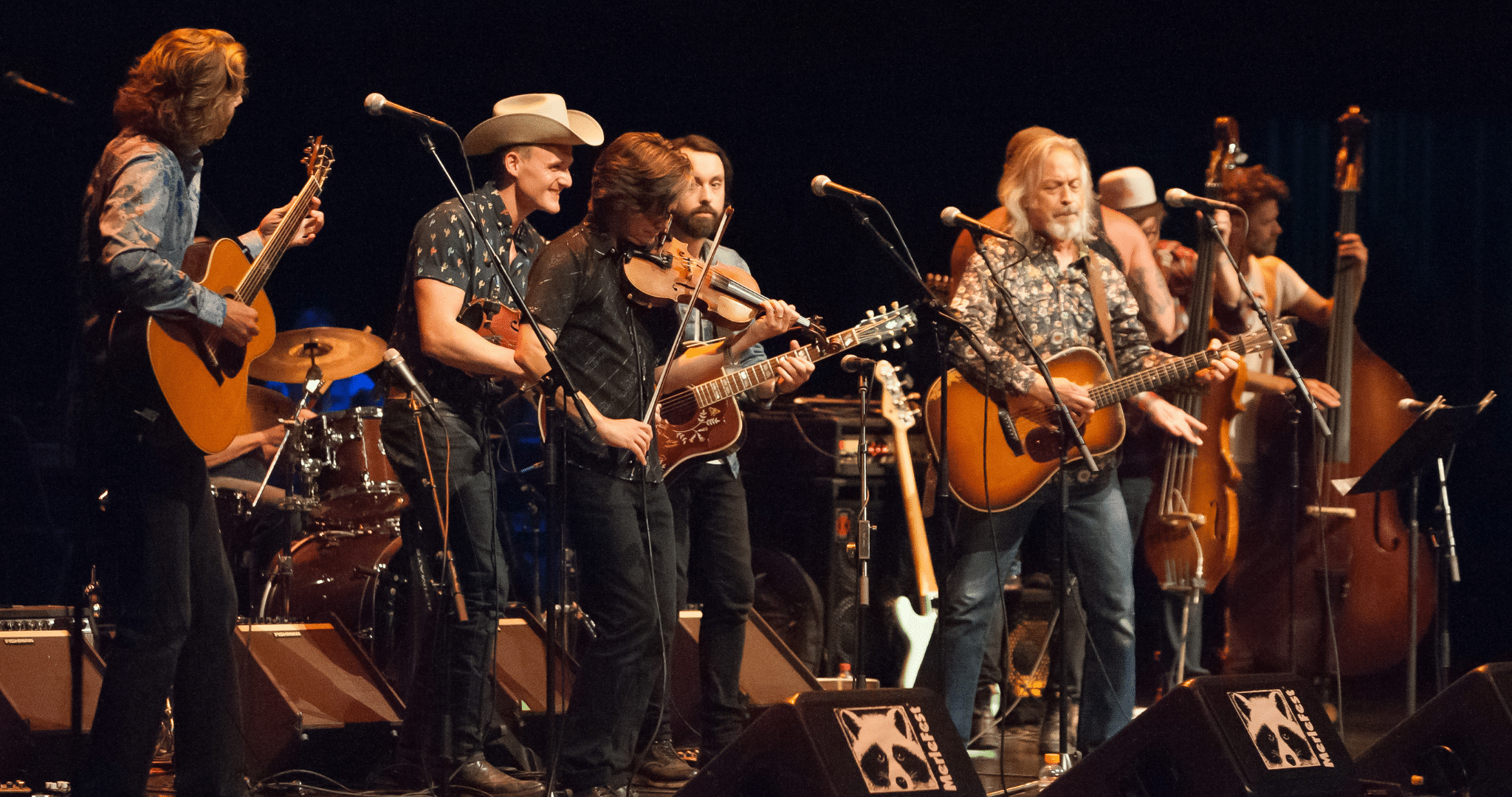
Missing the IBMA Bluegrass Live! Fest? You aren’t alone. For some boot-stomping fun in its place, head on over to the North Carolina foothills for MerleFest 2025, the annual homecoming of bluegrass, Americana, folk and almost every other kind of music in between in Wilkesboro.
From April 24–27, the campus of Wilkes Community College will become a musical menagerie with more than 100 musicians taking to 13 stages—exactly what founder and legend late Doc Watson intended when he named the Americana festival after his son and fellow guitarist, Merle.
The 37th MerleFest promises some incredible musical moments and memories with a lineup that includes the much-anticipated return of NC natives The Avett Brothers and Watchhouse (formerly known as Mandolin Orange), and the first-time appearance of icon Bonnie Raitt, whose music—like MerleFest—spans blues, folk, pop, country, rock and R&B.
Triangle-based The Barefoot Movement is also returning to MerleFest, along with another local band, A Different Thread, out of Chapel Hill, which is among the eight hopefuls competing in the 10th Annual Band Competition, where finalists vie for the opportunity to perform on MerleFest’s iconic Hillside Stage.
Late Night Jam Returns Making a surprise return this year, The Bluegrass Situation will present the Late Night Jam hosted by Sam Bush and featuring a super-set of collaborations with East Nash Grass, Jack Lawrence, Joe Smothers, Peter Rowan, T. Michael Coleman, Tony Trischka, Woody Platt (formerly of the Steep Canyon Rangers) and more.
“The Late Night Jam was always a unique and fun bonus set of music where you never knew who would show up or what you might hear,” says MerleFest Artist Relations Manager Lindsay Craven. “We took a pause on this offering so we could revamp and revitalize it for our fans and bring it back bigger and better than ever. Late Night Jam with Sam Bush and Friends will embody the spirit of MerleFest with unique collaborations you can only see here, and the highest-quality musical performances in the roots scene.”
Beyond its unparalleled musical offerings, MerleFest 2025 will also offer visitors a chance to explore the rich history of the festival through the MerleFest Archives and Oral Histories, now on display at the Appalachian State University Libraries. The exhibit spans the festival’s journey from its founding in 1988 to the present day through a curated collection of performance recordings, photographs and memorabilia, providing a glimpse into the festival’s growth and impact.
The state’s second-largest tourist draw, which acts as a fundraiser for WCC, will also offer shopping from a variety of vendors at The Shoppes at MerleFest, the Little Pickers Family Area, the Acoustic Kids Showcase, Jam Camp, Pickers Place, a wide range of good eats that double as fundraisers for the local community, and even nature walks and backstage tours. One-day general admission tickets from $90, multiday tickets from $245, merlefest.org.
Ahead of Raleigh’s last IBMA World of Bluegrass fest (Sept. 24–28), Billy Warden—who helped launched the festival with former business partner Greg Behr—reflects on its transformative decade-long run.
Who would’ve thunk that one of the brightest chapters in Raleigh history would involve so many banjo jokes? Since the International Bluegrass Music Association’s annual festival first landed here in 2013, the good-natured jabs have flown as fast as the notes in an Earl Scruggs solo.
“We were worried we’d be late,” one band deadpanned onstage. “Our banjo player locked himself inside his car again.”
But the festival’s success here is no joke. It was that once-in-a-blue-moon party where everyone leaves their country club insignias and other status symbols at home and shows up with the sole purpose of gettin’ down. With the jamboree wrapping up its run in Raleigh before moving on to Chattanooga, it’s worth celebrating the music made and lessons learned.
As bluegrass lyrics make achingly clear, the world used to be considerably different. In 2013, Richard Florida’s bestseller The Rise of the Creative Class was still an economic development lodestar, with its accent on trailblazing tech workers and hipster hang outs. Every mid-size city in America pined for its own version of Austin’s South by Southwest (SXSW), a “signature event” at the crowded crossroads of music, media, tech, design and uber just-flew-in-from-the-coast coolness.
Meanwhile, Raleigh was primed to host a major happening of some kind. The city had recently constructed a gleaming convention center and an accompanying amphitheater—along with reviving Downtown’s main artery, Fayetteville Street.
When a team that included staff from the Greater Raleigh Convention and Visitors Bureau, the Raleigh Convention Center, PineCone (Piedmont Council of Traditional Music), and key sponsors notched a deal with IBMA, a group with a national profile, many cheered. Some, though, wondered if the appeal of bluegrass would be too narrow, or if other attractions—such as MerleFest—had already cornered the market.
But bluegrass proved the perfect centerpiece for a community love-in. The genre is familiar and easy going, though not easy to play—serving up both neighborliness and virtuosity.
Billy Warden introducing one of the hundreds of acts that’ve performed over the years. Photo courtesy of Billy Warden
Sprinkling free music stages, crafts and dance tents over a generous swath of Downtown blocks, the festival immediately caught on with the lifeblood of Raleigh—not jet-setters, but young families. Here was an event that embraced a “take the kids” ethos as emphatically as that all-time-favorite funnel cake factory, the NC State Fair.
Everybody was welcome. At the festival, I bumped into buddies from high school and their teenage kids as well as the crowd of parents who chided me when I was a young’un. This also played out on the music stages, which often featured a picker as weathered as Grandfather Mountain jamming with a wet-behind-the-ears prodigy.
My own folks—steeped in ’60s pop, classic soul and the great balladeers (namely Barry Manilow)—had no stock in bluegrass to start, but came to cherish the festival scene.
In a marvelous moment of serendipity, the music that is as old as the hills proved oddly kismet with the latest and greatest in consumer tech. Because bluegrass relies on acoustic instruments, it’s relatively easy to set up and enjoy anywhere, including in hallways, hotel rooms, and sundry other corners and crannies. This led to innumerable impromptu jam sessions that awestruck fans captured on their mobile phone cameras and transmogrified into that Holy Grail of marketing, viral videos. Eat your heart out, SXSW!
Well over 100,000 revelers poured into the festival’s debut, with the numbers building in following years. The momentum was electrifying. The zeal fueled the spunk and smarts on display in 2015 when organizers moved the entire kit-and-caboodle inside the convention center after Hurricane Joaquin changed course and barrelled down on the city. The civic-minded heroics involved ought to be taught in Raleigh elementary schools; the logistics would make instructive reading for the U.S. nuclear submarine fleet.
This arm-in-arm, the-show-must-go-on spirit again took centerstage as another potential disaster loomed—COVID-19. No festival fared particularly well during the pandemic, but the most able pivoted to an online experience. Even stripped of its in-person bonhomie, the streaming-only version of the festival in 2020 was a tonic in scary times—a home remedy that went down smoothly and reassuringly.
A decade after the festival’s debut, Raleigh is in a different spot. Rather than seeking a shot at proving itself, Downtown is bouncing back from a few challenging years, mostly involving the post-pandemic depopulation of offices. But that rebound will no doubt come. We’ve shown we have what it takes—namely a heart as big as an all-welcoming front porch.
The Barefoot Movement brings about a fresh era with their new single.
If you aren’t barefoot, you’re overdressed. … From high school buddies to bandmates, Noah Wall and Tommy Norris have spent the last ~two decades making a name for themselves in the bluegrass world via their progressive Americana group, The Barefoot Movement.
After a forced pandemic hiatus, the dynamic duo—hailing from Oxford, NC—had to face a decision: move on or bring their music and motives through a renaissance. The power couple pushed on and just released their newest single, “Let It Out”—a “kind of battle cry for all who fight a war with anxiety and depression,” says Wall. Here, the bandmates take us back to their roots, delving into the deets of their latest song and giving us a sneak peak of what’s to come next. Play on…
Take us back to the meet-cute. Noah: We met in high school in Granville County 18 years ago. [Tommy] brought a guitar to senior English class, and I was really intrigued by his musical abilities. At that point, we started playing together and kept it going through college. He picked up the mandolin somewhere along the way, while I’ve always been a fiddle player and singer. Throughout college, we collected different band members to support our sound on the road, and they’ve come and gone. … Now, it’s back to the two of us.
Tune us in to what you’ve been up to the last two decades. Noah: We’ve put out three full length albums, two EPs, one live record, a Christmas album and a number of singles. We are ahead of our fourth album that comes out next year and our first single came out last week. We have gone from touring regionally and booking ourselves to acquiring a booking agency, which allows us to do more extensive touring. Now, we’ve been to most of the U.S., Burkina Faso, Africa and Canada.
Spill the tea on the new single. Tommy: It’s called ‘Let It Out.’ I was falling asleep one night, and I had a melody pop in my head. That’s the worst time for a song to pop in your head because you have to make the decision to get up and record it, or try to remember it in the morning. Most of the time you don’t remember it. Being lazy, I didn’t decide to get up and record it. I took a risk and spent time figuring out how it would look in music notation, and, luckily, I remembered it.
Noah: Normally I would write lyrics first, but this time, the music came first. I listened to the music to see how it made me feel and what I wanted to say. The point of the song is when you are dealing with something, it’s important to let it out. You don’t want to bottle things up—there has to be a balance of knowing when you can move on.
Is the rest of the album going to follow the same tone? Noah: We allowed ourselves to experiment a little bit more in the studio. I think in the past, we’ve been thinking more about how we would play it live, but this time we wanted to make a good record. We just followed the songs where they led. The song ‘Let it Out’ ended up being the album title as well because it works well with the rest of the songs, and now that it’s back to Tommy and I, we are a little more comfortable with our story. In the past, it’s been a band of four people. … We tried to make it more egalitarian and didn’t talk about our relationship, even though that has been the backbone of everything. We are willing to tap into some of our rock ’n’ roll influences and let go of any musical inhibitions.
Any musicians make their mark and influence your sound? Noah: We both bonded over Led Zeppelin early on. Tommy:Physical Graffiti or IV. Noah: We were classic-rock kids and grew up in the grunge era. In small ways that has come out in our previous recordings, but we just let ourselves lean into that. I wouldn’t say it’s a rock ’n’ roll record—there are still a lot of folk elements in there. We definitely wanted to keep the fact that we play acoustic instruments at the center.
*Responses have been lightly edited for length and clarity.
IBMA Bluegrass Live! festivities move indoors for the second time in 10 years in anticipation of Hurricane Ian. Here’s what to expect.
In 2015, bands of rain from Hurricane Joachin came down on Raleigh, soaking artists, vendors and attendees of bluegrass music’s biggest week—leaving organizers scrambling to move the International Bluegrass Music Association’s IBMA Bluegrass Live! festivities indoors to the relative comfort of the city’s convention center.
Fast-forward seven years and IBMA’s organizers announced Sept. 27 that all outdoor festivities associated with this weekend’s IBMA Bluegrass Live! will move indoors, due to expected rain and wind from Hurricane Ian as it approaches the western shores of Florida.
“The music will go on,” said IBMA Executive Director Pat Morris at the IBMA welcome reception celebrating the festival’s 10th year in the Cap City. “We have a fantastic week lined up.”
This year, however, will be different than 2015, when the ticketed festival and the free street events were all suddenly forced into the confines of the convention center. What won’t change is several days of bluegrass tunes ringing throughout the facility—some planned in ballrooms and convention rooms, others spontaneously erupting into jam sessions filling up the facility’s not-so-hidden corners and even in hallways and on staircases.
One major difference: The ticketed Main Stage performances—originally planned for Red Hat Amphitheater adjacent to the convention center—will take the stage in the Raleigh Memorial Auditorium at the Duke Energy Center for the Performing Arts. Reserved seating bought in advance will be honored, but, unfortunately, fans hoping for a free general admission ticket to see headliners such as the infamous Stringdusters, Jerry Douglas and Molly Tuttle may be out of luck. Organizers are still working out details to try to make some free seating available.
On a positive note, there’s still a lot of free entertainment to take in. All previously scheduled performances at the five free Street Stages are moving into the Raleigh Convention Center, along with all 115 vendors—from the Art Market to Shop Local to Black Friday Market. Also on tap indoors will be the beer garden, PNC Porch, jam “tents” and other activities.
Mayor Mary-Ann Baldwin said the resiliency of the organizers and the City of Raleigh is similar to that often sung about in bluegrass music, as well as the genre itself, which celebrated its 75th anniversary during the height of the pandemic.
“Whether you have been here before or it’s your first time, you are in for great entertainment,” she told the crowd in the RCC ballroom. “We did this in 2015 and it turned out great, and it’s going to be great again.”
Baldwin added she hopes IBMA will return to Raleigh for another 10 years. “The best part of IBMA is you get to be part of this unique experience and community,” she said. “It’s about bringing people together.” Stay dry—and keep dancin’. Sept. 30–Oct. 1, worldofbluegrass.org/festival
WEB EXCLUSIVE Triangle-based band Into the Fog to take the stage at the annual IBMA World of Bluegrass festival after taking home the W at the MerleFest Band Competition.
After more than a year of having nearly nowhere to play, members of the Triangle-based genre-bending newgrass trio Into the Fog are finding themselves escaping into the light of potential stardom.
Gigs ranging from Cary’s Lazy Daze Arts and Craft Festival to Banjos and Beers at The Raleigh Times to MerleFest are filling up the band’s dance card as quickly as they can book them, says Brian Stephenson, who plays guitar and sings for the fledgling group he helped found three years ago (rounding out the trio are Winston Mitchell and Derek Lane, who are often helped out onstage by friends Will Maxwell, Jack Snyder, Connor Kozlosky and Matt Austin).
And, now, you can catch the spotlight-stealing band this Thursday at The Pour House Music Hall as part of the International Bluegrass Music Association’s annual World of Bluegrass conference and festival’s IBMA Ramble.
TheNews & Observer mentioned Into the Fog as one of 10 acts attendees shouldn’t miss during the celebration, which runs through Oct. 2 at Red Hat Amphitheatre, the Raleigh Convention Center and myriad other Downtown venues as part of the IBMA Ramble and Wide Open Bluegrass celebration on Fayetteville Street on Friday and Saturday.
But no matter where they’re playing, Into the Fog brings a unique blend of bluegrass and blues mixed with some outlaw country and funk to any stage they find themselves on.
“We were really just coming together as a band when we went out to the Telluride (Colorado) Bluegrass Festival in 2017 to compete in its annual band competition,” Stephenson explained after playing a set on the Hillside Stage at the recent 2021 MerleFest music festival in Wilkesboro. “We didn’t win the competition, unfortunately, and, then, well, you know, COVID.”
After the band’s pandemic-induced hiatus, the boys, who hail mainly from Wake Forest and around the Triangle, have reemerged as the most recent winners of the coveted MerleFest Band Competition.
Fifteen hot minutes on the tiny Plaza Stage on Saturday afternoon were all the band was given to compete against nine other talented acts. Into the Fog used every bit of its time to persuade judges they deserved that spot on the Hillside Stage on Sunday morning to kick off the last day of the four-day festival.
“I still can’t believe we won after hearing some of the competition,” said Stephenson, who wasn’t afraid to share his emotional response to winning with his bandmates and friends who gathered around him after the announcement. “I cried again when I called my mom.”
It appears Into the Fog is just getting started, or, restarted as it were. While not part of the IBMA festivities, the band is playing at The Pour House again Friday with The Wooks and Stillhouse Junkies. You’re going to want to keep an eye on Into the Fog’s rise to stardom—as they’re only going up from here.