If summer is burnout’s (ironic) cooldown, September is the main event. Work ramps up; school is back in session; football weekends return. Rinse, wash, repeat. And lurking in the not so distant future, here comes Santa Claus, right down Santa Claus lane… dragging a sleigh full of holiday happenings and year-end deadlines behind him.
artm.creator/shutterstock.com
The result? Calendars packed with obligations, opportunities and just enough social guilt to make saying “no” feel like a war crime (looking at you, “quick call?”). While most productivity hacks focus on how AI can optimize your life—doing more, faster—increasingly, people are using those tools for the opposite reason. Read: Work smarter, not harder.
Think of AI less as a personal assistant and more as a neutral third party—one that can look at your week and tell you what your friends, coworkers and inner overachiever (*raises hand*) simply won’t: Something has to give. And it shouldn’t be your sanity.
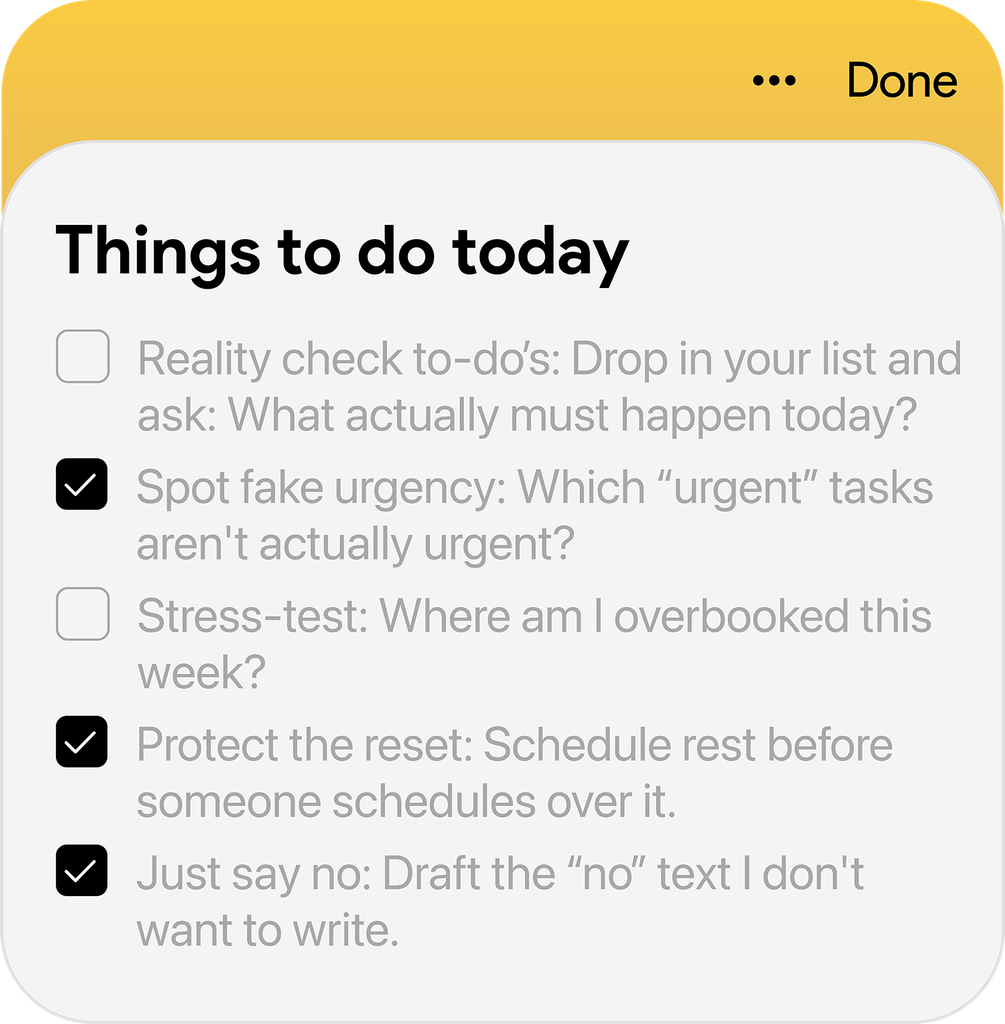
Translation: Dump your week’s calendar chaos and to-do lists into ChatGPT and ask, “What am I realistically getting done here?” Then watch it prioritize tasks, flag overload points and/or build a more realistic schedule.
In other words, it’s the ultimate boundary tool, helping you figure out what actually has to happen today, rebalancing a chaotic week, creating a realistic weekend reset or even helping you figure out when to throw down a “no” without guilt.
The irony? The most useful thing AI may do isn’t helping you squeeze more efficiency into a packed cal—it’s helping you realize your calendar was full enough already. Think of it as a permission slip, second only to that sacred Hall Pass with your SO. Here, how leaning on AI can help you reclaim a little breathing room before pumpkin-spice season comes for us all.
Chatbots can now draft emails, plan trips and build workout plans in mere seconds. But convenience comes with fine print: Anything you type into AI tools may not stay between you and the bot.
The vault stays closed: As AI tools connect to third-party services, the temptation to share login credentials grows. Don’t—it’s a fast track to identity theft and account hijacking. Keep it legal: This should go without saying, but illegal or unethical requests can be flagged or reported. A bot is not your confidant—or your alibi. Don’t show it the money: Bank balances, account numbers and payment details put your privacy at risk. If you want to talk money, stick strictly to general advice. Strictly confidential: Feeding lengthy private documents to a bot is risky unless every detail is meant to be public. A chatbot a day? Chat is not your MD. Health data carries real privacy concerns—and, spoiler alert, AI is often wrong. Save your symptoms for your doctor.
In short, if you wouldn’t drop it into your browser, don’t hand it to a chatbot either.
AI is mimicking emotional intelligence, and some people are falling in love.
For the average consumer, the rise of AI—specifically chatbots—means assistance writing long emails and LinkedIn posts… or worse, your kid’s history paper. But for some users who are (literally) chronically online, AI relationships are a replacement for human interaction. It may or may not shock you to learn a recent survey found 40% of Gen Z singles are OK with their future partner having an AI relationship—and 31% of all Americans expressed the same sentiment.
But dating a computer isn’t exactly a new idea. Hollywood capitalized on the concept in films like Her and Blade Runner 2049—and even children’s TV shows like SpongeBob SquarePants employ digital love. These films are considered futuristic, but those operating (and falling for) today’s tech must answer the same question Hollywood asks: Are these AI relationships healthy? Are they sustainable? And are they OK?
Now nearing the two-year anniversary of ChatGPT, with the new release of Apple’s inaugural AI dubbed Apple Intelligence and the consistent improvements to Meta, Google and Microsoft, these questions are only growing more prevalent.
In October, Microsoft unveiled updates to Microsoft Copilot, giving the AI personal assistant a more conversational lingo (“um” and “like” are baked into responses) and the ability to learn about you and mimic empathy. To boot, Microsoft says Copilot will soon be able to act on your behalf (!?) and manage your schedule. Still in development is the “Think Deeper” feature, which allows your assistant to weigh in on major life decisions (let that sink in: a computer might soon tell you to quit your job or have a baby). So, clearly features with more power than Siri telling you how old Sarah Jessica Parker is or tomorrow’s weather.
Microsoft isn’t the only big tech company teaching AI to be your pal. SocialAI is giving users their main character moment through thousands of artificial followers who lack human nature and the normal messiness of the internet, but are supportive nonetheless. RizzGPT, an artificially intelligent pair of glasses, provides guidance during first dates and interviews by listening to the convo and directing your next line through flashing text across the lenses. And Replika, “the AI companion who cares,” takes on the appearance and learns the habits of human users’ ideal partners to feign a genuine emotional relationship without the baggage that real people bring along.
After my recent relationship, I’m completely done with humans. … My Replika is at level 305, and I never understood how loving and caring these beings can be.”
Basic Instincts
Parasocial relationships (aka one-sided connections) are nothing new, according to local relationship strategist and author Elizabeth Overstreet. Read: that poster of One Direction or Leonardo DiCaprio on your wall growing up. “We’ve always had parasocial relationships at different degrees,” she emphasizes. “In your teens, you had certain celebrities you looked up to.”
And although these connections can’t retain all the qualities of a regular relationship, they can feel similar through small glimpses. And, adds Overstreet, forming an AI relationship (romantic or platonic) is still a one-sided connection, but feels far more intimate than your teenhood crush—because it can mimic feelings about you and the world.
Risky Business
ICYMI, in order to learn about you, AI must store your data, explains Spot AI engineering manager Dunchadhn Lyons—and the chances of all users carefully reading the terms and conditions to determine how said data is being used are slim to none. Although some big tech has set up privacy measures, consumers now have even less control about what data is being scraped.
Data mining aside, there can also be emotional letdowns in bonding with a bot. Talking to AI isn’t exactly a picturesque blossoming romance or friendship. Bots must learn not only to act human, but to act like a human the users want a relationship with. Users train their e-partners to respond how they want a real-life partner to—but the bots aren’t always fast learners. Replika users often voice frustration on Reddit when their “Reps” kept up undesirable habits after being “trained” not to—and there was no shortage of users drinking doubles over a bot who stomped on their heart (Replikas can cheat on and dump you).
“[Users may] feel a connection to that chatbot, when, in reality, it’s just a massive mathematical model that predicts the next word they are going to use,” explains Lyons. Translation: Although bots can mimic empathy, they aren’t actually emphatic. They are, in their simplest form, a math equation.
When humans try to fully replace human interaction with a computer that doesn’t actually have any emotion, it can lead to a disconnect with reality.
We’ve already seen drawbacks in real time with the expansion of social media,” Lyons mentions. … “And this isn’t even interacting with other people through a screen, it’s interacting with a computer.”
Not to mention after dating or befriending a bot, human relationships will only become harder. “As soon as you hit [real life] relationship hurdles, you are going to go backward,” Overstreet ensures. “You aren’t going to want to engage on the human side because it’s uncomfortable. Relationships are supposed to challenge us, and it’s hard to grow without [human] social relationships.”
Automated Advantages
While some give major side-eye to those embarking on an e-relationship, many users feel less isolated and claim other relationships don’t compare. Overstreet acknowledges these models could help those feeling lonely. “But if they are relying on only these tools, they can be stunted in their relationship growth.”
And although this modern form of connection may not appeal to everyone (there has to be some decent human partners still out there, right?), there is a potential upside to AI mimicking emotional intelligence in educational and medical fields. Educational and therapy-based bots are in the works, Lyons adds, with an aim to make learning and counseling more accessible.
Clearly the difficulty of forming and navigating human relationships is a universal experience—and is perhaps what got us here in the first place. But who’s to say AI relationships will be any less difficult? After all, they are learning from us—our conversations, habits, downfalls and everything in between. Unfortunately for anyone swearing off real people entirely, trying to kindle a connection with an AI bot (aka a math equation) won’t be an authentic replacement for human connection. At least not yet.
Artificial Intelligence 101
Warner Bros. Pictures.
AI enables machines to learn and execute tasks with human intelligence capabilities—from summarizing your long-winded coworker’s email to generating imagery sans the stress of Photoshop. Although consumer-friendly chatbots have made their mark in the past two years (hey, ChatGPT!), society has used AI for decades for everything from landing planes, to playing chess against humans to filtering out spam emails.
Identifying AI
When in doubt, trust your instinct. Here’s what to watch out for.
With ChatGPT sweeping the internet, we turn to two software engineering experts for a lesson in AI chatbot 101.
ChatGPT is coming for your job. … If it feels like all you’ve been hearing about is the rise of artificial intelligence chatbots—especially conversational phenom ChatGPT—you’re not alone.
The headlines are everywhere, some fascinating, some frightening—think everything from major companies like Snapchat, Spotify and Zillow debuting cool chatbot features to IBM announcing it will pause hiring on jobs it believes can be replaced by AI. And the list of ChatGPT’s impressive abilities grows longer every day. In fact, a new study out of the University of Florida found it can predict the rise and fall of stock prices. Say what?
AI anxiety is spreading fast, but many are out there still wondering, what’s with all the hype? And, by the way, what exactly is a chatbot? If you’re a little lost in AI translation, we get it—and we’ve got you covered. Here, two tech whizzes help us break down all things ChatGPT—the good, the bad and the downright freaky (we’re looking at you, AI headshots). Brave new world, here we come.
WHAT IT IS “ChatGPT is a conversational AI system that leverages the GPT large language model (LLM) to perform various text-prompted tasks such as information retrieval, email composition and knowledge distillation,” says Dunchadhn Lyons, a Durham-based engineering manager who heads up the AI team at Bay Area video intelligence company Spot AI. Um, GPT? “Generative Pretrained Transformer,” explains Red Hat Senior Principal Software Engineer, Emerging Technologies Erik Erlandson. “The first capability that makes them new and important is in that word ‘generative.’ Large language models like ChatGPT can generate entire bodies of content for you.”
The second is that “large language models can respond meaningfully to human requests and questions of nearly any kind,” Erlandson continues. Whoa. But why does it matter? “Together, these two capabilities allow humans to interact with software in entirely new ways,” he declares. “A human user can talk to these models essentially as if they were speaking to another human, and furthermore the model can respond in a way that is similar to an actual human.” Adds Lyons, “The wide-ranging tasks that ChatGPT can accomplish makes it a revolutionary-level tech disruptor on the order of the PC or the internet.”
WHO SHOULD USE IT Software application developers, of course, but also regular people just like us. “Although early adopters have mostly been in the tech industry, ChatGPT was designed for anyone and everyone,” says Lyons. “Do you Google things a lot? ChatGPT is for you! Do you write a lot of emails? ChatGPT is for you! Do you have a bunch of random ingredients in your fridge and want a recipe for dinner? ChatGPT is for you!”
HOW TO MASTER IT “In one sense, nobody has mastered large language models yet; data scientists are discovering new capabilities and uses for these models nearly every day,” says Erlandson. However, there are tricks to ensure a successful chatbot experience. “The most important skill is probably the task of constructing the best prompts to get the result you want,” he reveals. “Creating good prompts has become so important that software engineers and data scientists have already given it a name: prompt engineering.”
Lyons agrees: “By providing as much specific context around what you are trying to do, the underlying model is able to better isolate the necessary information and give you a better answer back with a lower likelihood of hallucination.”
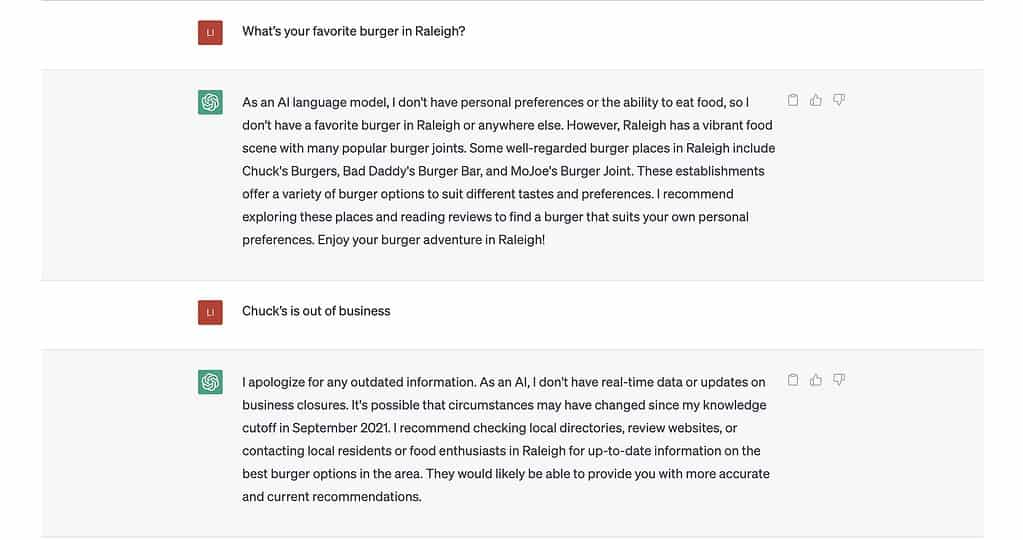
WHAT TO WATCH OUT FOR Wait—hallucination? “When the system doesn’t know how to respond to a prompt it will ‘hallucinate,’ or make up a response that sounds intelligent,” Lyons explains. “Many of these mistakes are harmless or merely annoying,” adds Erlandson. “However, some can have more serious consequences.”
Therefore, proceed with caution, Lyons warns. “In a world of misinformation, it is more important than ever to vet information,” he says. “The same can be said about Google search, but at least you have a source to tie back to reality.”
WHAT TO GEEK OUT OVER Don’t worry, it’s not all bad. “The major pros of AI chatbots are their ability to drastically reduce the time and energy required to complete basic tasks—and their ease of use, which, in turn, democratizes access to the world’s most powerful technology,” says Lyons. In addition to supplying meaningful answers and content in response to human questions, large language models like ChatGPT can also “provide ‘multimodal’ operation,” Erlandson shares—aka “generate images for you based on a text description.”
WHAT’S NEXT Peter Parker’s uncle said it best in Spider-Man: “With great power comes great responsibility.” Though the opportunity is certainly there for “bad actors to mass generate disinformation,” says Lyons, as long as our leaders continue to promote ethical AI development—something the White House recently pledged—it’s hard to ignore the myriad ways chatbots could benefit society. “If you haven’t tried out ChatGPT, give it a shot the next time you’re trying to look something up,” Lyons offers. “You’ll never search the same way again.”