City Council Meet & Greet
Join Raleigh Magazine & Midtown Raleigh Alliance on October 13 at Bowstring Pizza & Brewyard to meet with Raleigh City Council Candidates.
Preregister & get your first drink on us!




Join Raleigh Magazine & Midtown Raleigh Alliance on October 13 at Bowstring Pizza & Brewyard to meet with Raleigh City Council Candidates.
Preregister & get your first drink on us!

Aug. 12, 2022, marked Chief Estella D. Patterson’s one-year anniversary as Raleigh’s 30th police chief. She came here with a vision of making “Raleigh the safest city in America.” In a year marked by a waning pandemic and rapid return to “real life,” rising local gun violence and a concentrated focus on police pay, much has happened since Chief Patterson’s swearing in. In her sit-down with Raleigh Magazine, we talked about violent crime, police pay, the officer shortage—plus bringing nobility back to the police profession.
“Everything we’re doing as a department falls into one of these three buckets, And we’ve made advancements in all three, but there’s still a lot of work to be done.”
—Chief Estella D. Patterson
Violent Crime
“We are still striving toward Raleigh being the safest city,” says Patterson. While she acknowledges the uptick in violent crime, she clarifies that in her Q2 media rounds she publicly updated that “we’ve seen violent crime go up, but we’re seeing it go back down.” In January this year, we were up 13% in violent crime over last year. We are now still up slightly, but trending down at 4%. “Which is awesome,” she says, “and I credit that to the intentionality of really focusing on our violent crime and then also to the partnerships that we have created, like with the U.S. Attorney’s Office.” Clearly federal cases don’t resolve quickly, so “that partnership is huge,” she says, adding to that RPD’s close work with the District Attorney’s office via a frequent roundtable to review the city’s most violent crime offenders and ensuring those cases stick and get the most significant charges.

Salary, Recruitment + Retention
“I think a fair compensation for where we live would be to start our officers at least at $60,000,” says Patterson. “I truly believe the capital city should be higher than anybody else.”
However, she’s grateful Raleigh City Council approved police raises, effective July 30, 2022, bumping new officers from an abysmal $42,300 to $50,301—a jump that, at first sight, may look impressive. But much is at play here. While a ~19% raise is nothing to balk at—and makes major strides in helping to fill the roughly 125 vacancies (~15% of the police force—down from 21% in April)—that salary remains outpaced by other agencies in Wake County and across North Carolina.
While there’s still a gap, the chief is keen on highlighting opportunities RPD has to offer that aren’t afforded elsewhere—think take-home cars, serving as canine and motorcycle officers, or on SWAT or crash investigation teams. But Pattersonisn’t resting on her laurels. “We’ll keep fighting to get more,” she says. “We have to be more competitive than what we are now.”

Raleigh Police Foundation
One of Patterson’s proudest accomplishments has been achieving her goal to start a police foundation in Raleigh. Modeled after Charlotte’s foundation, the Raleigh Police Department Foundation (RPDF, raleighpolicefoundation.org) is comprised of a set of stakeholders who provide financial support and advocacy. After a premiere board meeting in early July, led by board chair and “huge PD supporter” Brenda Gibson, “our foundation is full steam ahead,” says Patterson. Beyond connecting NC’s two major metropolises, the foundation provides extraordinary support for our officers by making high-dollar purchases and equipment needs RPD wouldn’t be able to make within its current budget, she explains.
Noble Calling
As we approach 9/11, emotions and images flood to mind—including the now ubiquitous photo of first responders raising a flag from the rubble. And while we continue to say “never forget”… have we forgotten? Have we forgotten the gratitude, veneration and admiration we felt for the heroes who ran toward known peril, destruction, debris and devastation? In our sit-down with Chief Estella Patterson, we asked her what she thinks it will take to return to a time when police were trusted and respected. “We have to put the nobility back in,” she says. “I think that has been lost. We have to reinstill the ideal that any profession where you’re serving your community or country is noble.” Patterson points out the disparity in media coverage, implying it is part of the problem. “We had that big incident in April where our officers were shot at in the middle of the day, and that didn’t get a lot of media attention because they’d rather talk about us shooting somebody and killing somebody rather than us being shot at,” says Patterson candidly. “But those are the kinds of things our officers are facing on a daily basis. I just ask the public to continue to support the men and women that do this work. It’s a tough job. It’s going to get tougher every single day. We can’t fix it by ourselves,” she says. “We’re gonna need community support in order to do that.”

This year, when you go to the polls, you’ll find three bonds on the ballot—the most ever Raleighites have been asked to vote on at one time. What’s at stake? The future of parks (Raleigh Parks Bond Referendum), the future of schools (Wake County Public School Bond) and the expansion of Wake Tech Community College (Wake Tech Workforce Forward Bond). Worth noting, Raleigh voters haven’t voted down a bond in over 20 years.
Not all citizens realize that bonds aren’t about just shifting city money from pot A to pot B. Instead, there is a direct tax impact on taxpayers. To get us all up to speed—as a quick refresh or a sort of “bonds recap”—bonds are the cheapest way for a city or county to raise money and build infrastructure. For example, this year’s Parks Bond means $275 million for city parks—and equates to about a 4-cent tax increase to Raleigh homeowners, explains City of Raleigh Parks, Recreation and Cultural Resources Department Director Stephen C. Bentley. Translation: Raleigh homeowners with a January 2021 median tax value of $256,578 would see an estimated tax impact of approximately $103 annually.
So as inflation soars and with so much at stake in a city seeing seismic growth, we take a look at the three bonds on this year’s ballot and break down their potential impact against cost to Raleigh taxpayers. And as you cast your vote this Nov. 8—bonds or not—remember who you vote for determines how our tax dollars are spent.
Raleigh Parks Bond Referendum | $275 million
Elevator Pitch
The bond referendum is an investment in Raleigh’s overall quality of life and community health, including our environmental, social, physical and mental health, as the pandemic has clearly demonstrated the essential value of our parks and recreation opportunities. This bond also provides equitable investments in new park construction and renovations across Raleigh to meet the changing needs in our greater community.
Tax Value
4-cent tax increase to Raleigh homeowners—estimated tax impact on median tax value home ($256,578 in January 2021) is approximately $103 annually.
Projects Included
District A
District B
District C
District B&C
District C&D
District D
District E
Wake County Public School System Bond | $530.7 Million
Elevator Pitch
The bond would go toward 2024–25 WCPSS capital needs, including funds for five new schools and renovations of seven existing schools.
Tax Value
To fund, the county would add 1 cent to property tax, or $10 for every $100,000 of assessed value. Per the County, beginning in the 2024 fiscal year, a Wake County homeowner with an average assessed home value of $337,000 would see an additional $33.70 on their annual property tax bill.
Schools Included
New Schools
Replacement Schools
Wake Tech Workforce Forward Bond | $353.2 million
Elevator Pitch
The Wake Tech Bond would allocate money to Wake Tech Community College new buildings and repairs. A national study by Georgetown University’s Center for Education and the Workplace ranks Wake Tech in the top 20% of all colleges and universities in the nation, and the top 10% in North Carolina for student ROI 10 years after graduation. Investments in Wake Tech help provide job opportunities; create the skilled workforce a growing economy requires; and deliver a proven return on investment for students and the whole community. Independent studies indicate that Wake Tech generates more than $1 billion annually for our local economy, with each dollar invested in Wake Tech generating more than $7 in added income and social savings.
Tax Value
As with the WCPSS bond, to fund, the county would add 1 cent to property tax, or $10 for every $100,000 of assessed value.
Projects InCluded

We may not head to the polls to cast our votes until Tuesday, Nov. 8, for the statewide general election and municipal election, but the race is heating up in Raleigh. The filing period is officially closed, and now the candidates have been set. And before you flippantly close the tab, we implore you to get to know the field. Dig the local development? Hate it? Guess what—it’s the very people below who will be making those decisions for us over the next several years. And in our last municipal election in 2019, an abysmal 13% showed up to vote. Read that again: 13% of our residents are responsible for how our city has been managed and developed over the last three years. Wouldn’t you like to have a say? If you’re registered, please vote. And if you’re not, there’s still time. You have until 25 days prior to Election Day to register. In the meantime, start knowing the field and what’s at stake. We’ll see you at the polls, Raleigh.
Mayor
Mary-Ann Baldwin, incumbent
DaQuanta Copeland
Terrance (Truth) Ruth
At-Large
James Bledsoe
Joshua Bradley
Stormie Forte
Anne Franklin
Jonathan Melton, incumbent
John Odom
Portia Rochelle
District A
Mary Black-Branch
Whitney Hill
Catherine (Cat) Lawson
District B
Zainab (ZB) Baloch
Minu Lee
Jakob Lorberblatt
Megan Patton
Frank Pierce
District C
Corey Branch, incumbent
Frank Fields
Wanda Hunter
District D
Rob Baumgart
Jane Harrison
Todd Kennedy
Jennifer Truman
District E
Christina Jones
David Knight, incumbent
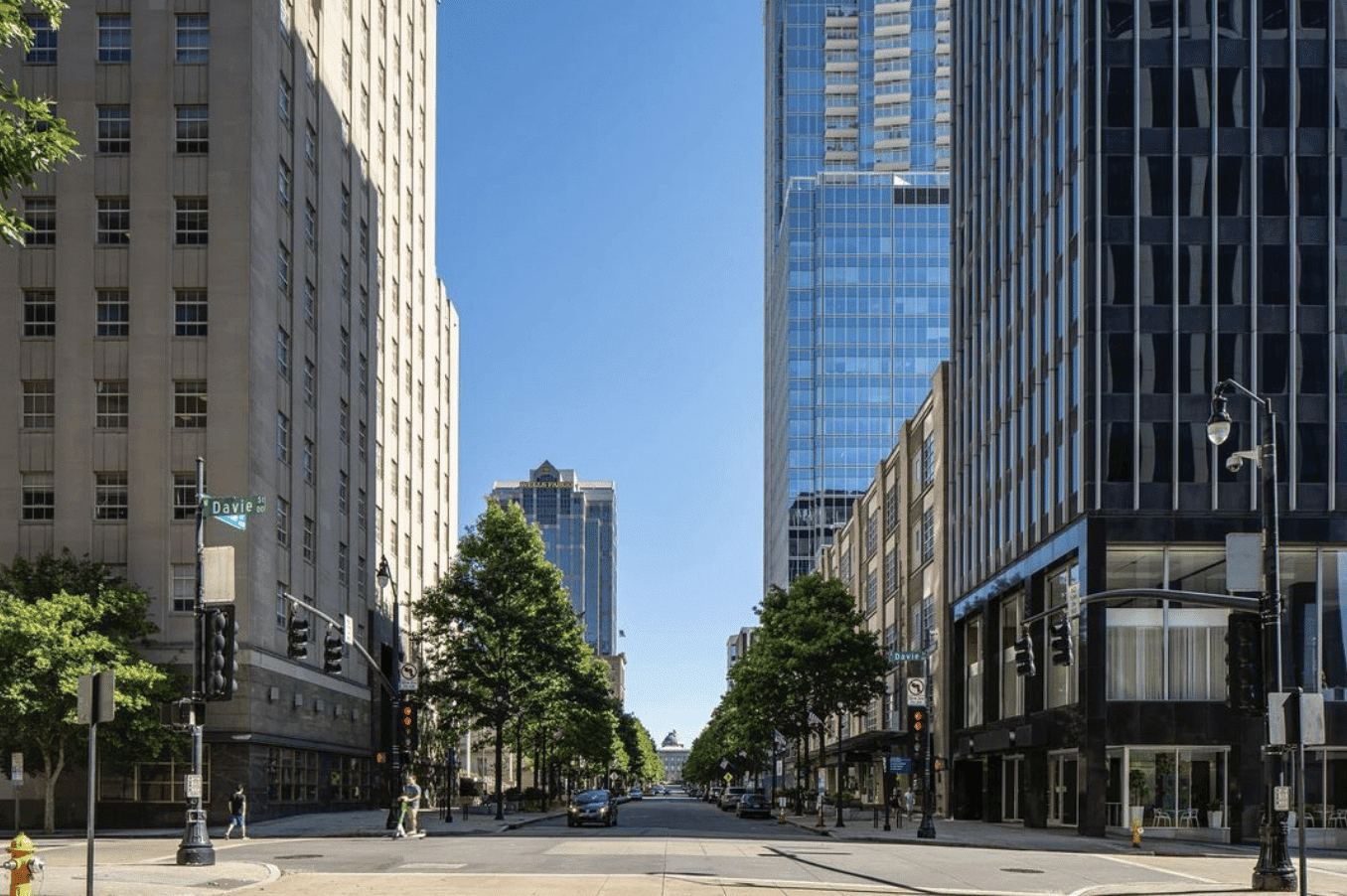
ICYMI, Raleigh is getting its first social district (!). And Raleigh is super thrilled about it—a game-changer for the area and just the first step in making Fayetteville Street more attractive to bars, restaurants and consumers, and bringing more foot traffic to the area. The pilot program gives the city a chance to gather feedback and assess what is and isn’t working—and could lead to additional social districts throughout the city. But beyond all the brouhaha are a slew of lingering questions about the rules, what areas are included in the district, etc., so we talked to Raleigh City Council Member Jonathan Melton to get to the bottom of it all. Read on for what you need to know. Then, we’ll see you on the streets—designated to-go cup in hand, natch—starting Aug. 15!
Specified areas where “people just walk around with a glass of wine or a beer, going into a store, sitting on a bench, etc.,” says Melton.
Fayetteville Street District—specifically Fayetteville Street from Capitol Building to Duke Energy Center, including Red Hat Amphitheater and City Market (borders = South, Blount, Morgan, Dawson), plus Warehouse District from Dawson to Union Station.

Several bars and restaurants are included in the designated social district, as well as Red Hat Amphitheater and Duke Energy Center. “An idea for the social district is that folks could go to dinner before a show, get a drink to go, and then walk down to the venue and finish the beverage before entering inside,” says Melton.
Moore Square and Nash Square are NOT included in the social district at this time, based on city staff’s recommendation, says Melton. “I think they preferred we take an incremental approach to the social district and avoid areas that might be conducive to folks trying to bring their own alcohol into the social district, which isn’t allowed under the state law,” he expands. “Moore Square also already has its own ABC permit associated with the Square Burger on site. It’s a pilot program though, so we will continue to gather feedback and examine the boundaries over the next few months.” According to Melton, the city would have to construct a barrier to separate Square Burger from the rest of the park due to social district rules and the permit.