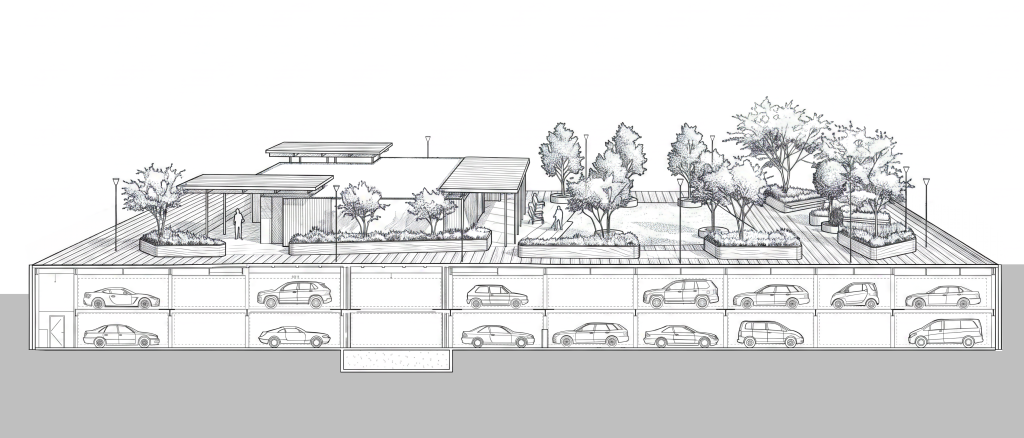
Amid DTR’s parking debates, a robotic garage is taking shape.
With Downtown parking prices and policies sparking plenty of recent debate, Raleigh may have found a new way to take the headache out of finding a spot: robots. Enter North Carolina’s first underground robotic parking garage, now under construction as part of phase 2 of mixed-use development City Gateway.
Consider this: Urban drivers spend an average of 17 hours a year searching for parking. Talk about a time suck. Slated to open in Q1 2027, the two-level facility aims to give drivers some of that time back while accommodating a whopping 228 vehicles—twice the capacity of a conventional deck of the same size—minus the endless circling, tight turns and parking-deck headaches. Bonus: Lower operating costs, 24/7/365 remote monitoring, and less worry about someone dinging your door.
Developed in partnership with AUTOParkit, the fully automated system is designed to consume up to 60% less energy than conventional parking garages. And with no need for ramps, drive aisles or pedestrian walkways, its smaller footprint makes room for retail, restaurants and City Gateway’s central public plaza—built atop the garage at sidewalk level along Kindley Street.
Rendering by SFLA
So how does it work? You pull into one of two loading bays, kick off your parking session and step out. From there, the system takes the wheel—literally—no circling a nine-story deck or uneasy parking maneuvers required. Instead, a lift whisks your vehicle down into the storage area, where it’s shuttled into its designated stall and tucked away. Advanced reservation capabilities are being looked into as well, in an attempt to “fit with the elevated parking experience we are targeting, especially associated with scheduled special events,” says SFLA Development Manager Asher McGlothlin.
The deck will accommodate nearly all cars, SUVs and pickups, with the exception of oversize vehicles. And EV drivers get an added perk: All 228 spaces are designed to accommodate charging. Plug it in and the system charges it up before sliding it into storage. When you want your car back, simply request it via the app for an average retrieval time of three minutes from request to loading-bay delivery.
While pricing is still TBD, developers say the goal is to stay competitive with other Downtown decks. The technology does support dynamic pricing used in other automated decks nationwide, but McGlothlin says they do not currently plan to use that capability. A peek at automated garages in other cities offers a glimpse of what Raleigh drivers might expect. In West Hollywood and Hoboken, New Jersey, rates are competitive with nearby public decks—if not slightly easier on the wallet. But how exactly pricing will break down in Raleigh remains to be seen—though City Gateway residents will be offered monthly permit parking at market rates.
The real test will come when everyone wants their keys at once. McGlothlin says the system can retrieve multiple vehicles simultaneously, and users can request their car ahead of time—with on-site ambassadors helping manage the flow during peak periods and special events. And should the robots go on strike, a backup generator keeps the deck operational during power outages.
There’s a sustainability play here to boot. Transportation accounts for ~52% of Raleigh’s greenhouse gas emissions, according to the city’s Community Climate Action Plan. And McGlothlin hopes the garage’s EV charging infrastructure will encourage more drivers to make the switch.
“Automation was chosen early in design because of what it lets us do on this site,” says SFLA Principal Barry Buckman, allowing them to showcase innovative ways of tackling climate issues, and also some of the development issues seen in an urban landscape.
And with driverless taxis already making moves in NC, the garage is designed with the future in mind—though, despite the ever-churning Waymo rumor mill, there’s still no planned partnership in place. “We’ve been in contact with Waymo and some other auto-taxi-type services to make sure that what we put in place now can accommodate them in the future, if that’s a direction they want to go,” says Buckman.
Ultimately, it’s a big step for the future of a city where parking is almost always top of mind. As Raleigh’s first fully automated parking facility, people will be paying for a different kind of experience, says McGlothlin. Will robots solve Downtown’s parking headaches? Only time will tell. But one thing’s certain: Raleigh’s parking game is about to reach a whole new (underground) level.
The Oakline could turn the journey between Downtown and Dix Park into a destination of its own.
From trolleys to aerial cable cars, Raleigh’s seen a wide range of ideas to link Downtown with Dix Park. Now, one pitch is outshining the rest: The Oakline—an elevated path for pedestrians and bikers—that could finally bridge the gap.
The two destinations sit a mere three-quarters of a mile from each other—basically a jaunt from Capitol Square to the Warehouse District—yet they feel miles apart. That’s largely thanks to uneven terrain, multilane roads, railroad crossings and sprawling intersections.
“We’ve got a 300-acre park, and we’ve got a vibrant Downtown—becoming more vibrant by the day,” Wake County Open Space & Parks Advisory Committee board member Sig Hutchinson tells RM. “The barriers include three of the busiest streets in the city, a railroad line and 50 feet of elevation.”
SfL+a Architects, Surface 678 and Preston Montague
Ideas for linking Downtown to Dix with a safer, bolder and more accessible connector have been floated for years—gondolas, trolleys, BRT and so on. The Oakline could overcome those obstacles and be the path to a solution.
Proposed by SfL+a Architects, the group behind the mixed-use City Gateway project coming out of the ground at the corner of McDowell Street and Martin Luther King Jr. Boulevard—alongside Surface 678 and Preston Montague Studio—the elevated path would stay relatively level the entire route and hurdle the uneven topography between the two crucial Oak City attractions.
And, most significantly, The Oakline would be an attraction in itself. The proposed plan wouldn’t just provide a safer connection, but would allow Dix Park to spill into Downtown—meaning getting to the park will feel like being at the park. Public art, local history, intentional overlooks and lush canopy trees would extend that destination vibe—with shade to boot.
As proposed, The Oakline would begin at the Martin Marietta Center for Performing Arts, jump the rail line and continue through City Gateway before hurdling MLK Jr. Boulevard, McDowell and South Saunders streets, ultimately leading to Dix in a 16-minute jaunt—and for those on wheels, six.
“One of the really strong suits of the current pathway is it’s half in private developments and half in the public realm,” says SfL+a Architects’ Barry Buckman. Unlike some big pie-in-the-sky infrastructure idea, much of the route already runs through compatible private projects like Salisbury Square or Rockway, or falls into NCDOT Right of Way—meaning pieces of The Oakline could piggyback on projects already underway, including BRT, adds Surface 678 landscape architect Charles Bradley.
City Gateway, Salisbury Square and Rockway could also help build out portions along private property, notes Buckman.
SfL+a Architects, Surface 678 and Preston Montague
The developments the route will snake through are not only compatible, but complementary, adds Buckman, nodding to its connections beyond Dix and Downtown, with easy access to neighboring F&B concepts, retail and gathering spots upping the area’s overall walkability.
But none of the hype—or hope—means The Oakline is a done deal. City officials, project architects and Downtown Raleigh Alliance hope to collectively push the project forward this fall to nail down design, cost and potential funding sources.
“There’s financial stacks that can make this a reality,” maintains Hutchinson, pointing to transportation funding. “Paint a picture of what people want, and they’re going to figure out a way to pay for it.”
Early enthusiasm is high. “When I saw this proposal, [I thought] they cracked the code,” says City Council member Mitchell Silver. “They actually figured it out.”
And the ambition extends beyond cracking Raleigh’s decades-old connectivity problem. “It will really become an iconic gateway into Downtown,” says Bradley. “There will be trees marching across the road, and there’s something really magical when you’re driving under oak trees into the City of Oaks.”
More than a route from Downtown to Dix, The Oakline would become Raleigh’s new front—and a calling card for the City of Oaks.
Another Path A path from DTR to Dix is already approved and in the works: The Chavis-Dix Strollway, a cultural trail linking Dix Park and John Chavis Memorial Park while celebrating historically Black neighborhoods in the area. The two paths follow different routes—the strollway will run along South Street through South Saunders Street.
“You can’t have enough good connections to get to Dix Park,” says Buckman. “There will be some amazing work celebrating the history of the Fourth Ward community throughout the Strollway, and we strive to have The Oakline celebrate that history as well.” The Chavis-Dix Strollway project is in planning stages and is backed by $3 million in federal funding secured by Congresswoman Deborah Ross.