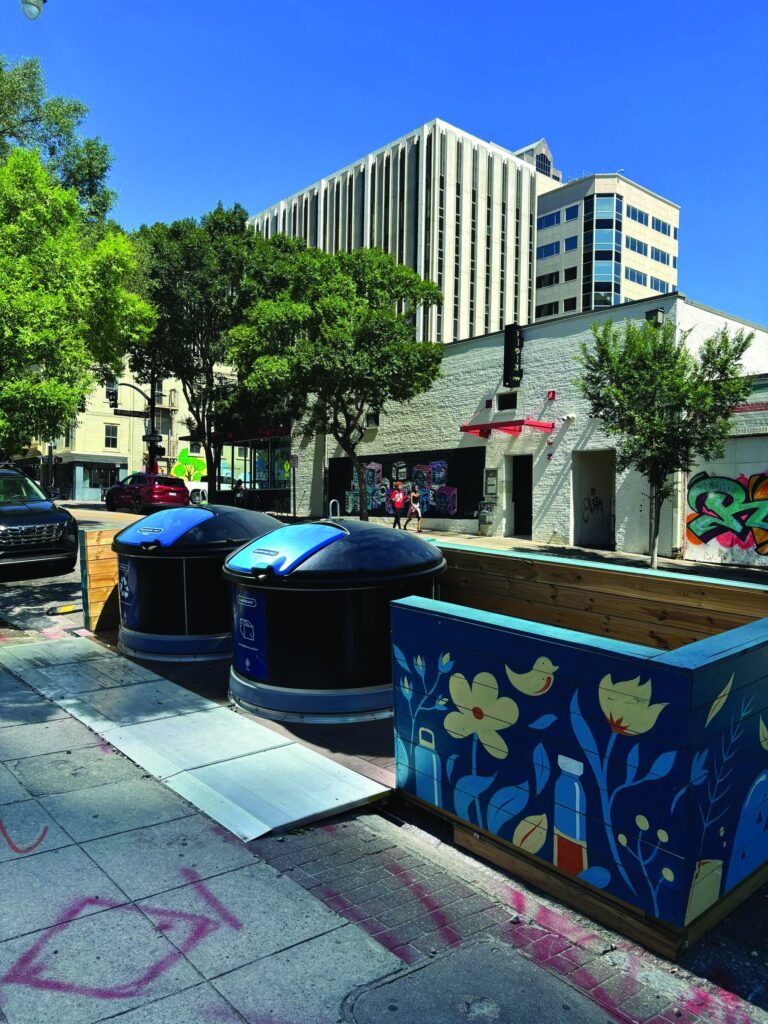
Raleigh may not look like the morning after a Shameless block party—but it’s not exactly spotless.
With the 20K residents living within a mile of DTR’s center—and thousands more commuting in on the daily—the city’s growing core generates plenty of foot traffic. And, inevitably, plenty of waste. So what’s being done about the pileup?
To many Raleighites, trash troubles feel more visible than ever. In 2018, residents reported 66.3% satisfaction with Downtown’s cleanliness. But by 2024, that number had dropped to just 56%.
Not everyone sees a problem. One Downtown business owner says Raleigh still feels squeaky clean compared to other major cities, noting that even graffiti rarely sticks around for long. Others disagree. DTR resident Bekah Gregory says she routinely spots trash piling up at key gateways like Capital and New Bern, as well as around public transit-heavy corridors like Blount and Wilmington streets and Moore Square.
For Moore Square dweller Christian Lockamy, this reality plays out daily: He’s watched people bypass trash cans and “just kind of trash the place.” The situation grew so grimy around an abandoned business that he submitted a cleanup proposal to Downtown Raleigh Alliance.
Assistant City Manager Evan Raleigh says he’s heard the mixed reviews—especially about those high-traffic areas near the bus station—and Raleigh isn’t standing idly by. Seven days a week, Raleigh’s Downtown Clean Team is on the ground, scouring for litter, grime, graffiti and more.
Starting at 6:30am, crews sweep areas like the Capital District, Glenwood South and the Warehouse District, then circle back for a second pass halfway through the day. Their focus is primarily on public sidewalks, plazas, tree pits and trash receptacles—really anything excluding trash collection (which is up to Solid Waste Services), says Raleigh.
In 2024 alone, the Clean Team collected 5,500+ bags of litter covering ~20K miles, says Public Information Officer Julia Milstead. Still, the task isn’t just about manpower.
“You have to make sure you’re staying on top of changes in behavior, patterns and trash locations,” says Raleigh. “Our team does a great job of that.”
The city is also tweaking its TRAC bin pilot program. Instead of freestanding cans cluttering sidewalks, new 95-gallon bins will soon be tucked into artistic enclosures set back from the street. Other efforts—like the ongoing beautification efforts along Fayetteville Street—are also in the pipeline.
But Raleigh stresses keeping Downtown clean can’t fall to the local gov alone. Enter the Great Raleigh Cleanup—founded in 2020 by Preston Ross III, the volunteer-driven org formed after he determined the litter had escalated into a public nuisance. “I very quickly recognized that it was too big for me to do alone,” he recalls. “So we opened it up to volunteers, and it really took off.”
Adds Ross: “If you’re complaining, you better be doing something.” Whether that means reporting cleanliness concerns, joining a cleanup crew or simply picking up after yourself, keeping Raleigh clean takes everyone.
As momentum builds on New Bern Avenue with Raleigh’s first Bus Rapid Transit (BRT) line and an influx of recently bowed businesses, a new development from the City of Raleigh will be a huge game changer for the area.
Over a year after the city bought the old DMV HQ on New Bern Avenue in Southeast Raleigh, city staff recently completed an intensive public engagement process for the future of the 5.88-acre property—with community ideas including affordable housing, indoor and outdoor community gathering spaces, the incorporation of local food (whether a commissary kitchen, co-op or food hall), retail, public art and installations that incorporate the history of the area, and overall accessibility.
“This site can hopefully become a hub for the surrounding neighborhood,” emphasizes City of Raleigh Deputy Director of Planning & Development and Urban Projects Ken Bowers—while acting as a connector to DTR as it continues to push out from the city’s core.
The DMV site in particular was attractive to the city for this project due to its location on Raleigh’s first Bus Rapid Transit line. “We wanted to make sure lower-income households were able to access the improved transit that’s going to be provided,” says Bowers. Not to mention “this part of East Raleigh has historically been affordable because market rates, sales prices and rents were lower than other parts of the city.”
Now, the site is undergoing a market and design study to gauge what’s possible: how much can actually be built, what types of projects make financial and physical sense, and where rents might land. That work wraps in November, after which the city will seek development proposals—aiming to pick a developer by Q3 2026. Bowers adds the current four-story zoning will likely have to change to meet community demands.
“The city doesn’t often have a large site like this that we can reposition to redevelop to achieve some community priorities and policy goals,” he explains. “If this is successful, we hope it can be a model for sites elsewhere in the city.”
Carolina Coops is hatching new horizons with its sustainable chicken coops.
The only thing better than fresh eggs is farm fresh eggs in your backyard—and Carolina Coops is bringing that luxury to city dwellers.
The Creedmoor-based coop biz was hatched by founder Matt DuBoise, who combined his love of construction and a grade-school project involving the care of chickens to offer custom-built and design-orientated (think Joanna Gaines-esque) coops—and his brand has since gone global.
Each coop is crafted to fit the specific needs of both the flock and the owner—especially crucial for those living in city limits with confined space. And, yes, the City of Raleigh *does* allow residents to house chickens, dependent on land mass.
“That is a big deal because customers don’t always know where the best place is for a coop,” says Kelly Alley, the brand’s PR and marketing specialist. “Coops have to be completely level in order to ensure the integrity stays intact.”
Alley adds that any coop will work for a first-time flock, but notes many customers need a bigger coop than they may think because of “chicken math.”
“It’s a real thing,” says Alley. “Which coop you choose is going to depend on how many chickens you have. Everyone says they’ll start with a few—and next thing you know, they have eight because they can’t stop getting them.”
And first-timers shouldn’t shy away. “Anyone can have chickens. It’s incredibly easy—and that’s why we’re doing everything we can to educate.” Talk about flocking together. carolinacoops.com
Dix Park is a destination meant to be biked—here, tips on how + where to explore.
If you’re not biking to Dix Park, you’re doing it wrong. And man-about-town Nick Neptune agrees. As director of outreach for the Dix Park Conservancy, board chair and president of Oaks & Spokes Raleigh’s bicycling and sustainable transportation advocacy nonprofit), and commissioner and vice chairman of the City of Raleigh’s Bicycle and Pedestrian Advisory Commission, Neptune’s biggest passions are Dix Park and biking. He also works with the City of Raleigh, donors and volunteers to ensure Dix continues to thrive as a remarkable space for all, no matter how you get there.
Here, the passionate pedaler merges his two callings, showcasing Dix Park as a biking destination and providing a plethora of reasons to roll up to the 308-acre campus on DTR’s western edge.
How accessible is Dix Park by bike from all directions?
Dix Park currently benefits from connectivity around its northern and eastern edges courtesy of Raleigh’s Capital Area Greenway system, and, specifically, the Rocky Branch Trail—which has access to Pullen Park, Boylan Heights and a number of shops and spaces along Downtown Raleigh’s southernmost edge. To the west, Dix Park is buffered by NC State’s Centennial Campus, including the Centennial Bikeway Connector running along the perimeter.
At the southernmost edge along Lake Wheeler Road—from the State Farmers Market to the intersection at South Saunders—the city is leading a massive improvement project including the addition of sidewalks, shared paths and bike-only facilities. Various other features like roundabouts and raised medians will help slow vehicular traffic, with construction slated to begin in spring 2025.
Fave pit stops on these different routes?
Between Boylan Heights and the southernmost edge of Downtown Raleigh, favorites include:
Rebus Works for cafe selects and grocery options 🛒
Tell us about the NCMA to Dix Park bike connection and why it’s important?
It’s just over 5 miles and about a 35-minute bike ride spanning Rocky Branch Greenway and Reedy Creek Trail. NTM biking is affordable, healthy and sustainable, thus, ensuring and improving bicycle connectivity between NCMA and Dix Park is as much about reinvesting in our collective civic health and social cohesion as it is about simply sharing the joys, pleasures and benefits of art and the natural environment.
Nick Neptune
Any updates on the connection between Chavis Park and Dix Park?
The Chavis-Dix Strollway, a vastly improved multimodal, people-oriented corridor connecting two significant Raleigh landscapes, is also intended to contribute to a citywide bike system as a safe connection for cyclists traveling east to west through this area along the southern edge of Downtown.
The project design will be influenced by a current study of the overall mobility and active transportation networks of Downtown Raleigh, along with the planned expansion of the Raleigh Convention Center. Following the final recommendations of the Downtown Mobility Study (expected spring 2025), more progress can be anticipated.
Note: Anyone interested in participating in Raleigh Transportation’s Downtown Mobility Study should join the first touchpoint and public engagement session May 29 at Raleigh Union Station from 4–7pm.
How do you recommend first-timers spend their initial visit to Dix Park?
Starting in June, stop by the Gatekeeper’s Cottage to get oriented via maps, program guides and helpful staff. The cottage is also one of three historic buildings on campus undergoing a $5 million preservation and restoration project being led by the Dix Park Conservancy, in partnership with the City of Raleigh, with financial support from the State Employees’ Credit Union and Foundation.
The Chapel (open weekends; features an ornate mural in the lobby illustrating the landscape’s past, present and future by NC artist Christopher Holt; public restrooms available)
Many longtime visitors to Dix Park continue to be surprised by our Hammock Groves tucked away in the trees in three serene locations across the park. Another little-known treat for veteran visitors would be the celebrated garden in the back of The Chapel. Maintained by a dedicated group of volunteers, the garden has been a beloved and calming space for many since its original planting in the late 1950s. To boot, The Dix Park Conservancy, in partnership with the City of Raleigh, is spearheading an update and renovation later this year to transform this space into a fully modern Healing Garden.
Through this contract, Darkhouse will conduct an analysis of the current state of the fire department, as well as develop a master plan to improve apparatus and response times, with the goal to forecast trends as the city expands—not only in terms of boundaries, but as the population density in certain areas increases.
“We want to have a third party come in and evaluate the fire department as it stands right now,” emphasizes RFD Division Chief Patrick Marks. “We want to make sure we are exercising the best practice on our deployment model—[with the] right fire stations and apparatus in the right places to do the best we can with what we have.”
Visualizing the fire safety situation, the city developed maps using analysis software to highlight areas on par with the minimum qualifications met in green, and areas lacking in apparatus and staffing marked in orange and red. (Note: Every district has at least one red area needing attention—namely Six Forks Road, along with Northwest and Southeast Raleigh).
Analysis is slated to wrap up within at least a year in hopes of having City Council approve the report before next year’s city budget is finalized to then implement those recommendations.