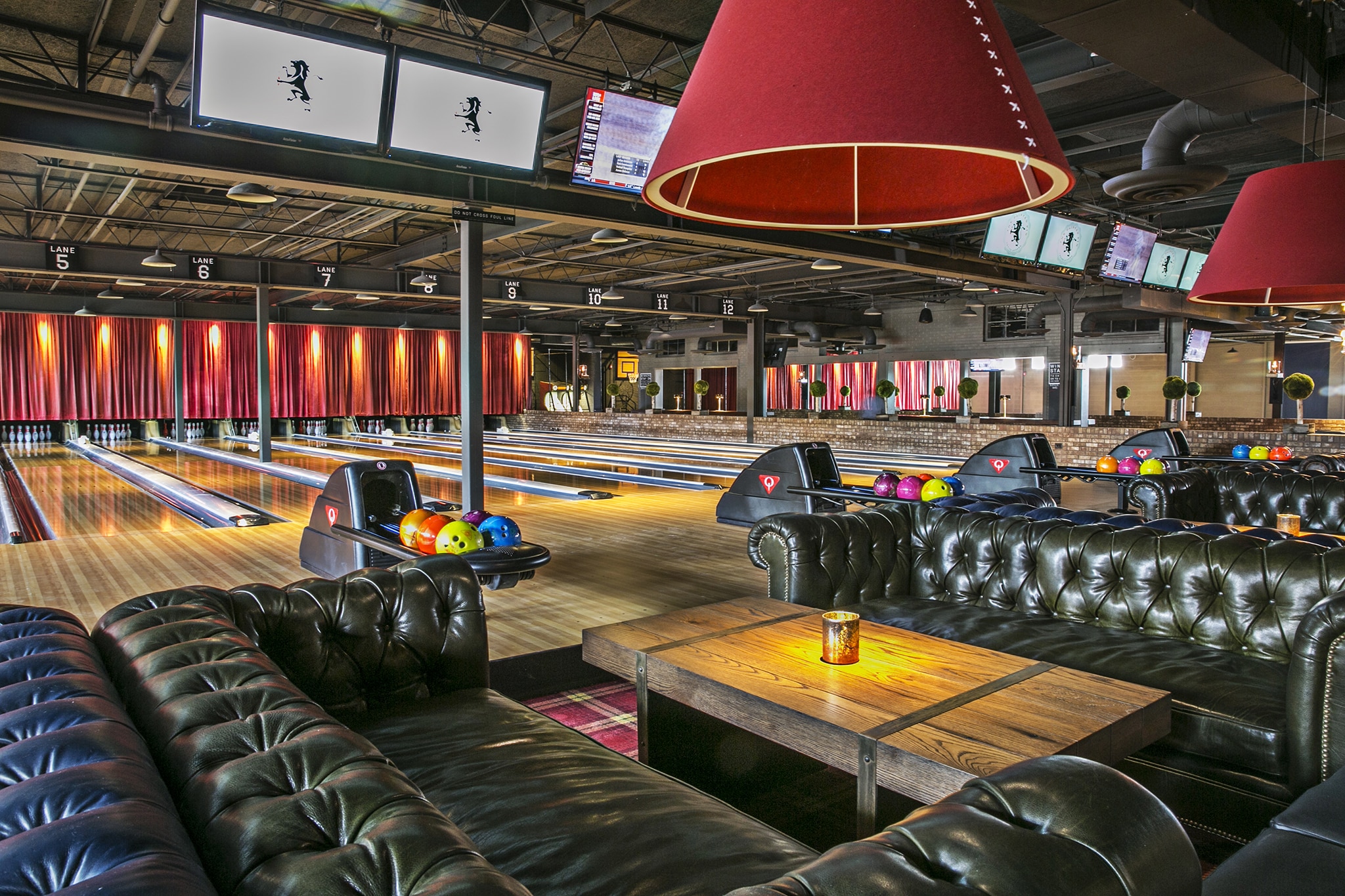
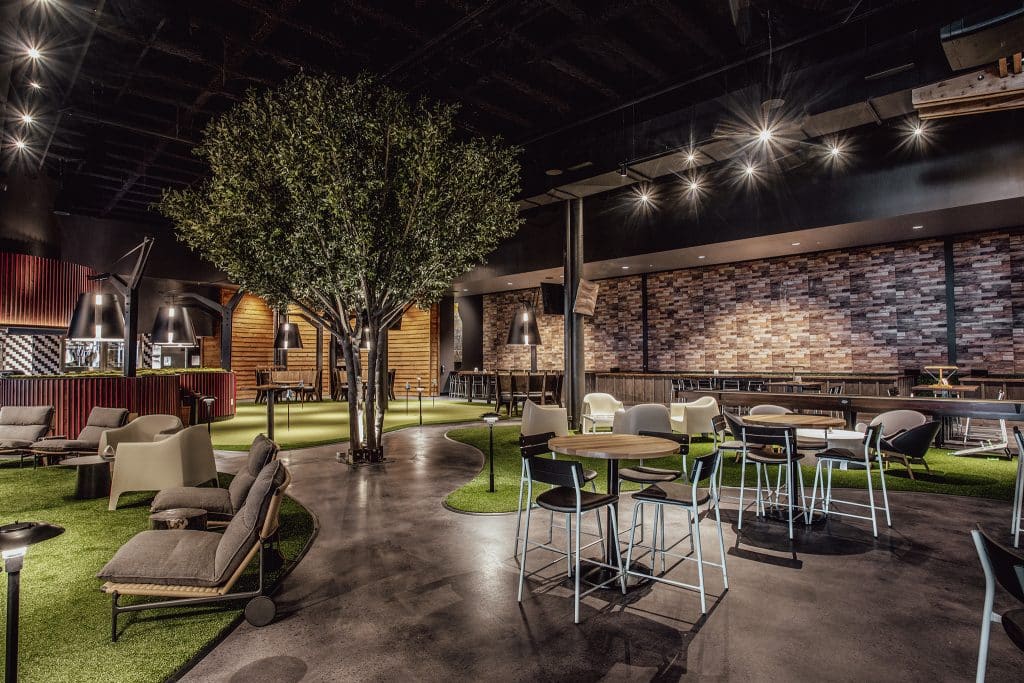
Step aside, eatertainment—sportstainment is here to play. The blend of sports and entertainment is surging in popularity, with a host of athletic activity concepts taking root in Raleigh.
And these sporty spots are ingraining themselves in the city’s existing culture and nightlife. Take Smash, a swanky new pingpong bar by LM Restaurants anticipated to open in the now-shuttered Carolina Ale House location on Glenwood South this summer. Set to showcase an “unparalleled nightlife experience,” per LM Restaurants, the club will serve up cocktails, shareable bites and entrees with a side of friendly competition—ideal for those who love a more interactive night out.
While Smash will be the city’s premiere pingpong club, several competitive socializing concepts have already dipped a toe in the Raleigh market. Hop Shots Mini Golf changed the game after bowing on Glenwood South in 2024, giving Raleighites their first taste of competition during a night out or barhop. Also testing the waters across the city—and riding the coattails of the increasingly popular pickleball wave—are popular Pin Point, the largest and first combined indoor pickleball and golf concept in the Southeast, and soon-to-bow Swing, which will deliver an “all-you-can-play destination” (think tennis, pickleball, padel and pingpong), plus plates and pours.
Pin Point CEO Garrett Leatham credits this local sporty surge to the popularity of a healthy lifestyle paired with a push to get off the screen and socialize. “It forces people to put their phone down, come out of their shell and break down barriers with sports we all love,” maintains the Raleighite.
To wit, the golf and pickleball club just broke ground on its second space in North Myrtle Beach, and despite drastically different demographics, both Raleigh and North Myrtle are anticipated to stay swinging—but for different reasons. “North Myrtle will be more entertainment-based, with more families spending a fun night with their kids,” emphasizes Leatham. “Raleigh is more a mix of entertainment- and membership-based.”
While locals love a boozy playground, many are leveraging sportstainment concepts for a sweat over swigs. Where eatertainment sees sips and snacks with a side of casual gaming, sportstainment serves a full-blown competition at any time of day with an optional bev or bite to boot.
From top: From bowling to pickleball, ATL’s Painted Pin and Painted Pickle are proof that sportstainment is more than a trend—it’s a lifestyle.
And Raleigh isn’t the first to capitalize on the trend—cities like Atlanta jumped on the bandwagon long ago, with hot spots cropping up citywide. ATL-based Painted Hospitality President & CEO Justin Amick has launched four separate sportstainment joints boasting bowling, duckpin bowling, pickleball, and a “park” with pingpong and games. Apart from ATL’s ever-increasing passion for paddle sports, Amick emphasizes the importance of sportstainment concepts—or “compeateries” as he calls them—planting roots near an abundance of large corporations.
“There are so many large gathering opportunities… like corporate team-building events and adult birthday parties centered around pickleball—it’s a huge part of making that model work financially,” he says. “It really helps fill those off-peak hours of business and those early days where your courts need to be activated in full.”
Even with multiple sportstainment concepts incoming, this activation of competition can still be glimpsed at Raleigh bars that don’t build out courts or base a whole theme on it—think the punching machine at Teets, the board games at Stella’s and the oversize Jenga tower you hear clatter to the floor at almost every bar Downtown. The bottom line: Sitting still is out, and living, playing and socializing are so in.
Luxury resident event service company SocialHub expands into the Triangle.
Even those who live in a 250+ unit apartment complex can sometimes get lonely—especially in our post-pandemic world. And it’s that growing epidemic that David and Monica Hickman have set out to tackle with SocialHub.
Launched in Charlotte in 2021—aka the “the perfect time,” according to Monica—the luxe event services venture aims to facilitate meaningful connections among apartment residents via unique and interactive experiences to drive resident engagement. While these intimate residential communities offer ample opportunities for connections, many people struggle to take that first step.
“Having been on the vendor side of multifamily properties and providing community-building services for almost a decade,” explains Monica, “we realized how much we loved helping people build connections and bridging the gap between residents and their new community.”
Previous rental-complex residents themselves, the duo has also experienced the positive impact community can have on overall living experience. “We made some of our best friends during that time,” she notes.
Photo courtesy of SocialHub
Photo courtesy of SocialHub
Photo courtesy of SocialHub
To facilitate that feel, SocialHub’s events and games run the gamut from karaoke and trivia to crafts, cocktail hours and pool parties. More elaborate ops include the likes of a Master’s “par-tee” complete with putting greens, tasty themed bites and John Daly cocktails to succulent terrarium-building for Earth Day and a taco and margarita bar for Cinco de Mayo. “We always like to give management companies options for holidays or special events,” shares Monica. “The companies can choose from a packet of events and decide what they feel would be the best fit for their particular community.”
By serving up relaxed, stress-free functions, the interactive hangs encourage residents to mix, mingle and ideally build lasting connections—and the response has been overwhelmingly positive. Partnering with some of the largest property management companies in the country (think Greystar and Willow Bridge), the social platform has hosted events in over 120 apartment complexes in Charlotte, Charleston—and now the Triangle.
Raleighites can experience socials at various local complexes, including 927 West Morgan, Level at 401, Mira, Elan City Center and more. “We’ve heard so many amazing stories about people building connections and making friends at our events,” shares Monica, “and to play just a small role in that has been so fulfilling for us.” After all, at the end of the day, a stranger is just a friend you haven’t met yet. socialhubcompany.com
The newest generation is here, and the race to understand them starts now. Born between 2025 and 2039, the newly debuted Generation Beta will make up 16% of the global population by 2035, the majority of whom will live to see the 22nd century. And—cue the existential crisis—these newbies are the offspring of on-the-cusp millennials and Gen Z.
Born to the first parents to come of age with social media, Gen Beta will be the first to live with AI from the jump. Coming online, so to speak, in the aftermath of the universe-meets-metaverse collision, they’ll never know a life where the digital and physical aren’t seamlessly intertwined. Unlike generations past, AI and hyper-realistic virtual realities will be fully embedded in their world—from early childhood education and entertainment to health care, careers and beyond.
As we know, the relationship between children and technology is hotly debated. Even before Gen Beta’s birth, tech has played a controversial but prominent role in parenting. Now, having grown up with tech themselves—and in not-so-subtle rebellion to the Gen Alpha “iPad kids” screen-deep start—Beta’s parents are expected to flip the script, with Gen Z parents placing a stronger emphasis on limiting screen time than generations before them.
How it will play out is yet to be seen, but many Zoomers, burned by the digital downsides of their own tech-heavy upbringings, have (ironically) taken to social media to vow against posting their children to their own socials or selling out to screens to control them—even more ironic given the tech nod embedded in “beta.” As documented on TikTok, Gen Z has zero interest in parenting the kind of child who throws a screaming-fit in a restaurant because their iPad battery hit zero.
Social analyst and demographer Mark McCrindle—famed for naming the past three gens—backs up the likelihood of an antiscreen sentiment from the most tech-savvy generation of parents yet. “Gen Z sees the benefits of technology and screen time,” he emphasizes. “But, equally, they see the downsides of it and are pushing back on technology and the age at which their children access and engage with it.” Add to that, Beta will also be the first born entirely postpandemic, so when they learn about COVID in school, it won’t even necessarily be taught as a contemporary event.
Taken together, and despite their parents’ pledges, Gen Beta can’t not live in a tech-drenched AI-riddled postpandemic world. As such, Beta babies are predicted to have careers requiring far less face-to-face interaction. What’s more, 86% of Americans think many of these careers are yet to be invented.
To be fair, every generation tends to get a bad rap once they become public nuisances, hauling sticky iPads with them everywhere—and certainly once they enter the workforce. But Generation Beta’s moniker alone is already considered an insult. While the name simply follows the structure of the Greek alphabet, pop culture links “beta” to weakness and submission—especially following “alpha.”
And if this new gen are truly “beta,” it won’t bode well for their ability to tackle the many hurdles ahead. Amid climate changes, global population shifts, increasingly frequent disasters and rapid urbanization, McCrindle predicts sustainability will be “not just a preference, but an expectation” as they are brought up in a world grappling with major societal and environmental challenges.
While Betas have their parents to thank for pushing sustainability to the forefront, they will take on a “sink or sustainably swim” mindset, thanks to this perfect storm they are set to inherit from the world. That said, researchers have their fingers crossed these societal roadblocks will result in a generation of globally minded and community-focused individuals. And the rest of us should cross our fingers as well—as the majority of Beta sets foot into society and into the next century, the fate of this changing world will rest on their shoulders.
PostScript Outreach enhances the lives of the disconnected through dinner and crafts.
Loneliness has long been a public health crisis—even before the pandemic made it apparent. And clearly a stigma still surrounds addressing feelings of social isolation.
Enter PostScript Outreach. Founded by Marsha Smitley with an aim to shutter out loneliness across all ages and demographics, the local nonprofit is building community by bridging the gap with its smash-hit program The Connection—aka weekly Thursday dinners boasting good food, connection-driven conversation led by a speaker and a creative dance, game or craft—for residents living at senior affordable housing complex Sir Walter Apartments.
Kindling friendships between those residing at Sir Walter has been no easy feat, especially because of a language barrier between English-speaking and Mandarin Chinese-speaking residents. Inspired to better connect with their neighbors, many Chinese residents wanted to hurdle this obstacle. PostScript answered the call with the introduction of ongoing English language classes and translation led by two volunteers.
Continuing to inspire since its launch, The Connection has expanded to kindle friendships in other spaces where connections can be difficult to cultivate—specifically for international students at NC State. Students initially volunteered with PostScript at their summer program, Staycation, chatting and connecting with the residents at Sir Walter. Some Mandarin Chinese-speaking students were even able to speak freely with the Mandarin Chinese-speaking residents—some having the first conversation in their native language they’ve had in weeks.
Once class began and schedules began to fill up, PostScript launched The Connection on-campus at NC State to continue to engage with students and other young professionals. Now the volunteers-turned-participants craft and kindle conversation together once a month, with the aim to lessen the loneliness many young people experience during formative college years.
Designed to build relationships and assure the dignity and worth, the get-togethers are about more than food and fun, explains Smitley, also the program’s executive director. “We are here because we have experienced loneliness, and we know how it feels.”
Over meals and crafts, the once-distant neighbors and students have grown closer, meeting to share “a little piece of who they are.” Conversations engage the participants, covering everything from physical health effects of loneliness to the ways we internalize stereotypes.
Ultimately, anyone can feel lonely, and it can easily go unnoticed by others. “It comes up in your body, in your senses,” says Smitley. “Loneliness is just a feeling that says, ‘I need to be connected to somebody.’” But with efforts like this one, connections can be forged. psoutreach.org
WEB EXCLUSIVE ICYMI, Gov. Roy Cooper eased even more COVID restrictions last week thanks to the increasing number of adults getting vaccinated across the state (about half of NC adults are partially vaccinated, and almost 40% are fully vaccinated) and the reduced risk of transmission of COVID-19 in outdoor settings.
Cooper still anticipates lifting mandatory capacity, mass gathering and social distancing restrictions by June 1, and as soon as at least two-thirds of adults are vaccinated with at least one dose, he’ll ease restrictions even further.
“North Carolina is able to continue moving forward thanks to people rolling up their sleeves to get their vaccine,” Cooper tweeted April 29. “The more we encourage our friends and family members to get vaccinated, the sooner we can put this virus behind us. We’ve already shown that North Carolinians are made of tough stuff. Together we are going to get through this.”
Here are the current restrictions, which went into effect April 30 and will remain in effect until at least June 1.
Masks are no longer mandated outdoors (masks are still required in indoor public places, however, until at least two-thirds of NC adults are vaccinated).
Mass gathering limits have increased to 100 people indoors and 200 outdoors. Larger venues can apply to get approval for higher capacity on a case-by-case basis.
Social distancing and capacity limits for certain businesses are still in place:
Museums and aquariums, retail businesses, salons, personal care and grooming businesses, and tattoo parlors can operate at 100% capacity (but are still subject to social distancing).
Restaurants, breweries, wineries, distilleries, gyms and other fitness centers and studios, pools, and amusement parks may operate at 75% capacity indoors and 100% outdoors.
Bars, meeting and reception spaces, lounges, nightclubs, auditoriums, sports arenas and fields, movie theaters, and gaming facilities may operate at 50% capacity.