Vaccination recommendations have been a long-standing debate, and the chatter has only escalated since former presidential candidate and lawyer Robert F. Kennedy Jr. was sworn in as U.S. Secretary of Health and Human Services.
Now, the conversation is spiking again after the Centers for Disease Control and Prevention abruptly changed the childhood immunization schedule, effectively reducing the number of recommended shots for children from 17 shots to just 11.
“President Trump directed us to examine how other developed nations protect their children and to take action if they are doing better,” explained the Secretary. Certain “peer nations,” such as Denmark, recommend less vaccines, and the U.S. is following suit to “strengthen transparency and informed consent.”
The new schedule no longer recommends vaccines for rotavirus, hepatitis A and hepatitis B, meningitis, RSV (respiratory syncytial virus), COVID, and the flu for every child. Ultimately, state governments will decide which vaccines are required for school entry, but the federal gov still yields significant influence over policy and access.
“No family will lose access,” Administrator for the Centers for Medicare & Medicaid Services and television personality Dr. Oz said. “This framework empowers parents and physicians to make individualized decisions based on risk while maintaining strong protection against serious disease.”
Regardless of where your trust in the department stands, the American Medical Association still suggests chatting with your physician to decide what is the best course of action for you and your child.
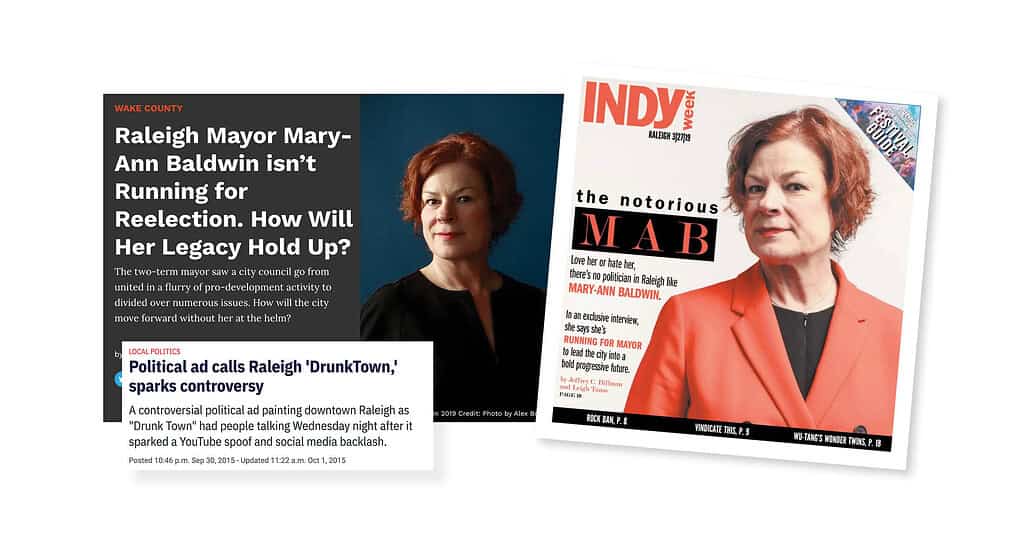
Whatever you may think of Mayor Mary-Ann Baldwin, you likely think something—strongly. We look back at the “notorious” city leader’s provocative tenure.
Love her or loathe her, the one thing everyone can agree on is Mary-Ann Baldwin has struck a chord in Raleigh. And she loves it.
Dubbed “Notorious MAB” by INDY Weekwhen she announced her run for mayor with the intent to “lead the city into a bold progressive future” on the heels of the “Council of No,” Baldwin retorted by proudly—albeit facetiously—splashing the “notorious” moniker across T-shirts. Five years later, the two-peat mayor has boldly fulfilled that promise every day since. And, now, as she’s set to pass the baton as the Cap City’s second-consecutive—and third-ever, behind Nancy McFarland (2011–19) and Isabella Cannon (77–79)—female mayor, she opens up to Raleigh Magazine about her time at the helm.
The blunted “moonshot” mayor began with so much hope. Elected on the heels of her already notorious five-term run as at-large Raleigh City Council member (think “Drunktown,” pro-development, etc.), she famously dreamed 2020 would be Raleigh’s shot for the stars. That is, until a pandemic ~90 days in turned the town—and the world—upside down. A handful of years later, the mayor of COVID, social unrest, development starts and stalls, and Citizen Advisory Council (CAC) conflict cedes a city that looks far different than its prepandemic persona.
And it is arguably the pandemic that has most shaped her public perception. But despite the economic and social upheaval, Baldwin—alongside an initial-term “pro-development” council—made good on plenty.
From the jump, Mary-Ann Baldwin publicly devoted herself to zoning reform and solving what she calls “the missing middle” by allowing Accessory Dwelling Units and increasing housing supply to level the homeownership playing field in response to rapid growth. But that commitment was met with an all-out war from residents wanting to “Save Our Neighborhoods” from an influx of townhomes and duplexes, specifically in Five Points, famously dubbed “ground zero for Raleigh’s housing fight” by Axios. Essentially, the public feared the price of housing volume would come at the cost of character.
“Townhouses are usually somebody’s entree to homeownership,” explains Baldwin of her push. “When I was first elected, you could only build a townhome in 20% of our city. I talked a lot about housing choice. It’s not affordable housing. It’s really about housing affordability and choice—quads, duplexes, etc.”
One of the stats she says she is most proud of is, over the past two years, about one-third of the building permits issued are missing middle. “The whole missing middle—while some people consider it controversial—it’s for the better of our city. And it’s also what you see trending as a way to address the housing shortage in cities across the country,” she maintains. “Bottom line is we don’t have enough supply. … And what I’m proudest of is what we’ve done with affordable housing. It’s been pretty amazing.”
She cites the $80 million affordable housing bond greenlit by voters on her watch, and projects like the ~$1.5 mill Idlewild, city-owned historic land sold for a dollar to make way for the city’s first cottage court permanent affordable housing. “And, just the other day, we approved $5 million for a new program that will help our unsheltered. We’re looking at getting 40 unsheltered families into permanent housing.”
Add to that a handful of historic bonds, including $275 million for parks and rec that paves the way for McFarland’s and mayoral candidate and former Dix Park Conservancy President and CEO Janet Cowell’s Dix vision, and, of course, the now-extended four-year terms and staggered two-year elections.
When it comes to passion, “I’m really focused on sports as an economic driver,” says Baldwin. “There’s been a lot of talk about Major League Baseball coming here. We have one of the best women’s soccer teams in the world, and our men’s soccer team is also great. So how can we leverage that and ensure this opportunity comes together?”
Baldwin reflects on her role in what is the city’s largest economic development project to date via the expansion of Lenovo Center (formerly PNC Arena) and the surrounding Entertainment and Sports District development. “I want to give the state—as well as Wake County—a lot of credit because they really stepped up and partnered to help make this happen,” says Baldwin.
Often compared to Atlanta’s The Battery, which brings in a behemoth ~$3 billion a year, the sports and entertainment buildout is expected to be a boon unlike any other the Cap City has ever seen.
Taken all together, love it or loathe it, Raleigh’s roster with Baldwin at the helm points to progress. “There’s not one thing I could single out,” Baldwin says when asked what stands out during her time as mayor. “I think it’s everything—getting things done is what keeps me going. Part of what makes me notorious is that I do move things forward. I’m not somebody who’s going to sit around—making a difference is what keeps me charged.”
Turning a hundred or so pages, people will remember landing the Omni Raleigh Hotel and securing the Convention Center expansion and renovation. They will remember a government that finally approved BRT and the Civic Tower (unifying the civic entities on one campus) after 10 years of talk, thus serving to ignite a region, improve efficiency, and enable better communication and collaboration.
And in what was easily the most contentious council vote in modern history, we could write a master’s thesis on the differentiator initiating, retaining and relocating Red Hat Amphitheater has been—and thankfully will continue to be—for Downtown, as well as for the city as a whole, both in terms of economic impact and urban appeal for residents and visitors alike.
But people will also remember a pandemic, civil unrest, mask mandates, economic upheaval, her push to disband CACs, and the horrific tragedies that occurred during her tenure: a mass shooting and the death of local 11-year-old Hailey Brooks as a result of a parade tragedy. Still a contentious topic regarding the city’s handling, the 2024 Veterans Day Parade has just been canceled, and the Brooks family is now suing the City of Raleigh.
Pointing more specifically to people’s direct dislike of Baldwin, they will also remember her fingerprints on the skyline. For every pro-development constituent, there are arguably more who have publicly condemned the mayor of having her hands in developers’ pockets—so much so that she stepped down from her day job at Barnhill Contracting Co. due to speculation.
“If we want to continue to be a desirable city, we have to be bold,” says Baldwin. “We’re not going to stop growth—and we can’t just sit back. We have to have a vision for where we’re going. And whoever the next mayor is needs to be able to articulate that vision and get people behind it so we can move forward.”
Beyond her growth mindset, Baldwin’s favor fell drastically in response to the ongoing mask mandate and her handling of the upheaval that all but deemed Downtown unrecognizable after businesses were set aflame and ransacked—and the curfew that could have helped prevent it. While it was then-Raleigh Police Chief Cassandra Deck-Brown who was obliterated for her now infamous quote saying she “would not put officers in harm’s way to protect property and insurance,” many DTR business owners and residents hold Baldwin just as accountable for not stepping in sooner to instill a curfew.
“Bless her little heart. I know she wanted that job [of mayor] for a long time, but she flunked the very first test,” said Clyde Cooper’s BBQ owner Debbie Holt in the aftermath—one of many DTR business owners who didn’t feel protected by the decisions Baldwin made.
“What you learn is there’s always going to be people who are unhappy with the decisions you make,” says Baldwin. “As I’ve said publicly when asked if I regret [not calling a curfew]—absolutely. But I learned a really valuable lesson from that. My gut was telling me to call for a curfew. The bottom line is we didn’t know paid protesters from out of state were coming here. … I was told at the time, if you call for a curfew, we won’t be able to enforce it. And I regret it. But the lesson I learned from it was to always trust your gut. Don’t let that happen again.”
But, as they say, first impressions are everything. For many, the trust lost to that failed first test couldn’t be reconciled. Never mind the devastating scene is one DTR is still recouping from economically and socially to ameliorate public perception and bring Downtown back.
Now, as Raleigh again sits at a crossroads between NIMBYs and YIMBYs; yesterday and tomorrow; growth and conformity; status quo and progress—between then, now and what’s next—a new leader looks to take the helm.
When asked what—or who—needs to be next for Raleigh, Baldwin’s answer is simple. “Janet Cowell is the only candidate with experience—both on the state and local level,” she says, nodding to the vision Cowell has shown in her role at Dix Park, and as a former Raleigh city councilor, state treasurer and state senator. “Other people running have good intentions, but they lack the experience. I firmly believe a city of almost 500,000 people needs an experienced leader who has vision.”
Cowell, she explains, understands we need housing affordability and choice, that transit is crucial to our future, and that parks and recreation are critical to our physical and mental health. “She understands how our state government works and will seek out partnerships that move our city forward—she is the clear choice to be our next mayor of Raleigh,” maintains Baldwin.
Reflecting on her own experience as mayor, she adds: “When I was elected, COVID hit, followed by social unrest. If I had needed to have a learning curve—if I didn’t know the city or budget or staff—combined with a learning curve of holding office, it would have been a disaster. People say to me, you picked a great time to be mayor—and actually I did because that’s where I was supposed to be. I was the person with experience, and if it had been any other way, it could’ve been a disaster.”
It all stacks up to what you could easily call a self-fulfilling prophecy that germinated from that playful, snarky pre-mayoral nickname. When asked if she still embraces “The Notorious MAB,” she talks openly about how women in leadership are perceived—and attacked—across the country, something their male counterparts openly admit they don’t face.
“While I might be notorious, if I were a man, it might be said, ‘Oh, he’s a great leader,’” she postulates. “Misogyny is alive and well in our country, and women are treated very differently than men,” she adds, nodding to infinite messages she’s received calling her every derogatory name you can fathom—and some you can’t.
“So what I would say about ‘notorious’? Hell, yeah, I embrace it,” she admits. “I’m going to own it and go with it. But that also has a lot to do with being a leader. People were ready for change—we want more housing; we want more density. They were tired of the NIMBY and controlled. … The fact is our city is going to change.”
“It is changing. I had an agenda. There were things I wanted to get done. And we’ve done it.”
When asked how she feels about not running again, in a word, “conflicted.” She says getting to this decision was extremely difficult. “After my breast cancer and everything I went through, I was more notorious than ever. It brought out all the strength. And I was like, I’m doing this again.” Then, her husband, Jim, had a heart attack, and she started to reflect on spending time with her family and granddaughter.
And as for what’s next for “The Notorious MAB”—likely something a little less notorious: time to be a wife, a mother, a grandmother, and time to travel, all while fostering her careerlong commitment to affordable housing via her role at Cooper Charitable Foundation.
“I just came to the conclusion that, at this point, some other things are more important,” Baldwin emphasizes.
And starting my new job at Cooper Charitable Foundation has really helped solidify my decision because I recognize I could still work in an area that’s important to me and make a difference. My heart will still be filled.”
So, as her chapter as mayor comes to an end, one thing is for certain—Raleigh will definitely never forget her.
If you build it—they will come. An inside look at Raleigh Mag’s inspired new DTR digs—and how it serves as inspo for a dynamic space people want to be in.
How do you create an office people want to work and spend time in? It’s the postpandemic-era billion-dollar question—and precisely what Publisher Gina Stephens set out to answer with Raleigh Mag’s new office digs.
Moving is difficult—full stop. Add to that the emotional aspect of relocating your behemoth multimedia company out of its fledgling office where it was born and grew, plus the pressures of navigating an era when work culture has drastically transformed and businesses are desperate to—and perplexed about how to—entice employees out of their preference for remote work. Not to mention innumerable contractors who tell you you don’t want—or can’t have—what you know you want. So goes the origin story of Raleigh Mag’s move.
But then, those contractors don’t know Stephens at all. RM’s founder, publisher and sole proprietor all but invented persistence. “Creating an office space our team—as well as clients, sources and the public—could and would want to be in or drop in and see us was precisely the goal,” she says of her vision for an office as dynamic as the magazine itself—that also truly grasps both Raleigh’s roots and her future. “I wanted a space to inspire creativity and collaboration that simultaneously functions as a cool spot to entertain, host cover-release happy hours, tape a podcast, etc.”
Beyond functionality, Stephens sought a space that showcases RM as the voice of Raleigh, at once reflecting our edgy, relevant MO while—like the content itself—staying versatile and having room for signage (!). Naturally, that space had to be in the heart of Downtown—and couldn’t be tucked away on the 12th floor of some shiny new skyscraper. It had to feel like Raleigh and be rooted in Raleigh—ground level and accessible for a boots-on-the-ground team. And, like RM, it had to be approachable—the kind of place you walk by and stop in. Essentially, your go-to city concierge.
After months of feeling like the perfect space might not exist and more viewings than worth counting, Stephens’ visit to frequent RM partner Niall Hanley (of Hibernian Hospitality Group fame) in his Harrington Street office proved fateful.
“You guys are everywhere,” the Morgan Street Food Hall owner told Stephens from his office in the same building . … “Everywhere except in a Downtown office I envision,” she jibed back, adding “I just can’t find a commercial Realtor who doesn’t insist what I want is the wrong thing.”
Hanley of course queried about what she was looking for. “Open, interesting, dynamic, ground-level, signage space,” she explained—to which he responded by showing her the available adjacent office space across the lobby. At the time it was “full of crap,” he joked, but it had the bones and Stephens had the vision—and the rest, as they say, is history.
Callie Collins Rhyne, Ryan Riek and Gina Stephens
Bringing the Vision to Life
Inspired by Barringer Construction, whose local office stimulated a return to work while “reflecting what they do as a company,” says Stephens, she turned to Market Leader Brian DiDiano, who intro’d her to Callie Collins Rhyne, crackerjack interior designer and owner of eponymous Collins Finishes & Furnishings.
Having worked with Barringer on various projects, Collins Rhyne teamed up with RM Creative Director Liz Reed Comella to brilliantly bring Stephens’ vision of a versatile, modern and inviting space to life—and at warp speed.
“I immediately understood the draw of the space,” says Collins Rhyne of the then buttercream-yellow area lit by fluorescent lights “that zapped all creativity.” Her approach? To think outside the box. “I tried to turn a lot of the existing spaces on their head during our initial meeting; for example, the conference room was oppressive, but when thought of as an office, it allows for critical heads-down work to occur without distraction. That freed up space to create the lounge.”
Collins Rhyne also worked with Comella on a vision to dedicate space to the magazine’s creative team so they could lean into the messiness of creativity, but not have to clean up if an event was taking place or passersby dropped in. “Taking the time to understand how each team worked helped to dedicate appropriate space for each function and still be flexible,” says Collins Rhyne.
In terms of structure, the existing space was one long hallway, she notes. “I wanted to be intentional about breaking up the space—making you stop and appreciate each area.”
Beyond the long hallway, there was also “adequate square footage, tons of natural light and a client with a clear brand,” she adds. “I was able to draw inspiration from the existing Raleigh Magazine brand, instead of the challenge I face with some clients, which is the new space needs to help develop a new brand.”
“It’s inspiring and really gets the creative juices flowing,” muses Collins Rhyne. “But it also challenged me to make design decisions that would transcend the current issue.” As such, the space is intentionally flexible, mostly via its furnishings, while keeping the basics core to the brand—like the brilliant wallcovering fashioned from some of RM’s top covers dreamt up by Collins Rhyne and designed by Comella, or the accent paint using the mag’s brand color palette.
That brand, and its inherent mercurial nature—ever-oscillating via a new podcast each week, daily social posts and web stories, three weekly newsletters, and 10 print issues a year—is something Stephens particularly aimed to lean into. “The magazine world is fast-paced,” echoes Collins Rhyne. “And since there’s a [print] deadline every month, the office needed to ramp up and cool down. I wanted to create a variety of spaces to support the team regardless of where they were in the production phase.”
Beyond that support, Collins Rhyne was also tasked with creating a hub that entices RM’s finest to ditch the couch or kitchen table to drive Downtown—which is really about being engaging in a way you can’t be at home, she says. Sure, the RM team is already on-site five days a week—sans some variation of team-dependent creative hybrid days—but Stephens still wanted us to want to come to work… and not feel chained to a desk.
“I have a pretty good idea of how people are working—or not working—from home,” says Collins Rhyne, “so I used that perspective to create a dynamic office.” Her goal? For an RM reader who’s never seen our office to “immediately know where they were without seeing a logo on the door,” she muses in retrospect. Essentially, the physical needed to be a direct extension of the RM brand.
“We didn’t just use the brand’s palette,” says Stephens of the colors you see cast throughout, “but also blended old history and new concepts, and kept a slight edge to things. The space needed to be interesting, but not distracting to work in. I think we achieved that balance.”
Ultimately, says Collins Rhyne, “we were able to deliver a final project without moving any walls or replacing any flooring, which helped keep us on schedule—and budget—but also meant every single detail had to matter.”
LIGHT WAC Lighting, Trig Modern; ART Illustrated & handlettered map, Bethany Faulkner; MEDIA CONSOLE West Elm SHELVES Floor shelves, repurposed by Collins Rhyne, Pottery Barn STATE SPIRITS + MIXERS Crude Bitters, Outer Banks Distilling, Sutler’s Spirit Co., Cook’s Mill Whiskey, Young Hearts Distilling, Durham Distillery, Blue Shark Vodka, Adictivo Tequila, Great Wagon Road Distilling, Fainting Goat Spirits, Chemist Spirits, Hackney Distillery, The Exchange honey
WALNUT TABLE Custom, Trig Modern; TOUCH TABLE LAMP Ameico, Trig Modern; MISTER ROGERS ART Gifted, Jason Howard, formerly from now-defunct The Atlantic Lounge
OFFICE CHANDELIER Modern Forms, Trig Modern; RED CREDENZA Vintage, lacquered by Rail & Stile
CUSTOM WALLPAPER Conceptual idea by Collins Rhyne, designed by Liz Reed Comella, Southport Graphics
SO INVITING: Beyond brand identity and inviting environs, Stephens wanted the DTR digs to break down that fourth wall—that impenetrable space between media and the public. An open-door policy, if you will.
Devil’s in the Details
An accelerated project eight weeks from start to finish, the revamp and relocation was both fast-paced and small-scale in Raleigh’s current commercial climate. “That’s just a tough combination,” says Collins Rhyne, who nods to past relationships as the ultimate advantage.
Raleigh’s Trig Modern served as one such “awesome partner,” who Collins Rhyne and Stephens tapped to achieve the vision. Finding high-quality, on-brand, stylish pieces on a tight deadline isn’t exactly standard. But solving problems is precisely what Trig hangs its hat on, says owner Ryan Riek, whose background is in hospitality (think former owner of Taste, The Oak, etc.).
The whole premise of Trig is “to bring the fun back to shopping,” Riek says of the now mod furniture shop-meets-wine bar he acquired and reimagined. “We bought it because we wanted to bring the fun back to quality furniture—furniture you can sit on and experience that you don’t have to wait forever for, with access to local, international… all the access you want.”
While the truncated timeframe isn’t typical, “a lot of that comes down to good relationships,” echoes Riek of Collins Rhyne’s hot take. That, and clear vision. Collins Rhyne was able to detail specifics—like shape, colorway, a black-and-white theme—“so for her it was just finding a scalable piece that would fit in the space, which made it easier to narrow down and solve the problem,” he says.
From there, Riek was able to find the optimal pieces in 24 hours—and deliver them well under the standard turnaround. Certainly, the more time you have, the more options you have, he admits—not unlike buying a wedding dress, or anything really, adds Comella. But Trig also sells off-the-floor and prides itself in working with all kinds of timelines as part of that problem-solving.
Furnishing RM’s physical brand realization is a full-circle moment for Riek. “Gina was there in the beginning when we first got JMR [Kitchens] up and running,” he reminisces. “We all started about the same time. And I happen to be in an industry now where I can assist.”
To create an inviting, multimodal space, the furnishings were critical. Beyond the lounge furniture and trio of lights Trig sourced, every accouterment Collins Rhyne implemented is multifunctional. The bar cart doubles as a magazine stand; touch-down tables can serve as bar tops during events. Even the lounge itself dupes as a dynamic space for team collab, a living-room feel to work in, or even a space to host a happy hour.
And for a team who has watched the city we love grow into not just a best place to live, but a beacon of the South—who has witnessed firsthand and in-depth her progress, setbacks, wins and losses, and told her stories—Raleigh relics naturally are requisite. Case in point: All of the art is historic or collected—making it timeless, notes Collins Rhyne—like the infamous black-and-white of Mister Rogers seemingly flipping two middle fingers (he was actually counting) that formerly hung in now-defunct The Atlantic Lounge (shoutout owner Jason Howard). Not to mention current and past RM covers—time capsules in their own right—displayed across floating shelves.
Doubling Down on Downtown
At a time when downtowns across the States are having to take a hard look at how to survive, and so many people are questioning DTR’s viability, “we’re doubling down on Downtown,” says Stephens, whose second Raleigh-launched magazine will turn 9 years old in September.
The seasoned publisher is also one of the brains behind Raleigh’s MidtownMagazine, which she co-launched in 2007 before going on to mastermind and establish RM—to inform, entertain and enlighten, to cover what matters and share the stories of our city, inside and out.
“We’re excited to be part of Downtown and be able to interact more directly. We tucked our heads down and worked hard to be the voice of Raleigh,” she says. “We always wanted to be located in DTR—in the heart of Raleigh—in an inviting place with a lot of flexibility… a place people want to work in, even on a Friday afternoon” (where incidentally I am, by choice, as she tells me this on the phone on her way to a meeting when I call her to chat over this feature—again).
And, yes, right now we’re all basking in the good feels of building a place that exudes our personality—like the way a teen swoons the first time they hang posters or gets free license to paint their room. It’s the ultimate self-identity, free expression win. But, real talk: “Building a business is hard,” says Stephens. “Don’t let anyone tell you it’s not. It’s just not for the faint of heart. … I opened up an office in Central Raleigh and planned to move in a year—two tops, then put my head down and 8.5 years later, we were still there. The walls we said we’d paint were still yellow.”
At the time, Stephens opened RM’s initial office as sole proprietor—and single mom to four kids—with just two staff members: Editor Christa Gala and Creative Director Caitlin Harrison. “This magazine is one of my babies,” says Stephens. “I gave birth there (figuratively, of course).” … Now, if it happens in Raleigh, you hear it here first. That goal to take you inside the issues, events and flavors that matter most to our city is one we realize on the daily, and “I wanted the space to reflect that—to really fit us.”
The Unveiling
“We’re so pumped to finally be able to showcase this,” says Comella. Now as we invite community partners, readers, followers, etc. in to interact, Stephens also looks to soon open the RM office up to the public one Saturday a month so Raleighites and visitors alike can come hang and have a beer with us, grab some mag copies or ask for hot takes on where to go to lunch (read: less tour guides, more insiders dishing trusted news, honest reviews and exclusive buzz).
Already though, the energy is electric. Our first day in the office, a few of Got to Be NC’s team stopped in for a chat in the lounge. “It’s so nice to have people stop in—and see people passing by,” says Stephens. “It’s a warm, fuzzy moment sitting in this chair in our new lounge, and this is exactly what I envisioned—those kinds of conversations and somebody just dropping in to see us.”
It’s no doubt a dream—and design—realized for a collective who eats, sleeps and breathes Raleigh. “The location could not be better,” maintains Collins Rhyne, “and I love that you can engage with the brand at street level night or day. It feels approachable and interesting—like any good magazine.”
And to do it all Downtown in this space, Stephens says teary-eyed, “I believe in DTR and in Raleigh. There’s absolutely nothing wrong with North Raleigh roots—it’s what made us. But I wanted us to be in the heart of Raleigh’s core. And here we are.”
Pour one out for COVID—and pour it up for NC’s bars.
The NCBar and Tavern Association cheers the recent Appeals Court ruling as NC’s private bars and taverns finally have cause to celebrate. A long time coming, the court ruled the “science and data” put forth by the governor did not support forcing private bars to remain shuttered for an entire year because, as the state argued, they were “more likely to spread COVID,” while 6,000+ restaurant bars, wineries, breweries and hotel bars were allowed to reopen.
At the time, private bars had no protection—or association—like that of their restaurant/hospitality peers. Enter longtime bar owner Zack Medford—aka “Mayor Medford” for his vast efforts—who began a bar association and was a driving force to galvanize the movement locally, lobbying for bars and taverns, and organizing electrifying rallies.
“North Carolina’s Constitution provides for equal treatment under the law, and we didn’t receive it. … Bar owners paid that terrible price, and we are still a long way from ever recovering.”
—Zack Medford, NCBATA President
Fast-forward to June 4, 2020, NCBATA filed a lawsuit on behalf of the 185 businesses to reopen under the same rules as restaurant bars. Of those 185, 168 remained in the case during the appeal.
“It’s a bittersweet victory,” says NCBATA President Zack Medford. “We are celebrating the win, but I just wish it never would’ve been necessary to involve the courts in the first place.” If Gov. Cooper had reopened private bars and taverns alongside restaurant bars, breweries and hotel bars, “then many bars like Coglin’s Raleigh and Isaac Hunter’s Tavern might still be around,” he mourns. “Instead, hundreds of small business owners across the state lost their life savings, their bars and their way of life because the governor deemed it safe to drink a beer sitting at a restaurant’s bar, but unsafe to drink that same beer sitting at a tavern.”
As for what’s next, the case will return to trial court, where Medford hopes damages are afforded to the state’s private bar owners. “While the court can’t go back in time and give bars the same opportunity the governor gave restaurants, the court can asseses monetary damages for these small businesses owners,” he maintains. “For many of us, it will be too little too late—but these operators at least deserve some kind of financial relief from the state.” Let’s hope the cause for cheers continues.
Worth the wait, Smoky Hollow nears retail capacity with a half-dozen new standouts.
Turns out, in the case of Smoky Hollow, perception is not reality. At first glance the highly anticipated development that sprung on the scene midpandemic to big fanfare in 2021 may look, well, hollow—but the DTR destination is entering spring with all but one space spoken for.
While winter in Smoky Hollow may have seemed more fizzle, less sizzle, the reality is a lineup of concepts are confirmed and in the works. Certainly, there’s no question the nascent Kane Realty Corp. district has faced hurdles—arguably an unprecedented experience for a developer known for Field of Dreams sort of home runs (read: if Kane builds it, they will come).
But, for Smoky Hollow, it really boils down to patience, and, as they say, the proof is in the pudding. Ultimately, developments—no matter who devises them—are no less immune to pandemic woes than the rest of us. “Success in retail development isn’t guaranteed,” says Kane Realty Managing Director of Operations Stacey Buescher, “especially amid rising interest rates and construction costs.”
Thus, opening a districtwide development in the height of COVID, many of the initial leases were signed when there was no “business as usual” for anyone. So local developers took chances on businesses—as did Kane, who was also vehemently committed to leaning into local and regional concepts in the Hollow.
“We will always take chances on local businesses,” says Buescher, “understanding that setbacks may occur. The failure of one or two doesn’t define the entire project. Our commitment to bringing vibrant retail with a dynamic merchandising mix to Downtown Raleigh remains steadfast.”
Part of that commitment is patience. When Kane signed with Chapel Hill-based pre-Prohibition pioneer The Crunkleton, there was no way to know it would take years for the concept to open—thanks to 20% postpandemic rise in construction costs and crowdfunding efforts. Now, armed with a general contractor, permits and equipment—and after a January fundraising event at Smoky Hollow and another one coming up—the cocktail institution that’s garnered ink from The New York Times and The Bitter Southerner will no doubt play a palatable role in the Hollow’s retail renaissance.
”We will always take chances on local businesses, understanding that setbacks may occur.”
— Stacey Buescher, Kane Realty Managing Director of Operations
To boot, a roster of retailers is set to join already flourishing Madre, Dose Yoga, Midwood Smokehouse and Hause of Dogs. The brainchild of owners Michelle and James Park—the duo behind Raleigh’s iconic Shiny Diner and Peak City Diner in Apex—Tucker Street Diner will slide into the former J. Lights space. Fusing nostalgic charm and contemporary culinary innovation, its focus on classic locally sourced American fare with a modern twist and an artisanal coffee program look to redefine local dining—and perk up the Hollow—when it bows this fall.
A lease is also currently pending for a fitness concept to take shape across from Madre on the West Street side of the Hollow. And in the burgeoning retail row between that fitness outpost and Dose, the Hollow will welcome additional concepts to include Alaksha’s Indian Bistro, artisanal ice cream experience Morelia Gourmet Paletas (expected as early as this month) and Jet Set Modern Pilates. Also slated to bow this month across from Milklab on West Street is Noire The Nail Bar.
Smoky Hollow (photo by Susan Holt Photography)
Doubling down on the development, Dose just re-upped its lease, and, next door, the team behind Madre is taking over the former New Anthem space with a new neighborhood bar.
That resurgence will also include activating what is arguably some of the hippest space in DTR—which has already held such events as Raleigh Fashion Fest, Now Serving, the City of Oaks Marathon finish line, and Bubbles & Brisket to great fanfare. All look to return, and Kane is working with DRA to further activate the space for concerts this spring.
Ultimately, says Buescher, “Smoky Hollow is proof you can create new thriving neighborhoods when you give it the right type of thoughtfulness and time.” Translation: Patience is indeed a virtue.