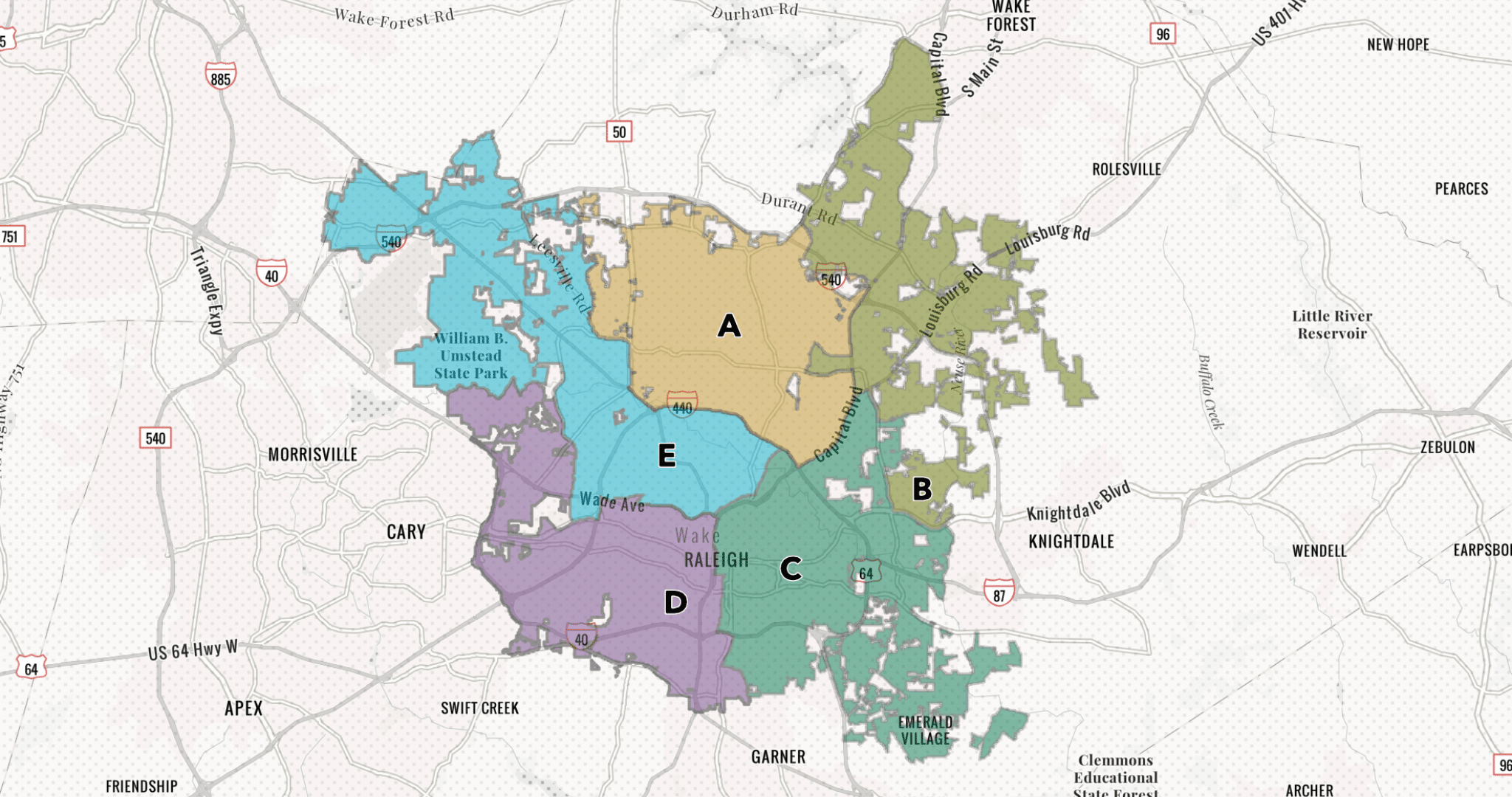
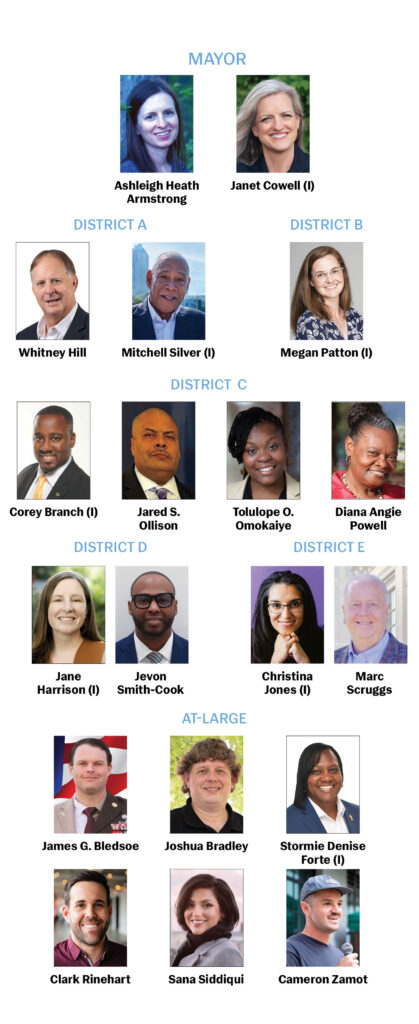
’Tis the season, Raleigh. The election filing period for local races closed Dec. 19—meaning it’s officially time to get acquainted with the field and what’s at stake.
This year, Raleighites will head to the polls for municipal elections twice: the Statewide Partisan Primary + first-ever nonpartisan City of Raleigh Primary Election March 3, and the General Election + City of Raleigh Municipal Election Nov. 3 (with a second primary May 12, as necessary).
Only mayoral and district contests with more than two candidates will be included on the March ballot. For at-large, a primary comes into play with more than four candidates. As such, District C and at-large contests will be included in the upcoming primary.
Another major shift: Raleigh is moving to four-year staggered terms for mayor and city council. This year, the mayor, one at-large seat and Districts A and B will be elected to four-year terms. The remaining at-large seat and Districts C, D and E will be elected to two-year terms—then move to four-year cycles in 2028. To maintain staggered terms, half of the City Council seats will expire every two years. The longer, staggered terms allow for greater continuity and stability in leadership, District B council member Megan Patton tells RM.
As the field takes shape, brush up on your vision for the city—and decide who’s best equipped to lead it. See you at the polls, Raleigh.
A new city council is being sworn in Dec. 5 at Union Station, including four new faces: Mary Black, Megan Patton, Jane Harrison and Christina Jones. Many have described this council as divided—and reelected Mayor Mary-Ann Baldwin as having to govern a council pitted against her. But, for her part, the mayor is optimistic. “People always want to paint negative pictures,” said Baldwin in a conversation with us one week post-election.
“This is the most diverse council in the history of Raleigh—and probably the youngest,” she said. “So I’m thinking, ‘I can’t wait to hear new ideas and these perspectives.’ And we have to respect that and all work together.” During and since the election, the council has been cast by nearly everyone as anti-growth vs. pro-growth. But the mayor doesn’t see it that way. “They actually are not anti-growth. They fall across lines of smart growth, and I think we share common values,” she said, including affordable housing, transit, small business and climate change, to name a few.
In talking to new council members, Baldwin says she thinks there could actually be a lot of unity and consensus within city council, which begins with building relationships and trust, listening to one another, and a willingness to compromise. Bottom line: “The campaign is over,” said Baldwin. “Now we govern. It’s not about activism. It’s about doing what’s best for our community.”
Are CACs the most divisive issue?
A hot-button issue leading up to the election and now anticipated to be one of the most divisive issues facing council are Citizen Advisory Councils (or CACs). If you aren’t familiar, you’re not alone. According to a city survey, more than 90% of residents had never heard of or been to a CAC—meaning this is a “hot-button issue” for a select few. That said, reinstating or revamping these advisory councils was also the central issue fueling some candidates to throw their hat in the ring for city council.
In short, CACs were intended to be nonpartisan advisory boards representing different geographical regions of the city, comprised of nonelected citizens. These councils routinely held meetings as a way of dispersing information and gathering public input. The CACs were disbanded without public input or notice in early 2020, a move for which Mayor Baldwin took much ire in the media. But, she says, her goal was to actually make community engagement more inclusive—not eliminate community engagement altogether. “My feeling is that CACs were exclusive, not inclusive, and we’re looking at ways to make community engagement inclusive.”
For their part, new District E Council Member Christina Jones served as former chairperson of the Raleigh Citizen Advisory Council. And new District D Council Member Jane Harrison reestablished the West Raleigh Community Advocacy Council and has vocally advocated for reestablishing robust community engagement. “Economic development should be community-centered, and city decisions must recognize the voices of the most affected groups, including historically marginalized communities and neighbors adjacent to a development,” Harrison told Raleigh Magazine. “We need forums like CACs and neighborhood associations to convene across the city, sharing information and developing leadership capacity to bring the best ideas forward.”
We asked Baldwin for her take on the return of CACs, and she nodded to the active community engagement board that council has asked to come up with ideas to move things forward. “I would like to see that community engagement board do its work and let us listen to them about what they think is needed,” she said. “And I hope we allow the community engagement board to do its work.”