


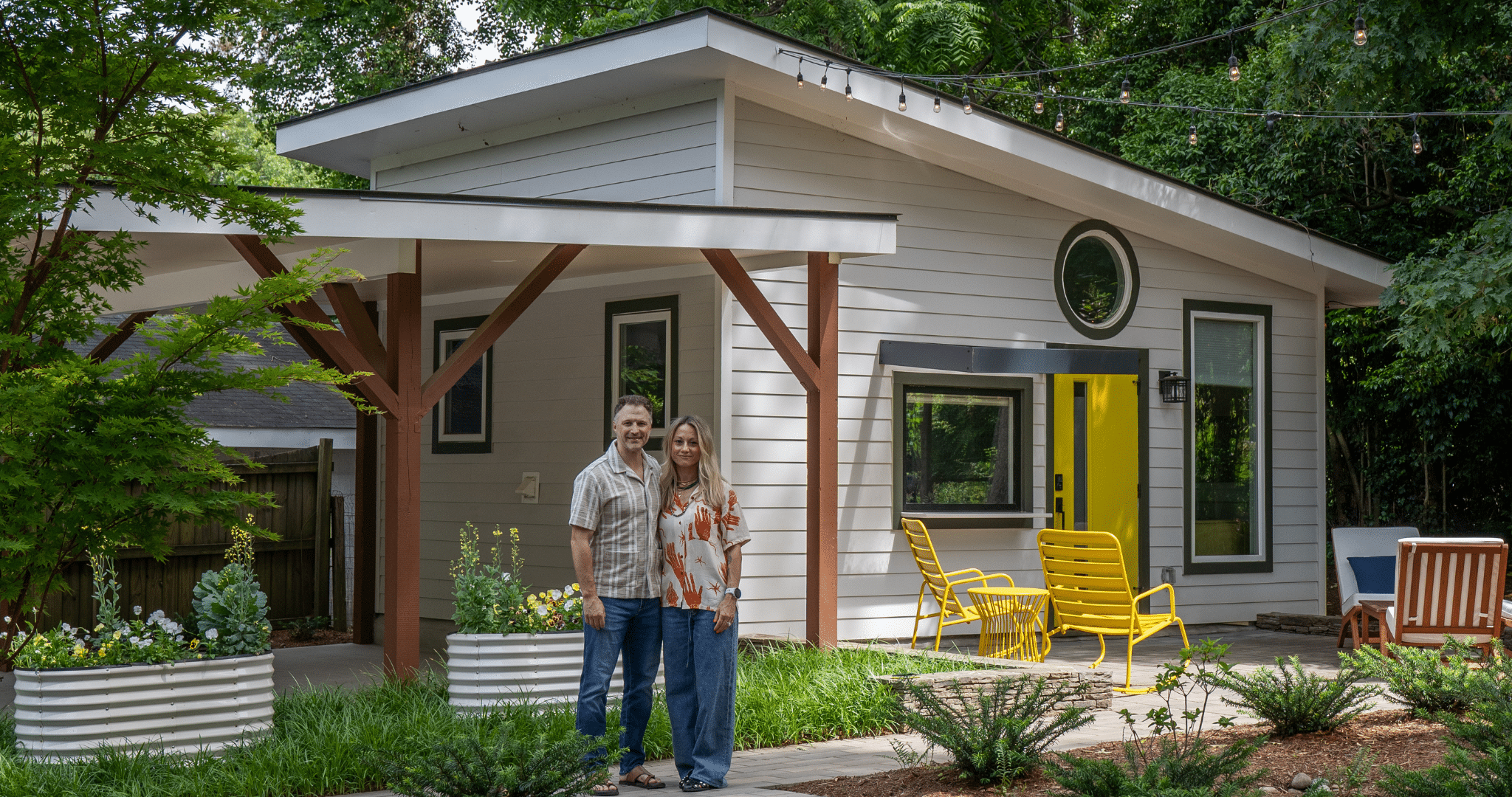
Living Large: ADU Life
Size does matter—but not the way you think. In this case, downsizing can be the difference of housing affordability in a city teeming with growth.
It’s been five years since Raleigh entered her ADU era—and as a massive gamechanger for housing accessibility and versatility in an increasingly volatile housing market, it’s hard to fathom what all the hoopla was to get those accessory dwelling units approved. As it tends to go, you’d think Raleigh was teetering on the edge of ruin every time a new project hits the headlines. Remember? ADUs were going to destroy neighborhoods. The North Hills uprising—billed as a “logistical nightmare”—is now a well-oiled Midtown machine. And don’t even start on tower announcements.
Flashing back through the Cliffs Notes, Raleigh greenlit the ADU Unified Development Ordinance in 2020. The tiny home tug-of-war really amped up in 2013 when, in the face of public pushback, the city pulled the ADU regulations at the last minute. Fast-forward through the Mordecai Backyard Cottage Project—helmed by NCSU College of Design professor Thomas Barrie, who also serves as director of the Affordable Housing and Sustainable Communities Initiative (AH+SC) and WakeUP Wake County Board of Directors chair—sparking a community push and initial (albeit restrictive) 2018 ordinance that spurred a WUWC task force and a shift in voter mindset to pro development. Six years, two City Councils, and a whole lot of grassroots grit later—Raleigh got it done.
Since then, for the most part, it’s been all praise, no problems. If anything, the biggest “problem” is people don’t seem to be aware they can do these backyard bungalows—and what a viable option they serve for adaptive living, from in-fill housing and reduced footprint to added Airbnb or rental income making room for your brood to bloom.
“There’s several options out there,” says Chuck Shomo, who is now sole owner of Tiny Homes Raleigh, which has already built about 10—with three more in progress—of Raleigh’s ~50 ADUs to date, running the gamut from investments to Airbnbs to granny flats. “It’s just getting that information out. I think ADUs are the future for Raleigh—and I see it tripling, quadrupling even, in the next few years.”
To be fair, according to local ADU’ers, the buildout can be a bit of a headache. In the case of ADU-savvy Travis Bailey, who, with his wife, is now putting the finishing touches on his long-delayed Boylan Heights backyard addition, it’s really about choosing the right builder. “We absolutely would do it again,” affirms the born- and raised-Raleighite. “But I would have gone with a smaller construction firm that would have been a lot more cost effective… and [for whom] the ADU could be their primary focus,” adds Bailey, who first learned more about these “perfect solutions” as a volunteer on Mayor Nancy McFarlane’s campaign in 2017 when ADU was a big buzzword.
Raleigh’s made it easier to say “yes” to ADUs via the fast-track program—“a big step forward,” says Shomo. Bailey echoes the sentiment: “It’s part of being a first adopter of anything,” he admits. “You’re going to face more headwinds and challenges with getting things done—and the hope is, for people down the line, the process will be more streamlined. I’m very hopeful it’s going to get faster and cheaper as more people do it.”
If stats are any indication, that time is nigh. While not every state is down to downsize, NC already ranks in the top five best states for tiny house living across a trio of key categories: third for tiny home builders/manufacturers and for Google search interest per capita, and fifth for number of tiny home communities—with Texas taking top cede nationally, according to Home Gnome’s extensive 50-state analysis.
The demand is real—and the potential? Only getting better. Just five years in, Raleigh’s ADU moment is less a niche experiment and more a quiet revolution. “Five years ago, the city was pretty tight-fisted—and even maybe when this ordinance first dropped,” surmises Shomo. “But it really did pave the way for this new era. Now, he muses, companies are shipping them all over the country, and they’re targeting Raleigh as a market. “ADUs are going great. They are definitely helping a lot of people. I think it’s the future.”
While early adopters took a few hits to smooth the road, the path ahead looks clearer—and more cost-effective—by the day. What started as a back-lot battle is now shaping the front lines of Raleigh’s housing future. Flip the page to scope six locals proving how small spaces make a big impact.
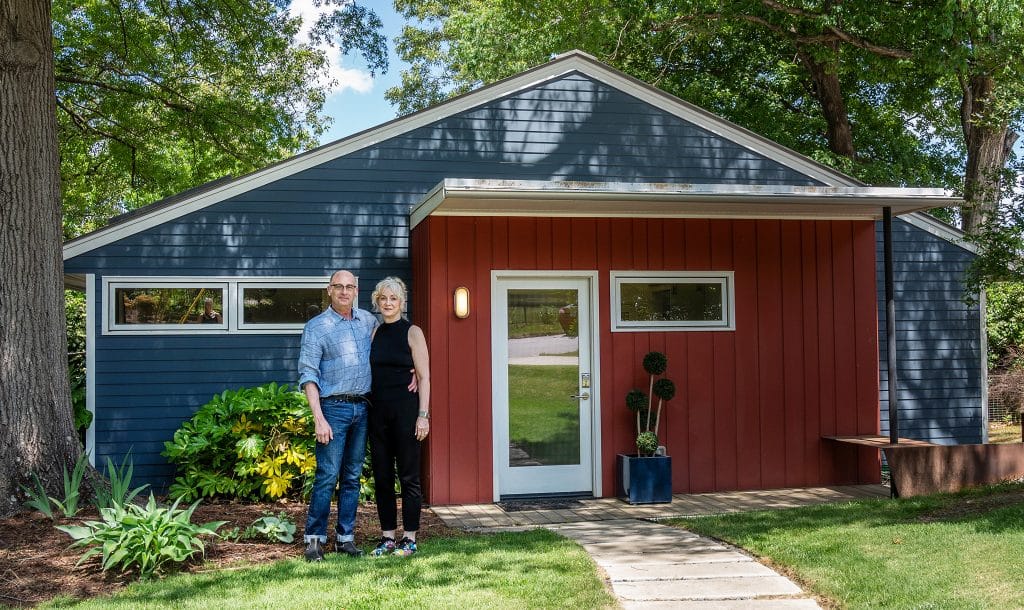
VILLAGE VIBE
Martin Streicher & Paige Tharrington
Purpose and parties collide in this Village District retro-chic dual-purpose addition. Talk-therapy office by day, party pad by night (or any time the mood strikes), the convertible corner-lot 550-square-foot space can easily shift to a one-bed, one-bath MIL suite, rental or Airbnb. Sparked by the demo of Paige’s St. Mary’s office to redevelopment, the couple pivoted from pricey buying options to building on-site. “We looked for something to buy Downtown or in Cameron Village—everything was crazy expensive or teardowns. So, we pursued building on our property,” says Martin. Fashioned by REdesign.build with adaptability in mind, the would-be foyer and soundproofed bedroom provide the perfect layout for a professional waiting area and client sessions—offset by a large vibey sun-washed “living room-slash-party room” that opens to a shared covered patio for carport parties. So: a midcentury-mod mood, a meeting room and a moment.

BLOODWORTH BOOMERANG
Thomas & Lisa Barrie
Dubbed the Barrie Guest House and built for housing flexibility in the heart of Mordecai edging the empty nesters’ circa-1907 historic-register home, this mod backyard retreat by Armature Design Build provided just that for the Barries’ boomerang son transitioning back from the Big Apple. “The prime motivation was to add one affordable unit to the Raleigh housing market—designed to be rented at a very affordable rate,” explains Thomas, an NCSU College of Design professor and nonpracticing architect (except on his family), who also serves as director of the Affordable Housing and Sustainable Communities Initiative (AH+SC) and WakeUP Wake County Board of Directors chair. Outfitted with full kitchen, living/dining area, sleeping loft and bonus 60-square-foot garden shed to boot, the beautifully appointed abode—with interiors and landscape by Lisa—was first used as a flex weekender guest house as the couple grew accustomed to it. Positioned with primo views of the backyard garden, best served from the porch perch, the fall 2023-completed 300-livable “square-footage poor and spatially rich” space, as Thomas puts it, ultimately served up a prime affordable—and independent—place for their 32-year-old son to land. Small in size, big on impact—this tiny build is a blueprint for flexible, future-ready living in Raleigh.

THE ARTIST LOUNGE
Reggie & Georgia Tardy
All function, all flair, no compromise—the wildly successful and versatile Artist Lounge sets the bar at Shaq height. A flex space with serious main-character energy, the nee-2021 artful oasis is a vibe—period. Carefully crafted to cater to creatives of every stripe via 600 square feet of adaptive interiors, tailored to fit any vision, the creative haven boasts private workspace and outdoor event-ready amenities to boot. “We had a vision, and linked up with Jeremy Hauch and Hauch Design Architecture,” says Reggie of the fateful find after he stumbled on Hauch’s card on a jobsite. “They came in and saw that vision,” delivering an intentional, innovative space for community. A muse with an alfresco fire feature and fully stocked mini fridge, the convertible Downtown art studio is offset from the couple’s Boylan Heights beaut of a home by heated saltwater pool and versatile entertaining space—think outdoor bar, multilayered seating, Astroturf stretch and electrical access for seamless F&B service. “We wanted to open the idea to all kinds of the community,” adds Reggie. A mood with a mission, it’s not just a space—it’s a statement.

MAYVIEW MARVEL
Matt Johnson & Carolyn DeVita
Purposeful meets party pad via The Hannah: a 320-square-foot vibey “desert”-set oasis situated behind an 80-year-old bungalow. Having forked over five grand on the dream design, Matt spent two years stuck in the search to bring it to life before “kind of kiboshing the whole thing,” he vents. “It was unbelievable—the quotes coming back were the price of a new house. It was just not palatable—and I’d given up.” That is, until he stumbled on the then “tiny little website for Tiny Homes Raleigh,” he recalls. “They saved my bacon.” One of the first Raleigh ADUs fashioned by THR and fast-tracked by the city, the casita has since logged some 130+ Airbnb stays to the tune of ~$2,500 per month—and, at this rate, will pay itself off in less than 10 years. When not booked, the dwelling doubles as entertaining space, a college-kid crash pad or, say, a reception-hosting hub for the newlyweds (true story) that easily converts to a granny flat down the line. “I didn’t get the ‘dream’ two-story ADU I wanted,” says Matt, “but I do have a really cool 300-square-foot space with a carport add-on and some interior customization that came in at a third of the price—so then I had the budget to build this dream space around it. It just took me finding that right person to help me bring this small slice of heaven to life.” So, The Hannah’s not just an ADU—she’s a vibe manifesto.

BOYLAN BALANCE
Travis & Melissa Bailey
When your blossoming brood starts outgrowing the historic home you bought in 2016—and love—in a volatile housing market, an ADU presents the ideal solution. So instead of packing up, this Boylan Heights bunch leveled up. “We wouldn’t have been able to make our existing house work with our expanding family without this space,” says born-and-raised Raleighite Travis, who joined the Historic Development Commission to design progress that preserves history. “I joined the Commission to figure out how can we make developing in historic areas more permissible while also being respectful and keeping the historic nature intact.” Serving up responsibly designed flex office space for the professional remote/hybrid couple, the just-completed 800-square-foot convertible addition by REdesign.build is crafted to adapt as priorities shift from diapers to downtime—think large living room, kitchenette, laundry and half-floor loft, making it rent-, Airbnb- or even boomerang kid-ready. Future-proofed, family-first and firmly rooted, staying put never looked so forward-thinking.

WYCLIFF WONDER
Julie Augustyn & sons: Corey, Charles and Caiden Brady
She wasn’t house-hunting for an ADU-ready lot, but when Julie stumbled on this prime West Raleigh corner of opportunity in 2020 in sync with the ordinance, the writing was on the wall. The timing, the zoning, the bones—it all lined up. A seasoned commercial real estate pro and newly single mom, she foresaw the future for her family and scooped up the aging ’70s split-level reno opp with ADU potential. So goes the origin story for The Ellis—the sideyard-born Tiny Homes Raleigh model named for Julie’s late grandfather, now populating other pockets of the city to boot. “I was very happy with the process,” she says. “It works wonderfully for this corner and has been a beautiful addition—and I think it has added to our community.” Breaking ground on the prototype in May 2022, the 576-square-foot stunner now serves as an ideal fit for its long-term tenant seeking a simpler, smaller footprint. “I built with the intention of it being in-fill housing,” says the mother of twin teen and 7-year-old boys. “But I plan to live here—so I could see it being used as flex space by my family in the future.” So what started as a personal pivot is now a citywide model for living small and dreaming big.

