A newly released 10-point action plan sets to bring vibrancy back to Fayetteville Street.
Things are finally looking up for Fayetteville Street. While the once-vibrant sector had arguably lost some of its luster, Downtown Raleigh Alliance and the City of Raleigh recently released the first set of recommendations from their ongoing Downtown Raleigh Economic Development Strategy in an effort to revitalize North Carolina’s Main Street.
The “Activating Fayetteville Street” report developed by the Interface Studio-led consultant team features 10 recommendations for making the corridor more attractive, competitive and connected based on local need and other city attractions. Taken together, these “10 big ideas” could mark the biggest shift to the district in 15 years.
“Fayetteville Street and our central business district are part of the face of our Downtown, city and state,” says DRA President and CEO Bill King. “So elevating this area is critical to how Raleigh is experienced and perceived.”
Setting a new course for the heart of Downtown, the goal of the recommendations is to breathe new life into the area from the NC State Capitol to Martin Marietta—from highlighting Black-owned businesses and adding more housing on and around Fayetteville Street to connecting main attractions via a family-friendly route and more.
“The intention is to implement as much as possible, but realistically I expect some will still have to evolve or adjust as things change,” says King. That said, look for the streetscape design update to begin immediately, as well as changes to City Plaza, parking fees and many of the placemaking/public art aspects. “We have steps outlined for the first 100 days and first year to drive progress,” he maintains—progress that will only proliferate as Interface continues to seek ways to maximize Downtown’s strengths. Here, the takeaways we think will have the biggest impact on our city.
Courtesy of Google Maps
Courtesy of Monroe Street Midway
Defining the Districts
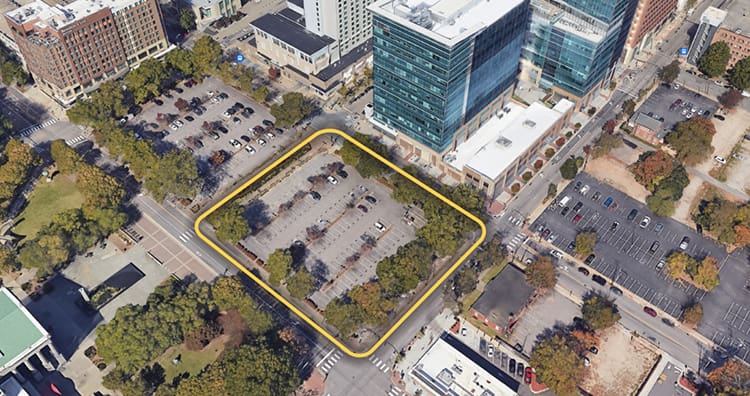
“Art pulls a community together,” as would a designated Arts and Entertainment District in the lower area, which would also serve to attract local and national establishments and entertainment ops while further fostering Fayetteville Street’s identity. The abandoned parking lot at the northwest corner of South and Wilmington streets serves as a primo spot for “play, small business opportunities and entertainment options,” according to the report.
Courtesy of Interface Studio
Courtesy of Interface Studio
Bright Streetscapes
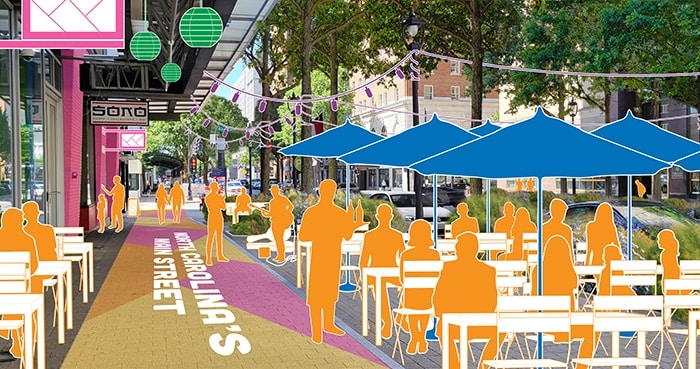
Famously supersized, Fayetteville Street’s sidewalks have never lived up to their full potential. Swapping current antiquated planters, benches and newspaper corrals for designated zones for outdoor dining would serve as a smart solution, which would free up space for walking, furniture and activity (think outdoor vending, workspaces, lawn games and temporary stages). Meanwhile, added greenery and lighting on significant buildings, trees and sidewalks would bolster literal vibrancy, wayfinding and safety.
Photo by Patti McConville, Alamy Stock
Utter Relief
The lack of public-access relief stations in DTR has long posed a problem. Taking a cue from Portland, relief could be on the way in the form of new self-cleaning public bathrooms + increasing hours and maintenance for free bathrooms in public buildings. Answering the call for another shortage would include improved parking signage, increased time allowances on parking apps and first-two-hours-free parking in City-owned garages.
Rendering by Interface Studio
Photo by Kebony
Courtesy of DRA
Leveraging Public Spaces
“On the playground is where I spend most of my days…” That’s the hope—by activating the oft-underutilized street into a full-blown 16- to 18-hour veritable playground via inviting well-lit passageways bustling with outdoor dining, vendor stalls, recreation, public art and more. This also goes for positioning City Plaza as “Downtown’s front porch” and establishing a visitor center.
Courtesy of Interface Studio
Photo by blazeCLT
Downtown Connector
Bold connections generate growth. Thus, a Chavis-Dix Strollway could be implemented to connect DTR to Dix Park and the Rocky Branch Trail, with a South Park Heritage Walk bridging the gap from DTR to Chavis Park and other East Raleigh destinations.
Human Touch Group Pavillion by Partyk Lewinski
Lucky Plaza by Choo Yut Shing
Marketing Main Street
Raleigh’s “Main Street” needs to assert its identity. Period. Engaging public space design and street activity via mobile retail carts, food trucks and permanent stalls in dead zones would increase foot traffic—as would the creation of a Downtown gift card program.
DRA taps urban planning consultants to reimagine Downtown.
Downtown Raleigh’s watershed moment is now. Storefronts remain empty; office buildings are slow to refill; foot traffic is low—at least in certain areas. Despite vast efforts by stakeholders and city leaders alike to restore the once vibrant city center, the “if you build it, they will come” approach hasn’t worked—yet.
But maybe we’ve been thinking about it all wrong. Focusing largely on bringing people back to Fayetteville Street specifically has long been front of mind. It makes sense—Raleigh’s “Main Street” is the major artery channeling through DTR, doubling as the central business district and lifeblood of our city.
Attracting retail to the corridor has been seen as the primary solution for reenergizing the area—until now. In an about face, stakeholder and DRA Economic Development Strategy (EDS) committee member David Meeker recently revealed, “Fayetteville Street doesn’t work for retail.”
“We need to reset our expectations when it comes to Fayetteville Street,” says Meeker of his perspective shift following a meeting with consultants from Interface Studio during their first visit to the City of Oaks in early August. As a refresher, the Philadelphia-based planning and urban design practice was selected in July by DRA to lead the EDS for DTR for their ability to challenge us, says DRA President and CEO Bill King.
That challenge out of the gate is getting real—“so there’s the question of Downtown Raleigh’s identity and brand,” says Interface Principal Scott Page in a sitd-own interview with Raleigh Magazine. Another huge revelation. … Sit with that for a moment. Nashville is Music City; Vegas is Sin City. Who is Raleigh? And who is it for? Interface hopes to answer those questions.
While Downtown Raleigh already has a plan, it was devised in 2015—and much has changed since then. Interface is here to fine-tune it to what Raleigh is now, tasked with activating not just Fayetteville Street but the entire Downtown economy, repositioning the office market, increasing diversity among businesses, supporting existing businesses, filling empty storefronts and developing the “next big idea for Downtown.”
“The heart of what we’re here to do is to understand the challenges at a local level,” says Page, whose firm will visit monthly to engage with stakeholders, business owners, residents and visitors. “It really does become a question of the experience of Downtown Raleigh—how do we continue to activate Downtown if workers are not in the office five days a week and the housing is slowing down? How do we make sure folks living in the suburbs or visiting from other cities are coming back time and time again?”
Interface is primely positioned to answer those questions, with a portfolio ranging from metropolises like Atlanta to midsize cities like Grand Rapids, Michigan, to small towns like Macon, Georgia. The studio’s forward-thinking urban revisions encompass everything from park improvements and pedestrian infrastructure in Wilmington, Delaware, to the creation of Spruce Street Harbor Park at the Penn’s Landing Marina in Philadelphia, complete with floating barges featuring lily pad water gardens, F&B vendors, hammocks and more to maximizing a crucial street in Philadelphia as a greenway for economic development.
From their first visit to Raleigh alone, Interface’s impact is clear—first, by acknowledging our Main Street is on the brink of being a “blah-za” (a term the firm dubs for districts that are just “meh”—aka areas that “were intended to be places for people but don’t really serve adequately in that role,” explains Page). And, perhaps more importantly, to realize Downtown encompasses more than just Fayetteville Street.
“All downtowns face similar challenges, but all downtowns have different solutions,” says Page. “Part of our job is to look at the programming and see where there might be opportunities to expand it and do so in a way that directly supports Downtown retailers and restaurants.”
One of the things Interface has done to better study Downtown is create a measuring tool to understand what it feels like to walk every single street, says Page. “What it will help to reveal are pockets of activity that feel really good.” City Plaza, for instance, serves as the ideal host for concerts, productions and other activations. But when events aren’t taking place there, it sits mostly empty.
“Filling in Downtown is important,” reiterates King. “If you map out the residential buildings and developments, they’re kind of clustered in a handful of places, which is good—but having those spread out would be helpful and would allow us to have density across Downtown and support more businesses.” Besides just buildings, filling in those pockets with additional experiences will also create a vibrancy that will attract people from all over the city—and beyond.
“There’s a lot of great things in Downtown Raleigh that a normal visitor—or even people that live in the region—wouldn’t know about, and those are the types of things we want to highlight,” maintains Page. “Whatever the answer is to how Raleigh differentiates itself, it should be obvious on the streets and in the public spaces. So when you’re here—whether you live a couple of blocks away and you’re walking to work or you’re visiting for a festival—you should feel it.”