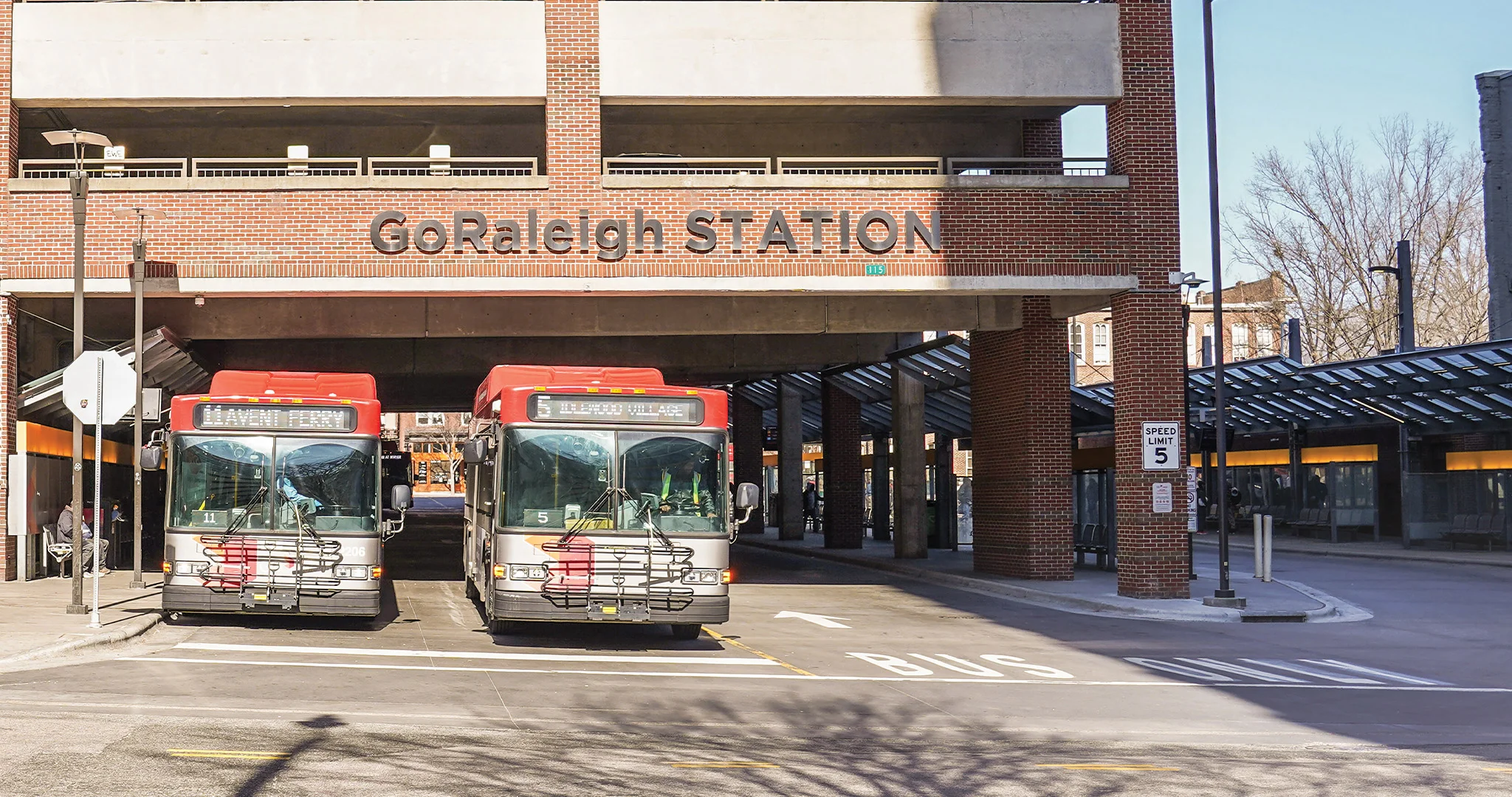
Following ongoing concerns over the state of GoRaleigh’s Moore Square bus station, plans are now in motion to rethink DTR transit. At its Oct. 6 meeting, City Council approved a Mobility Hubs Study that will examine potential improvements to the existing station—or whether a new DTR facility or decentralized approach makes more sense. Consultant WSP USA Inc. will evaluate up to three strategies: improving the existing GoRaleigh station through crime prevention and environmental design; identifying alternative Downtown locations; and exploring a distributed facility model. The broader study will also look into Raleigh’s hub-and-spoke network versus grid system, including opportunities for cross-town connections that bypass Downtown altogether. The City of Raleigh Department of Transportation expects to return to Council with initial recommendations in six to nine months.
The Oakline could turn the journey between Downtown and Dix Park into a destination of its own.
From trolleys to aerial cable cars, Raleigh’s seen a wide range of ideas to link Downtown with Dix Park. Now, one pitch is outshining the rest: The Oakline—an elevated path for pedestrians and bikers—that could finally bridge the gap.
The two destinations sit a mere three-quarters of a mile from each other—basically a jaunt from Capitol Square to the Warehouse District—yet they feel miles apart. That’s largely thanks to uneven terrain, multilane roads, railroad crossings and sprawling intersections.
“We’ve got a 300-acre park, and we’ve got a vibrant Downtown—becoming more vibrant by the day,” Wake County Open Space & Parks Advisory Committee board member Sig Hutchinson tells RM. “The barriers include three of the busiest streets in the city, a railroad line and 50 feet of elevation.”
SfL+a Architects, Surface 678 and Preston Montague
Ideas for linking Downtown to Dix with a safer, bolder and more accessible connector have been floated for years—gondolas, trolleys, BRT and so on. The Oakline could overcome those obstacles and be the path to a solution.
Proposed by SfL+a Architects, the group behind the mixed-use City Gateway project coming out of the ground at the corner of McDowell Street and Martin Luther King Jr. Boulevard—alongside Surface 678 and Preston Montague Studio—the elevated path would stay relatively level the entire route and hurdle the uneven topography between the two crucial Oak City attractions.
And, most significantly, The Oakline would be an attraction in itself. The proposed plan wouldn’t just provide a safer connection, but would allow Dix Park to spill into Downtown—meaning getting to the park will feel like being at the park. Public art, local history, intentional overlooks and lush canopy trees would extend that destination vibe—with shade to boot.
As proposed, The Oakline would begin at the Martin Marietta Center for Performing Arts, jump the rail line and continue through City Gateway before hurdling MLK Jr. Boulevard, McDowell and South Saunders streets, ultimately leading to Dix in a 16-minute jaunt—and for those on wheels, six.
“One of the really strong suits of the current pathway is it’s half in private developments and half in the public realm,” says SfL+a Architects’ Barry Buckman. Unlike some big pie-in-the-sky infrastructure idea, much of the route already runs through compatible private projects like Salisbury Square or Rockway, or falls into NCDOT Right of Way—meaning pieces of The Oakline could piggyback on projects already underway, including BRT, adds Surface 678 landscape architect Charles Bradley.
City Gateway, Salisbury Square and Rockway could also help build out portions along private property, notes Buckman.
SfL+a Architects, Surface 678 and Preston Montague
The developments the route will snake through are not only compatible, but complementary, adds Buckman, nodding to its connections beyond Dix and Downtown, with easy access to neighboring F&B concepts, retail and gathering spots upping the area’s overall walkability.
But none of the hype—or hope—means The Oakline is a done deal. City officials, project architects and Downtown Raleigh Alliance hope to collectively push the project forward this fall to nail down design, cost and potential funding sources.
“There’s financial stacks that can make this a reality,” maintains Hutchinson, pointing to transportation funding. “Paint a picture of what people want, and they’re going to figure out a way to pay for it.”
Early enthusiasm is high. “When I saw this proposal, [I thought] they cracked the code,” says City Council member Mitchell Silver. “They actually figured it out.”
And the ambition extends beyond cracking Raleigh’s decades-old connectivity problem. “It will really become an iconic gateway into Downtown,” says Bradley. “There will be trees marching across the road, and there’s something really magical when you’re driving under oak trees into the City of Oaks.”
More than a route from Downtown to Dix, The Oakline would become Raleigh’s new front—and a calling card for the City of Oaks.
Another Path A path from DTR to Dix is already approved and in the works: The Chavis-Dix Strollway, a cultural trail linking Dix Park and John Chavis Memorial Park while celebrating historically Black neighborhoods in the area. The two paths follow different routes—the strollway will run along South Street through South Saunders Street.
“You can’t have enough good connections to get to Dix Park,” says Buckman. “There will be some amazing work celebrating the history of the Fourth Ward community throughout the Strollway, and we strive to have The Oakline celebrate that history as well.” The Chavis-Dix Strollway project is in planning stages and is backed by $3 million in federal funding secured by Congresswoman Deborah Ross.
New Red Hat Amp rising—and bringing a serious upgrade with it.
Raleigh’s favorite boutique amp is making major headway in front of its 2027 opening act.
Marking a major milestone this summer with the topping out of its highest vertical steel, construction is now in full swing on the ~$40M Red Hat Amphitheater move across Lenoir Street.
The new DTR digs promise an upgraded concertgoing experience from top to bottom, including improved sightlines, high-tech concessions, backstage spaces and—cue the applause—permanent bathrooms. Because after 16 summers of Porta Potties, some amenities deserve a standing O.
“We want everyone to look forward [to] what a great thing this is going to be for concertgoers, shops, restaurants, hotels—and everyone Red Hat Amp has a positive economic impact on,” says Raleigh Convention and Performing Arts Complex Executive Director Kerry Painter.
As beloved as the McDowell Street space has been during its 16-season run, it was never built to last. Originally conceived as a temporary placeholder on land earmarked for now-incoming convention center expansion, the scrappy amp became a DTR institution in its own right.
And for those who have sweated and swayed at the OG site, the memories will live on—literally. Last month, the venue curated a time capsule packed with stage-side scrim banners, news clippings, merch, artist riders and more, which will be cracked back open in 2076.
Meanwhile, its successor is already booking shows for 2027. Consider this an encore—not an ending.
Downtown Raleigh Alliance has a new vision for the paused circulator: Link Marbles, the state museums and Dix Park to turn scattered destinations into one family-friendly Downtown experience.
Downtown Raleigh’s museums and attractions are a major draw—but they’re also scattered across a footprint that can be difficult to navigate on foot for families with littles or visitors unfamiliar with the grid.
Now, a defunct city route could be the difference between a visitor frequenting one or two spots and spending a full day in the city core, says Downtown Raleigh Alliance President and CEO Bill King.
The timing offers a rare opening to rethink the R-Line. Launched in 2009, the Downtown circulator was paused in August for up to 18 months, giving the city a chance to reconsider what—and whom—the next iteration should connect.
King expanded on that vision at the recent State of Downtown event: Connect those attractions with a route that lets families park once and spend a full day exploring. Together, he suggested, they could offer a family itinerary that outshines others across the region.
“When you build these experiences all up together,” says King, “they become a lot more powerful than they are individually.” The connector could make it easier for families across the region to plan a day—or even a weekend—of Downtown activities, he adds.
A museum visit wouldn’t have to be the day’s only stop. With a ride between destinations, it could be the start of a much bigger outing.
For King, that could mean thinking about the R-Line less as a way to simply move people around Downtown and more as the thread that ties some of its biggest family attractions together. The destinations are already here. The opportunity is making them feel like one experience.
Check-in time has arrived in Raleigh—but it’s about much more than high-end hotels.
By Melissa Howsam & Lauren Kruchten
We’ve been saying it for years—and for good reason. Raleigh’s hotel boom is coming. But it isn’t just a random flurry or a lust for the suite life. It’s about building an identity.
Plans for a new crop of boutique, luxury and full-service hotels have steadily stacked up across DTR, promising more rooms, more rooftop bars and, finally, the upscale stays Raleigh has long lacked.
A robust hotel inventory is part of the infrastructure a city needs to compete for the major sporting events, conventions and marquee attractions that put it on the national stage—and bring thousands of visitors along with them, Greater Raleigh Sports Alliance Director Tori Collins tells RM. And it’s a formula Raleigh has already seen pay off: The 2023 NHL Stadium Series weekend generated $20.1 million in economic impact, while this year’s Stanley Cup Final delivered another $13.4 million and more than 6,700 hotel room-nights across Wake County.
And check-in time has arrived as several of those long-awaited projects are now opening, while still more are under construction or taking very real shape. The iconic round Holiday Inn debuted its second act as Hotel Indigo. The Oberlin is nearing its reveal in the Village District. The long-planned Omni is moving forward alongside the convention center expansion. And White Lodging is preparing to transform Downtown’s Sheraton into a Westin—adding yet another major player to Raleigh’s growing hospitality roster.
And that’s just the confirmed reservations. From a planned upscale hotel at City Gateway to boutique projects and potential stays tucked into some of Raleigh’s biggest mixed-use developments, the next wave is already checking in behind them.
Because this boom isn’t only about where visitors stay—it’s about creating a city they want to stay in.
Downtown Raleigh’s iconic “hair curler” Holiday Inn is finally getting new life. Marking a new chapter as Hotel Indigo Raleigh, the 204-room DTR fixture just unveiled a $36 million transformation that brings it into the modern age while preserving its unmistakable circular nee-1969 exterior.
While almost no aspect of the interior has gone untouched, Tidal Real Estate Partners Principal Eyal Einik emphasizes the design intentionally harkens back to the hotel’s ’60s heyday—from new coffered ceilings referencing the building’s architecture and geometric carpeting inspired by its circular room configuration to a largely locally rooted art program.
Sean Junqueira
“The location is a pillar of the brand,” he says. “The goal was to bring as much of Raleigh into the hotel and let the building speak for itself.”
Its crowning glory: 20th-floor cocktail lounge and event venue High Ground—creating a new perch for Raleighites and out-of-towners to sip, dine and gather from a vantage point unlike anywhere else in the city. Below, 204 boutique rooms, a warm contemporary lobby opening onto Hillsborough Street, and a lush courtyard designed for guests and locals to linger round out the reinvention.
Coming full circle, Hotel Indigo preserves the character that made one of Downtown’s most recognizable landmarks memorable while opening its doors to a new generation.
Delivering a dose of history—and a bolt of energy to an already booming district—the Oberlin Hotel is ready for check-in. The 153-room hotel marks Village District’s first stay and Hilton’s second Curio Collection property in NC, filling what Regency Centers GM Brooke Conn calls “a long-standing need for lodging in Raleigh’s central hub.”
But this isn’t some could-be-anywhere hotel—or just a place to sleep. Developed by family-owned, Winston-Salem-based Quality Oil Co., the boutique stay is uniquely Raleigh. And it’s deeply rooted in city history, down to its moniker, a nod to the historic Oberlin Village—one of Raleigh’s freedmen’s communities established by Black landowners and families following emancipation. That legacy of self-determination, resilience, community and opportunity carries throughout the property, as seen in the large-scale mural by Raleigh-area artist Sean Kernick paying homage to the historic neighborhood.
The Raleigh nods continue into the well-appointed guest rooms and public spaces, but the latter are designed as much for locals as overnight guests. Street-level Grounded, an open-to-the-public boutique coffee bar and cafe, moves from breakfast and grab-and-go fare into a daytime gathering spot, while lobby lounge Proper dishes lunch, dinner and cocktails that spill out to the courtyard. Flexible meeting and event spaces, including the Magnolia ballroom and adjoining outdoor courtyard—add capacity for weddings, corporate gatherings and celebrations of 150-plus, filling another previously underserved need in the district.
Still to come: Wren Rooftop, the hotel’s signature sixth-floor restaurant and bar, slated to bow in early 2027—bringing with it contemporary Southern fare rooted in NC ingredients backdropped by sweeping 13-foot ceilings, walls of glass and a wraparound rooftop patio serving up expansive DTR views.
All told, the long-awaited hotel delivers another piece of Village District’s evolution into an 18-hour destination—giving visitors a place to stay and locals plenty of reasons to check it out… or check in.
Set to become a cornerstone of Raleigh’s newly dubbed Fourth Ward Entertainment District, the long-awaited 29-story Omni Raleigh Hotel brings something the city has sorely lacked: 600 rooms and serious meeting capacity rising between the expanding Raleigh Convention Center and Martin Marietta Center for the Performing Arts.
Catering to those enhanced meeting and event capabilities, the transformative stay strengthens Raleigh as a premier destination for business and leisure travel via its massive ballroom, 61,000 square feet of flexible meeting space and rooftop pool—all directly supporting the Convention Center and Raleigh’s growing pursuit of larger conventions and events.
“We believe great hotels are shaped by the communities that surround them, and Omni Raleigh is designed to reflect the essence of this dynamic, fast-growing city,” says Omni Hotels & Resorts President Kurt Alexander.
And the local appeal goes beyond conventiongoers. The first-ever coffee shop from Raleigh-based Peter Millar will pour an exclusive Black & White Coffee Roasters blend, while a sports bar with golf simulator and covered outdoor patio brings another place to play. Meanwhile, NC’s first Bob’s Steak & Chop House adds another destination dining draw backed by Raleigh-inspired artwork.
Visit Raleigh
WESTIN RALEIGH Fayetteville Street District
Construction starting spring 2027
The Downtown Sheraton is getting more than a new flag on the building. Slated for spring construction, the conversion of the 353-room hotel into a Westin promises what White Lodging VP of Investments & Development Eric Stone calls a “transformative renovation.”
“I don’t think there’s any area of the hotel we won’t be touching,” he adds. Think new guest rooms, lobby, corridors, meeting and public spaces, destination restaurant and bar, plus additional meeting space and a modified facade that will transform it into an urban destination. Perhaps most consequential: The potential relocation of the hotel’s main entrance to Fayetteville Street—a move designed to inject new energy into the corridor and complement the city’s broader push to activate the area. The overhaul comes as Raleigh prepares to expand its convention center—and hotel capacity along with it.