by Lauren Kruchten | Mar 27, 2026 | April 2026, Buzz
Proposed DTR parking policies are causing a stir.
Parking is the lifeblood for Downtown—no question about it. Not just for residents, employees and out-of-towners, but for small businesses that rely on people venturing Downtown to spend money.
Now, proposed changes to Raleigh’s parking policies are meeting mounting backlash—from both DTR regulars and would-be visitors—as well as the local shops, restaurants, bars and fitness studios that depend on them.
The City of Raleigh presented three different options to Council in March to offset the projected $8 million FY27 budget shortfall in its parking fund—a deficit six years in the making. City staff ultimately favored a proposal that would increase parking rates, reduce free parking options and introduce new costs for some Downtown businesses (see callout box).
Staff positioned the price hikes alongside other areas of the city they said were also considering raising parking rates, though those centers were quick to shut down the rumors (see below).
Council members pushed back on the proposals: Mitchell Silver stressed one hour of free parking simply isn’t enough, while Megan Patton went so far as to call all three options “nuclear.” Their concerns reflect what’s at stake, as Downtown Raleigh Alliance’s free two-hour parking pilot has generated ~$3.8M in annual spending across the five participating decks.
Artspace CEO Carly Jones tells RM that visitors frequently point to DTR parking as a persistent challenge. The free two-hour parking, she says, has been a huge lift for Artspace and surrounding art organizations.
Now, that incentive is in jeopardy. And DRA is sounding the alarm: “We believe the proposal is way too aggressive, would have a dramatic impact on Downtown’s economy—and we do not support its implementation,” stresses DRA President and CEO Bill King. “Our storefronts are 90% locally owned and need their customers to be able to have easy and affordable access, or they will simply go to many other options around the city and region for dining and shopping.”
King adds parking costs affect the ability to lease DTR office space, attract visitors and maintain a vibrant core—and that more modest, incremental changes could accomplish the city’s goals without harming the economy.
“The scope and breadth of these proposed changes are simply too much at one time for an economy that still needs help,” he says.
DRA is encouraging residents and stakeholders to share their opinions with Council before new policies take effect in January. Meanwhile, the City is working on an RFP for a parking study to guide decisions on which facilities to keep, eliminate or allocate to private markets. In April, new recommendations will be brought back to Council in private small-group meetings held out of the public eye.
For now, the debate over how—and how much—to charge for parking Downtown is far from settled. In the meantime, it’s crucial to make your voice—and opinions—heard.
Have thoughts? Email [email protected]
Current City-Recommended Parking Changes
Off-Street Deck Parking
Monthly parking spot $135
(up from $125)
Move to 24/6 (every day but Sunday)
and increase hourly rate by $2–3
Reduce two-hour free parking
program to just one hour
Increase Small Business Downtown
Parking Relief program from
$0 to $60 per month
On-Street Parking
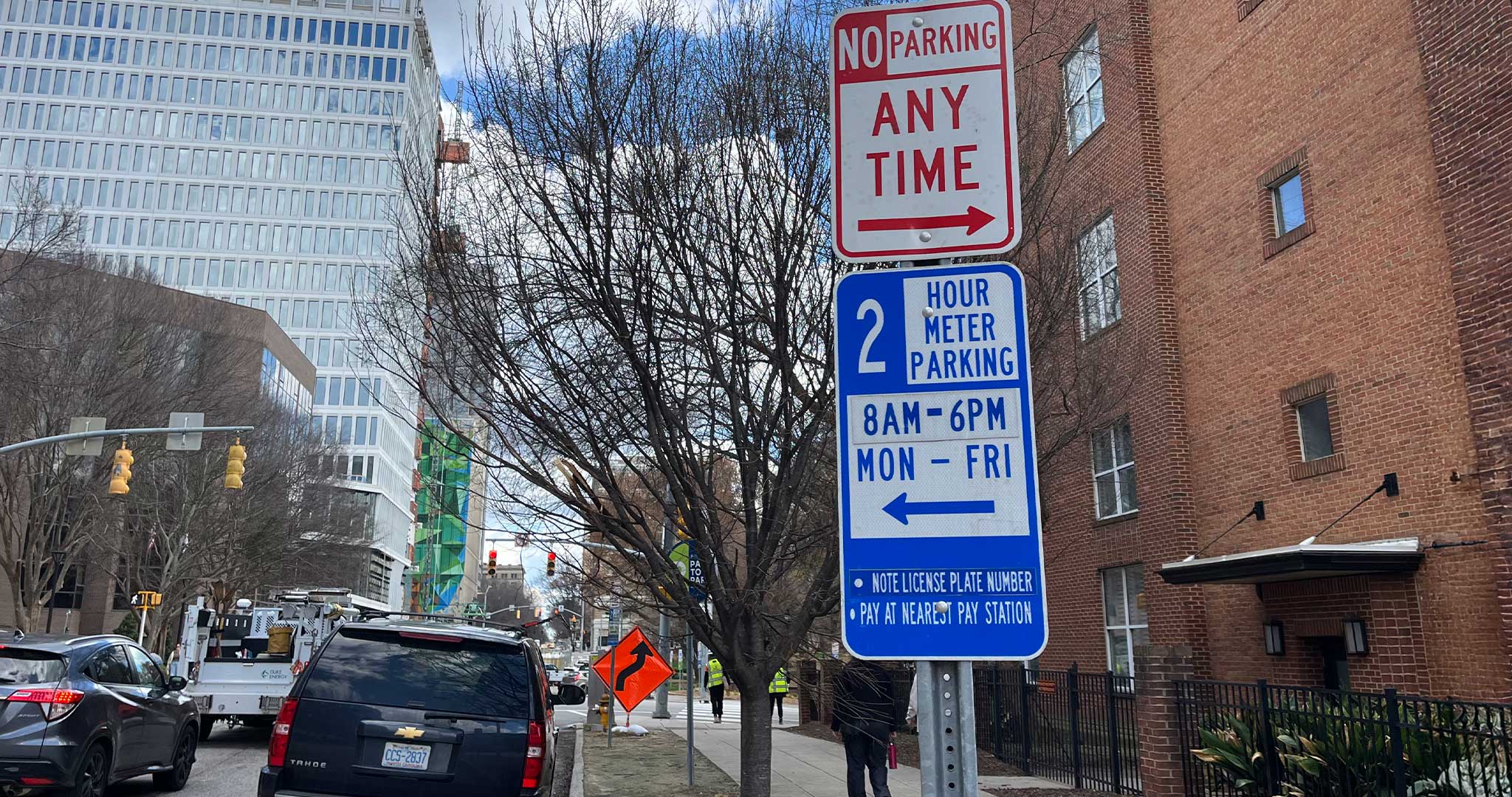
Increase rates from $1.25 to $2.50/hour, keep existing hours (Mon.–Fri. 8am–6pm)
Parking Policies Around Town
Raleigh Iron Works
The City cited upcoming parking price hikes for RIW, but Grubb Ventures insists that’s not the case. The up-and-coming development offers free public parking in both retail surface lots and the garage—and “this is not set to change in the near future,” a spokesperson tells RM.
Village District
Despite comments during the work session, the center says it has no plans to introduce paid parking. “Village District remains committed to offering parking at no cost and supporting a welcoming, accessible experience for everyone who visits,” GM Brooke Conn tells RM. Current measures include no overnight or student parking, two-hour limits at storefront spaces and requires patrons be on-site while parked.
North Hills
The Midtown shopping center requires all vehicles to register to park via its Power Parking system in the North Hills Innovation District, the Bank of America Tower deck and Park District’s street-level parking. Failure to do so may result in a $35 fine. The policy includes three hours of free parking for patrons, easy paid extensions, as well as dedicated parking access for tenants, residents and employees.

by Heidi Reid | Aug 19, 2024 | Buzz, September 2024
Like a virtual corn maze, maneuvering Raleigh’s ever-growing amount of DTR lots and apps can be overwhelming—but how did we get here? And how do we navigate it?
Ask any Raleigh resident their feelings on going Downtown and you’ll hear the same narrative: Figuring out where and how to park and pay is the worst. Read: an overwhelming maze of public and private parking options people would sooner skip than solve—especially given the costly consequences.
You know the drill. You’re endlessly circling for a street spot before giving up and pulling into a private lot, where you’re forced to find or download yet another parking app to then get gouged for $20—only to return some five minutes late to a ticket upward of ~$125. Such scenarios are playing out across DTR on the daily, prompting residents and visitors to weigh venturing Downtown—where every lot is a puzzle of rates and rules—against alternative live-work-play districts dishing plenty of free parking (think North Hills, Village District, Fenton—though those areas can come with their own lot battles and endless hunts).
So, how did we get here? A quick refresh: Longtime Raleighites may remember the infamous McLaurin Parking monopoly. Rolling out their empire in 1948 on South Salisbury Street behind the Sir Walter Hotel, the McLaurin family was the name in NC parking for 70 years—managing both public and private parking locally, including a city contract of 8,000+ parking spots.
Fast-forward to 2017 when the McLaurins sold their parking conglomerate off to The Car Park of Boise, Idaho. From there, enter the swath of parking management czars we love to loathe today—including Secure Parking, ParkMobile and more. And, with them, the exorbitant rates and fines—aka the measly ~$18 private parking violation from 2015 has septupled to up to $125, with hourly rates currently clocking in at $6+.
Despite the melee, DTR’s popularity peaked this summer, seeing its highest post-pandemic monthly foot traffic. Still, parking accessibility remains a hot-button topic to keep Downtown thriving—and the exorbitant fees, fines and frustration have yielded new efforts to curb the parking fluster.
One idea currently being kicked around includes making the first two hours of public parking free in city-owned garages. “The matter is still under consideration,” explains Parking Superintendent John M. Wynn.
And contrary to public perception, Downtown is actually overflowing with available parking options. “Current supply of parking, particularly off-street, is plentiful and more than meets current demand,” says Rob Murray, communications analyst for the City of Raleigh Transportation Department. And as “private developers are including parking to support their projects, the City of Raleigh does not anticipate building new parking.”
And they shouldn’t. Almost one-third of DTR is off-street parking, easily overshadowing the national average of 16%. So, ultimately, it’s a matter of education and accessibility—from knowing where to park for cheap to navigating the sea of parking apps.
Private vs. Public Lots
The cardinal rule for Downtown parking: Always opt for street and city deck parking. For starters, there’s the convenience. Street parking can be paid on-the-go via the Passport Parking app, and these spots, as well as city-owned parking garages and lots, are cheaper by the hour—not to mention city citation fines start at just $15 if paid immediately. It’s in your best interest to handle city-issued tickets promptly to ward off escalating fines and the boot—which the City can enforce once any vehicle racks up three 90-plus-day-old unpaid citations.
Private lots, alternatively, are infamous for pricey parking, camera-tracking cars and sky-high fines. Beware of multimanaged lots boasting confusing signage with a riddle of QR codes. While they are legally required to specify which spots are which, it’s your job to figure it out based on your colored wheel stop (aka that concrete block at your front tires).
DTR Parking Hacks
- Seven city parking decks are free on weekends.
- Street parking is free on weekdays from 6pm–7am unless otherwise marked.
- Once your parking fully expires, Passport Parking will allow you to reup your time limit.
- City parking decks charge a $10 flat rate during special events.
- If you park in a deck and pay at one of the kiosks, you can exit the deck without stopping via plate readers.
- If you pay for hourly parking, set a timer for a few minutes before your parking is set to expire.
- Park and ride—the R-Line is up and running again throughout Downtown Thursday through Saturday until 2:15am.
Apps and websites to use for parking Downtown in Raleigh
- Passport Parking
passportparking.com
City-contracted; zone-based
- ParkMobile
parkmobile.io
NC State-contracted; advance reserve via spot finder map
- ParkWhiz
parkwhiz.com
Compare prices; pre-purchase discounts; advance mobile event parking passes (Canes games, concerts)
- The Car Park
thecarpark.com
City-contracted lots/parking garages + private lots
- Honk Mobile
honkmobile.com
Prepaid parking credits
- Secure-a-Spot by Secure Parking USA
secureparkingusa.comOnline subscription-based parking; cash-back options
Private Tickets: Do You Have to Pay?
Legitimate parking tickets cited by private companies are civil matters—not criminal offenses. So while the government can’t come after you for any unpaid tickets, it can affect your credit score (though not your car insurance rates) if reported to a collections agency. So—arguably smarter to shell out the ~$60 than gambling on your credit score. Plus, like government-issued tickets, private tickets grow exponentially in price the longer you wait to pay them—some upward of a whopping $125.
The lack of legislation involved with private lots has its pros and cons. While it means repercussions for unpaid citations are harder to enforce, it also means lots can charge any amount they wish for hourly parking and violations—and there are few laws defending you when a problem arises. In fact, certain law firms won’t even touch private parking tickets.
And because the number of citations issued is so high, parking ticket scams are more common in private parking lots—especially ones using QR codes to collect payment. Pro tip: If a ticket requires payment via reloadable debit card or wire transfer like Cash App, Zelle or Venmo, it’s a fraud. Always visit the website listed before paying to confirm it’s legit.
Beyond scam alerts, navigating the private lot violations is often overwhelming, including receiving aggressive letters in the mail threatening to impound or immobilize your car a mere 60 days post-ticket. (Don’t forget: Your plate is tied to your home address—and they will find you.) While the parking company cannot hunt down your car and tow it from just anywhere, they can legally tow or boot your vehicle the next time you park in that lot or another lot they manage. While these arguable scare tactics prove obnoxious and stress-inducing, private lots are private property—and if you break the contract (aka the terms and conditions you opted to skip over) the companies are legally permitted to defend themselves—even if it feels predatory.
According to The Car Park VP of Marketing Cory Collins, who manages several private and public lots in Raleigh, violations are not given a flat rate—but based on the offense. “We believe strongly in the importance of keeping an ADA parking space available for those who need it,” explains Collins, “so the violation for parking in an ADA space will be more than for expired time.”
Although The Car Park doesn’t use a collections agency, they, like all other private lots, reserve the right to. “The majority of our revenue comes from folks paying for parking, not parking violations,” adds Collins. “Enforcement is about keeping parking accessible and fair. … Most people choose to do the right thing and pay the violation if they owe it. We’re often lenient and work with folks when there’s a reasonable mistake that’s led to
the violation.”
Pro Tips:
- Ensure the parking spot color correlates with the color on the sign you scanned.
- Verify how long you paid to park in the lot
- Camera recordings mean mailed tickets if you try to play the system.
- Don’t pull into a private lot at all if you don’t plan to park there
How Raleigh Stacks Up
Fun fact: Relative to other comparably sized cities, the City of Raleigh’s fine is extremely low, starting at just $15—and only charges for Downtown street parking from 8am to 6pm. Meanwhile, cities like Nashville and Kansas City charge to park on the street around the clock, and Sacramento charges $62.50 for parking violations. Ultimately, pricing, fees and location are parking problems that any healthy, thriving metropolis must tackle. So how have other cities handled these growing pains?
What Not to Do:
- Pricing based on location. Like Raleigh, New York City uses an app so drivers can pay for parking “in a New York minute”—but, unlike the City of Oaks, metered parking can cost up to $13/hour. Hence, most New Yorkers opt for public transit.
- Privatizing more parking. After the infamous $1 billion deal in the midst of the 2008 financial crisis giving private firm control of all metered spots and pricing, Chicago must now buy or rent street spots back if they want to build a bike lane or host a street fair.
- Require parking minimums. Atlanta aimed to tackle parking problems via minimums to ensure enough spots for all. Instead, many lots sit vacant on the busiest nights, thus driving up the cost of living, creating heat islands and resulting in lost city revenue.
Best Practices:
- Progressive pricing. To increase parking turnover, Austin’s on-street parking is adjusted by the hour—first two hours, $2 each; third hour, $1; each subsequent hour, +$0.50 more than the last—with an hourly maximum of $5.
- Collaborative parking. Houston’s Community parking plan expands curb parking, allowing permitted residents and employees to park in metered spots, plus nonpermitted visitors for up to three hours.
- Extensive research. In response to the higher demand for parking in its two main districts, Charlotte is slated to implement infrastructure changes based on the research from its 139-page strategic parking plan including studies of 15+ other cities.

by Lauren Kruchten | May 30, 2023 | Buzz, June 2023
Answering Raleigh’s Parking Puzzle.
After adding one parking app too many to our phones and pulling a $100+ parking ticket, we investigated the puzzle that is DTR private-lot parking.
Downtown is back. People are flocking in droves on the daily—whether it’s for dining and drinking, events, festivals, or concerts. But Downtown parking can seem like a labyrinth, a search that’s cumbersome at best, a straight deterrent at worst. Despite myriad decks and lots, finding a spot alone can feel nearly impossible—never mind having to then navigate lot restrictions, or download and learn some new app.
Last month, we learned a Raleigh resident was slapped with a $125 parking ticket in the private lot directly across from the One Glenwood building. The CVS-long ticket was littered with fine print—“if you pay within 15 days you’ll get a $90 discount; if you pay within 30 days you’ll get a $60 discount,” and so on.
So it got us thinking… Why are there so many different apps—and which are even legit? Most importantly: Do you really have to pay?
For starters, turns out there’s actually only one parking app the City of Raleigh contracts with across its 10 parking decks and two lots: Passport Parking. “And that’s it,” says Matthew Currier, parking manager for the City of Raleigh Transportation Department. “Everything else—which is a lot of operators and private owners, etc.—is all done Wild West-style.” Translation: The property owner can easily establish a private lot and charge whatever they want. So rates and rules can vary widely even with the same app in different lots.
“It’s just a form, and all [they do] is collect your license plate, your money and attach the amount of time you can be there,” explains Currier. “That’s a really easy thing to spin up from an app-developer perspective. … I’m not 100% sure what ramifications they have or what access they have post-issuance of a citation,” says Currier.
So wait? Does that mean there are no consequences? This revelation of course befell a set of new questions. Beyond the apps, who’s monitoring these lots, and who’s tracking ticket payment—and to what end? After reaching out to various parking app operators and property managers of local private lots, ultimately neither takes responsibility for procuring ticket payment.
One verified DTR lot owner told us, “We use The Car Park [app] to monitor and collect payments when our tenants are closed at night and weekends, but we have no involvement with their operations.”
The latter conflicts with what the app operators told us. “We do not enforce payment with the lots we partner with,” said a representative for Honk Mobile, which was echoed by ParkMobile. “Each parking lot is owned by their own operator and each operator has their own enforcement on who to ticket/tow.”
So while it’s unclear if there are any real ramifications for not paying those private tickets, you’ll have to decide if it’s a risk you’re willing to take.
Got a City of Raleigh parking ticket?
$ You have 21 days to pay.
$ After 21 days, if you still haven’t paid, the ticket goes up by $10.
$ Still haven’t paid? You’ll get a notice in the mail.
$ After 200+ days of no payment, the city sends the citation to NC Department of Revenue Debt Setoff Unit, which procures payment via lottery winnings or state income taxes.
$ If you have three or more outstanding citations for 90+ days, the city notifies you and is permitted to boot your car.
Here are a handful of credible apps you’re likely to see around town.
*Allows you to reserve a parking spot in advance
Passport Parking
passportparking.com
Contracted with the city; zone-based parking
ParkMobile*
parkmobile.io
*Contracted with NC State; reserve a spot in advance via spot finder map
ParkWhiz*
parkwhiz.com
Find and compare prices for now or later; pre-purchase discounts; snag mobile parking passes for events in advance (e.g. Canes games, concerts)
The Car Park
thecarpark.com
Find and compare prices; join waiting list
Honk Mobile
honkmobile.com
Offers prepaid pack of parking credits; doesn’t require app download via QR code
Secure-a-Spot by Secure Parking USA*
secureparkingusa.com
*Offers monthly subscription-based parking + cash back options; find and book online in advance


