by Raleigh Magazine | Mar 15, 2019 | March 2019, Retreat, Stuff
Spring is almost here, and all the plants and wildlife that were dormant over the winter are slowly coming back to life. Mirror Mother Nature’s lush awakening with deep, hunter-green-hued decor throughout your home. Vases, pillows, candles and other fun accessories will make you feel new, too, or, paint an accent wall in a shade of bold emerald to breathe new life into your interior space.

There is something timeless about this color. Its deep saturated color pairs well with gold accents or creamy white. Secret Garden makes for a regal, rich dining room or perhaps on a front door and shutters on the outside with beige or taupey siding. This color will never go out of style.
—Carole Marcotte, Form & Function, formandfunctionraleigh.com

Hunter Green is back! We like to use Benjamin Moore’s Forest Green 2047-10, such a rich color from nature, yet with dramatic sophistication. It is great in a traditional office or library. For a more transitional look, pair it with Benjamin Moore’s Tranquility AF-490 with accents of pewter and white.
—Debbie Cain, Inspirations, inspirationsraleigh.com
 Green is a color that reminds us of Spring because of its roots in nature. Green is also supremely versatile. The bolder shades of green can add an untamed elegance. Here’s to going green.
—Tula Summerford, Design by Tula, designbytula.com

Our favorite is Salamander by Benjamin Moore. It has a pinch of blue. We could totally see the color on kitchen cabinets!
—Roux MacNeill Studio, rouxmacstudio.com

by Lauren Kruchten | Jun 9, 2018 | June 2018, Retreat, Stuff
This summer, we’re catching serious island vibes with the color of the moment, a palm tree green that comes in various shades ranging from a dark emerald to a faded jade. The bold shade is perfect for eye-catching accents or striking centerpieces, with a natural energy. Palm Tree Green is great for dressing up your home in a tropical atmosphere that’s almost as enjoyable as the real thing.

Large fishing float, $49.95; Form & Function

Koi painting by Lauren Ivey, $90; Inspirations Raleigh

Rosanna set of four 8″ leaf plates, $60; Zest Café & Home Art

Green vase, $48; Zest Café & Home Art

Crocodile print tray; $28; Zest Café & Home Art

Making Midcentury Modern book, $35; Form & Function

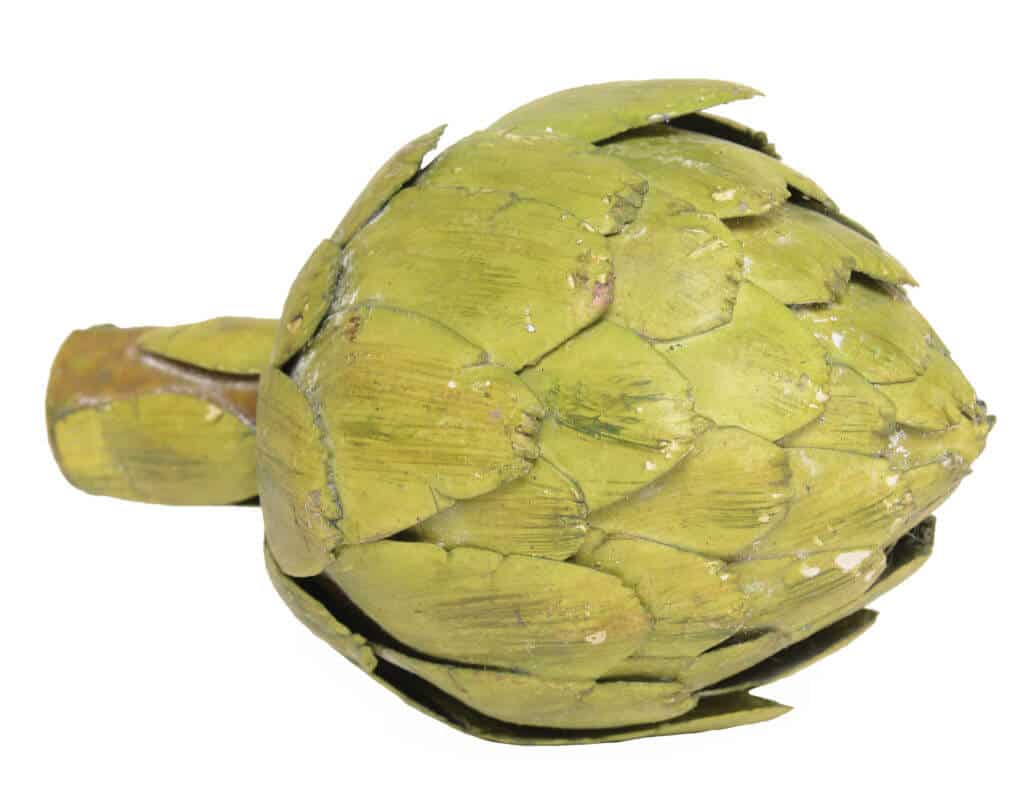
Decorative artichoke, $4.50; Affordable Chic

Pottery coaster, set of 4, $38.95; Form & Function

Small green planter, $25; Form & Function

I love the richness of this deep green. It would look striking against white trim and other white accents in a sunroom….think lacquered white bamboo chairs and other white garden accents. It would make a fabulous front door color against Crisp Linen SW 6378 on the exterior siding.
—Carole Marcotte, Form & Function, formandfunctionraleigh.com
 I love SW Talipot Palm SW6726. Dorothy Draper dressed the walls of many amazing rooms in Palm Greens. I love the fact that tropical colors can bring the outside into your home. Palm Green is often used to define the architecture of a room. Used in fabrics, draperies and accessories, it always adds glamour and vibrancy to any space.
—Tula Summerford, Design by Tula, designbytula.com
 Amy Howard’s One Step Chalk Paint in “Easy Street” is a shade of green that looks as though it were plucked right from the garden! It’s a pretty spring green that’s deep enough to carry you through every season. For your spray painting needs, try Amy Howard’s lacquer spray in Easton Green.
—Laurie Ledbetter, Affordable Chic, affordablechicshops.com
 My favorite shade of Palm Tree Green is Rosemary by Sherwin Williams SW6187. This is my favorite green go-to paint for cabinets and built-ins. It’s a very classic color that works well with anything. This green in my eyes is magic!
—Stephanie Tidwell, Stephanie Tidwell Interiors, stephanietidwell.com

by Layla Khoury-Hanold | Mar 12, 2018 | Eat, March 2018
Microgreens take root in the City of Oaks.
AS THE PLANT-BASED diet trend gains traction, greens are commanding more real estate on restaurant menus and plates, but there’s a tiny yet mighty green that’s vying for more of the spot- light: the microgreen. Not to be confused with sprouts, microgreens are the fi rst true leaves of a vegetable or herb. Often used to give plates a pop of color, some of Raleigh’s top chefs are giving microgreens their due, treating the intensely- fl avored leaves and stems as a stand-alone ingredient that enhance dishes’ fl avors and textures. Locally, it’s all thanks to Tami Purdue.
Purdue, who traded in her career in intellectual property to grow microgreens out of an abandoned shipping container, is the founder of Sweet Peas Urban Gardens, which grows more than 55 varieties of microgreens. It’s not as crazy as it sounds. Through her volunteer work with Inter-Faith Food Shuttle, Purdue learned how to grow microgreens at a workshop led by urban agriculture pioneer Will Allen. Allen promoted microgreens as both a solution to food insecurity as well as a small farm business model, with the caveat that, to be profitable, growers had to sell to chefs. Purdue was so inspired that she immediately drafted a business plan and planted her first microgreen: arugula. During the summer of 2014, Purdue experimented with growing diff erent varieties while analyzing small farm business plans. By the end of the season, she gave up her day job to become a microgreen farmer.
Purdue continued growing microgreens out of her Raleigh residence and brought her fi rst harvest—arugula, pea shoots, a spicy mix with radish, arugula and mustard greens, a mild mix with broccoli, cabbage and kohlrabi, and micro cilantro and basil—to the Wake Forest Farmers Market. Chef Lotah Fields from Farm Table Kitchen & Bar was so ec- static to fi nd microgreens that he bought everything. “That’s what got me inspired that I could do this and that there was a little bit of a market for it,” Purdue says.
INDOOR GROWING SPACES

18 Seaboard’s ribeye with Agrodolce, collard spatial, squid ink aioli and Sweet Pea’s sunflower shoots.
Over the next year, Purdue sold to more restaurants through Raleigh City Farm, where she met Ben Greene, a NC State University graduate whose master’s degree thesis and subsequent business, the Farmery, developed indoor farming technology that converted abandoned shipping containers into indoor growing spaces. “I said, ‘I want one,’” says Purdue. “I looked at the data about how much could be grown in it and it was fi ve times what we were growing in my house.”
The 40-foot grow box’s efficient space and controlled environment allowed Purdue to consistently produce fresh microgreens, much to the delight of local chefs. Her prime location just outside downtown meant that chefs could easily pick up—or sometimes literally pick—their orders. Though Purdue had to relocate to Hillsborough late last year, she will return to Raleigh with two additional grow box installations, one at the Transfer Co. food hall, opening this summer, and one at Rebus Works, where she also sells at their Saturday market. While Purdue has seen more interest in microgreens among consumers—likely due to their purported health benefi ts, as a recent study shows that microgreens pack four to 40 times more nutrients than their fully-grown counterparts— chefs remain her best customers.
RESTAURANT REQUESTS
Four years later, Farm Table Kitchen & Bar is still a loyal customer. Chef Jerome Zimmer uses microgreens to add dimension to everything from fi sh to roasted vegetables, and even had Purdue specially grow micro caraway for a recent Triangle Wine Experience dinner. Its toasty rye notes complemented the rye bread served with a pork pâté and pulled together a branzino dish plated

Farm Table’s Salmon Piperade with onions, peppers, roasted tomato, grilled fennel, chorizo, melted leeks and herbs
with a Russian dressing. Another custom request came from chef Patrick Colley at Caroli- na Country Club, who used slightly bitter pumpkin microgreens to balance the sweetness of a butternut squash bisque. “They [also have] a very thick leaf so they added a subtle texture to the soup along with the pumpkin seeds,” Colley says. “I know this may sound a little strange, but I also felt like they added a certain element of umami to the dish.”
Instead of topping Pharmacy Café’s grilled halloumi sandwich with ho-hum mesclun, chef Patrick Cowden pulls in Sweet Peas’ spicy mix, a blend of cilantro, radish, arugula and mustard microgreens with nuanced peper notes. Bowden has also experimented with microgreens in vinaigrettes, where micro herbs like sorrel yield a bright, refined flavor without the astringency. At Raleigh institution Vinnie’s Steak House, chef Tom Armstrong incorporates microgreens into weekly specials and is particularly into micro herbs. “Right now, we’

Olive tapenade, pickled red onion, slow roasted tomato, lemon-rosemary aioli & spicy mixed greens on baguette
re doing beef carpaccio and we’re using chervil on that,” he says. “I thought about doing fried parsley leaves, but micro chervil has a fresher, cleaner flavor. It’s like a better version of parsley. It brings a mild herbaceousness to the other flavors, like capers, horseradish and egg yolk.” And, at 18 Seaboard, chef Jake Wood also uses microgreens to elevate meaty fare, relying on micro garlic to deliver a pronounced chive flavor and snappy texture to beef carpaccio, and nutty-sweet sunflower shoots to offset the richness of a rib eye. Purdue enjoys working with chefs and seeing her microgreens shine in their creations, but as part of her mission to spread the microgreens love, Purdue donates Sweet Peas’ market leftovers to A Place at the Table, a pay-what-you-can café where chef Aaron Stienessen uses sunflower shoots and pea shoots to deliver fresh crunch to sandwiches and salads.

by Alexandra Drosu | Apr 17, 2017 | April 2017, Retreat, Stuff
Celebrate spring with green shades inspired by the outdoors. The youthful and fresh hue adds serenity and contemporary elegance to any room. Plus, “Greenery” is this year’s Pantone Shade of the Year!

“Amy Howard’s chalk-based One Step Paint in Dunavant Green fits the Pantone “Greenery” description quite well. It’s a happy, spring-green that is beautiful with navy and taupe, just to name two color pairings for this versatile green.”
— Laurie Ledbetter, Affordable Chic

“Let’s dance into the spring of 2017 with Benjamin Moore 2029-50 Potpourri Green. It is alive with youthfulness and color. I live succulents and I just finished this little piece at Inspirations Home Decor and More… love those greens!”
— Sandy Maccioli, Awesome Abode

“My favorite Botanical Yellowish Green is Valspar’s CRUSHED OREGANO 6007-6C. Trim these soothing green walls with a crisp glossy white to create a serene space. Select art with other shades of green to pull the room together. Green is classic, timeless and never boring!”
— Tula Summerford, Design by Tula

by Cindy Schaefer | Mar 2, 2016 | Eat, March 2016
Got a green thumb but no ground? Or want to learn?
Check out a community garden. There are dozens in the City of Oaks, growing fruits, veggies and flowers; some even house chickens, beehives and other animals. Most offer volunteer opportunities, too, so you can have a hand in the planting and harvest yourself.

They’re in the unlikeliest of places—from schools and daycares to churches.
With the desire for local food, it’s easy to see why community gardens have been sprouting up around Raleigh the past few years. Gardens do more than produce fresh, healthy food.
Tending plants becomes a group effort, fostering a sense of camaraderie. Plus, there’s always someone to help if you don’t know what you’re doing. For seasoned farmhands, it’s a prime way to connect with like-minded people and share expertise.
In Raleigh, community gardening is allowed on private property almost anywhere, provided zoning, code and ordinance conditions are met.

About 30 community gardens dot the city, estimates Anya Gordon, co-owner of the Irregardless Café and active proponent of urban agriculture.
“To my mind it has to do with the growing recognition that the food we are eating is making us sick, destroying our environment, using up non-renewable resources and exploiting the underclass of guest workers,” she says.
Gardeners in North Carolina have the advantage of seasonal crops year-round. “In this area, we can grow four seasons, with different crops in each season,” Gordon says. “It’s amazing how much can be sourced locally.”
What’s in season?
Winter: Bok choy, Brussels sprouts, carrots, celery, rutabaga, spinach, peanuts, sweet potatoes.
Spring: Strawberries, arugula, asparagus, beets, broccoli, green onions, mustard greens, blueberries, cabbage, hot peppers, kale, leafy greens, squash, snow peas, zucchini, radishes.
Summer: Blackberries, honeydew melons, peaches, plums, watermelon, turnips, canteloupe, raspberries, figs, grapes, pears, butter beans, corn, cucumbers, eggplant, garlic, green beans, okra, tomatoes, white potatoes, green peppers.
Fall: Apples, muscadines, Swiss chard, winter squash, pumpkins, cauliflower, spaghetti squash.
Well Fed Community Garden
1321 Athens Drive, Raleigh
www.irregardless.com/garden
The Well Fed Community Garden, sponsored by the Irregardless Café, uses organic practices to grow vegetables, fruits, herbs and flowers and provides a home to eight chickens and two beehives. The front yard contains a walking labyrinth and native flower pollinator gardens. The Irregardless Café purchases 80 percent of the produce grown by the garden while the remaining 20 percent is given back to the community. Volunteers are welcome two days a week to learn about urban agriculture.
The Wedge Garden
214 Park Ave., Raleigh,
at Alexander Family YMCA
www.thewedgegarden.com
Established in 2010, the mission of the Wedge Community Garden is to promote a healthy and connected neighborhood through gardening, educating neighbors and volunteers, and sharing the harvest with neighbors, volunteers and the community. The garden got its name from its wedge-shaped plot on Park Avenue.
Alliance Medical Ministry
Community Garden
101 Donald Ross Drive, Raleigh
www.alliancemedicalministry.org/
community-garden
This garden in Southeast Raleigh, founded in 2010, provides fresh produce to the ministry’s uninsured patients. It’s the focal point of a wellness program that provides produce, education and exercise. Volunteer opportunities are available.
Raleigh City Farm
800 N. Blount St., Raleigh
www.raleighcityfarm.com
Raleigh City Farm got its start in 2011 from a group of community-oriented people who wanted to show the importance and value of an urban farm with a social enterprise model.
“Raleigh City Farm grows food – sustainably – on our small plot of land while also working with several local member farms,” says general manager Rebekah Beck.
Member farms receive help co-marketing and branding their produce for sale to local chefs and restaurants and Community Supported Agriculture (CSA) members. “The goal is to help community members know and appreciate where their food comes from by serving as a very active and visible example of urban farming,” Beck says.
Stop by the Saturday Farm Stand (9 a.m.-noon) in the bustling Person Street Plaza area to pick up some fresh produce. Events are held throughout the year incorporating local food, beer and music as well as workshops, farm tours and work days.
On Saturday, April 23, RCF will hold it 4th annual bEARTH day celebration. From 9 a.m. to noon, the community is invited to volunteer at the Farm. A concert and party from 6 to 10 p.m. will follow. Tickets on sale in March.
National Applause
In August of 2015, Crude Bitters and Sodas’ “Rizzo” won the first Good Food Award given to a bitters manufacturer. Rizzo is a bitter flavored with rosemary, grapefruit and peppercorn. GF awards are given to products with high environmental and social stewardship and exceptional flavor.