Seven local nonprofits. One shared mission: putting your dollars to work before a setback becomes homelessness.
A parked car was never supposed to be home. But that’s exactly where one local mother and her two children found themselves after a divorce upended their lives. Bouncing between their car, emergency shelters and, when she could afford it, hotel rooms, she kept working—and saving—determined to secure a permanent home for her family.
And she almost did. The apartment was within reach. The monthly rent was manageable. But the thousands of dollars required upfront to actually move in weren’t. After everything she’d done right, $3,000 stood between her children sleeping in a car and sleeping in beds of their own.
Her story is far from unusual. So many of Wake County’s housing-insecure neighbors aren’t who you might imagine. They’re working parents, professionals and families who were making it—until suddenly they weren’t. An illness. An injury. A divorce. An unexpected death in the family. One ordinary setback that becomes another, and in a flash, the stability they spent years building begins to unravel.
That’s precisely what RM’s Give Raleigh, in partnership with Pinnacle Financial Partners, was designed to interrupt. The annual 40-day giving campaign raises funds for Cooper Charitable Foundation, which puts those dollars to work through seven local nonprofits helping neighbors stay—or become—safely housed.
For this single mother, that nonprofit was Oak City Cares. A $3,000 Cooper Charitable Foundation grant covered the move-in costs, finally allowing her family to trade nights in parking lots for a permanent home. Today, her children have a safe place to sleep, study and grow—and their mother can focus on raising them instead of wondering where they’ll spend the night.
Ten bucks didn’t pay that $3,000. Neither did $20 or $100. But your $10 was never meant to do it alone. Add it to ours. And your neighbor’s. Your mom’s. Your dad’s. Then add Pinnacle Financial Partners’ dollar-for-dollar match of the first $10,000 raised. That’s what Give Raleigh does. That’s how $10 becomes something much bigger.
Last year, those gifts became $118K+ through Give Raleigh—money Cooper Charitable Foundation put into the hands of those seven local nonprofits that know exactly where a few dollars at exactly the right moment can change the trajectory of someone’s life.
A deposit gets paid. A bed gets delivered. A car gets repaired. A student stays in school. A mother stays housed. That’s the $10 difference. That’s what happens when Raleigh gives together.
Meet the Mission
Seven ways your gift can help keep a Wake County neighbor moving forward.
Family Promise of the Triangle | 1993 Home is more than an address. Family Promise helps families move from cars, motels and borrowed couches into permanent housing through prevention, emergency shelter, rapid rehousing and ongoing support.
The Green Chair Project | 2010 Four walls don’t make a home—a bed, table and chair do. The Green Chair Project transforms empty apartments into homes by providing furniture and essentials for families rebuilding after homelessness, crisis or disaster.
Oak City Cares | 2019 Finding support shouldn’t be harder than asking for it. Oak City Cares connects neighbors with housing, employment, health care, meals and other essential services through Wake County’s one-stop hub for homelessness resources.
Wake Tech Fostering Bright Futures | 2009 You can’t put a price on education—until you can. FBF removes financial barriers through tuition assistance, stipends and wraparound support, helping former foster youth stay in school, earn degrees and build independent futures.
Healing Transitions | 2001 Recovery isn’t a straight line. Healing Transitions provides free peer-based recovery services—from emergency shelter and detox to long-term support—giving people as many chances as it takes to rebuild their lives.
The Carying Place | 1993 Sometimes preventing homelessness is as simple as helping a family through one difficult season. The Carying Place combines short-term housing, financial education and personalized support to help hardworking families achieve lasting stability.
The Women’s Center of Wake County | 1977 Everyone deserves a safe place to begin again. Wake County’s only day shelter for single women provides meals, showers, housing support, case management and life-skills programming to help women move from crisis to stability.
How a missed paycheck, a broken car or one unexpected bill can lead to homelessness—and how Give Raleigh is working to interrupt that story.
She clocks out at 4pm—which means she’s already too late. Too late for the only emergency shelter in Wake County where mothers can stay with their children. So instead, she pulls up in a parking lot for another night at “home” in her car.
But she doesn’t have the life you probably imagine. She has a job. Her child has daycare. She did everything she was told to—and still, it wasn’t enough.
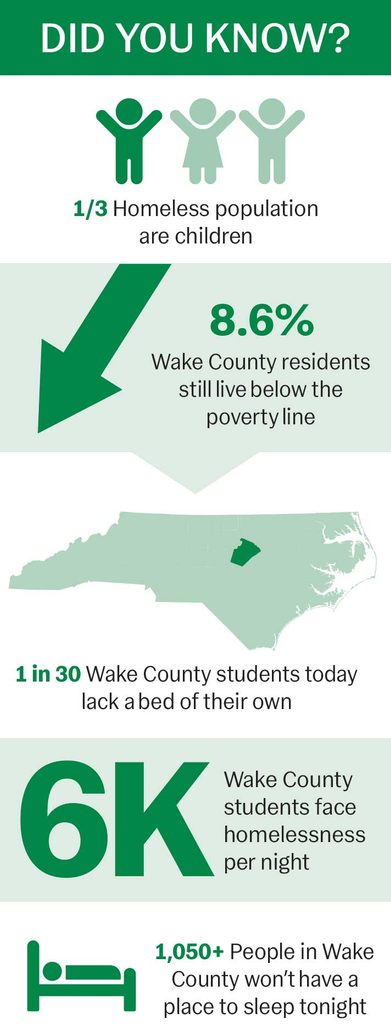
It sounds like an anomaly—but in Raleigh, it’s anything but. Across Wake County, more than 1,000 people are sleeping outdoors or staying in emergency shelters—and the daily waiting list for a bed alone is 120 deep. Behind those numbers are stories—not of people who gave up, but of people who have run out of options: a parent paying $90/night for a motel, a family sleeping in their car, someone choosing between fixing a transmission or paying rent, a domestic violence survivor starting over, a professional who just got wiped out by unexpected hospital bills.
The often-overlooked reality is, most people don’t become homeless because of one catastrophic event. They get there one ordinary setback at a time. The crisis isn’t always losing a home—it’s having no one to solve a small problem before it becomes a devastating one.
That’s where RM’s fourth-annual Give Raleigh comes in. Returning focus to housing insecurity this year, the 40-day giving campaign rallies support for boots-on-the-ground organizations working to keep small setbacks from becoming permanent ones. Kicking off Sept. 1, Raleigh Magazine, in partnership with Pinnacle Financial Partners—which will match the first $10,000—will raise funds for Cooper Charitable Foundation, supporting seven local nonprofits helping keep Wake County families housed, safe and stable.
If you’ve ever moved, you already understand the barrier. Making rent often isn’t the biggest hurdle—it’s coming up with the security and utility deposits, first month’s rent, application fees, and furnishings—all at once. For families already living paycheck to paycheck, those upfront costs can be impossible. Give Raleigh exists to bridge that gap, through locals giving as little as $10 to make a difference.
Efforts like Wake County’s Wake at Home initiative are making meaningful progress moving people from encampments into permanent housing. But local nonprofits say preventing homelessness before it begins remains one of the greatest unmet needs.
Last year, Give Raleighraised $118,180 to help these seven local nonprofits intervene before temporary setbacks became permanent—creating substantial impact in the fight against homelessness. This year, we’re doubling down. Because Give Raleigh isn’t about charity. It’s about intervention. It’s the difference between “I lost my apartment” and “I’m sleeping in my car.”
Meet the Mission
Homelessness is less about who someone is, and more about what happened to them. Last year’s $118K+ raised through Give Raleigh enabled Cooper Charitable Foundation to support seven local nonprofits helping neighbors move from housing insecurity to stability. Meet the missions—and just four of the many families whose stories changed because someone chose to give.
Family Promise of the Triangle | 1993 Home is more than an address. Family Promise helps families move from cars, motels and borrowed couches into permanent housing through prevention, emergency shelter, rapid rehousing and ongoing support.
The Green Chair Project | 2010 Four walls don’t make a home—a bed, table and chair do. The Green Chair Project transforms empty apartments into homes by providing furniture and essentials for families rebuilding after homelessness, crisis or disaster.
Oak City Cares | 2019 Finding support shouldn’t be harder than asking for it. Oak City Cares connects neighbors with housing, employment, health care, meals and other essential services through Wake County’s one-stop hub for homelessness resources.
Wake Tech Fostering Bright Futures | 2009 You can’t put a price on education—until you can. FBF removes financial barriers through tuition assistance, stipends and wraparound support, helping former foster youth stay in school, earn degrees and build independent futures.
Healing Transitions | 2001 Recovery isn’t a straight line. Healing Transitions provides free peer-based recovery services—from emergency shelter and detox to long-term support—giving people as many chances as it takes to rebuild their lives.
The Carying Place | 1993 Sometimes preventing homelessness is as simple as helping a family through one difficult season. The Carying Place combines short-term housing, financial education and personalized support to help hardworking families achieve lasting stability.
The Women’s Center of Wake County | 1977 Everyone deserves a safe place to begin again. Wake County’s only day shelter for single women provides meals, showers, housing support, case management and life-skills programming to help women move from crisis to stability.
Real People, Real Impact
Where Every Dollar Goes
The Green Chair Project $20K granted 136 people supported 72 beds/cribs provided for children 47 households received Essential Home Furnishings Package
If it can happen to Tristan, it can happen to anyone. Earning $85K+ a year with a job, apartment, car and beloved pup Lacy by her side, it was a sudden migraine on an otherwise ordinary workday that brought it all crashing down. After leaving work sick, Tristan blacked out behind the wheel and crashed into a median—and in the aftermath, lost her job, car, apartment and even her dog. “I never knew from one day to the next if I was going to live or die,” she recalls. But with help from The Women’s Center, including Cooper Charitable Foundation funding for her first month’s rent, application fee and security deposit, Tristan found her footing—and a new apartment. Then The Green Chair Project stepped in to turn those four walls into a home, furnishing the space where she was finally reunited with Lacy. Today, she’s not just back on her feet—she’s engaged to her childhood sweetheart and volunteers twice a week at The Women’s Center, helping other women find their way forward. “None of this would’ve happened if it wasn’t for all of you,” she says.
Oak City Cares ~$43.4K granted 35 households helped 35 deposits and move-in costs covered for families moving into stable housing
A parked car was never supposed to be home. But that’s exactly where a local mother and her two children found themselves after a divorce upended their lives. Bouncing between their car, emergency shelters and, when they could afford it, hotel-hopping, she worked tirelessly to save enough for a place of their own. Even then, the upfront move-in costs remained out of reach. Until a $3K Give Raleigh grant through Cooper Charitable Foundation and Oak City Cares changed that—finally unlocking the front door to a permanent home. Today, her children have the stability every child deserves: a safe place to sleep, study and grow. And one mother can finally spend her energy raising her children instead of wondering where they’ll sleep—all because someone chose to give.
The Carying Place ~$7.5K granted 3 families supported Paid emergency funds for transportation issues
For a local preschool teacher and single mother of three, an unexpected car repair to the tune of several thousand dollars threatened to undo years of hard-won financial stability. A 2021 graduate of The Carying Place, she had a stable home, full-time employment and even an emergency fund—until the unexpected expense far exceeded that safety net. Rather than forcing her to choose between reliable transportation and wiping out her savings, support through Give Raleigh and Cooper Charitable Foundation helped cover the necessary repairs. But the impact went far beyond fixing a car: She could still get to work, and support her children and keep her family moving forward—all while protecting the progress she’d worked so hard to achieve.
Family Promise of the Triangle $20K granted 12 people (5 families) helped 4 rental arrears that kept families from being evicted 1 family received security deposit and first month’s rent for permanent housing
Finding a home was only half the battle. After successfully transitioning into permanent housing, a local mother of two thought the hardest days were behind her. Then complications from Stage 5 kidney disease forced her to take a leave of absence from work, leaving her unable to keep up with rent. Just when everything she’d rebuilt was at risk of slipping away, Family Promise—through Give Raleigh and Cooper Charitable Foundation—helped keep her family safely housed. Today, she’s back at work, receiving in-home dialysis and can spend her energy focusing on her health and her family instead of fear and instability.
Raleigh Mag’s 6 most significant issues for the first 100 days
After almost a decade covering every inch of Raleigh from legislation to libations, Raleigh Magazine is primed to posit what we think are the biggest issues facing our city as we usher in a new era. After the votes are counted and the dust settles on election season, a new mayor will take the helm for the first time in five years. Beyond mayor—and on the heels of Raleigh’s youngest and most diverse city council—we stand to have as many as seven new council members take oath, as every district, save District D (Jane Harrison), is contested. So, as we turn the page on our future this December, the first 100 days will serve as a good barometer for where we are headed—and these are the issues that matter most.
Pro-Growth Development Over the last five years, several projects and towers have been voted down—or not presented for fear of a “no” vote. Will the new city government support a 40-story tower Downtown? In North Hills? Our city’s literal shape is on the line. And those first few zoning votes will be very telling.
HousingDensity In our sit-down with Mayor Mary-Ann Baldwin (see “The Notorious MAB” feature), she hones in on housing density as a top priority: “When we approved our comprehensive plan—10 years in the making—it was really built around growth centers as where the density would be, and we’re seeing that happen, connected by transit. … We cannot ignore the fact we desperately need housing—all types of housing.” How the new council and mayor approach the missing middle and housing affordability will be critical to set the tone for our future.
Police Pay On the heels of a 10% pay raise last year, Raleigh police officer salary still only starts at $56,991—which is less than Cary, Holly Springs, Wake Forest and Apex. Will the new government green light another 15% raise to propel our police officer income to a more competitive rate for a capital city?
Bringing Back Main Street Revitalizing Fayetteville Street has been a central focus since DTR’s pandemic decline. In a recent council meeting, at-large member Jonathan Melton expressed the urgency to energize the corridor now—not a year from now. Will the new council approve the funding to revive it—and see it as a priority—to propel our Central Business District and the lifeblood of our city?
Removing Barriers for Small Businesses We’ve reported on the “one-size-fits-all” expensive approach that paralyzes small businesses (think chef Scott Crawford’s Jolie) trying to get off the ground. What will our new leaders do to set the tone and solve this issue of cutting the red tape for business owners?
Recruiting Major League Sports Sports have proven a priority in the market as a critical economic driver. Baldwin, alongside outgoing Gov. Roy Cooper and Canes owner Tom Dundon, have committed to bringing MLB to Raleigh. Now, only time will tell how the next governor, mayor and council participate in and propel these efforts.
The squeeze is real—but despite astronomical price increases, Raleigh remains one of the most affordable major metros in the U.S.
Feeling a war on your wallet? Who isn’t. If you can’t shake the feeling that “cash rules everything around me,” it’s because, well, it has been for a while now. But in a world where no matter how much you make, it has cost more to do (or have) less for a few years now, the good news is, your dollars go further in Raleigh.
But the squeeze is no doubt real. U.S. inflation peaked at 9.1% in its stratospheric ascent in June 2022, reaching the highest level since 1981—even outpacing wages from April 2021 through this spring—with no sector unaffected… and leaving us nowhere to hide (hey, skyrocketing home prices, utilities and dinner tabs). School meals soared a staggering 300+% over the previous year in January 2023, as housing, staples and everyday needs also spiked.
While we felt the heat turn up on burning budgets in Raleigh, turns out our fair city remains relatively affordable. Especially now, as inflation eases—holding steady at 3.7%—Raleighites are starting to feel relief at the pumps, the grocer and in a cooling housing market. In a side-by-side comparison to a handful of major U.S. metros, Raleigh proves why she is still the best place to live.
Raleigh on the Rise
Inflation is no joke—and spiraling costs in most sectors can make it feel like living in Raleigh is becoming unaffordable. While costs are no doubt rising across the board—with housing jumping ~$150K in the last four years alone—Raleigh remains a very affordable place to live across all categories in a cost-of-living comparison. In essence, “there’s a reason we consistently show up in those Best Places to Live lists, with a regional cost-of-living index below the national average,” per Work in the Triangle data. But seeing is believing. So we tapped Work in the Triangle’s super-cool online interactive tool that allows you to compare cost of living in a handful of metros known for migrating or serving as comparison to our City of Oaks.
How Cost of Living Stacks Up
Boston
Chicago
Philadelphia
Manhattan
Austin
$100K Annual Salary
Will go 34% further in the Triangle
Will go 15% further in the Triangle
Your salary will go just as far
Will go 57% further in the Triangle
Your salary will go just as far
Groceries
13% less in the Triangle
10% less in the Triangle
14% less in the Triangle
22% less in the Triangle
Cost about the same
Housing
55% less in the Triangle
32% less in the Triangle
Cost about the same
80% less in the Triangle
13% less in the Triangle
Avg. Home Price
$935,580
$550,943
$437,562
$2,559,715
$506,117
Avg. Apartment Rent
$3,826
$2,944
$1,594
$4,773
$1,843
Utilities
20% less in the Triangle
9% more in the Triangle
7% less in the Triangle
Cost about the same
9% more in the Triangle
Transportation
26% less in the Triangle
18% less in the Triangle
12% less in the Triangle
18% less in the Triangle
6% more in the Triangle
Health care
7% less in the Triangle
You won’t notice a difference
You may pay a bit more in the Triangle
You won’t notice a difference
You may pay a bit more in the Triangle
Misc. (salon, vet, movies)
20% less in the Triangle
Cost about the same
Cost about the same
27% less in the Triangle
Cost about the same
Raleigh vs. National Average
Avg. home price : $423,402 vs. $469,810
Avg. Apartment rent: $1,706 vs. $1,440
Gas: $3.81 vs. $3.80
Phone: $185.16 vs. $192.26
Total energy: $196.32 vs. $185.44
Doctor visit: $134.79vs. $129.92
Veterinarian Visit: $51.52 vs. $62.73
Housing and Living Numbers Breakdown
Population Growth: 529,550; 17% growth 2011–2021
⬆️ 3.8% South Atlantic region (eight states and DC) recorded the highest annual increase in consumer prices YoY as of end of September
$455K: 2023 Wake County median home price, ↓ $9,750 decrease over year prior
Food Finance
Remember when a carton of eggs outpaced a gallon of gas? And never mind what people will pay for Sriracha. But despite that behemoth bump, menu prices started outpacing supermarket staples this spring—and while both are trending downward, food away from home rose 6% year-over-year from September 2022 to 2023, compared to only 2.4% during the same time frame for groceries (the smallest 12-month gain since December 2021). Here in Raleigh, regional menu price growth also continued to slightly outpace national growth.
“Restaurant margins are much leaner than people believe,” says Amber Moshakos, president of LM Restaurants, who owns and operates such local gems as Vidrio, Taverna Agora, a’Verde and Carolina Ale House, and a scad of restaurants in Wilmington and Florida. “We focus on being efficient and smart in all areas of our business—from labor costs to costs of goods to overhead. We work on the controllables of the business. Utilities, paper goods, laundry and such are good ways we watch the overall business while not constantly adjusting price.”
As people start to pull back on dining out or make less expensive food choices, says Witek Marketing President Trish Witek, who works with numerous popular Triangle sup spots, restaurateurs “are aware of these cost thresholds and are doing everything they can to minimize menu increases. But at the same time, they have to pass on those continuously increasing costs to stay in business.”
While you may have seen price increases at some spots, other restaurateurs prefer to eat the costs instead of passing the burden to their patrons. “No restaurant can really raise prices to cover true costs of business,” maintains Moshakos. “We focus on hospitality and creating a great experience so guests will come back.”
One way she says LM offsets rising expenses is by actually increasing guest visits. “The main focus for us is to keep our quality standards high,” she says. “We cannot shortchange the guest experience.” That said, if increases are applied, restaurants will try to do so in the most guest-friendly way possible, like spreading the price increase in smaller increments across myriad menu sections so it is less impactful, she says.
“[People experience] sticker shock—but they don’t realize how much labor goes into the free chips and salsa you might expect on the table.” —Cheetie Kumar, Ajja
“Inflation impacts everybody,” Ajja owner Cheetie Kumar said in a recent Bloomberg interview. “We absorb all those costs, but we can only absorb so much because our margins are already so thin.” And while some item prices (like eggs) may be going back down, others are going up—so it’s always fluctuating, she says, noting that we’ll never see the prepandemic prices on staples like cooking oil again. And local restaurants are not in a position to negotiate pricing.
4 Most Common Staples Restaurants Order Most
Cooking oil: “Almost tripled in cost—the price is coming back down a little, but nowhere near where we used to be.”
Dairy (milk, butter, sour cream, etc.): “Dairy is still high and continues to fluctuate—at one point double market costs.”
French fries: “French fries remain high, as do eggs. … We don’t anticipate seeing a change in fry costs until the next crop.”
Eggs: “Eggs are also a staple. Last year was at the highest market due to bird flu. We have now seen egg prices come back down, but we aren’t back to original prices yet.”
“You can’t have a menu without these staples, so we have to sharpen our pencil on how to carry the costs without making unreasonable price increases. We can’t overprice ourselves.” —LM President Amber Moshakos
“Swipe life,” meet swipe fees. Using a credit card at restaurants and bars could cost you as service charges for credit-card use become common practice in cities like New York—and Raleigh isn’t far behind. Locally we’re seeing fees at places like The Piper’s Tavern (3.5%), Ladyfingers (3%) and Dram & Draught (2.5%), among others—with more considering the fee for 2024.
~$502 Million The staggering amount Mastercard and Visa plan to hike swiping fees on restaurants and other businesses over the coming months
While credit card fees already rank as the third highest cost for U.S. restaurants, some experts simply see it as the cost of doing business and maintain those processing fees should not be passed on to patrons. “Penalizing them for paying in a way you accept but do not prefer seems to me to be a very ungracious policy,” hospitality professor Jonathan Deutsch, PhD, told Restaurant Business.
Other insiders see the fees as a life vest for the industry. “Credit card companies continue to chip away at what has become a very narrow profit window for the hospitality industry,” says a local industry insider, bemoaning swiping fees as a last resort against slim margins and charges handed down by credit card companies. “We need to try to recoup fees where we can. So it’s not a matter of if, but when.”
“I say who, I say when, I say…” how much. Suddenly Julia Roberts’ dramatic 1990 outburst pushing against paying clients in Pretty Woman feels very relevant today for tipping. … “Tipflation” is a trending term this year, burning up the media circuit, social channels and brunch talk as we navigate the changing rules for tipping and tipping fatigue in the wake of pressure to tip on, well, everything. The takeaway? While some local businesses like Layered Croissanterie require a tip to order—in this case, online—arguably the best part about tipping is the choice. In our chat with a cadre of Raleigh cafe, bar and restaurant owners this year, 20% remained the average suggestion for tipping on bites and beverages, with 30% encouraged for exceptional service.
What Raleighites Make & Do for a Living
Got talent? In spades, actually. Raleigh ranks as the No. 1 place for business and careers for a reason. As one of the most highly sought-after cities in the country touting some of the most educated professionals, Raleigh is a dynamic economic hub with businesses stacking up among some of the world’s biggest. Driven by skyrocketing growth in population, a diverse pipeline of talent, outstanding quality of life and low business operating expenses, Raleigh rates as a top place for business with a slew of corporate headquarters, and technology and life science companies in the area.
10 Fastest-Growing Occupations Across Wake County
OCCUPATIONS HOURLY SALARY
Laborers and freight, stock, and material movers, hand $15.92
Software developers $62.46
Registered nurses $37.34
Home health and personal care aides $13.54
General and operations managers $51.00
Cooks, restaurant $15.30
Waiters and servers $11.05
Stockers and order fillers $14.95
Market research analysts and marketing specialists $33.72
Heavy and tractor-trailer truck drivers $22.88
MAJOR EMPLOYERS
Advance Auto Parts
Bandwidth
Gilead Life Sciences
Martin Marietta
Merz Therapeutics
Pendo
Red Hat
Wages
According to the Economic Policy Institute, in July 2022 at the peak of inflation, the federal minimum wage was worth less than any time since February 1956 when the federal minimum wage was 75 cents per hour—or $7.19 in June 2022 dollars. And July 2021 had marked the longest stretch of time without a federal minimum wage increase since Congress first established the wage in 1938.
30 States & DC Have Higher Than Federal Minimum Wage
$20 Minimum wage for fast-food workers in California— highest in U.S.
Life$tyle Look
How much it costs to live in Raleigh with a certain lifestyle
Do you ever look at a house or a car or a grocery cart and wonder how much it costs to live that way? Who doesn’t. While everyone’s lifestyle is unique, we took a snapshot of a half-dozen-ish real-life Raleighites to see how much they spend monthly to maintain it.
North Raleigh Wellness Guru Monthly budget $3,000
27-year-old single post-grad rocking a job and a side hustle for extra $$, rents an apartment in central North Raleigh that has utilities and internet bundled in rent, and would rather eat ramen than give up the gym membership, but shops to survive at Harris Teeter and eats out twice a week. Drives a paid-off old Prius and travels quarterly on the cheap, and—the linchpin here—charges everything on their credit card and never pays it off in full to keep up the lifestyle.
53-year-old marrieds-with-no-children living in a four-bedroom paid-off home in Central Raleigh with one paid-off car that rolls out only when necessary. They prefer walking and biking everywhere, keep a beautiful lawn, shop at Walmart, travel and eat out infrequently—but always budget tea at Ladyfingers—and are wealthy on account of spending only what is necessary.
Midtown Marrieds Monthly budget $8,500
47-year-old married mother of two public school-attending tweens living in a 3-BR dual-income home in Midtown who lives for lattes and leg day at the gym, shops at Wegmans and Target, drives a Volvo and rocks two car payments (her husband has an Audi), travels three times a year, orders in twice per week, and goes out to eat ~once per month.
Downtown Dude Monthly budget $4,700
40-year-old single professional living in a 1-BR high-rise in DTR, who loves shopping and live music, eats out most of the time, scores pantry staples at Publix (but who needs groceries?), and travels quarterly.
West Raleigh Dog Mom Monthly budget $6,300
45-year-old single professional living in a 3-BR townhome in West Raleigh with a fur child and an Acura SUV on lease who spends more than she should on Amazon, happy hours and the veterinarian, scores fresh produce from Hungry Harvest and pantry staples from Target and Food Lion, orders in and eats out ~twice per week, and plans more trips than she actually takes.
Budding Brood Monthly budget $9,325
34-year-old married real estate agent, mother of three tots under the age of 5, living in a three-bedroom two-income single-family home in Northeast Raleigh, who spends her budget on Costco groceries, childcare and gas toting the family team back and forth to daycare, Saturday soccer, and activities with friends in their Honda Odyssey and Toyota Camry. Eats more McDonald’s than she cares to mention, dreams of date night and one day traveling again.
North Raleigh Near Empty-Nesters Monthly budget $9,550
62-year-old New York transplant near-empty-nesters with one kid in college and one nearing graduation, with one stable income and an affinity for New York prices. They spend their money on tuition, plenty of auto expenses, lawn care and takeout, shop at Publix and travel monthly (mostly to see their child).
Shutterstock; Sources: U.S. Bureau of Labor Statistics; Work in the Triangle; Wake County Register of Deeds, U.S. Census Bureau, EMSI estimates; US. Census Bureau, ESRi forecasts; Raleigh – (LAUS) – Dec. 2027; Redfin; EPI. All data as of press time
New study explores the gender gap in the housing market.
It’s 2022 and gender inequality is still an issue. And now, it’s affecting the already ubercompetitive housing market, as evidenced by real estate provider PropertyShark’s recent study exploring the gender gap in real estate—which has grown exponentially over the past five years.
According to the study, single women can only afford a home in 17 out of 51 top U.S. markets while men can buy in 29. Lucky for female Raleighites, however, the City of Oaks is one of those 17 affordable markets.
To conduct the study, PropertyShark used data on median incomes for men and women from the U.S. Census Bureau’s 2020 statistics, and then applied it to a calculated average monthly mortgage payment. (Affordability was defined as the “upper limit on monthly mortgage payments at 30% of monthly income.”)
When looking at our fair city, PropertyShark found that Charlotte is unaffordable for single women, requiring female buyers to put 35% of their local median income toward a mortgage, while male buyers only put 26% (so much for the Queen City nickname, huh?).
The City of Oaks, on the other hand, only requires 22% of the local median income to be put toward a monthly mortgage for female buyers and 17% for male buyers, making it affordable for both single male and female future homeowners—a stat that makes Raleigh the No. 5 most affordable city for single female buyers! (Though we still acknowledge the 5% disparity, ahem.)
BTN
34: Number of cities single women cannot afford to buy in today. (This number is 10 more than just five years ago.)
22: Number of cities single men cannot afford to buy in today
49%: Amount of median national income single women have to spend to pay a monthly mortgage payment
32%: Amount of median national income single men have to spend to pay a monthly mortgage payment (aka men are barely over that affordability threshold nationally while women are almost 20% over it.)
22: The number of cities where male and female buyers can’t buy, which has risen from 14 since 2017