The Midtown mixed-use destination is set to file a new rezoning request.
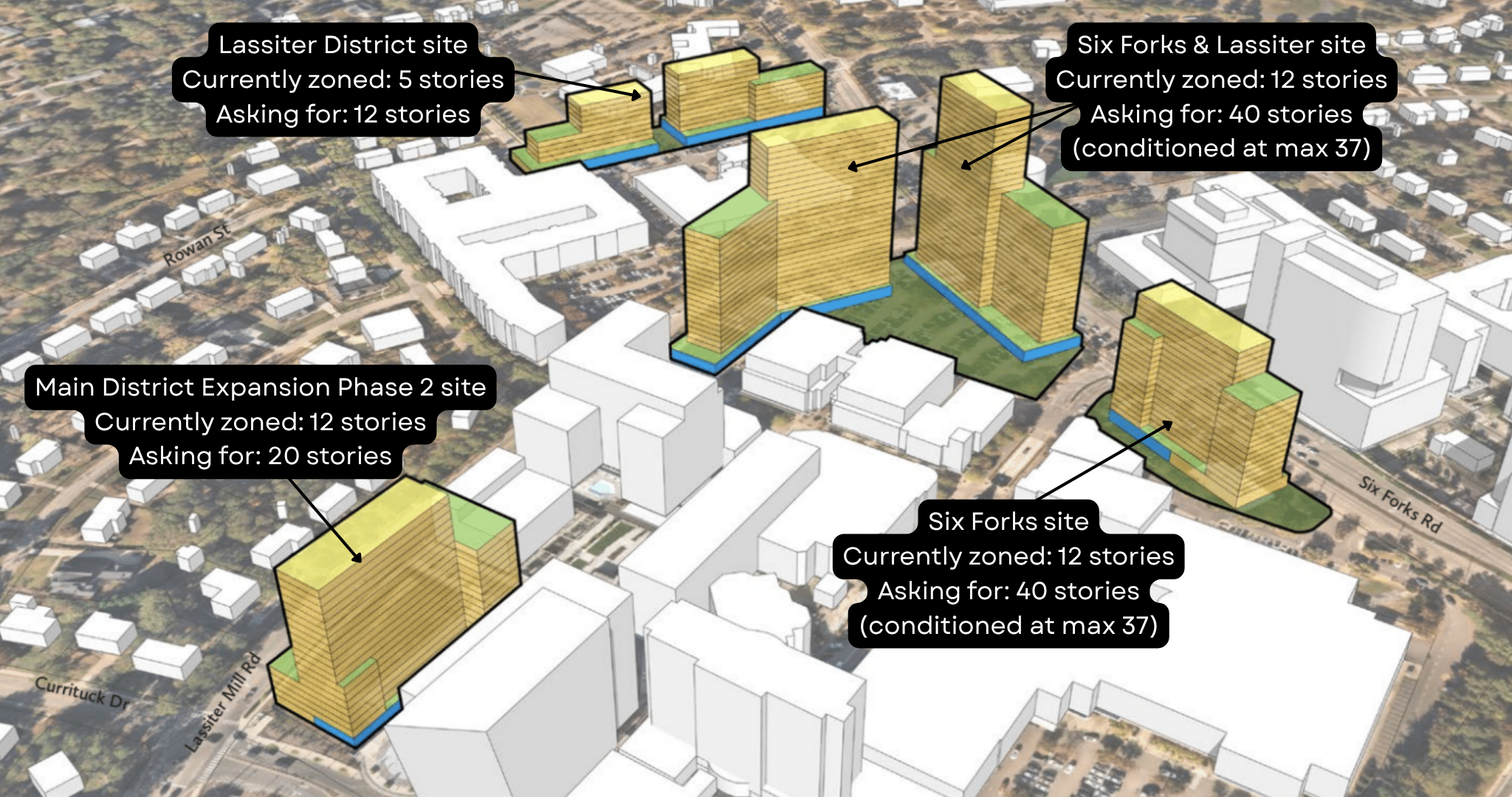
North Hills wants to grow again—but this time, the aim is to go up rather than out. The booming Midtown development is slated to request rezoning updates for five parcels in the North Hills Main and Lassiter Districts in August, with the plan to keep the allowable density the same while increasing heights to 12, 20 and 37 stories (see map)—plus enable more open public space, pedestrian amenities, ground-floor activation and a varied skyline.
“North Hills has evolved into a world-class mixed-use destination… and activation is everywhere,” maintains Barry Long, principal and president of Urban Design Associates, the design firm supporting North Hills’ exploration of best uses for the remaining developable sites. “A few auto-oriented sites, such as the gas station at the corner of Lassiter and Six Forks, remain at the perimeter. The North Hills team is pursuing a zoning modification to transform these outdated lots into meaningful places.”
The request comes ~four years after they submitted a controversial rezoning in 2021 asking for a 30-story tower at the intersection of Six Forks Road and I-440—which was later withdrawn in 2023 upon opposition from City Council and community pushback.
“The last premier parcels in Raleigh’s Midtown deserve the best we can create with the appropriate balance of height, density and beautifully landscaped ground level spaces.” —John Kane
Now, North Hills tells Raleigh Magazine in a sit-down interview they’re taking a different approach, pulling inspo from how the community interacts with the open public spaces across the development—from Beach Music to Midtown Park to the new Main District Expansion spaces. To wit, Kane Realty is holding an Open House July 30 at Church of the Apostles from 5–7pm to gain feedback from the public to shape the new rezoning application and appease some previous concerns.
The North Hills team is already working with the city to identify some of those community needs and priorities. “We want to have a lot of opportunities throughout this process to talk with city staff, council and the community as a whole to make sure the project can deliver meaningful public benefits,” says Kane Director of Development Kallie O’Haren Walker—with one possibility potentially including the upgraded Fire Station 9 along Rowan Street conditioned in the first rezoning.
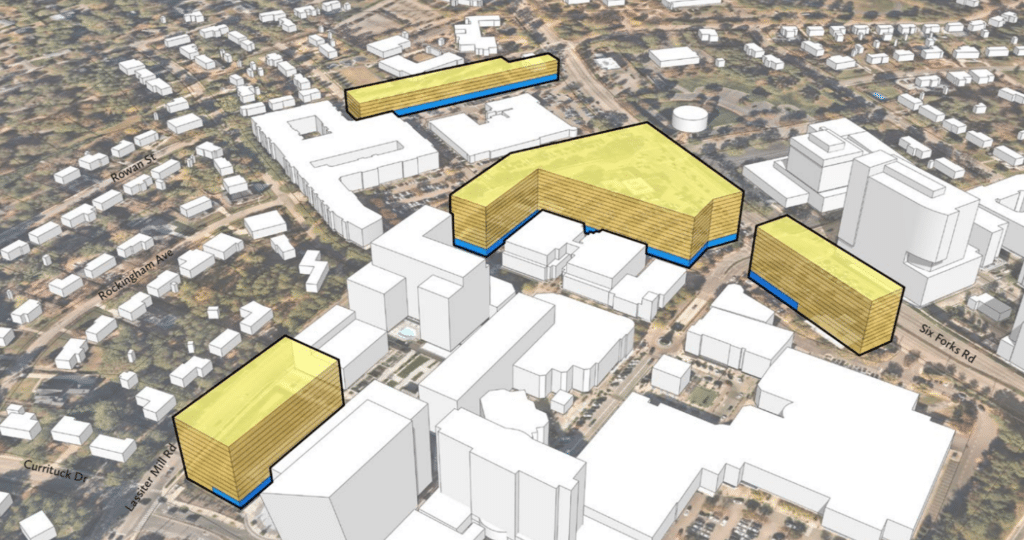
But the key difference in the new proposal, while asking for a height increase, is not asking for increased density or square footage over what is currently allowed (2,500 residential units and 3 million total square feet). “We’re changing the shape of what we’re zoning, not the scale,” maintains Walker.
North Hills Current Allowable Density
While specific plans are in flux, Walker imagines the likes of public gathering areas, ground-floor retail and restaurants, with opportunities for outdoor activation and dining—plus improved pedestrian and bike connectivity. Walker also notes the North Hills team is very aware of traffic concerns in the area and is proactively looking into solutions for vehicular travel as well.
As such, the Lassiter and Six Forks sites will feature integrated parking decks, with the potential addition of below-ground parking, says Walker. The increased heights will also enable outdoor amenity spaces within the buildings themselves.
All this said, these projects are at least five, 10, 15 years down the road. “We want to acknowledge that some of the properties included in the rezoning case are home to active businesses,” notes Walker. “We have no imminent plans to start these projects—this is a long-term planning process and it’s about future flexibility, not immediate changes or impacts to those businesses.” With another community meeting set for sometime this fall, it’s only a matter of time until we see how North Hills will shape up—literally.
What’s Going Where:
Six Forks & Lassiter site: Exxon gas station and tire shop (4369 Six Forks Road), currently zoned for 12 stories, asking for 40 stories (conditioned at 37)
Six Forks site: North State Bank lot (4270 The Circle at North Hills St.), currently zoned for 12 stories, asking for 40 stories (conditioned at 37)
Wells Fargo Bank lot (4220 Lassiter Mill Road) – currently zoned for 12 stories, asking for 40 stories (conditioned at 37)
Lassiter District site: Walgreens strip (4441 Six Forks Road), currently zoned for 5 stories, asking for 12 stories
Main District expansion phase 2: Empty parcel on Lassiter Mill (next to the Beltline), currently zoned for 12 stories, asking for 20 stories
North Hills on the rise with new residential tower.
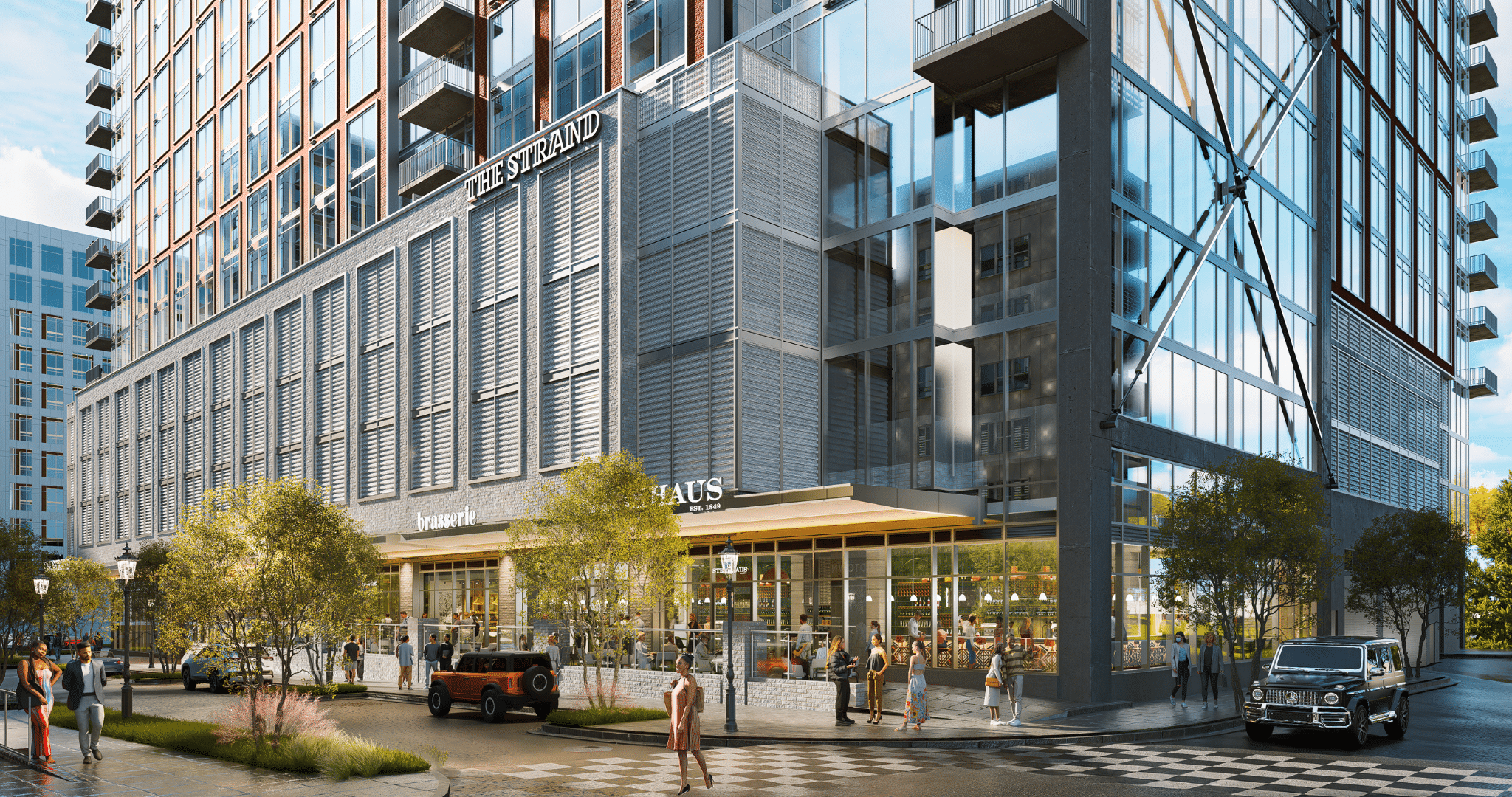
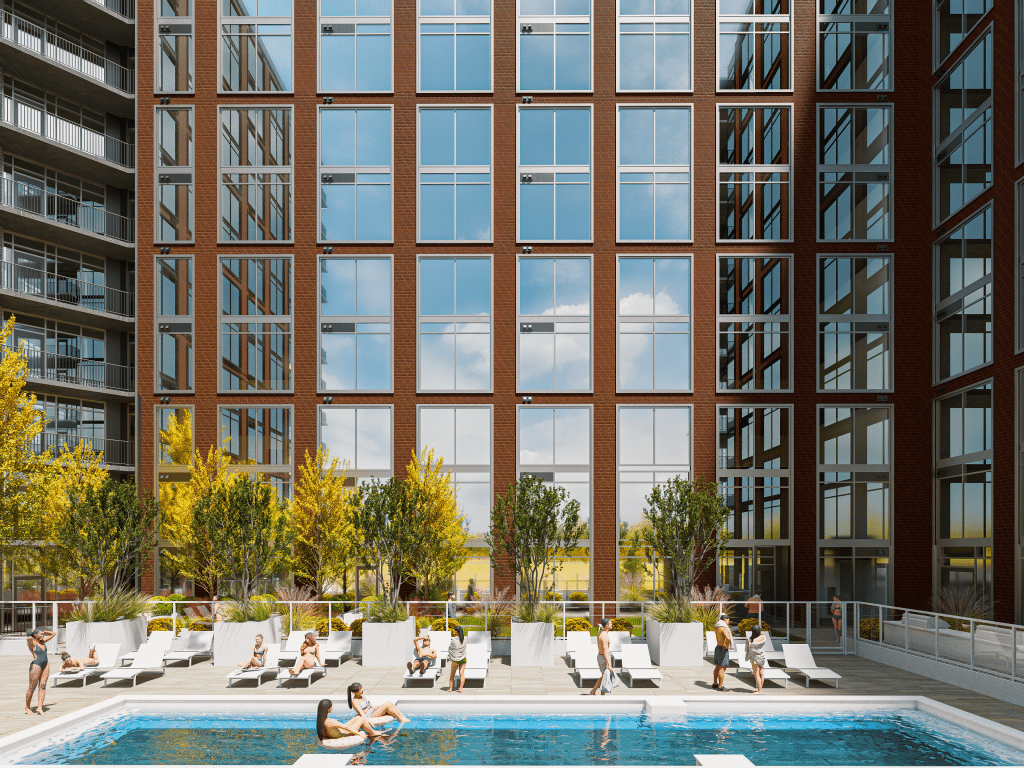
“Luxury” has become a popular buzzword in the local residential development world—but Kane Realty Corporation’s newly announced The Strand in the Park District at North Hills promises to fully deliver on its promise of luxe living… and then some.
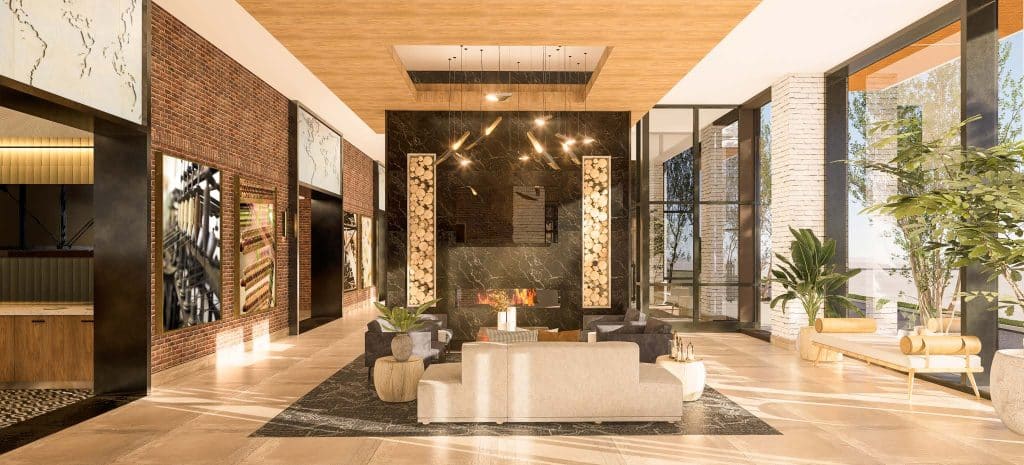
With Atlanta-based Rule Joy Trammell + Rubio leading the design, the architecture firm is taking the aesthetics and trends seen in the ATL market—and beyond—and introducing them into the 2027-slated 20-story, 362-apartment project, which includes studio; one-, two- and three-bedroom layouts; and penthouses.
“We’ve certainly been inspired by some of the larger metropolitan areas—especially across the Sunbelt—that may be a few more years advanced than our market, and starting to bring those amenities here to Raleigh and stay on the cutting edge of what residential developers are doing across the rest of the country,” says Kane’s Kallie Walker, adding the tower is already poised to “stack up well against other high-rises in North Hills with top-of-the-line finishes.”
Case in point: The Strand’s lineup of amenities are taking Raleigh living next-level, delivering elements not seen in other local apartment buildings. Think a hidden speakeasy accessible only to top-floor penthouse residents, each treated to their own wine locker (!), plus two additional club rooms available to all residents: one on the sixth-floor amenity deck with the pool and fitness center, and another on the 18th level.
Also unique to the building, the fitness center and club room will serve up an indoor/outdoor connection, in addition to a lap pool—with what will be “the largest outdoor amenity deck certainly in North Hills, if not in Raleigh as a whole,” maintains Walker. Not to mention given its orientation, The Strand will have some of the best views of DTR that North Hills—or anywhere—has to offer.
Its name a nod to NC’s textile industry, The Strand will embrace a sophisticated industrial feel throughout, seen first and foremost in its distinctive exterior architecture—featuring cross bracing that’ll add interest and excitement to the development’s entire skyline. “It’s like a true structural representation of what’s happening inside the concrete of the building that will be reflected on the outside,” explains Walker.
That fabric theme will continue inside, with textural moments throughout the interior spaces and local art. “A lot of the feel to it has to do with integrating into the community itself,” shares RJTR Director of Marketing Chizoba Ibeanusi—“blending the aesthetic of the design with the overall neighborhood, as well as really using materials that give that industrial feel.”
On the public-facing side, The Strand will bring much-needed dining to the area via a potential restaurant partner—a national brand with a local presence, says Walker—already eyeing the whopping 9,000-square-foot ground-floor retail space, with outdoor space stretching the entire front.
And for those concerned about losing the surface lot The Strand is replacing, those short-term retail spaces will be covered in the ~500-spot five-story integrated deck—plus all the short-term parking at Park Central and the Advance Auto Parts tower.
“We continue to develop in North Hills because the demand continues to be there,” claims Walker. “There’s been a lot of chatter about the pipeline and apartment deliveries especially over the past two-ish years—but we’re excited for The Strand to be the only high-rise delivering in the market in 2027.”
CityPlat plans to transform the former Kmart department store into a live, work, play concept.
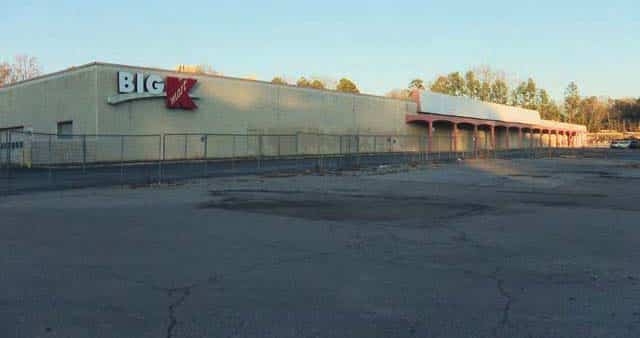
The eyesore that has long plagued West Raleigh is finally getting new life—and, as such, all the recent surrounding urban development can finally start to come together. After sitting empty since 2018, the locally loathed former Kmart building on Western Boulevard that grates on eyes as far as from the Beltline has been scooped up by CityPlat, with plans for a live, work, play concept—think similar to Kane Realty’s mixed-use North Hills Main District.
Photo courtesy of WRAL
“This is a legacy project for us,” says CityPlat investment leader G Patel of the last major site left on the Beltline. “This is a very large undertaking for our firm. We’ve had our eyes on this site for many years, and it finally aligned to where we can take this project on and feel comfortable with it.”
The prominent location of the site will lend itself to the project becoming a family-forward flagship destination, with the firm “being cognizant about how to make the impact and the changes the site needs.” Building out the 12.08-acre property in phases, CityPlat plans to upgrade the property from the ground up—exterior, landscaping, utilities, parking—to repurpose the existing 117,000-square-foot structure.
Rendering by Redline Design Group, courtesy of CityPlat
Rendering by Redline Design Group, courtesy of CityPlat
And—as Beltline regulars may have noticed—construction is already well underway. After officially breaking ground in January, the dated Kmart building was completely gutted. Now, CityPlat is whiteboxing spaces for future tenants. Taking notice of where Raleighites want to be and what they want to be doing, the firm aims their focus on fitness facilities, sports and recreation concepts (hey, pickleball courts!), and entertainment spaces to activate a fam-friendly lifestyle.
Upping the accessibility factor, the development will flow seamlessly with public transit via easy access to a future bus rapid transit line—a major perk once living spaces round out the mixed-use ecosystem. “That is years down the road,” notes Patel. “It’s definitely a BRT overlay, so having density there would be ideal for the site.”
Garnering residents and visitors to the complex will eventually link local districts and even suburbs. “It’s a great connector—you have the university right there, you have Lenovo’s resurgence and the Blue Ridge Corridor, and then the connectivity between Cary and Raleigh,” emphasizes Patel, who has been heading local entrepreneurship endeavors since 2006. “It’s just such a great hub to activate that.” And West Raleigh is poised for a new destination.
Raleigh parking is getting more strict—here’s what you need to know.
“Parking” has become a dirty word in Raleigh. Long ahot-button topic—especially Downtown—people tend to opt for mixed-use developments or big-boxes that have ample free spaces. But a new wave of parking enforcement may shift that perspective. If you thought that $15 ticket for overstaying your welcome on a DTR street was bad, try a $265 fine to get a barnacle off your windshield in a North Hills lot otherwise known for being relatively lax about enforcement.
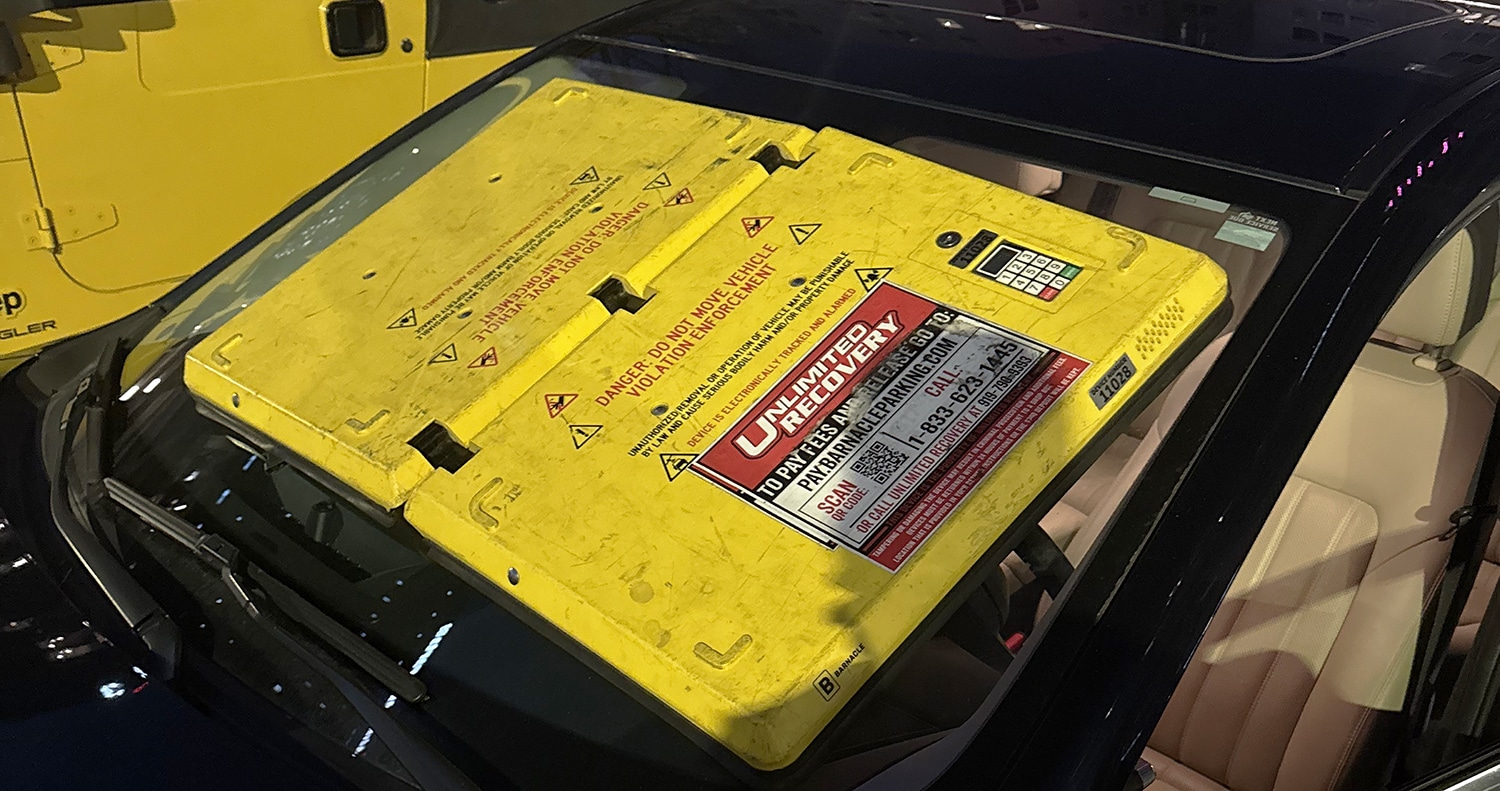
Barnacle Know-How A barnacle is a device that snaps to a vehicle’s windshield, blocking the driver’s view and making it impossible for them to drive away. To remove it, the violator must scan the QR code on the barnacle and pay a fine to get a code that will release the device’s suction. They then must deposit it in a nearby dropbox, after which they’ll typically receive a deposit back.
Learning the limits of that leniency firsthand, a North Hills regular was recently met with a bright-yellow barnacle clamped to his windshield—something he’d never before encountered—after spending a day doing business in the mixed-use development. “I’ve parked there for four, five hours at a time before and never saw anyone get ticketed or towed,” he says.
When he reached out to Unlimited Recovery, one of the third-party services that patrols the lots, he was told the price was nonnegotiable—regardless of being on-site for business. “This is an issue,” he laments. “I know [North Hills] needs to enforce limits, and you can’t just leave your car there overnight, but how do you do it the right way?”
That question, and the implementation of fines in general, taps into the reality that even a parking space that claims to be “free”—whether lot, street or deck—never truly is. Someone always has to pay for it—even if it’s not you. Now, mixed-use developments across town traditionally touting free parking are trying to find ways to restrict and limit parking spots via fines and constraints. Here, we dive into the rules and penalties being employed—and how to navigate them.
Village District
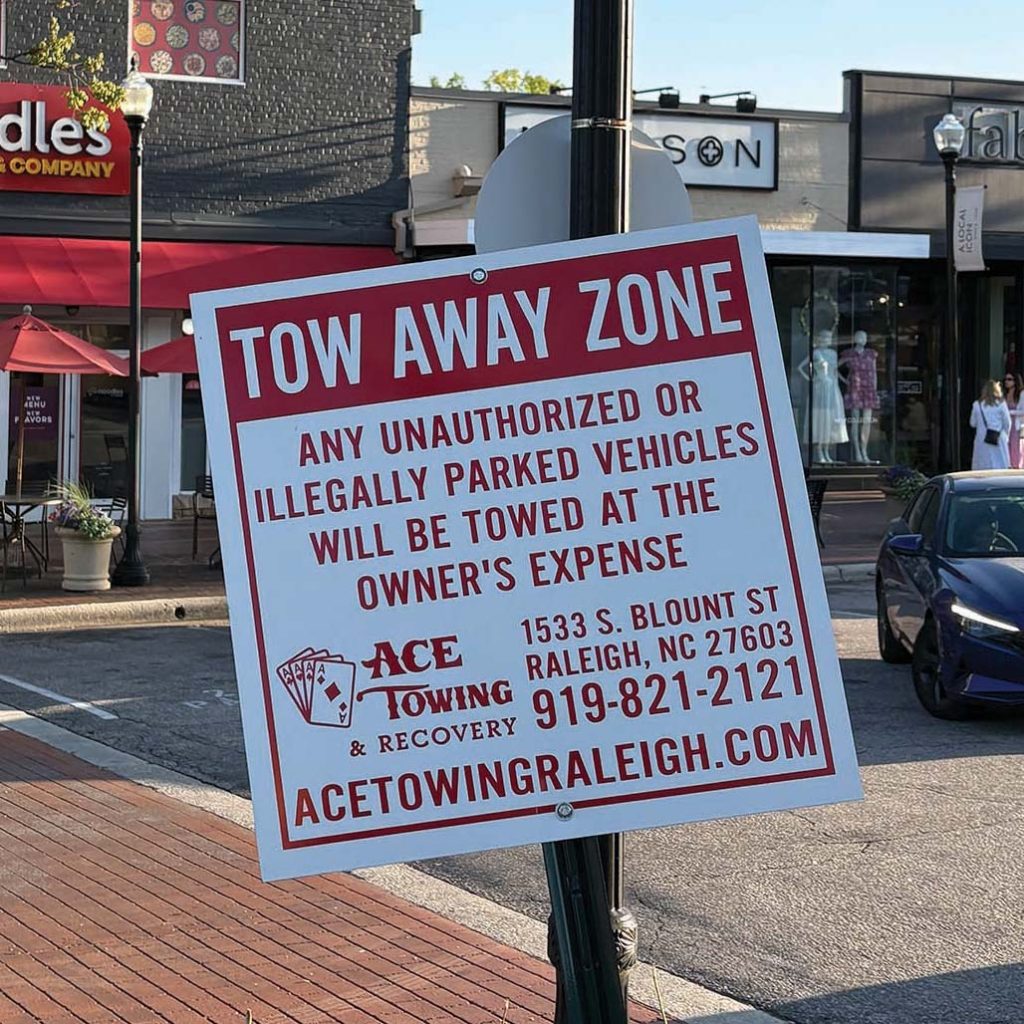
Photo by Raleigh Magazine
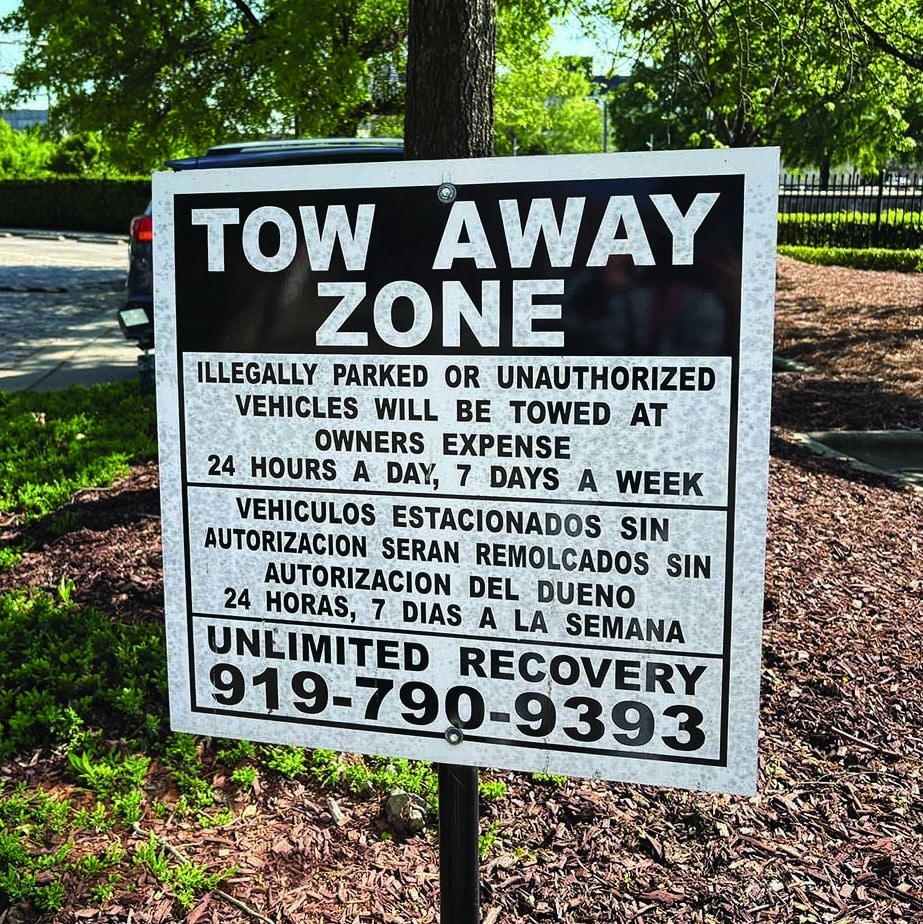
“Tow away zone” signs now dot Village District, part of Regency Centers’ efforts to keep parking in check that started in 2023 with restricting storefront and sidewalk spaces to two hours, while leaving the rest of the spots unrestricted. Visitors parking beyond the posted two-hour limit will first get a written warning, with repeat violators getting towed at their own expense.
Village District GM for Regency Centers Brooke Conn notes parking at the DTR-adjacent 18-hour destination is the hardest obstacle to overcome, given the volume of businesses and employees—and expanding parking is limited by cost and available land. The current model helps to “reduce long-term employee parking and keep spaces available for customers who might not be staying for an extended period,” she explains, nodding to the positive feedback they’ve received from both operators and customers.
“We think we’ve found a balance with the current parking setup and are constantly reviewing the trends at the center for peak visits,” adds Conn, also noting Regency is looking at parking trends in other regions and researching national parking initiatives in an effort to improve demands and adapt to the needs of their shoppers.
North Hills
Photo by Raleigh Magazine
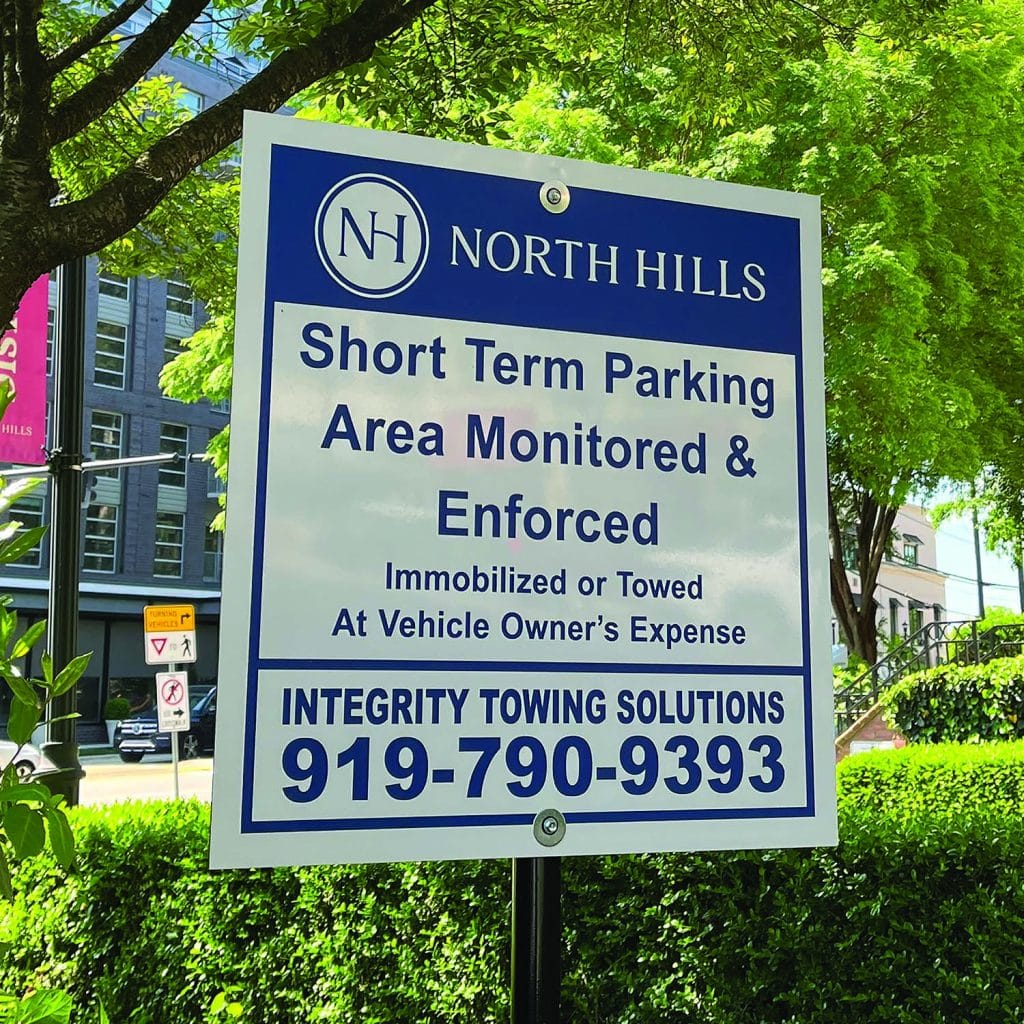
Known for decades for its vast unlimited free surface parking lots, myriad enforcement tactics from towing to barnacles and boots are part of a strategy Kane Realty Corp. has gradually rolled out. Kane’s Hannah Smith emphasizes North Hills has always monitored and enforced a two-hour parking policy. But violators don’t get an initial warning—as current signs state, they’ll be “immobilized or towed at vehicle owner’s expense.” And no portion of fines go to Kane.
“We are always looking at parking and working on fulfilling new needs and challenges as they arise, especially as our property grows,” says Kane Realty’s Dawn Baker, noting the majority of deck and lot parking remains unrestricted unless marked otherwise.
To wit, short-term retail parking has been moved to the lower levels of the Park Central deck following the closure of the popular surface lot across from Happy + Hale and Orangetheory to make way for new apartment building The Strand—and its many tenants.
Long-term parking is available in the Main District Target deck and surface lot near Coquette, save for both two-hour and 15-minute storefront spots—to name but a couple areas. “The policies are in place to support our tenants and to ensure turnover in high-demand areas,” maintains Smith.
Downtown Raleigh
Photo by Raleigh Magazine
We’d be remiss not to mention barnacles have also made their way Downtown to private lots, which are further upping the ante to crack down on those violating parking signs or neglecting to pay upfront.
The Junction Salon & Bar manager Devyn Solana was recently slapped with a $715 barnacle fine—including a $200 deposit for return to one of two DTR dropboxes—in the Depot lot, despite having a validation code for employee parking.
“[The Barnacle enforcement tool] was first introduced in 2016,” explains Russell O’Quinn, parking superintendent with the Raleigh Transportation Department—“so not as new as someone might think. The City of Raleigh does not use it.”
Many view the barnacles as unfair and predatory—with one Raleighite arguing they run counter to Downtown’s push to boost traffic. However, Barnacle Parking’s Colin Heffron told CBS17 the tool is intended to be a more efficient alternative to towing. “It’s quicker for the violator because, in fact, you’re gone in 5 to 10 minutes,” said the VP of strategic partnerships and integrations. “Whereas had you been immobilized with another device, we reckon it could be 4 to 5 hours before you’re on your way.”
With Downtown long wearing the scarlet A for parking “difficulty” and barnacle backlash now mounting, it all comes back to the underlying reality that all parking costs somebody something—and if you overstay your welcome, that someone will be you. Period.
“Why don’t they just charge for parking?” asks one local about North Hills. “Or clearly state you’ll get a $265 barnacle if you violate time limits? If it’s not free, it’s not free.” The big takeaway? Pay attention to signs, warnings and time limits—or you’ll literally pay the price.
RH, Audemars Piguet, CHANEL Beauty. From the looks of these recently bowed and forthcoming brands, it’s clear the cap city is starting to dip its toes in the luxury market—meaning Raleigh is not simply growing in size, but in sophistication and grandeur.
As a city that often decries new development in lieu of landmarks (see: the all-out outrage about the infamous round Holiday Inn on Hillsborough Street), a question surrounding the up-and-coming luxury market arises: Is Raleigh really ready for it?
The barrage of incoming designer brands buying into the belief they’ll earn the attention—and paychecks—of Raleighites points to yes. “It says a great deal about their confidence in our market,” says Steve Brown, senior vice president and director of retail leasing at Kane Realty, regarding how notoriously selective brands such as RH are about storefront placement.
And Brown himself echoes the brand’s confidence, noting that even though the North Hills’ CHANEL Beauty will exclusively feature fragrance and beauty, the possibility it will consider expanding to a full apparel and accessories boutique is totally on the table.
Although she agrees Raleigh is ready to step into the affluent atmosphere, Artsuite founder Marjorie Hodges advises small businesses should not be left behind. “There is a demand for investment in quality items,” she emphasizes—“whether it’s art, fashion or interior design. It’s all about quality of investment.”
While a proponent of such grabs as North Hills’ 2023 Bal Harbour Shops Pop-Up, Hodges says Raleigh should aim to retain its swath of unique local brands and shops. “We shouldn’t try to be Fifth Avenue or Rodeo Drive,” she cautions. “There is something different about Raleigh—and it would be a shame if national brands took over.”
Bottom line, big-name storefronts aren’t the only places you can scratch the itch for luxury. Raleigh has long retailed designer brands—local businesses such as MODE Consignment, Uniquities and dress sell both new and secondhand designer products.
So as long as Raleigh works to ensure local businesses can still thrive among the bigger brands, the city appears poised to take the next opulent step toward manifesting a lap of luxury.