Tax hike? Not this time. Raleigh’s newly approved $1.78 billion FY2026 budget delivers big wins for city employees and public services—without raising property taxes.
But fees? Expect to see a ~$4/month bump in water, stormwater and solid waste bills—which mixed with some classic belt-tightening helped fund a $350M boost over last year’s $1.43B budget.
More than lip service, it’s all part of City Manager Marchell Adams-David’s theme for the year: Our Greatest Asset: Our Workforce. A $35M compensation study rollout will overhaul pay for 450+ job types, boosting salaries for 7,000+ city employees. Firefighters, police and telecommunicators will score double-digit bumps, with across-the-board pay hikes baked in for full- and part-time staff.
Through this contract, Darkhouse will conduct an analysis of the current state of the fire department, as well as develop a master plan to improve apparatus and response times, with the goal to forecast trends as the city expands—not only in terms of boundaries, but as the population density in certain areas increases.
“We want to have a third party come in and evaluate the fire department as it stands right now,” emphasizes RFD Division Chief Patrick Marks. “We want to make sure we are exercising the best practice on our deployment model—[with the] right fire stations and apparatus in the right places to do the best we can with what we have.”
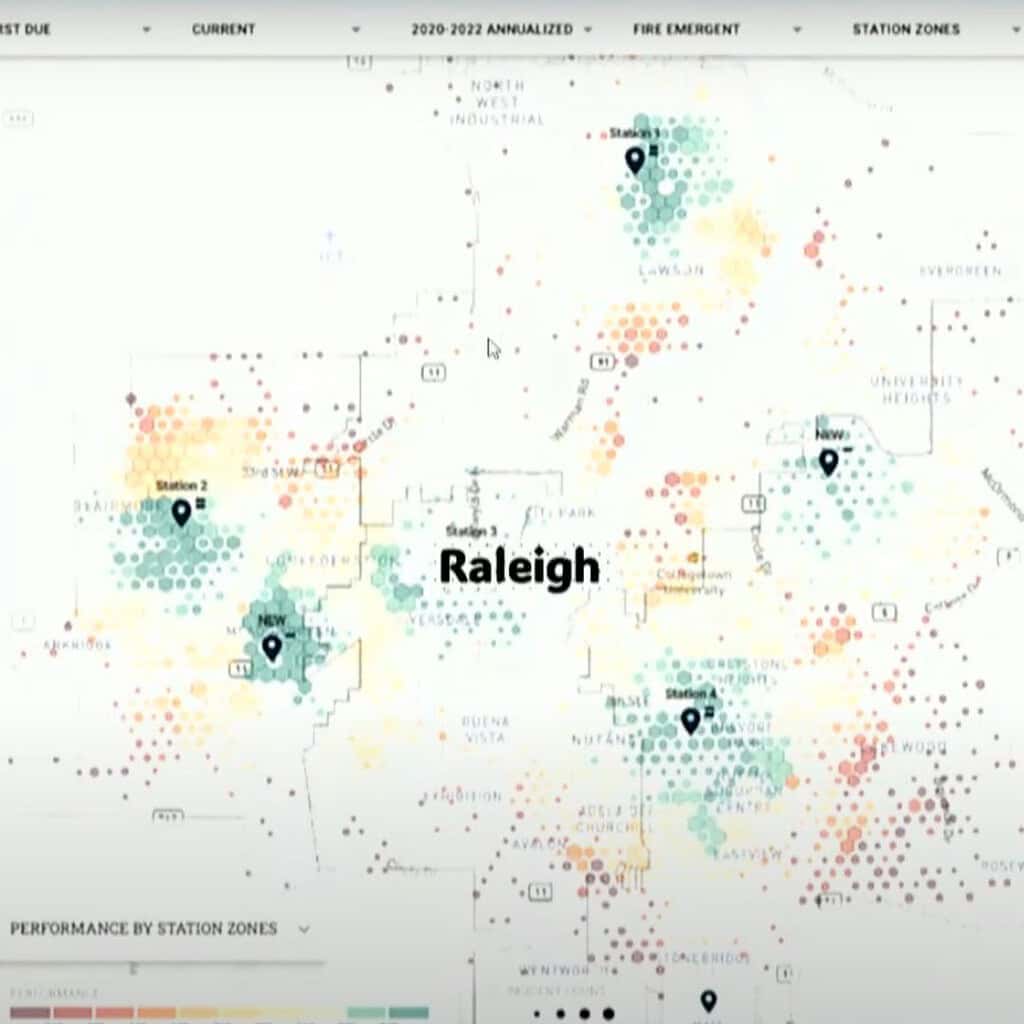
Visualizing the fire safety situation, the city developed maps using analysis software to highlight areas on par with the minimum qualifications met in green, and areas lacking in apparatus and staffing marked in orange and red. (Note: Every district has at least one red area needing attention—namely Six Forks Road, along with Northwest and Southeast Raleigh).
Analysis is slated to wrap up within at least a year in hopes of having City Council approve the report before next year’s city budget is finalized to then implement those recommendations.