Cheers! DTR’s first distillery delivers stellar spirits with a food menu to match.
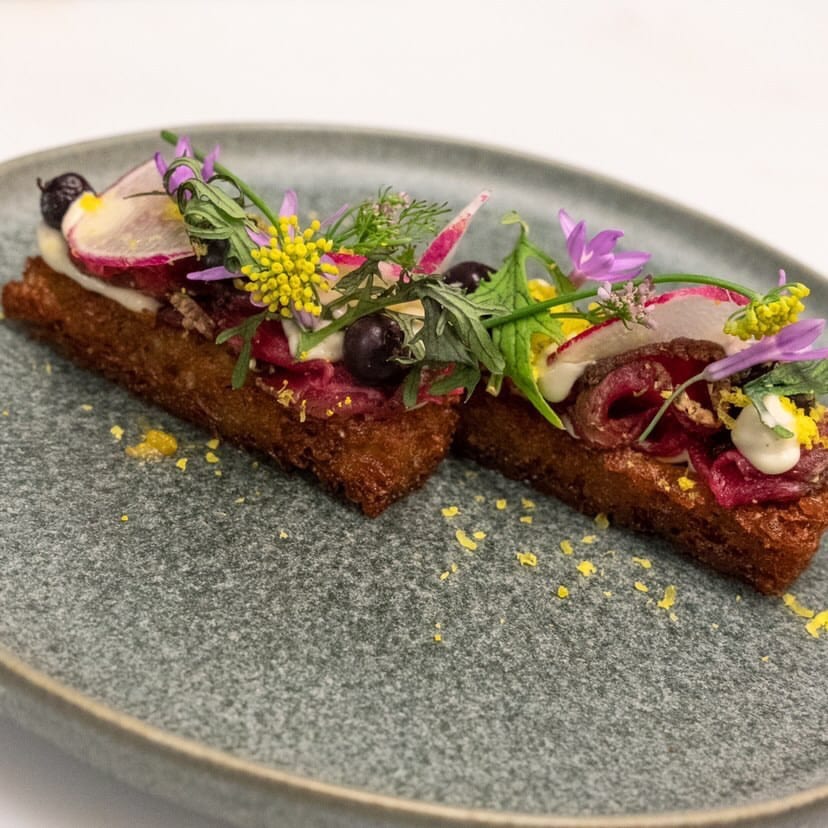
There’s more to Downtown Raleigh’s first-ever distillery than just spirits (though the house-distilled gins, amari, vodka and more coming out of the space are certainly the main attraction). The food menu, developed by executive chef Alex Ricci and sous chef Josiah Halbohm, without a doubt serves as Young Hearts Distilling’s secret weapon—and will keep you coming back time and again.
Highlighting ingredients from local producers (including Fox Farm Forage, Chapel Hill Creamery and Joyce Farms, to name but a few), the menu “will showcase the best of the season,” says Chris Powers, co-owner of Trophy Brewing Co. and Young Hearts.
Inventive dishes include fried lion’s mane mushrooms with tofu “Parmesan,” young Genovese basil, and bourbon and honey grain mustard aioli; Southern sweet potato pappardelle with caramelized buttermilk, watercress, fig mostarda, chanterelle mushrooms and scallion oil; and beet bourguignon with red wine-braised beets, local carrots, pearl onions, king oyster mushrooms and herb fingerling potatoes. (Drooling yet?)
The food menu pairs exceptionally well with Young Hearts’ interesting spirits, which include a “vodka distilled from sugarcane, as well as an agave spirit, which is our homage to tequila,” says Powers.
As part of the distillery’s diverse amari program, a “house” or full-time amaro is in the works as well, and be on the lookout for a collaborative apple brandy with Two Metre Tall Brewing out of Tasmania.
“This new project will include some things you might expect, along with a slew of things you might not,” adds Powers. “We’ll be combining that with a cocktail, beer, wine and, of course, a food program to match.”
But the distillery’s distinction as DTR’s first and the bangin’ food and beverage program aren’t Young Hearts’ only draw—albeit it is more than enough. It’s also the physical space itself, creating an intoxicating mix between the distilled spirits and the people drinking them.
Young Hearts will be the only spot in Raleigh where customers can come in, see where and how distilled spirits are made and meet the distiller—immersing themselves in the creation process of what they’re drinking. This setup is similar to Trophy Brewing Co.’s space, where the brewing containers are on display for patrons to peep.
“We want to bring life to a building that’s been there since 2008,” says Powers. “We’re ready for the next step, and we want to focus on things like this that make us happy and that get us excited and creative.”
A focal point of the new (ahem, “young”) space, the distilling area is on the first floor, visible from the street and again upon entering the space. With a spotlight on the distilling process, booth seating and an expanded mezzanine seating area, this innovative space is engineered to engage from the moment guests step through the door.
The second floor features the new bar in a light and airy setting, including a roof deck with a large wood and steel cover, plus heaters and fans, making the outdoor area viable yearlong, rain or shine.
Powers and his team have always dreamed of opening a distillery and inspirit Raleigh locals with a soft spot for small businesses (and booze, obv) to pay them a visit at this new hip distillery spot. We promise the housemade liquor and food menu are totally worth a shot! @youngheartsdistilling
It started with a flurry of accounts of sexual harassment and abuse on social media against employees, managers and the owner at downtown’s Bida Manda and Brewery Bhavana.
Over the summer, it grew into an avalanche, encompassing restaurants like Neomonde and Ashley Christensen’s Poole’s Diner, tattoo and piercing shop Blue Flame, Red Hat’s HR department and bartenders, musicians, tattoo artists, body piercers and other men—almost exclusively men—about town.
Raleigh is having a #MeToo moment, with survivors recounting stories of their abuse anonymously, naming the perpetrators, and a new third party platform, the Raleigh Protection Alliance, emerging on Instagram (@raleigh_ncpa) to give them a space to share their experiences, connect and document it all.
With new posts from survivors popping up on the group’s page daily, the #MeToo avalanche is growing, not slowing. “The purpose of our organization is to shed light on issues of abuse and assault,” the volunteer-run group says in its mission statement. The group, which has similar affiliates in at least five other North Carolina towns and cities, says it is working on forming as a nonprofit while continuing its mission. “[NC Protection Alliance] considers itself a space for survivors to come forward, share their stories, receive resources and, most importantly, create dialogue that fosters support. It is our hope that by amplifying voices, accountability and change will happen.” (The group wrote it is “flooded with new tasks currently” due to a surge in new followers and is “putting a hold on media interactions” until it adjusts in messages to Raleigh Magazine in response to an interview request).
Survivors and their advocates say the NCPA and similar platforms are helpful for those who have experienced abuse, providing a safe and cathartic way for them to speak out.
“When we first started seeing survivor stories on social media almost a decade ago, there was far more easily targeted victim blaming against survivors,” says Monika Johnson-Hostler, the executive director of the North Carolina Coalition Against Sexual Assault (NC CASA), a nonprofit that works statewide to end sexual violence through education, advocacy and legislation. “Now, allies are shutting down victim blaming in a way I don’t think existed before. The victim blaming was a part of why survivors didn’t come forward and because it wasn’t public, there wasn’t a space for other people to see how nasty it was. I’m watching people step into the space, advocating and calling out horrific, vitriolic victim blaming and seeing more people step in as allies to survivors.”
As to the second part of the group’s mission statement—the hope for change and accountability to happen—there has been change, to be sure.
Last month, Vanvisa Nolintha and Patrick Woodson, the owners of Bida Manda and Brewery Bhavana, announced they were stepping away from the company following outcry online and in-person protests when the restaurants tried to reopen with curbside pickup service. They issued an apology on Bhavana’s Instagram page and announced the hiring of a new CEO. (The company’s original owner and manager, Van Nolintha, left and divested his ownership following allegations of abuse and mismanagement, in June). Christensen released a lengthy letter apologizing for abuse alleged to have taken place at Poole’s (though received swift backlash online for naming the survivor and not contacting her before re-sharing her story). Blue Flame Tattoo scrubbed its social media presence and has reportedly closed its doors following the departures of several employees. And a new local service, Harassment Free NC, is working with businesses to help them assess their policies, evaluate their workspaces and company cultures and train business owners and employees on how to create safer, harassment-free work environments.
“We fully support survivors speaking out,” says Amy Circosta, who co-founded Harassment Free NC this summer. “Their stories are crucial to raising awareness and accountability and having businesses inspired to make substantive changes to prevent harassment is where we see ourselves being useful.”
Johnson-Hostler says she supports NCPA’s approach but acknowledges that how much real accountability there will be as a result of online callouts, and businesses responding to them, is still an open question.
“It is yet to be seen if this is going to make the community safer,” says Johnson-Hostler. “I certainly believe in systemic work. I absolutely believe we should be saying, ‘here are some policies and practices to put in place to create a workspace that is preventative to sexual violence and the culture around harassment,’ and then, ‘here are ways to support survivors as they come forward.’”
Then, there’s the question of the potential for collateral damage. It’s one the NCPA has already had to grapple with following accounts of rape and other instances of sexual abuse the group shared on its page that were made against a local tattoo artist, who formerly worked at Blue Flame and now owns Raleigh Tattoo Company, as well as allegations made against a piercing artist who recently worked at Blue Flame.
“Just to clarify—we never encouraged any business to close up shop, nor did we demand any particular response from them,” a post on the NCPA’s Instagram page reads in response to reports of the artists leaving Blue Flame and the business reportedly closing. “We’re not privy to the process of the decision for these individual artists to quit …We can only trust that these steps were the ones that the artists and owner felt were right, even if they were heartbroken.”
Johnson-Hostler says she shares the view that the outcomes of survivors publicly sharing their accounts on a third party social media platform shouldn’t be a consideration in whether they decide to speak out.
“There is always going to be collateral damage but that is not a reason to silence survivors,” she says. “As a survivors’ advocate, I cannot raise my hand to silence survivors in any way, shape or form. I am not going to say [speaking out] couldn’t shut down a business or cause major damage to a business that could be ‘undeserving,’ but the damage to survivors is centuries old.”
Johnson-Hostler says she is interested to see what the NCPA and its role in shaping Raleigh’s #MeToo movement will look like going forward.
“We don’t really know what the evolution of this group of survivors will be,” she says. “My hope is major change in our communities. And for those survivors, healing.”
Nafkot Ethiopian Restaurant continues the legacy of the longstanding Abyssinia in Mission Valley.
Zenebe Wolde always dreamed of opening a restaurant. When he drove a taxi years ago and people asked where he was from, he told them Ethiopia. The next topic of discussion to come up was always Ethiopian cuisine, and how different and delicious it is.
“My wife already did catering within the Ethiopian community and people in our community encouraged us to open a restaurant,” says Wolde of Nafkot Ethiopian Restaurant. Nafkot opened in October and took over the space of Abyssinia Ethiopian Restaurant in the Mission Valley shopping center after the longstanding restaurant’s owners decided to get out of the business. The space has undergone a complete remodel and is decorated with African pottery and artwork and a safari mural covering one wall.
“We had been saying for years that it wasn’t the right time to open because Raleigh wasn’t ready for cultural food,” Wolde continues. “But in the last few years, we’ve seen a lot of international restaurants open up.”
Traditional and innovative dishes comprise the menu, accompanied by injera bread, made from gluten-free teff, and Ethiopian drinks including coffee and two imported beers. Meat dishes range from tender chopped prime beef to chicken sautéed with rosemary, onion and green peppers. The extensive vegetarian menu, which ranges from lentil and chickpea to steamed vegetable dishes, is also completely vegan to comply with religious fasting days when nothing from an animal is eaten. The relaxed atmosphere and cultural touches create a sense of warmth and welcome to visitors, whether they’re familiar or unacquainted with the cuisine.
“You have to be comfortable eating with your hands,” says Raleigh resident Memory Lynh Pham of Nafkot. “I had friends who had never experienced Ethiopian [cuisine], so I had to guide them through using your hands.”
Pham, who moved to Raleigh in 2008 from San Jose, spent five years looking for good Ethiopian food after her favorite restaurant, Queen of Sheba in Chapel Hill, closed. When she found Nafkot, Pham knew she was in luck.
“Any good Ethiopian restaurant knows you want some more injera, the unleavened bread,” says Pham. “A good place will give it to you, no questions. Nafkot is like this. I don’t know another Ethiopian restaurant in this area that is that welcoming and open.”
A welcoming and open atmosphere is what Wolde strives to create. From a coffee ceremony to communal eating, Nafkot offers a different culinary experience from what we typically experience in the United States.
“It’s not only the food, it’s the fun of people coming together and eating with their hands,” says Wolde. “If you go out to dinner as a family of four or five, each person gets an individual plate and an individual dining experience. Ethiopian restaurants allow you to eat together. Even if you order different food, we’re going to bring it to you on one big plate so you can share it.”
Pham says she hopes more people in the Triangle discover Nafkot and find the same love for Ethiopian cuisine that she has cultivated.
“They made me feel at home because they understood I loved the food,” says Pham. “If you’re open, they welcome your curiosity with open arms. And it’s the best food you’ve had.”
At Rosewater in North Hills, it’s the little things that make up the beauty of the big picture: baskets full of lemons, roses in glass vases on round bistro tables, rose gold light fixtures and plenty of greenery.
Those who remember the Bruegger’s Bagels shop that occupied the space located between the Captrust and Bank of America buildings until 2017 would agree a substantial transformation has taken place. No more is it the generic bakery found in shopping centers and strip malls in cities large and small across the United States. Now, it’s the intimate, American-style bistro, serving Mediterranean small plates and comfort food dishes that Rosewater’s owner, Giorgios Bakatsias, envisioned.
“The space kind of winked at me,” says Bakatsias, a longtime fixture in the local dining scene. We’re sitting on Rosewater’s enclosed patio on a cloudy, rainy day but the space feels warm, like you’re in a greenhouse in wintertime, with its wood-paneled walls, soft lamplight and tall windows. “It was just a beautiful, sleepy garden and I saw it buzzing with energy, the piazza in the center of a community. I fell in love with the building, the architecture, the structure.”
Giorgios Bakatsias; Photo by Jennifer Robertson
Bakatsias, whose Giorgios Hospitality Group also owns Vin Rouge, City Kitchen and Parizade in Durham and Chapel Hill’s Local 22 and Bin 54, personally designs all of his restaurants. This space, too, Bakatsias has made his own.
“I wanted to mix the elements of what allows guests to feel happy,” he explains. “This, to me, felt joyful, whether rainy or sunny. I incorporated wood and elements of art and the right lighting. You feel it’s in this state of golden light, like at nighttime when everything radiates with it. It’s almost like a sunset, constantly.”
When developer John Kane of Kane Realty Corp. decided not to renew the Bruegger’s lease two years ago, he said at the time that he wanted, with this essential piece of real estate, to go in a different direction. Those wary of the chain restaurants and big box stores that often crop up in expensive new developments like North Hills were pleased to learn that the space’s new tenant wouldn’t be another national brand but a local entrepreneur.
Mike Smith
Mike Smith, the president and chief operating officer at Kane Realty, says the company is committed to supporting local restaurateurs and has been working intentionally to create great spaces for them and other local business owners. He points to Rosewater, as well as Coquette and Vivace, as examples of that commitment in North Hills.
Downtown, Luang Prabang, a Laotian concept from the owners of Bida Manda and Brewery Bhavana, will occupy the marquee ninth floor space in The Dillon. And the upcoming Smoky Hollow development on West Street will, Smith says, have “a very targeted focus on local operators,” including local restaurants, bars, cafes, retailers and other business owners.
“There are so many great local chefs and food purveyors in Raleigh and we are trying to create spaces and places in advance for what we believe is the need,” Smith says. “We know there is work that needs to be done together to make it a success. We want to make sure we’re thoughtful in the design as we think through it and try to anticipate what a local restaurateur is able to be.”
Bakatsias says roses signify balance to him, which is why he chose to name his newest restaurant “Rosewater.”
“Balance, whether it’s in food or spirituality, whether in fun and laughter, whatever life chooses to be and how it is, there is always some kind of balance that is necessary. [Here], we want to have this European romance but we spice it up some. I love the aroma of rosewater, but you have to use it in balance.”
Another aspect of life that requires balance? How we choose to build our communities.
“I guess chains are necessary for this community to be successful,” Bakastias says, “but I was delighted that [Kane Realty] was responsible enough to realize that [this space] is a little jewel and they wanted it to be independent. I saw it, we both met and it was like this perfect marriage. I’m excited to see more of this so we can have a balance in the community.”
Chef Blake Gotliffe’s farm-to-table café brings hyperlocal eats to Smithfield.
There’s a lot of work that goes into chef-owner Blake Gotliffe’s farm-to-table menu at Under the Oak Café in downtown Smithfield.
For one, there’s tending to the farm in his backyard in nearby Clayton, which provides much of the produce for the restaurant’s lunch sandwiches and salads, dinner entrees and his wife Megan’s desserts. In addition, 90 percent of the menu’s remaining ingredients are sourced from North Carolina farmers and producers, requiring trips to nearby towns to pick up products—including a run to Raleigh twice a week for seafood from Locals Seafood, meat from First Hand Foods and various items from the State Farmers Market. “I prefer the one-on-one interaction with farmers,” Blake says. “Really knowing the people and supporting them means a lot.”
Under the Oak Farm; Photo by Felicia Perry Photograpy
Then there’s the task of curating menu items and cooking them to order for hungry customers, a job that comes easily to Gotliffe thanks to five years in the restaurant industry under his belt, with two of those years spent working under chefs Scott Crawford, Eric Montagne and Steven Goff at Standard Foods. Gotliffe attributes much of his skill to his time working at the now-closed restaurant and grocery store that was located just outside downtown Raleigh. Although he went to culinary school at Wake Tech and ran his own catering business before he joined Standard, Gotliffe says he realized there were techniques and methods of cooking that he had yet to learn.
Crawford helped him develop his palette and balance flavors, Gotliffe says, and he was able to put his skills to the test in Standard Foods’ prepared meals section. It was Gotliffe’s job to use the restaurant’s vegetable scraps or items that weren’t selling in the grocery to make dishes people could heat up at home, a task that now influences much of his cooking at Under the Oak, which opened last February. Gotliffe’s menu is based off of sustainable practices such as preservation, full utilization of resources and zero waste. His specialties are homemade pickles and charcuterie, both of which feature on the restaurant’s signature charcuterie board and in many of its beloved sandwiches. Gotliffe makes his own bread for the sandwiches, too. “The sandwiches are very special in that regard,” he says. “It’s rare that you eat somewhere where they make the meat, they make the bread and they grow the lettuce and make their pickles. It’s a 98 percent scratch-made sandwich.” Condiments, including Lusty Monk Mustard and Duke’s mayo, both of which are North Carolina-sourced products, comprise the other two percent.
On the dinner menu—served Friday and Saturday nights—Gotliffe makes a special handmade pasta dish each week using a variety of freshly made pastas, which are also used in a mac and cheese prepared with Ashe County Cheese and local cream. These dishes are sides to meat and fish-focused entrees, while creative small plates change with what’s available and in season. “I like to say [the menus are] very versatile,” Gotliffe says. “It’s mainly just seasonal cooking. I let the product decide my menu.”
Blake and Megan Gotliffe; Photo by Stacey Sprenz Photography
Seasonal local produce also helps Megan decide on items for the restaurant’s dessert menu that includes rotating cakes, tarts and ice creams. Also a graduate of Wake Tech’s culinary program and a former pastry chef at Mandolin and The Umstead, Megan, too, practices preservation to save summer produce for winter desserts and vice versa. Megan also runs her own wedding cake business, I Do Cakes, and occasionally sells cakes and cupcakes through Under the Oak Catering.
But Smithfield isn’t Raleigh and Gotliffe says his menu needs to be more approachable for Johnston County residents than the adventurous menu at Standard Foods, though he says Smithfield diners appreciate Under the Oak’s local sourcing—the Gotliffes have a steady stream of regulars, some of whom dine at the café every single day.
“There is no other farm-to-table restaurant out here at all,” Gotliffe says. “It’s definitely opened people’s eyes.”
“I’ve enjoyed getting to know the locals and I’ve kind of fallen in love with this town,” adds Megan.
A 40-minute drive from Raleigh, Under the Oak gives you the perfect excuse to experience what the Gotliffes love about Smithfield for yourself. undertheoakfarm.com