A Better Beltline

A Better Beltline

Improvements to I-440 are needed, but the impacts will be significant.

On a sunny, windy day last month, a lone golfer drives a ball onto the green on a nine-hole, Par-3 golf course. A few hundred feet away, players from a U.S. Tennis Association league lob balls back and forth. The swimming pools situated between the golf course and eight tennis courts stand empty in March, but it’s easy to imagine kids slipping down the twisty red waterslide come summertime.

In a few years, it’s likely that the recreational facilities at the NC State University Club, located since 1961 on Hillsborough Street just down the road from the exit off of Interstate 440, will look dramatically different. As part of planned improvements to a stretch of the Beltline north of Wade Avenue to Walnut Street in Cary, including widening the road from four to six lanes, the club stands to lose up to a quarter of its 46 acres to eminent domain. As currently planned, the project takes up half of the club’s tennis courts, as well as most of an adjacent parking lot, rendering the swimming pools untenably close to future traffic.University Club Pool
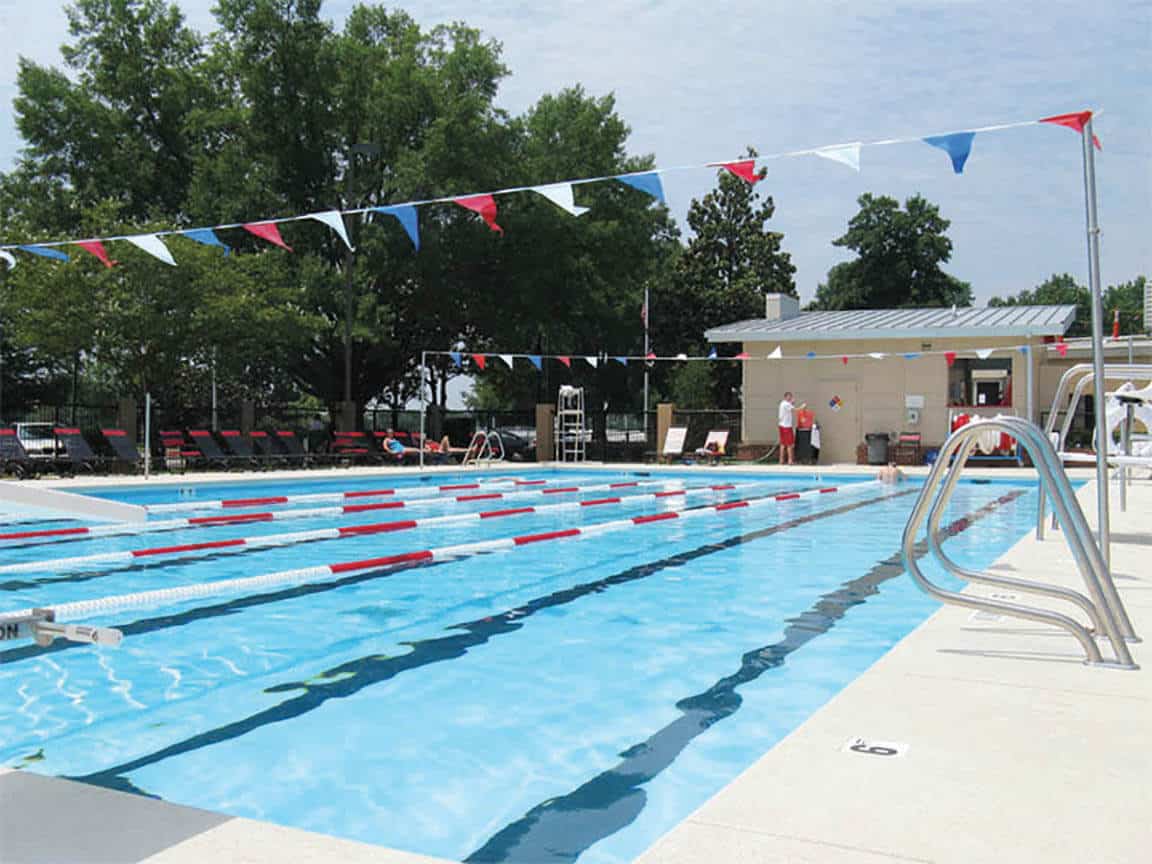
“Our goal is to have a reconfigured footprint before [the N.C. Department of Transportation] touches the property, so there’s no interruption of service to our members and guests,” says James Ivankovich, the club’s general manager. “There is going to be some movement of different amenities. How extensive that is isn’t known at this point, but we’re working through every possible scenario.”

The I-440 widening package, projected to cost $475 million, will improve a stretch of highway built in the 1960s that can tally up to 90,000 vehicles per day. Parts of the highway rack up crashes at a rate three times the state average due to short acceleration and deceleration ramps, drivers having to merge in the fast lane, bottleneck congestion and other issues.

Though the improvements—which include replacing bridges, upgrading interchanges and physically lowering Blue Ridge Road to be situated underneath a railway—are needed, the impact is significant. Dozens of businesses and residents will be displaced and major entities, including Meredith College, NC State University and the University Club will lose large swathes of property. NCDOT-hosted public meetings beginning last summer have brought out hundreds of concerned stakeholders.

“We definitely understand that the widening needs to happen,” says Kristi Eaves-McLennan, the executive director of marketing at Meredith College. The women’s college is currently slated to lose roughly 10 acres of land, and the project will impact apartment residences on campus as well as athletics practice fields. “[The land] is a planned future growth site, where some of the ground is more level and we need to think about the long term. Hundreds of Meredith constituents have made their voices heard about this project, writing in their opinions and going to meetings, saying how much they value the Meredith campus and its importance to the community.”

At NC State, Associate Vice Chancellor Jeff Bandini, who manages the university’s real estate portfolio, says the project will affect “buildable acreage” on the Centennial Biomedical Campus, a storage building on Ligon Street, the Biomedical Campus’s short-game golf practice facility and a maintenance building located on its northeastern corner. The university doesn’t have a current estimate for the amount of acreage affected by the project due to recent adjustments in the project’s design.
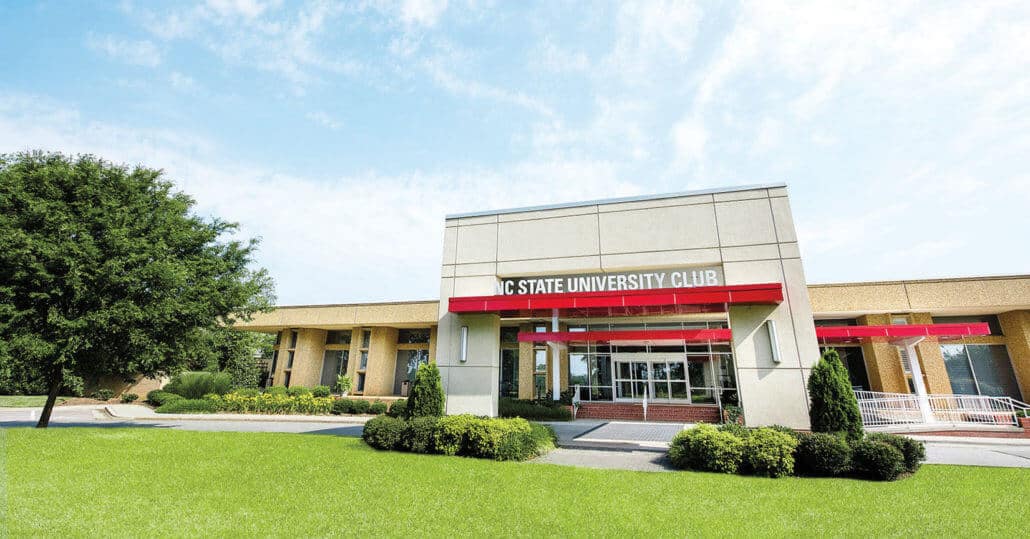
NC State University Club

“We are meeting with stakeholders and talking to different groups all the time,” says Steve Abbott, a spokesman for NCDOT. The department has been able to change the plan from preliminary stages to reduce its physical footprint and mitigate some of the impacts to property owners. Stakeholders say DOT officials have been open to listening and responsive to their concerns.

In July, the department will hear presentations from four different design-build contractors and later this summer will award final planning and construction of the project to the highest-scoring bidder. NCDOT will then be in a position to discuss compensation with all of the entities affected by the project, and construction is on track to begin in spring or early summer of next year.

“The biggest thing for us, other than compensation, is timing of the project,” says NC State’s Bandini. “We need significant lead time to move people and replace our short-course facility. So from a facilities perspective, as a large entity we need a lot of time to plan and relocate folks. We’re asking not to start the project with our property.”

Ivankovich says the University Club is in the same boat. It’s sending out surveys to its more than 900 members to get their input on how they want to see the property reconfigured—and hopefully improved—and the club will look to hire an architect once it knows more about the final design.

“A lot of this is about being vocal, letting the DOT and the different agencies governing this process know the impacts and the personal stories this could cause havoc with,” Ivankovich says. “From the DOT’s standpoint, they’re doing their jobs, but there is a people side to this that’s important, and maybe there are better ways to think about it and alternatives that haven’t been considered.”

If all goes well, the I-440 improvements will make the highway safer and less congested by 2025. The improvements will also fit neatly with the county’s 10-year, $2.3 billion transit plan, which will see Wake County and the City of Raleigh working with NCDOT on Bus Rapid Transit along the Western Boulevard corridor.

“We’re working together to make sure what we’re doing on the highway side doesn’t hurt what we do on the future transit side,” says Joey Hopkins, Division Engineer for the state highway division covering Wake County.

“We want to reach a deal with the stakeholders, offer relocation help; there are all kinds of things we can do,” adds Abbott, the DOT spokesman. “We know we’re inconveniencing people by taking property, and we want to make them feel alright about it. We want to reach a deal, and if we can’t, it goes to the courts.”

That’s an outcome that all the parties, at the moment, appear to be working hard to avoid.

“A lot of this is about being vocal, letting the DOT and the different agencies governing this process know the impacts and the personal stories this could cause havoc with.” — James Ivankovich

A Fresh Space For Downtown’s Farmers Market

A Fresh Space For Downtown’s Farmers Market

Changes are in store for downtown Raleigh’s weekly summer farmer’s market: it’s rebranding and moving from City Plaza to Market and Exchange plazas, the two pedestrian corridors located between Fayetteville and Wilmington Streets that the city recently spruced up with a $1.2 million investment.

“We want to see those plazas activated and demonstrate that they are great locations to host an event,” says Stacey Simeone, the marketing director for the Downtown Raleigh Alliance. “These plazas may not be huge but we want people to realize that they are available to rent from the city.”

Simeone expects the market to host the same number of vendors in its new home as in previous years. It will no longer be called the Raleigh Downtown Farmers Market, however, but Market on Market instead. “We wanted to be more inclusive of the fact that it’s makers and all kinds of different artisans, not just farmers,” Simeone says.

The market has proven popular with downtown residents and workers, and valuable for vendors. At least three who had their start at the downtown market have gone on to open brick and mortar locations, including Kim Hunter’s Sarah Cecilia Good Food Company—Hunter now owns Kimbap in Seaboard Station—as well as The Freezing Pointe, which rebranded as Andia’s Homemade Ice Cream with a location in Cary, and Melina’s Fresh Pasta, which now has a store in Durham.

Market on Market kicks off Wednesday, May 9 from 11 a.m. to 2 p.m. and runs through late September.

(more…)

Painting the Permanent

Painting the Permanent

North Carolina artist Elizabeth Bradford will open two concurrent shows at The Umstead Hotel and The Mahler art gallery downtown. Bradford began her career painting the farms and gardens of the elderly residents who populated the rural community near her family’s farm in north Mecklenburg County. She watched as years passed and the farms and gardens gave way to subdivisions and shopping centers.

“I was glad to have painted my elegy for the way it had been,” Bradford says. “In some way, it gave a sense of permanence to what was impermanent.”

Bradford’s exhibit will feature her latest work, “Wild and Sacred,” realistic depictions of nature ranging from tree roots growing into a creek bed to cattails flourishing in a duck pond.

“I learned I could sit in one spot in the woods and paint for hours, lost in the natural opulence,” Bradford explains. “Animals and birds would cease to see me as a threat because I was still for so long. I have come to believe that I am now painting the permanent…”

Bradford’s work is featured in permanent collections across the state, including UNC-Greensboro’s Weatherspoon Art Museum, the Mint Museum, the Kenan Center and UNC Rex Heart and Vascular Hospital.

Rolling Along in Raleigh

Rolling Along in Raleigh

A look at what’s ahead for transit in the city this spring.

➊WAKE COUNTY TRANSIT PLAN

We’re in the second year of Wake County’s 10-year, $2.3 billion transit plan, and there are lots of changes on the horizon. In the next fiscal year beginning in July, Wake will invest $4.7 million in planning for 20 miles of bus rapid transit and 37 miles of commuter rail services, at a total long-term cost of $47 million. Starting this year, riders 18 years old and younger will be able to ride public buses for free, to encourage them to become lifelong transit users. GoRaleigh and GoTriangle will get more, new buses; 55 bus stops will receive improvements and the county will add and improve park-and-ride lots. Additionally, GoRaleigh, GoCary and GoTriangle will build on their expanded services from 2017, adding new routes and increased frequency.

In Raleigh, there will be new bus routes along Poole, Barwell, Rock Quarry, Martin Luther King Jr. and Sunnybrook Roads, adding services to schools, shopping and community centers in Southeast Raleigh. The plan will also realign the Rex Hospital route, adding four new routes along Blue Ridge and Edwards Mill Roads to serve the NC Museum of Art, the NC State Fairgrounds and PNC Arena.

GoTriangle will increase frequency on its express routes between Durham and Raleigh (DRX), and Chapel Hill and Raleigh (CRX). It will add service hours to Service 100, which serves RDU Airport and Route 300, running between Cary and Raleigh. Finally, the on-demand service Wake Tracs, which serves elderly and disabled customers, will add more than 3,600 trips, an  the Regional Transit Information Center will expand its operating hours. Reach them with questions at 919-485-RIDE. Email your comments on the work plan to info@waketransit.com before March 12, or get more information on the plan at waketransit.com.

➋ UNION STATION OPENING

At long last, downtown Raleigh’s Union Station will open in late spring in the Warehouse District! In this fi rst phase, the station will feature a grand civic hall and retail, dining and offi ce space; amenities for Amtrak passengers including a waiting room, a center island passenger platform and a daylit, enclosed concourse between the station and platform; a large public gathering place near the intersection of West and Martin Streets, and sustainable features including a pollinator garden and green roof areas. Future phases of the station will accommodate inter- and intra-city and commuter rail ser- vices, local and regional buses, taxis, bikes and more.

➌ DESIGN A BUS SHELTER

Local artists are invited to submit designs for 10 of the city’s bus shelters to the Office of Raleigh Arts. If you’re the artsy type, create an original image for a vinyl wrap that will be applied to a city bus shelter this summer; playful images that will engage families are encouraged. Selected artists receive a $750 honorarium, and their work will be displayed on a GoRaleigh bus shelter for at least a year. Submissions must be received by March 15. Learn more at raleighnc.gov.

➍ WEST STREET CYCLETRACK PILOT

In May, the city will install a protected, two-way bike lane known, as a cycletrack, running for fi ve blocks on West Street between Martin and Jones Streets and connecting the Warehouse District to Glenwood South. Cycletracks off er cyclists a dedicated bike lane that’s protected from motorists, parked cars and sidewalks by physical barriers, such as planters, fl exible posts or medians. The West Street pilot is a partnership between the city and Raleigh cycling communi- ty group Oaks & Spokes, which will contribute $20,000 toward the project. At the end of the pilot period in November, the city will evaluate its success and decide whether to install a cycle track permanently, as well as in other locations around Raleigh. Provide your input on the West Street Cyletrack pilot through the City of Raleigh’s website at raleighnc.gov.

Spring Reading List

Crime and marriage to time travel – check out these new titles.

As suggested by the staff of Quail Ridge Books

From Mamie Potter: After reading an advance copy of A State of Freedom by Neel Mukherjee (Norton $25.95), I felt stunned (this is not hyperbole). When I finished the last powerful, one-sentence chapter, I went back and read the first chapter again, and realized how skillfully Mukherjee had laid the groundwork for the novel and its intricacy. Even now, as I’m writing this review, I’m thinking about the characters, wondering how in the world I’m going to find something to read next. Make time to read this book.

Tayari Jones’ new novel, An American Marriage (Algonquin $26.95), is an exposition on the criminal justice system in our country in general, and in Louisiana, where the incarceration rates are exceptionally high and disproportionately biased toward minorities. The marriage of Celestial and Roy is put to the test when he is falsely accused of a crime and imprisoned. Through letters, the couple tries to salvage their marriage and prove Roy’s innocence, facing obstacles both within their families and without. This book is full of the unexpected and the expected, but an “expected” that we cannot continue to find acceptable. I found myself deeply sympathetic to the couple’s helplessness and the strain it put on their relationship. An excellent choice for book clubs, the novel has just been chosen as the new Oprah Book Club selection, and we have a limited number of signed copies on hand.

From Ken Norris : Matt Haig is one of my favorite authors simply because, in all his books. he asks and answers the really hard question — What the hell is going on? — whether you’re an alien who finds himself transplanted into human society (The Humans) or a teenage girl who finds she’s a vampire (The Radleys). In Haig’s new novel, How to Stop Time (Viking $26), Tom Hazard looks like a regular 41-year-old man. But at the time of the novel’s narration he is some 400 years old as a result of a curious condition that causes him to age only one year for every 15. What Hazard and the reader experience is the human condition attenuated almost beyond bearing — not only the amplification of love, joy, loss, and grief but also the intensification of alienation, of always remaining an outsider, necessitated by centuries of life, something for which humans are ill equipped.

From Jon Carroll Thomas : The Gone World by Tom Sweterlitsch (G.P. Putnam’s Sons $27). This apocalyptic time-travel noir draws from a very deep and dark well. It is brutal, poetic, and very, very exciting. I particularly enjoyed its strong female characters and the “messiness” of time-travel and alternate realities. Highly recommended for mystery and sci-fi fans. This is Sweterlitsch’s second novel and he continues to be an author to watch.

The Great Alone by Kristin Hannah (Holtzbrinck $28.99) is a powerful, compelling story of survival – survival of the natural elements and of the human spirit. It’s 1974, and 13-year-old Leni Allbright lives with her devoted mother, Cora, and abusive father, Ernt, who was a prisoner of war during Vietnam. America is changing after the war, and Ernt thinks their best chance at a fresh start is to move off the grid, to America’s last frontier – Alaska. Grizzlies, wolves, and dropping temperatures are Leni’s worries outside of her family’s cabin, but as Ernt’s battle with his demons rages on, it’s no safer inside. The result is a beautifully descriptive, heart-wrenching adventure.

The Line Becomes a River: Dispatches from the Border by Francisco Cantu (Riverhead $26). Cantu personalizes the U.S.-Mexican border and all of its complexity in a way I’ve never seen. His writing is beautiful, with haunting and detailed descriptions of the desert, the immigrants, the cartels, and his own fears about violence and identity confusion. The criminalization of searching for a better life and the dehumanization of the process is looked at from several angles, and his journalistic approach does not make judgments, but clearly tells the facts. A great new writer to follow.