by Jane Porter | Mar 12, 2018 | Buzz, March 2018
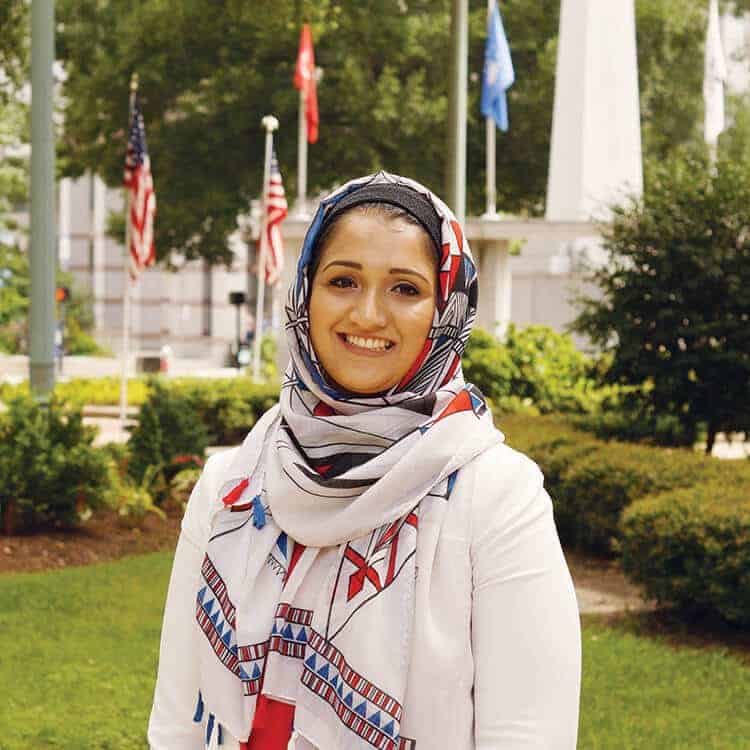
IN SEVEN DECADES —since the city adopted the council/manager form of municipal government in 1947—Raleigh has never seen a woman of color serve on its city council. Last summer, Zainab Baloch, running for an at-large seat in a crowded field of candidates, sought to be its first. If she had won, Baloch, 26, would have been the youngest person ever elected to the city’s highest governing board. She also would have been the council’s first Muslim member. “We need more diverse representation in government, whether it’s age, race, gender— it’s just not adding up,” Baloch says of her decision to run. “I saw on a federal level a lack of representation but once I started looking at Raleigh’s demographics, I was like ‘whoa.’ Our city council is definitely not representative at all.”
Friends convinced Baloch to jump in the race a few weeks before filing opened, and she had two months to campaign and get her name out. She spoke with local political fixtures who became mentors, including former state treasurer and onetime council member Janet Cowell, and Yvonne Holley, a state representative from a district in southeast Raleigh. Mostly, Baloch says, she and her team learned how to campaign as they went along; in the end, she came away with 11 percent of the vote.
Baloch was born in Raleigh, the first of six children to parents who immigrated to North Carolina from Pakistan 35 years ago. During college at NC State, the “diehard Wolfpack fan” and psychology major worked for the city, as a summer camp and after-school director at Optimist Community Center and then as a regional coordinator for various youth programs around Raleigh. That experience was Baloch’s first taste of how government works and it partly inspired her to pursue a master’s degree in public administration at UNC-Chapel Hill, which she’ll complete this summer, while working for the state’s Division of Mental Health. More broadly, though, the work opened Baloch’s eyes to the inequity that still persists in an otherwise progressive—and economically thriving—growing city. “I saw discrepancies within the youth programs throughout the city, the differences in programs and resources and community centers,” she says. Baloch cites studies that show cities in North Carolina, including Raleigh, have low upward mobility rates as compared to cities in other regions in the U.S. “If you’re a poor kid in Queens, New York or Oakland, California or Washington D.C., you have a better chance of getting out of poverty than if you’re one in Raleigh.”
Baloch says the city has a role in allocating resources to— and promoting economic development in—its communities more equitably, but that factors like ensuring access to public transportation, as well as to educational and physical and mental health facilities through zoning initiatives, play a part too. “If you’re not mobile, there’s not much you can do, especially if your community doesn’t have the resources,” Baloch says. “We really have to think when we’re planning about how we’re bringing equity into the equation, not just looking at it afterward, but realizing that equity goes into every single department.” To help tackle problems of inequity, physical, social and economic mobility and others that Raleigh faces, including its lack of affordable housing, Baloch joined the board of WakeUp Wake County. The education and advocacy nonprofit has been a staunch proponent of expanding public transportation, environmentally and economically sustainable development and high-quality public education since 2006.
Baloch calls affordable housing “the million dollar question” and says WakeUp Wake County is a valuable tool for bringing different affordable housing stakeholders—citizens, public servants, developers, elected officials and others—to the same table to have a conversation.
“We need to stop this whole stigma of, if you want affordable housing then you’re against growth, or if you want balanced development, you’re anti-development,” she says. “We’re going to have to work with developers on more affordable housing options, and we need to come up with more creative and innovative ways to tackle it. It’s not just Raleigh, it’s a national crisis.”
Creativity and innovation are where, Baloch says, better representation in government is key. It will be the younger generation that offers fresh ideas for addressing persistent problems, so it’s
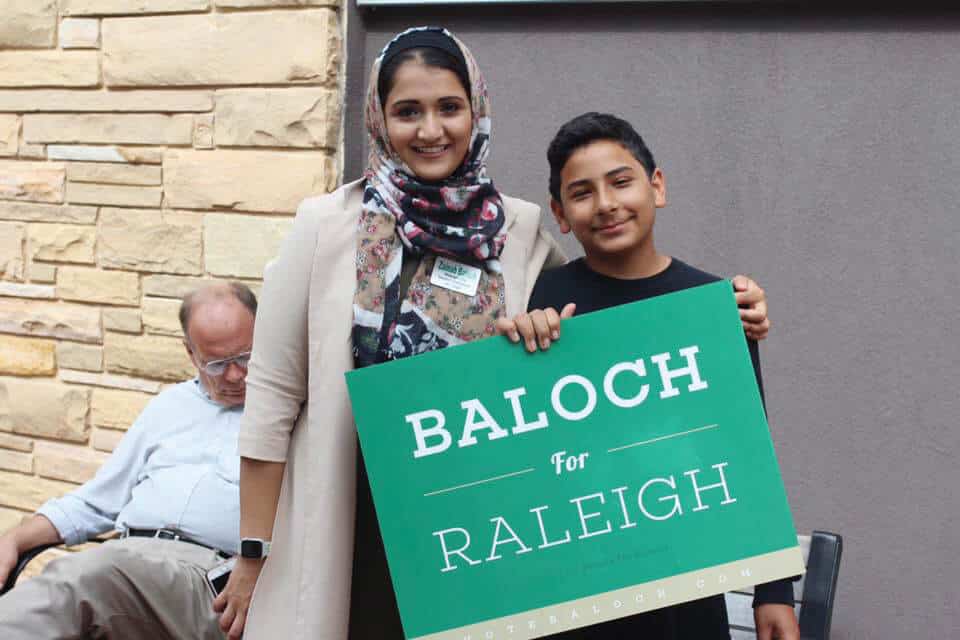
crucial for the city, and others, to actively engage young people to get them to serve and to convince them that their service can effect change. Baloch envisions a partnership between the city and representatives from area colleges and universities, as well as young professionals, dedicated to working on policies geared at issues that most affect them.
“Half my battle in running for council was telling people what council does,” Baloch says. “You have to change an entire culture, but making an active effort to get people involved is the first step. Millennials are the most civic-oriented group, and we should take advantage of that. We need to realize that them being in or a part of government is the same as wanting to do better for the world.” For her part, Baloch says her interest is still in local government and that a seat on the city council is still her goal— only this time around, she has two years instead of two months to prepare for a run for office. “We got almost 11,000 supporters and after the election, I got to meet with so many different people,” she says.“What we did wasn’t a small deal; it was a big deal, and we need to build on it. Creating something, building on it, getting a lot of young people involved…I’ve already started the process, so I’m going to have to keep going.”

by Jane Porter | Mar 5, 2018 | Buzz, March 2018
At the direction of a state bill introduces this summer, a committee of lawmakers last month began studying how to break up large North Carolina school districts and county/city systems that had previously been merged. It’s the first step in a sweeping move that could see some of the state’s largest school systems, including Wake County and Charlotte-Mecklenburg, split into smaller districts.
Proponents of the bill- which passed along partisan lines in June, with the mainly Republican support- argue that school districts which had been merged to save money, as Wake and Raleigh schools were in 1976, could be run more effectively as smaller economies of scale. Entire county school systems wouldn’t have to close down for weather events that affected only some parts of the county, for instance, and some students might be able to attend schools closer to their homes.
But opponents of the move, including many Democrats, say splitting up school districts could lead to a re-segregation of schools along racial and economic lines. Wake County Commissioner John Burns, a Democrat, has been outspoken on the issue recently; Wake County is the state’s largest school system, and the nation’s 15th largest, with 160,429 students. “This study commission is being assembled to study a bad idea,” Burns said in a February statement. “Dissolution of the Wake County Public School System into smaller systems would raise taxes, cement social and economic inequities, reduce performance, and result in worse outcomes. We have an excellent school system in Wake county. Through it, we all support all of our children. If the state wants to investigate ways to improve that system, they could increase state funding, pay our teachers more, and reduce the burden of standardized testing.”
The study committee, composed of nine Republicans and three Democrats, will hear presentations on the size and structures of the state’s school districts and how smaller and larger districts compare. It’s expected to report back on its findings in May, including on whetter to punt the issue to voters via local referenda.

by Jane Porter | Mar 5, 2018 | Eat, March 2018
In the last six months, Vidrio has tweaked its menu and found a chef for the long haul.

HUNDREDS OF HANDBLOWN glass orbs cover the dining room wall in colors ranging from ocean blues to clay-pot terra-cottas that suggest a Santorini sunset. Afternoon light floods 16,000 square feet of space on two levels, while rope chandeliers and fishermen’s crates conjure the accoutrements of a ship.
It’s easy to be enchanted by Vidrio, the year-old Mediterranean restaurant on Glenwood South that feels more like an Adriatic beach retreat than a family-style restaurant in downtown Raleigh. But for all its beauty—and its widely praised Mediterranean cuisine to match—the latest local addition to LM Restaurant’s portfolio saw its share of early struggles. “In the very beginning, we had a lot of issues,” says Lou Moshakos,the founder and CEO of the Raleigh-based hospitality group. Other brands under the LM umbrella include Taverna Agora, Carolina Ale House and Bluewater and Oceanic in Wilmington. “In the last six months, we have come a long way. I really believe it. The guys have done a fantastic job.”
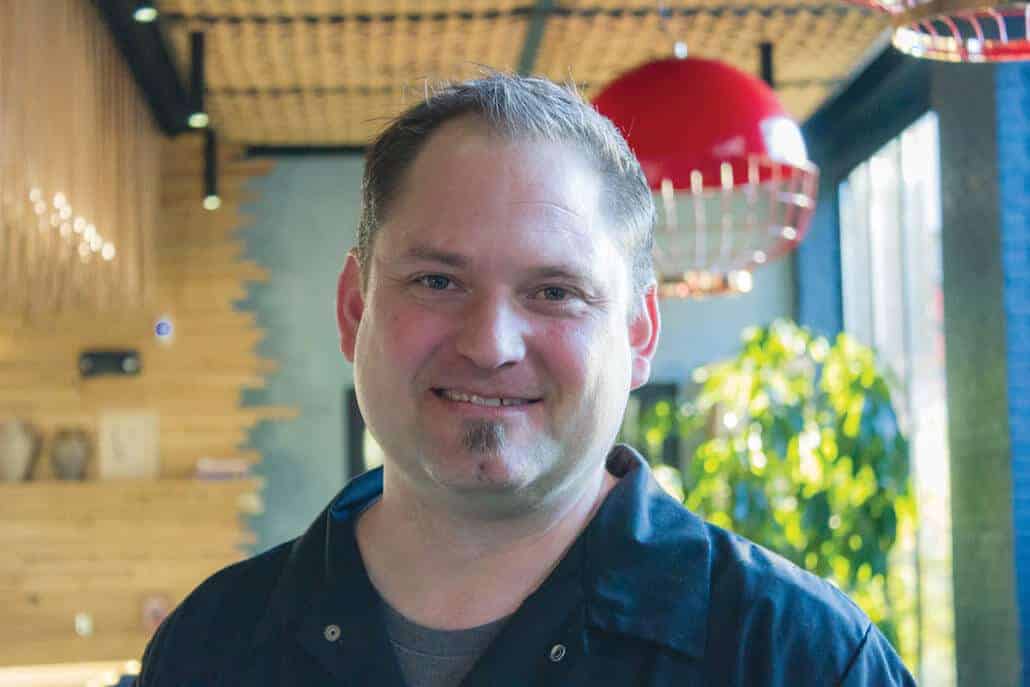
The guys include Jay Spungin, Vidrio’s general manager, and Aaron Whitcombe, its third—and hopefully final—executive chef.  Since the fall, when Whitcombe came on board in early September, the pair have worked consistently to recruit and retain top-notch talent, as well as to tweak an ambitious menu to be more in line with Raleigh market customers’ expectations. Now, Vidrio is reaping the rewards, having booked nearly 500 private events at its upstairs event space and racking up five-star reviews on Yelp and social media, which Moshakos says he monitors daily.

Moshakos, who came to the U.S. in 1978, was born in raised in Glykovrisi, a small village in the Southern Peloponnese. Grecian traditions of long, wine-soaked meals spent sharing plates of food and relishing the company of family and friends informed Moshakos’ vision for Vidrio, which takes its name from the Spanish word for glass. Dishes inspired  from regions all over the Mediterranean are served family-style and brought out to tables in the dining room or to the bar as they’re ready, in a continuous stream. Guests can order bottles of wine and cocktails, or choose wines by the glass from close to 50 different taps in order to experience a variety that’s unrivaled locally. It’s an untraditional style of service that Moshakos says gives guests lots of flexibility. “That was the key right from the start, to give that flexibility,” he says. “You want to come in alone and have a couple of drinks and a snack; you have that flexibility. You want to sit down at the bar and have two or three plates, you can do that, or come in with a group of 10, 20, 50, 200…500.” Whitcombe, the chef, says guests seem to appreciate Vidrio’s shared small plate and family-style dining method, though the restaurant has made some tweaks to the concept to better connect with customers. For instance, Vidrio started out selling a large, hand-cut, grass-fed steak at a steakhouse price but found that guests wanted something different; now, smaller, less expensive cuts of steak appear on the menu. “Diners have the opportunity to taste and experience more food and experience wine from around the world,” Whitcombe says. “In addition, the menu is set up that if a guest wants a more traditional style dining experience, they can have it without losing the identity of Vidrio.” The restaurant’s biggest growing pain has been finding good people for its staff of more than 50. It’s a problem that, in a tight labor market that hasn’t quite reached the big city levels of places like New York, Miami and Chicago to draw talent from, many Raleigh restaurants continue to grapple with. But Vidrio is beginning to see improvements.
Lou Moshakos and daughter, Amber, who has just been named President of LM Restaurants
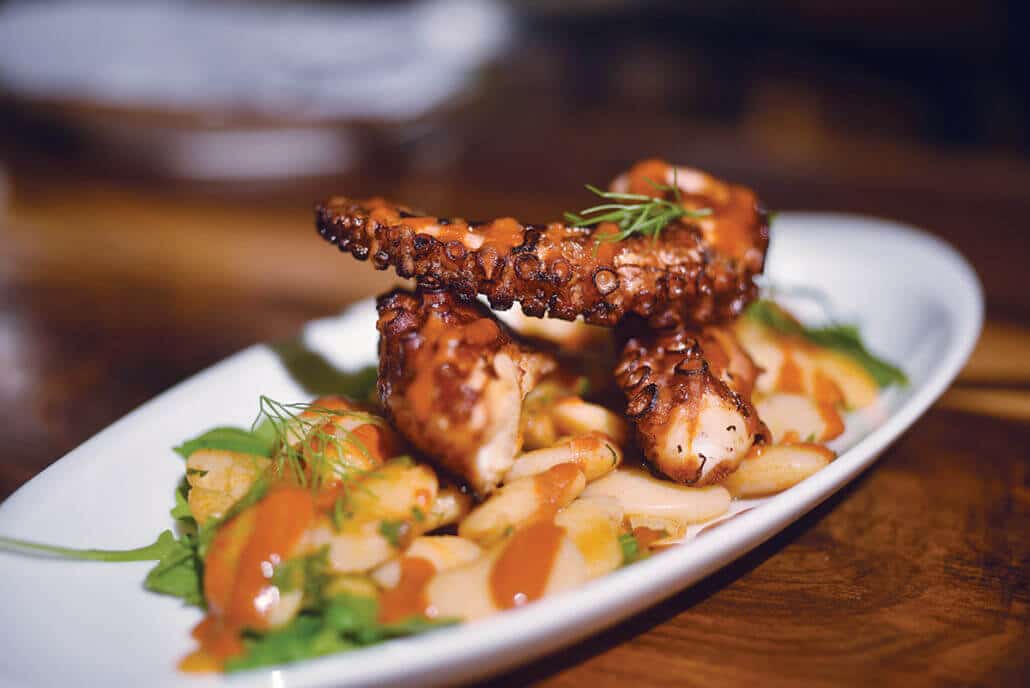
“I’ve felt the shift now that we’re out in the marketplace a bit, now that we’re considered one of the better places in town, we are seeing people come to us,” says Spungin, the general manager. “Where we were having to search out so much in the beginning, now people are starting to come to us. That’s something we want, that we’ll rely on, having great peer groups of people who already work with us and want other professionals they know to come work with them.” If one thing has always been consistent at Vidrio, it’s been delicious, locally sourced, seasonally suitable and superbly prepared food. The restaurant is renowned among seafood lovers for its tender charred octopus, Branzini ceviche and woodfired prawns. It’s celebrated for its tasty Italian-inspired dishes, including a creamy agnolotti.
Guests rave about Vidrio’s Moroccan beef skewers with harissa Greek yogurt, its flatbreads, charcuterie and its green chickpea hummus. For Vidrio’s menu, no detail is too small, with food cooked in olive oil imported from Moshakos’ hometown in Greece. This spring, expect new menu items that reflect Whitcombe’s varied style and extensive experience in Mediterranean cooking, and that strengthen Vidrio’s concept of sharing and social dining. “It’s an experience we want to bring to our guests and their families,” says Moshakos. “When you go to Greece, it’s hours-long meals. We mingle, it ties everyone together. Put the cellphone away, and enjoy each others’ company.”

by Jane Porter | Feb 28, 2018 | Buzz, March 2018
At two all-women’s poker clubs here in Raleigh, players compete for a cause.
THERE ARE A COUPLE of requirements for joining Raleigh’s quarterly Friday night poker group, the Queen’s Club. First, it’s ladies only. Second, ithelps if you’re a prominent community leader, nonprofit president or a high-level business executive. Third, you’ve got to possess a sense of magnanimity—all your winnings will be donated to charity—as well as a sense of humor; serious poker getups, especially mirrored sunglasses, are encouraged.

Possessing a working knowledge of the club’s game of choice, Texas Hold ‘Em, however, is notably absent from this list of requirements. “We set up this whole club and neither of us know anything about Texas Hold ‘Em, which is pretty typical of us,” says Natalie Perkins, Raleigh branding agency Clean’s CEO, of starting the Queen’s Club with her friend and the club’s founder, Virginia Parker. “So we get into playing Texas Hold ‘Em, and set up a whole club for it, without knowing what we we’re doing. That’s pretty standard.” Parker, the Triangle market manager for Bank of America, heard about the Poker Face Girls Club, another all-women’s poker group based in Raleigh, through a friend last year. “Women love to get together and spend time with one another, what better way than through poker,” she thought. So she approached that club’s founder, attorney Anne Underwood, and discovered the original club had been set up as a nonprofit in 2014. Poker Face Girls Club, it turns out, had origins similar to the Queen’s. “I formed the general structure, applied for tax exemption and then invited three great friends to work with me and to learn to play Texas Hold ‘Em,” Underwood said in an email to Raleigh Magazine. She quickly grew her club to 34 members, who all pay for membership and a yearly operating fee, which is ultimately donated, in portions, to each winner’s choice of charity or nonprofit. The Poker Face Girls Club has contributed more than $19,000 to 19 groups in the past four years. “Our motto is have fun and give back, and we certainly do both,” Underwood says.
The Queen’s Club established itself a sister group under the Poker Face Girls Club’s nonprofit umbrella, but it operates completely separately. The club held a trial run last June, recruited a total of 27 members, and has had four poker nights so far. Chris Bell, the east Triangle’s regional manager for Sun Trust Bank, became the club’s head dealer. Enticed by the networking opportunities with some of the Triangle’s most high-powered women, other male executives—provided they knew the rules of the game, and committed to wearing tuxes—came onboard as dealers too.
“Chris runs the whole show and makes sure everybody knows how to play, and gives a little instruction beforehand,” Perkins explains of the gatherings, which take place at Clean’s office on Six Forks Road. “We’ve got great dealers who will stick with us and coach us a little bit. You’ve got these super Type A women who get downright competitive, but it’s funny, the past three times we’ve done it, a newbie who has never played has either won or come in second.”
Queen’s members choose poker names – Perkins is Holden Aces, while Parker is Poker Face Parker—and ante up $100 at the beginning of each evening to buy chips with. Each player writes their choice of charity on a whiteboard and, after an hour or so of socializing, they break up into smaller groups and play hands at each of four or so tables, until the player with the most chips wins. At the end of the night, they write a big check to the winner’s charity of choice.
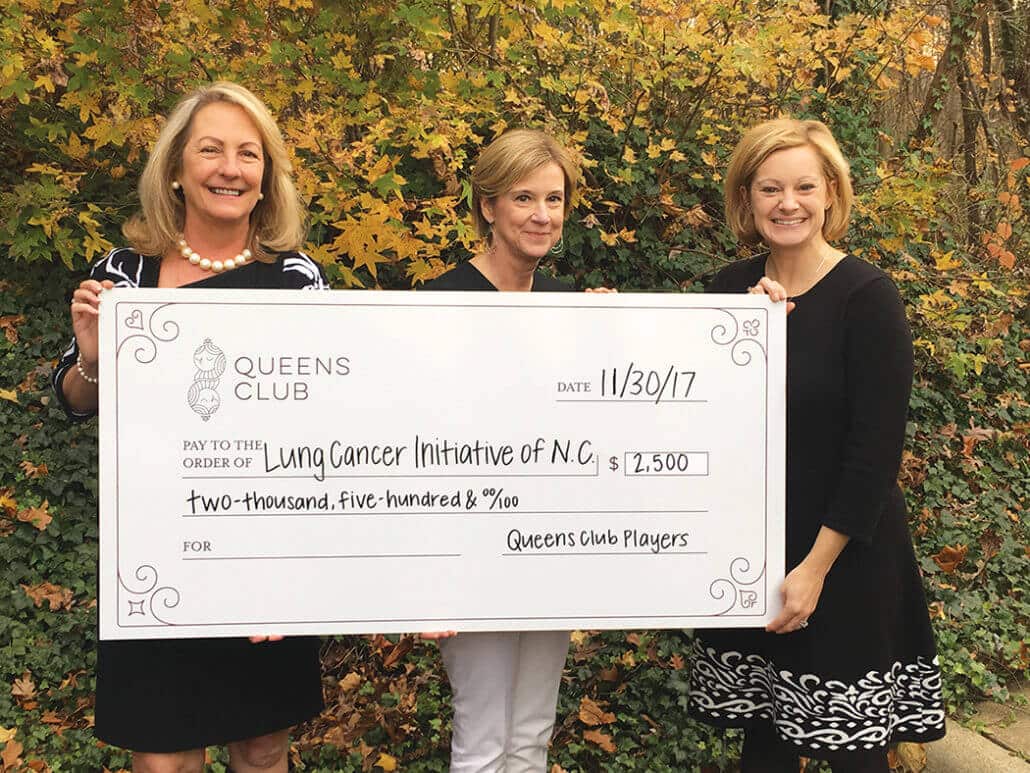
So far, the Queens have contributed more than $8,000 to various charitable groups, including the Make A Wish Foundation of Eastern North Carolina and Triangle Reading and Radio Service. Perkins, who receives treatment for a rare form of lung cancer, recalls the second poker night in November when the players all secretly changed their charity of choice to the North Carolina Lung Cancer Initiative in her honor. Then, they conspired to make her the evening’s winner, though she insists she would have won fair and square. “All of a sudden I turn around and there’s a line of people at the white board,” Perkins says. “No matter who won, the money was going to my favorite charity. Then, toward the end of the night, all these chips started piling onto my pile, which…I was going to win anyway! I had a great hand!”
The Queen’s Club hopes to grow its membership to 30-plus this year, to maximize the amount of money they’re able to raise and contribute. “I don’t think it’s going to be really hard, to be honest, since you don’t even have to know how to play poker,” Parker says of growing the club. “I just love being able to say, ‘you know, I’m not free this Friday, it’s poker night!’” Underwood, the founder of the original Poker Face Girls Club, says she’s not aware of any other charitable poker clubs or nonprofits in cities other than Raleigh. But it’s not hard to see the idea catching on, with more clubs starting here in the Triangle and beyond.
“The best thing is, we’re playing for charity,” Parker says. “It’s for the friendship of it all, for the social side of it. You’re okay with whoever wins because all the money is going to a good cause. It’s just a couple of hours sitting around with your friends playing poker.”

by Jane Porter | Feb 28, 2018 | Buzz, March 2018

Nicholas Fuller
Larry and Amy McBennett lived in their 1,900-square-foot home, built in 1940, in Raleigh’s Anderson Heights neighborhood for a decade. When the couple decided to sell the charming one-story house with the stone exterior and prominent chimney at 2705 Hazelwood Drive two years ago, they faced a dilemma. “We felt strongly that the facade was beautiful and fit nicely in the neighborhood,” Larry McBennett says. “We were aware that in the pricier neighborhoods in Raleigh, a lot of houses are being torn down and large McMansions are put up in their place. We knew that was a strong possibility for our lot. We did not want that to happen because it would be inconsiderate to our neighbors. And we wanted to preserve the house.”
The couple’s realtor, Randy Scherr, introduced them to Greg Hennis, a builder and the owner of GJH Construction. Hennis promised to preserve the home’s modest facade, original front rooms and masonry fireplace while expanding the house’s footprint up and out the back on the quarter-acre lot. In other words, he’d add the living space of a mansion without the ostentatious frontage or encroaching on neighboring lots, thereby preserving the home’s integrity as well as the neighborhood’s character.

Original exterior
“Within a handshake, we sold it to [Hennis] and he decided everything about the expansion,” McBennett says. “He did a spectacular job.” The house, now 5,455 square feet with oak floors, shiplap walls and plenty of natural light from tall, double hung windows, looks the same as before from the street in terms of its scale. But inside, there’s open space galore with a sprawling, all-new kitchen/family room, a first floor master suite, three upstairs bedrooms, a bonus room and dozens of cabinets, closets and functional nooks and crannies.
Crown molding, recessed lights and a spacious, stained pine screened-in porch profess a meticulous attention to detail. Most importantly, though, the neighbors are pleased. “We had our first open house right after we finished,” says Scherr, the realtor. “I had more people come through than any open house I’ve ever had before, and 80 percent of them were neighbors. They all just wanted to see it and the neighbors were enthralled. They all complimented us for keeping the integrity.”
The Hazelwood expansion epitomizes—and offers a solution to—the ongoing struggle that’s been playing out in older Raleigh neighborhoods for years due to the area’s explosive growth: longtime residents want to preserve the character of homes and neighborhoods they’ve long admired, lived in and loved, while a new crop of buyers want big homes inside the Beltline that they’re willing to pay top dollar for. In many cases, the resulting teardowns give rise to large homes on small lots, stirring up tensions and creating more than a little friction between neighbors. But with consideration and thoughtful design, compromise is possible, as the McBennetts’ story shows.
“My wife and I have strong feelings about neighborhoods being harmonious places to live,” McBennett says. “We both grew up in eastern North Carolina, in neighborhoods where people knew each other; there was a lot of interaction among families, and people were considerate of each other.”
Raleigh’s origins date back to the mid-eighteenth century, and it was designated North Carolina’s capital in 1788. Some of its neighborhoods, including Historic Oakwood and Mordecai near downtown, are almost as old, featuring original homes built as far back as the mid-1850s.
Most of the city’s neighborhoods inside the Interstate 440 Beltline were developed between 1900 and 1950. After the Second World War, as in many U.S. cities, residents flocked to the suburbs, giving rise to the development of large subdivisions on hundreds of thousands of acres of land. Today, most of the city’s population of roughly 460,000—more than 230,000 people—live in the northern part of the city, in neighborhoods such as Wakefield, Bedford at Falls River and Brier Creek. The Raleigh-Cary metro area currently has a population of 1.3 million and, in the next 25 years, it’s expected to nearly double in size, with 2.2 million residents by 2040. It’s not hard to see why.
Recently, financial services web site Magnify Money ranked Raleigh fourth on a list of the 50 largest U.S. metros for a balanced lifestyle. The site considered factors such as average commute time, proportion of income spent on housing, earnings versus time spent working, local income equality, health and sleep, and prices for goods and services compared to the national average. While the study found that Raleigh’s percentage of median income that goes to cover the median housing costs was pretty middle-of-the-road at 20 percent, people are already feeling the crunch of a dwindling affordable housing supply on the ground. With few lots available within city limits to build new housing and only a few areas left where housing is truly affordable—the area east of downtown near St. Augustine’s University is one—more and more people are moving to the northern and southernmost edges of Wake and to neighboring counties where housing is cheaper and more abundant.
In the following pages, we take an in-depth look at where Raleigh lives now, with a sampling of ten neighborhoods we feel are representative of the city. These neighborhoods comprise both old and new and are located both inside the Beltline and out. If you’re looking to buy, we have some suggestions—including 2705 Hazelwood Drive, which will host an open house on March 10 from 1—4 p.m. If you’re looking to sell, you’re in luck because it’s a seller’s market at the moment. Know that you have options if you don’t want your home to become another tear down. And finally, if you’re looking just to look, we hope you’ll learn something new. As they say in the real estate business, it’s location, location, location. Right now, Raleigh’s it.
Bedford at Falls River

3005 Grandview Heights Lane $454,000
Located in northwest Raleigh and developed in 2001 on 600 acres of hills bordered by the Neuse River, Bedford at Falls River is one of the city’s newest neighborhoods. The community, which is split into several individual subdivisions featuring different styles of homes at various price points, features a recreation center, two swimming pools, playgrounds, tennis and volleyball courts, and more than 200 acres of parks, greenways and open space. A central Town Square functions as a gathering space for neighbors and features an iconic clock tower.
Median ListingPrice:
$347K
Price per SquareFoot:
$136
Cameron Park/ Cameron Village

311 W Park Drive
$600,000
Developed in 1910 on land that was formerly part of the Duncan Cameron Plantation, Cameron Park is bordered by Broughton High School, Saint Mary’s School, Pullen Park and Cameron Village. The neighborhood features various architectural styles and sizes, including bungalows, Colonial revivals, Modernist homes and duplexes, all close to downtown and to NC State University. The homes in Cameron Village, scattered all around the Cameron Village Shopping Center, are comprised of 1950s ranch style houses, townhouses and luxury condos and apartments. Development of the area began during the late 1940s.
Median Listing Price:
$600K (Cameron Park); $535K (Cameron Village)
Price per Square Foot:
$284 (Cameron Park); $240 (Cameron Village)
Brier Creek

11524 Jordanus Drive
$529,000
Brier Creek is located near the intersection of I-540 and GlenwoodAvenue in northwest Raleigh, a 2,000-acre subdivision of single-family homes both modest and mansion-sized, luxury condos, businesses and shopping centers featuring big box stores. Centrally situated between downtown Raleigh and the Research Triangle Park, and adjacent to RDU Airport, Brier Creek features a country club neighborhood with an 18-hole golf course, a country club, tennis pavilionand a fitness center with an Olympic-size swimming pool.
Median Listing Price:
$307K (Brier Creek Country Club);
$529K (Regency at Brier Creek)
Price per Square Foot:
$149 (BCC); $202 (Regency)
Downtown Raleigh

222 Glenwood Ave Apt #403
$379,000
Bordered by Peace Street to the north and Martin Luther King Jr. Boulevardto the south, the downtown Raleigh housing market largely consists of high-rise, luxury apartments and condos, townhouses and loft developments, all located within walking distance of downtown’s businesses, restaurants, government buildings and nightlife. Most of downtown’s housing was built in the last decade, including complexes such as SkyHouse on South Blount Street, the Hue and the Dawson in the Warehouse District and the Quorum, the Link and 222 Glenwood around Glenwood South. Other buildings are conversions, such as the Hudson on Fayetteville Street, formerly the city’s Belk department store when the street was a pedestrian mall.
Median Listing Price:
$369K
Price per Square Foot:
$273
Five Points/ Glenwood/ Hayes-Barton

2417 Fairview Drive
$925,000
Five Points is a central area comprised of shops, restaurants and businesses at the intersection of Glenwood Avenue, Fairview and Whitaker Mill Roads, with fuzzily defined borders and neighborhoods including Hayes Barton, Bloomsbury, Georgetown and Roanoke Park. Hayes Barton is one of the larger neighborhoods located inside the Beltline, developed after the First World War and characterized by bungalows and grand homes with large front porches. The Glenwood neighborhood stretches north from Peace Street to Wade Avenue, and includes the Glenwood-Brooklyn Historic District, with cottages and bungalows from the 1890s to the early 1900s.
Median Listing Price:
$475K (Five Points); $560K (Glenwood); $965K (Hayes Barton)
Price per Square Foot:
$242(Five Points); $214 (Glenwood); $242 (Hayes Barton)
Historic Oakwood

407 Polk Street
$550,000
Located northeast of downtown, Oakwood arose after the Civil War as parcels of a dense woods known as “Mordecai Grove” were sold off and developed. Today, the city’s only intact nineteenth century neighborhood features homes dating back to the 1850s to a few contemporary homes built in the Modernist style. The majority of the neighborhood’s hundreds of homes feature historic architecture from the Civil War-era Neo-Classical styles, to Victorian Queen Annes and French Second Empire-inspired houses. The City of Raleigh designated Oakwood as the city’s first “local historic district” in 1974, with the intention of preserving the neighborhood’s charming homes and unique character.
Median Listing Price:
$395K
Price per Square Foot:
$277
North Ridge

1709 Hunting Ridge Road
$599,000
Located off Falls of the Neuse Road in north Raleigh, North Ridge is sandwiched between the Beltline and I-540, on 750 rolling acres. The golf and country club community was developed in the 1970s and features large, single-family homes ranging from 2,000 to 6,000 square feet. Ranch homes, arts and crafts styles and two-story houses with French and English accented features are common in North Ridge, and the community offers two 18-hole golf courses, tennis courts, a fitness center, swimming pools and a clubhouse.
Median Listing Price:
$450K
Price per Square Foot:
$166
Mordecai

1403 Wake Forest Road
$724,000
Raleigh’s oldest neighborhood, located north of downtown, Mordecai is named for the plantation on which is was developed in the 1700s. Today, the Mordecai House—built around 1785—is the city’s oldest house still standing in its original location. The compact, historically protected neighborhood features a historic park and several other historic buildings, including the Pilot Mill cotton mill established in 1892. Mordecai’s 200 or so homes mostly were built on deep lots following the First World War. The neighborhood is accessible via Person Street, a booming business district with lots of locally-owned shops and restaurants, and it’s adjacent to Seaboard Station and William Peace University.
Median Listing Price:
$498K
Price per Square Foot:
$250
North Hills

4516 Crabtree Pines Lane
$474,000
Raleigh’s fastest-growing neighborhood located off of I-440 consists of subdivisions anchored by The Circle at North Hills Shopping Center between Six Forks and Lassiter Mill Road. “Midtown,” as it’s known, is a gateway from downtown and older Raleigh neighborhoods inside the Beltline to the newer subdivisions in the northern part of the city. While development of the area began in the 1960s with ranch homes surrounding the regional shopping mall, North Hills looks a little different these days. High rise buildings and luxury condos as well as an open-air shopping center are centrally located, while surrounding neighborhoods such as Ramblewood feature townhouses and apartments. The Cardinal at North Hills, an upscale retirement community, opened recently off of St. Albans Drive.
Median Listing Price:
$470K
Price per Square Foot:
$191
Stonehenge

2817 Dunkirk Drive
$444,900
Founded in 1977, the north Raleigh subdivision features nearly 1,400 homes, a range of modest single-family homes, townhouses, apartment complexes, shopping centers and retirement communities. Bordered by the Lake Lynn watershed to the west and bisected by Creedmoor Road, most of the homes and newer developments within Stonehenge are located inside the city limits, though there is an unincorporated section of the community. The Seven Oaks Swim and Racquet Club offers tennis courts and swimming pools.
Median ListingPrice:
$385K
Price per Square Foot:
$146