The secret sauce to a great city could rest in the Power of 10.
Think big. Think 10. Raleigh’s future isn’t just about streetscapes and skyscrapers—it’s about crafting places people actually want to be. And that doesn’t just happen. Enter the “Power of 10,” a simple yet transformative concept: Every city needs at least 10 destinations, and each destination needs at least 10 things to do.
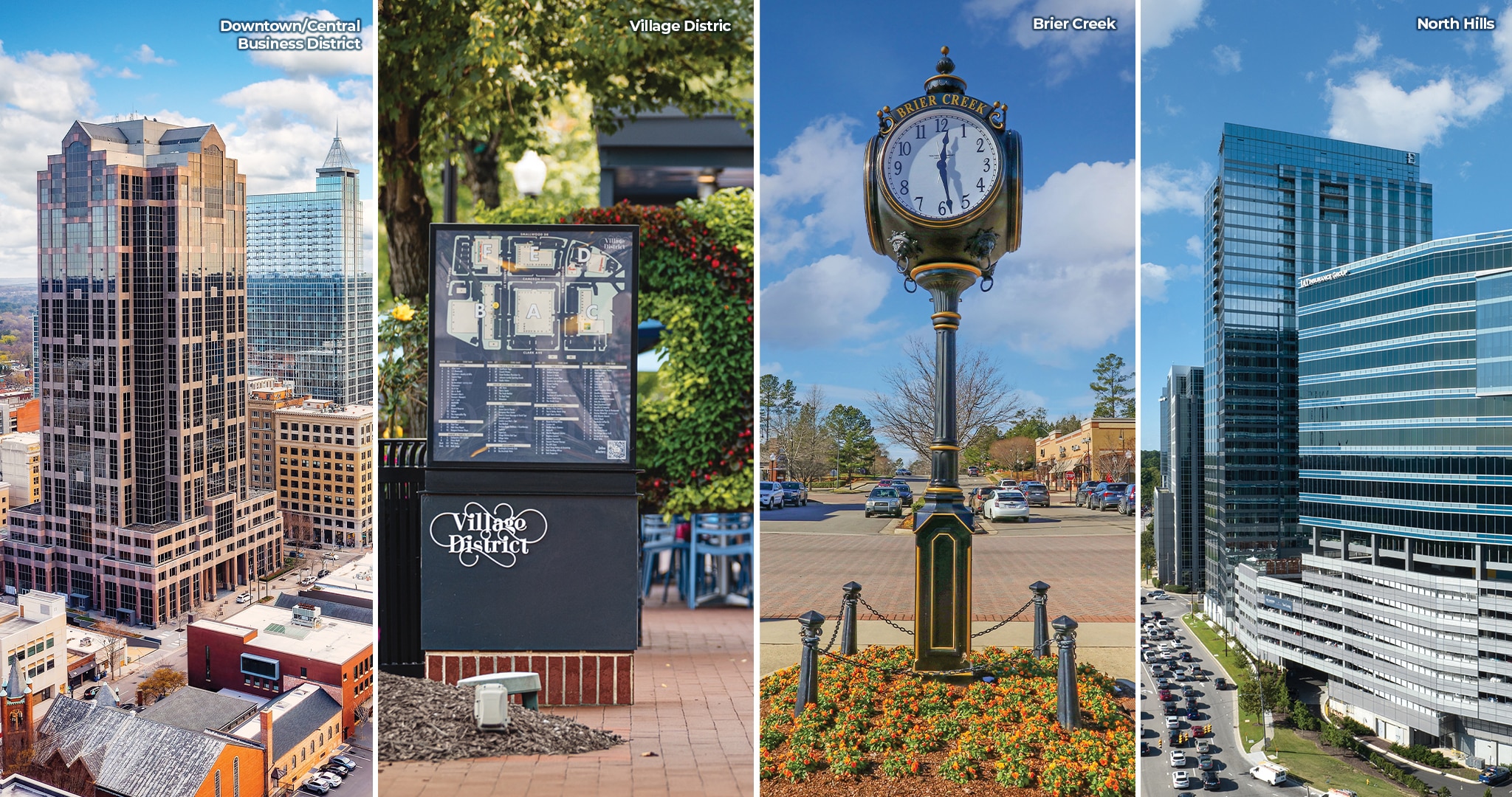
Originated by the Project for Public Spaces (PPS), the framework reveals why cities like New York and Atlanta lure people in—and keep them coming back. Such is the philosophy behind Raleigh’s 2009 Comprehensive Plan, which directed 60% to 70% of new growth to eight growth centers focused along key urban and transit arteries like the Beltline and 540—think Midtown, West Raleigh and Village District—plus 15 multimodal corridors, extending the Power of 10 principle to shape a vibrant and connected city.
As former COR Chief Planning Officer and current City Council Member Mitchell Silver puts it: “If I come Downtown—as a senior couple, a single, a family—what are the options? You have restaurants—then what do you do? Places like New York… there’s so much to do, probably like a power of 100. That’s what makes those places exciting—people come back again and again. That’s the goal.”
Building on that foundation, new potential pockets now emerge as the Comprehensive Plan 2030 gears up to shape the city’s next chapter through 2050.
Placemaking in Action
As aspirational as it is practical, Raleigh’s growth framework already reflects this principle. The point isn’t just garden variety shopping, dining or strolling, notes Silver. The real magic is layering elements—rest, play, art, music, food, history, connection—so people linger, explore and return.
As such, applying the Power of 10 isn’t just theoretical. Standalone attractions like museums or parks serve as a great draw, but deliver “the power of two, maybe three, at best,” says Silver. “People come, look, maybe hit up the gift shop—and leave. The real challenge: What can you build around the museum or park?” The telltale sign—are there people there? And do they stay there?
He nods to Nash Square—lonely trees, empty walkways and angled parking that could morph into a vibrant hub where people actually want to linger. Even the strongest attractors can stumble without a complementary cast. Take Wilson’s Whirligig Park—a momentary magnet that, on its own, risks being forgettable, explains Silver. But with the upcoming Carolina sports and entertainment stadium and planned ~50-acre live-work-play mixed-use project, that fleeting draw evolves into a full, thriving ecosystem.
Looking to 2050
Given Raleigh’s demographic shift, the urgency for this approach grows sharper. The city is young: ~60% under age 40, and ~80% under 55. Yet, Silver warns, “the [older] minority is trying to drive planning decisions. We need young people to speak up.” Future growth hinges on creating these multidimensional hubs—places where people don’t just pass through but stay, engage and thrive.
Layer on a looming constraint: Raleigh is projected to run out of developable land within 20 years. Yet, the simple reality remains—people are coming. The city’s population boomeranged ~50%, adding roughly 200K residents in the last 20 years. “I called it Mayberry the Metro,” says Silver of the now more than 65 people relocating to Wake County every day. So it’s not a question of if—but how we manage it.
By honing in on our people-centered placemaking pockets—through public spaces, new mixed-use developments and urban design innovations—Raleigh can scale up its Power of 10. And in doing so—from blueprint to buzzworthy—transform a city of streets into a city of destinations.
Urban Growth Centers – 2009 Comprehensive Plan
Brier Creek
Crabtree
Downtown/Central Business District
Midtown/North Hills
New Bern/WakeMed
NE/Triangle Town Center
Village District/University area
West Raleigh
Potential Pockets for Urban Growth: 2030–2050
Capital Boulevard
City Market
City Plaza
Downtown South
Moore Square
Triangle Town Center (reimagined)
WakeMed Corridor (BRT)
Warehouse District
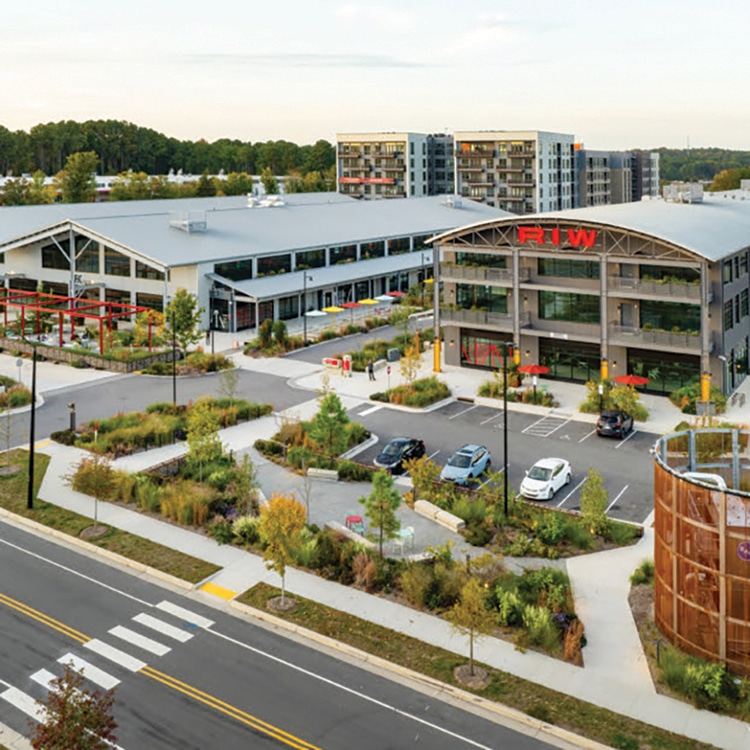
Emerged Naturally – Raleigh Iron Works
Raleigh Iron Works
A game changer for East Raleigh—and key connector between Downtown and Midtown—Raleigh Iron Works is a work-stay-play hub on the former Peden Steel site. Breaking ground in fall 2021, Phase One boasts 200+ apartments, buzzy retail, and ambitious public art and maker/pop-up programming, anchored by standout F&B spots from Brodeto and Little Rey to St. Pierre and Ponysaurus Brewing—and, yes, that trademark slide bringing a playful touch that’s core Raleigh.
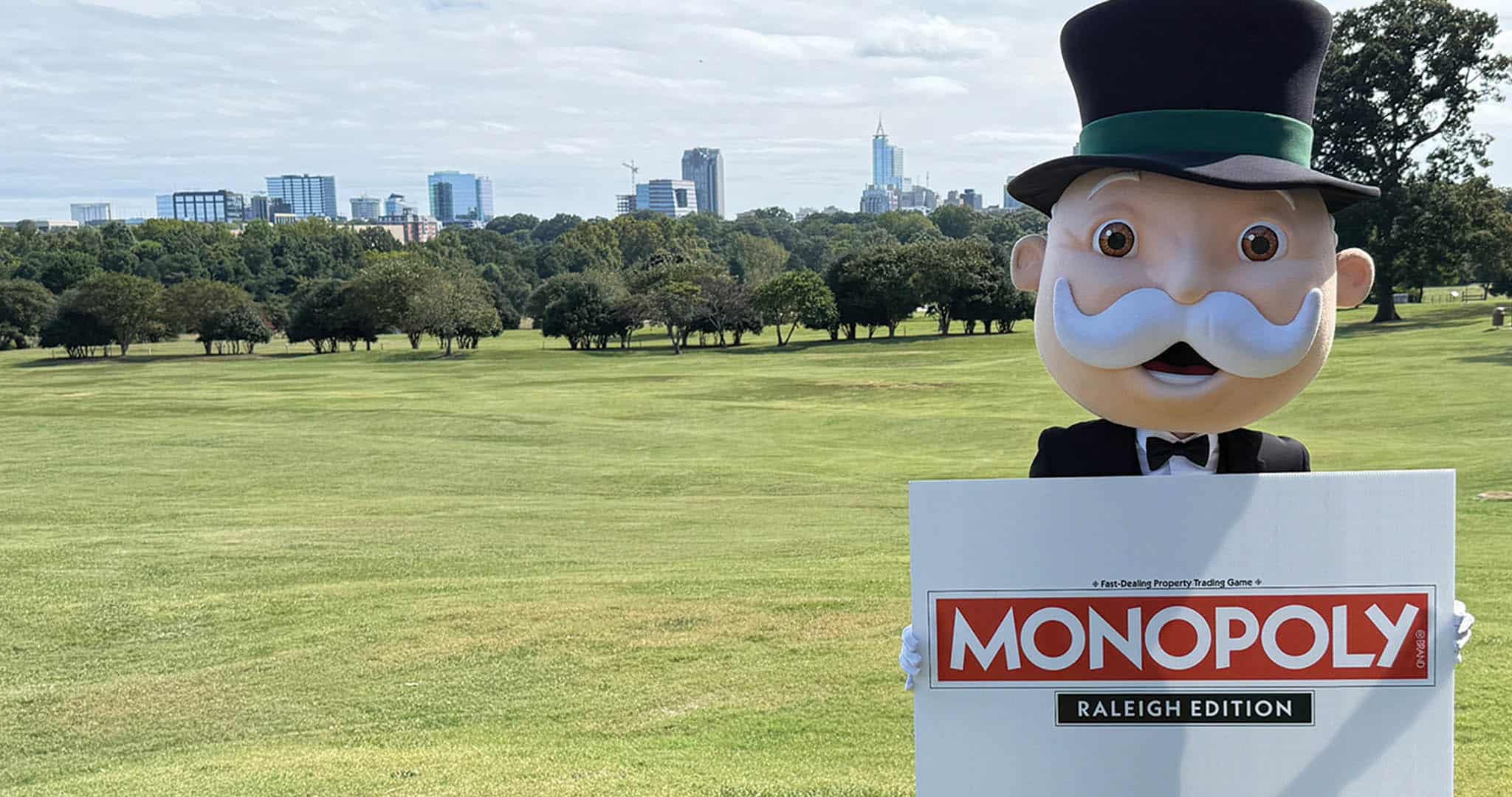
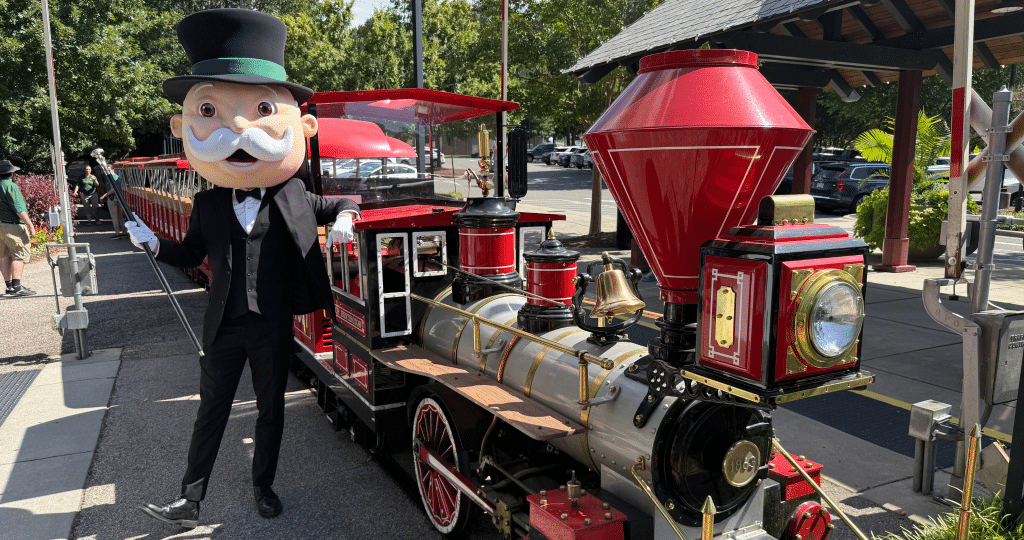
Get ready to pass go and collect that $200, Raleigh. Flaunting his “get out of jail free” swagger, “Rich Uncle Pennybags”—aka Mr. Monopoly—recently shuffled around town collecting intel for the upcoming Monopoly: Raleigh Edition, dropping next September.
As Hasbro’s newest select, Raleigh appealed to the 90-year-old world’s fave gamemaker because the city “has a culture unlike anywhere else across the world,” said Top Trumps USA’s Katie Hubbard at the kickoff event alongside Pennybags and a spirited Canes’ Stormy. “Raleigh is just the perfect fit.”
And as for what local pieces will “fit” those famed Boardwalk to Baltic Ave spots, Pennybags is scooping locals to submit ideas for the fully authentic Raleighized edition, from “go” and “jail” to the Community Chest and Chance cards to the currency. “We’re super excited to see where you go with the family, dates, the dog,” said Hubbard. “If you’re new—the first place you went. We want to know all of it.”
Also taking the mic, Mayor Janet Cowell highlighted “iconic” mainstays like Fayetteville Street, Chavis Park, and Shaw and NC State universities, noting selects also include fresh spots to capture the city’s diversity.
“The city pride here is off the charts—even transplants feel rooted and proud,” Hubbard told RM. Mused Cowell: “We’ve got the growth and population”—really speaking for everyone when she said: “I can’t wait to play.”
Top Trumps USA Inc
TOP TRUMPS TIPS
Submit your fave Raleigh brands, hot spots + events
Over 1,200 people in Wake County won’t have a place to sleep tonight. That number isn’t just a statistic—it’s a father, a single mother, a young adult trying to finish school, a hungry child, a neighbor or colleague, a family facing a fight for stability.
The solution is simpler—and closer—than many realize: The biggest barrier to housing isn’t monthly rent. It’s upfront costs like security deposits or first and last month’s rent. “There is housing around us. It’s just not always affordable,” says CCF founder and namesake John Cooper. CCF Housing Stability Grants remove those barriers, providing bridge funding that turns the impossible into a reality.
Ranging from $531–$5,500, these grants give people solid footing and a fresh start—empowering seven local organizations to deliver life-changing support at every stage of need. From assisting the unsheltered through Oak City Cares to offering women safety, stability and basic needs at The Women’s Center to helping children and families access permanent housing and support services through Family Promise of the Triangle, the reach is wide. Grants also fund addiction-recovery housing via Healing Transitions, help foster youths transition to living on their own through Wake Tech’s Fostering Bright Futures program, provide essential home furnishings to people coming out of homelessness or crisis through The Green Chair Project, and give working families in Cary short-term housing and services through The Carying Place—because “a couch is not a bed. A car is not a dwelling. A hotel is not a home.”
Recently, 10 such grants helped 21 people move into stable housing: A 76-year-old woman who has bounced from shelters to her car to the DTR streets for 10 years; a 34-year-old overcoming addiction; and a 73-year-old who suffered liver failure and cares for her daughter and granddaughter. All of them can afford their monthly rent—what they needed was the security deposit leg up.
The simple reality: Homelessness isn’t just a headline—it’s a human being. These people have faces. They have names. They have stories. “I never knew from one day to the next if I was going to live or die,” says a local who, after leaving work with a pounding migraine, drove into a median—an accident that cost her both her job and apartment. “The Cooper Foundation paid my first month’s rent, application fee and security deposit—they help you with every single thing you need to get back on your feet,” she says from the comfort of the furnished home she now shares with her “guardian angel” pup, Lacy.
These are just a few of the very real examples of how, together, our dollars amount to very real results. This year, Give Raleigh isn’t just about giving hope—it’s about giving security and a fresh start. In honor of Raleigh Magazine’s 10th anniversary, we’re calling on our loyal readers and community to give $10—or multiples of $10.
With your generosity, whether a Hamilton or hundreds, we can continue transforming lives across Wake County, one stable home at a time—and thanks to TowneBank/Towne Insurance’s generous match of the first $10,000, every single dollar you give has double the impact. Please give whatever you can, even $10—because every dollar counts, and because no one should have to wonder where they’ll sleep tonight. Through Nov. 10, giveraleigh.com
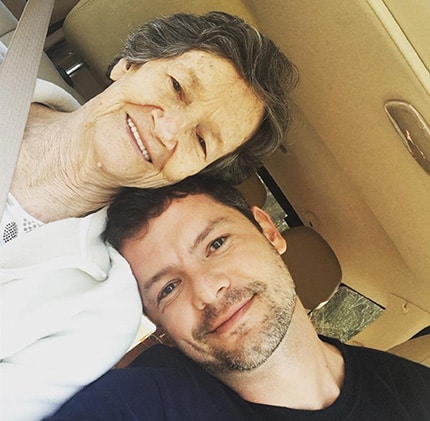
“My grandmother’s unconditional love is the most precious gift anyone has ever given me. So, I started the foundation to honor her, to continue her tradition of helping others.” —John Cooper
Heart of the Story
For CCF founder John Cooper, the fight against housing insecurity is deeply personal. Growing up in a modest home, he witnessed firsthand the weight of financial strain—and how easily stability could slip away. His mother juggled multiple jobs while enduring domestic violence, and his grandmother lived on a meager fixed income—yet provided the stability that allowed him to pursue college and build a career. After his grandmother passed, Cooper sought a way to honor her, founding the Cooper Charitable Foundation to ensure others wouldn’t have to face the same uncertainty alone. “She provided a lot of stability for me in a childhood that was often chaotic,” he recalls. Through CCF, he is turning his own story into a lifeline for others, breaking down barriers so everyone has the chance—and the ability—to find not just shelter, but dignity and hope.
Guide Your Giving
CCF’s small grants mean big impact. Support the organization that hits home by picking your partner from these seven CCF partners at giveraleigh.com.
Family homelessness is often hidden. Instead of street corners, many families are in cars, motels or couch surfing—struggling quietly under the weight of shame and stigma. Yet families with children make up nearly a third of the homeless population. That’s where Family Promise steps in, providing prevention, emergency shelter, rapid rehousing, transitional housing and aftercare programs since 1993 to help families move into safe, affordable, permanent homes. Because every child deserves more than a car seat or a couch to call home. familypromiseofthetriangle.org
A home is more than four walls and a concrete slab—it’s a bed to sleep in and a table to gather around. But in booming Wake County—one of the fastest growing counties in the nation—nearly 100,000 residents still live below the poverty line, unable to afford basic household furnishings. The Green Chair Project bridges that gap—providing beds, tables and essentials that transform empty rooms into homes since 2010 for families overcoming homelessness, crisis or disaster to reclaim stability and dignity. thegreenchair.org
Addiction touches us all: a parent, partner, friend—even ourselves. And it rarely looks the way we expect. “Always open, always free, always everyone, always another chance, always community”—with special emphasis on the homeless, uninsured and underserved—Healing Transitions has been connecting with people on their terms since 2001 with innovative, on-demand, peer-based recovery services: from emergency shelter and nonmedical detox to long-term support and sustained sobriety, rekindling a person’s ability to return to a meaningful, productive life. Because recovery often takes many tries, they believe in unlimited chances—until someone wakes up sober, employed and hopeful again. healing-transitions.org
Every night, hundreds of Wake County neighbors face the uncertainty of sleeping outside. Oak City Cares meets people where they are, offering meals, showers, laundry, coordinated care and—most importantly—hope. As the central hub for homelessness services in Wake County, they have been bringing together nonprofits and county agencies under one roof since 2019, helping individuals and families navigate housing, employment, health and hunger. By coordinating care in one DTR location, the “one-stop-shop for individuals and families at risk” works to make homelessness rare, brief and nonrecurring. oakcitycares.org
A young adult aging out of foster care often faces the world alone. Covering tuition and fees, plus stipend, Fostering Bright Futures helps students focus on college classes instead of where to sleep at night, in turn decreasing the number of dropouts among foster youth. Since 2009, supported by the Wake Tech Foundation and numerous community partners, the program serves a comprehensive support system that removes barriers to education and independence by providing integral life skills and financial guidance—empowering former foster youth to earn degrees; pursue careers; and build stable, self-sufficient futures. waketech.edu
Imagine a woman finally tucking her children into a warm bed, knowing tomorrow won’t be another fight for survival. For single women escaping homelessness, every day is a battle for safety and stability. The Women’s Center of Wake County provides housing support, counseling and life skills that turn fear into hope, survival and self-determination. As Wake County’s only day shelter for single women, TWC has been serving meals, showers, laundry, health care connections, case management and more since 1977—creating a pathway from crisis to security and transformation. wcwc.org
When you think of homelessness, do you imagine teachers, firemen, grocery cashiers or your favorite Uber/Amazon driver? Wake County’s homeless population has nearly doubled since 2020, with over 6,500 children experiencing homelessness—and their parents are people just like these. That’s where The Carying Place comes in—empowering hardworking families through short-term housing, life skills training and wraparound support to build financial literacy, housing stability and the tools necessary for lasting independence since 1993. Because “a couch is not a bed, a car is not a dwelling and a hotel is not a home.” thecaryingplace.org
Got milk? NC State footballer Hollywood Smothers does. While getting an inside take on the star running back’s upcoming milk promo as the ultimate OG recovery drink, we got to know the man behind the helmet.
Fave spot on campus? Carter-Finley
How does it feel to be back playing in your home state? It means everything. I play with a lot of guys I actually played with growing up, like Sean Brown on my team. … Also having more of my family come through. It ain’t nothing but a two-hour drive for them to get to the game. That’s the best part ever.
CFB moment you’ll never forget? Georgia Tech touchdown run in the last couple minutes. I should’ve kneeled, should’ve took a knee and slip at the 1, but we needed a play at that moment. Feels like that was one of my good plays.
You’re a rapper? I just do it for fun. … Growing up, my dad used to produce music, so I always had an ear for it. In my free time, I’ll just record a song on my phone. After my friends heard it, they were like, ‘Just put it out and let other people hear it.’ I started dropping a few songs, and a lot of people on my team will listen to it.
Fave local restaurant: Ruckus Pizza—I eat there a lot.
Show you’re binging: I’m probably late, but I just started getting into Power on Starz.
Slicing onto the scene, Pizzeria Toro promises to be your next ’za obsesh when it fires up next summer at Seaboard Station.
Courtesy of Pizzeria Toro
Having already amassed a cult following, the uberpopular Bull City wood-fired pizza place is sliding its signature pies into an ever-fitting former trucking company garage that’s part industrial grit, part open-air chill—and soon to be home for their neighborhood hangout alongside upcoming The Common Market.
Bright, high and airy, the space screamed Toro to the team: raw, open and ready for bar-and-pizza-joint energy. “We’ve always been really picky about where to put another Toro,” says chef/partner Gray Brooks of the pizzeria’s sophomore effort after over a dozen years in Durham—“but when this opportunity came up, it just felt right.”
Helmed by Gray, who cut his teeth in fine dining, alongside Seattle-bred hospitalitarians Jay Owens and partner + wife Cara Stacy, Toro Jr. is the byproduct of the trio’s MO of marrying thoughtful service, elevated eats and casual vibes. That philosophy shows in every aspect of their Durham success and selects—from classic margherita and pepperoni pies to seasonal creations crowned with locally sourced ingredients, all blistered and charred to perfection.
Long lauded by local foodies, critics and national outlets as one of Durham’s top ’za destinations, the team looks to bring that same winning recipe to Raleigh. “Operating a restaurant outside of Durham is going to be a new challenge for us—one that we’re really excited about,” shares Brooks. “We’ve always loved the food scene here—so many talented chefs and great staffs. And we’re stoked to be a small part of it. I think we’ll fit in pretty well.”