Size does matter—but not the way you think. In this case, downsizing can be the difference of housing affordability in a city teeming with growth.
It’s been five years since Raleigh entered her ADU era—and as a massive gamechanger for housing accessibility and versatility in an increasingly volatile housing market, it’s hard to fathom what all the hoopla was to get those accessory dwelling units approved. As it tends to go, you’d think Raleigh was teetering on the edge of ruin every time a new project hits the headlines. Remember? ADUs were going to destroy neighborhoods. The North Hills uprising—billed as a “logistical nightmare”—is now a well-oiled Midtown machine. And don’t even start on tower announcements.
Since then, for the most part, it’s been all praise, no problems. If anything, the biggest “problem” is people don’t seem to be aware they can do these backyard bungalows—and what a viable option they serve for adaptive living, from in-fill housing and reduced footprint to added Airbnb or rental income making room for your brood to bloom.
“There’s several options out there,” says Chuck Shomo, who is now sole owner of Tiny Homes Raleigh, which has already built about 10—with three more in progress—of Raleigh’s ~50 ADUs to date, running the gamut from investments to Airbnbs to granny flats. “It’s just getting that information out. I think ADUs are the future for Raleigh—and I see it tripling, quadrupling even, in the next few years.”
To be fair, according to local ADU’ers, the buildout can be a bit of a headache. In the case of ADU-savvy Travis Bailey, who, with his wife, is now putting the finishing touches on his long-delayed Boylan Heights backyard addition, it’s really about choosing the right builder. “We absolutely would do it again,” affirms the born- and raised-Raleighite. “But I would have gone with a smaller construction firm that would have been a lot more cost effective… and [for whom] the ADU could be their primary focus,” adds Bailey, who first learned more about these “perfect solutions” as a volunteer on Mayor Nancy McFarlane’s campaign in 2017 when ADU was a big buzzword.
Raleigh’s made it easier to say “yes” to ADUs via the fast-track program—“a big step forward,” says Shomo. Bailey echoes the sentiment: “It’s part of being a first adopter of anything,” he admits. “You’re going to face more headwinds and challenges with getting things done—and the hope is, for people down the line, the process will be more streamlined. I’m very hopeful it’s going to get faster and cheaper as more people do it.”
If stats are any indication, that time is nigh. While not every state is down to downsize, NC already ranks in the top five best states for tiny house living across a trio of key categories: third for tiny home builders/manufacturers and for Google search interest per capita, and fifth for number of tiny home communities—with Texas taking top cede nationally, according to Home Gnome’s extensive 50-state analysis.
The demand is real—and the potential? Only getting better. Just five years in, Raleigh’s ADU moment is less a niche experiment and more a quiet revolution. “Five years ago, the city was pretty tight-fisted—and even maybe when this ordinance first dropped,” surmises Shomo. “But it really did pave the way for this new era. Now, he muses, companies are shipping them all over the country, and they’re targeting Raleigh as a market. “ADUs are going great. They are definitely helping a lot of people. I think it’s the future.”
While early adopters took a few hits to smooth the road, the path ahead looks clearer—and more cost-effective—by the day. What started as a back-lot battle is now shaping the front lines of Raleigh’s housing future. Flip the page to scope six locals proving how small spaces make a big impact.
Photography by Sean Junqueira
VILLAGE VIBE Martin Streicher & Paige Tharrington
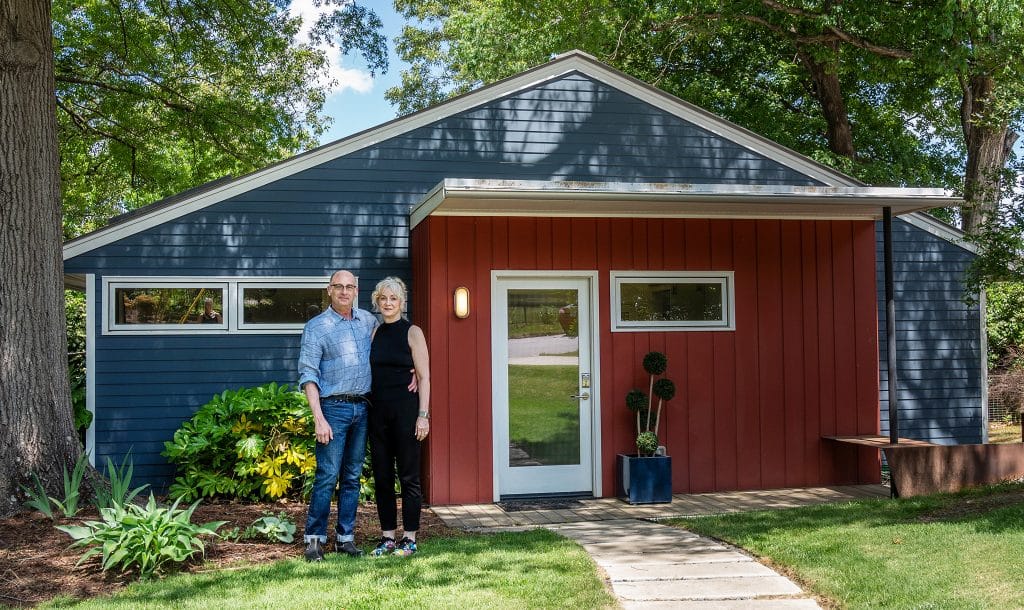
Purpose and parties collide in this Village District retro-chic dual-purpose addition. Talk-therapy office by day, party pad by night (or any time the mood strikes), the convertible corner-lot 550-square-foot space can easily shift to a one-bed, one-bath MIL suite, rental or Airbnb. Sparked by the demo of Paige’s St. Mary’s office to redevelopment, the couple pivoted from pricey buying options to building on-site. “We looked for something to buy Downtown or in Cameron Village—everything was crazy expensive or teardowns. So, we pursued building on our property,” says Martin. Fashioned by REdesign.build with adaptability in mind, the would-be foyer and soundproofed bedroom provide the perfect layout for a professional waiting area and client sessions—offset by a large vibey sun-washed “living room-slash-party room” that opens to a shared covered patio for carport parties. So: a midcentury-mod mood, a meeting room and a moment.
Photography by Sean Junqueira
BLOODWORTH BOOMERANG Thomas & Lisa Barrie
Dubbed the Barrie Guest House and built for housing flexibility in the heart of Mordecai edging the empty nesters’ circa-1907 historic-register home, this mod backyard retreat by Armature Design Build provided just that for the Barries’ boomerang son transitioning back from the Big Apple. “The prime motivation was to add one affordable unit to the Raleigh housing market—designed to be rented at a very affordable rate,” explains Thomas, an NCSU College of Design professor and nonpracticing architect (except on his family), who also serves as director of the Affordable Housing and Sustainable Communities Initiative (AH+SC) and WakeUP Wake County Board of Directorschair. Outfitted with full kitchen, living/dining area, sleeping loft and bonus 60-square-foot garden shed to boot, the beautifully appointed abode—with interiors and landscape by Lisa—was first used as a flex weekender guest house as the couple grew accustomed to it. Positioned with primo views of the backyard garden, best served from the porch perch, the fall 2023-completed 300-livable “square-footage poor and spatially rich” space, as Thomas puts it, ultimately served up a prime affordable—and independent—place for their 32-year-old son to land. Small in size, big on impact—this tiny build is a blueprint for flexible, future-ready living in Raleigh.
Photography by Sean Junqueira
THE ARTIST LOUNGE Reggie & Georgia Tardy
All function, all flair, no compromise—the wildly successful and versatile Artist Lounge sets the bar at Shaq height. A flex space with serious main-character energy, the nee-2021 artful oasis is a vibe—period. Carefully crafted to cater to creatives of every stripe via 600 square feet of adaptive interiors, tailored to fit any vision, the creative haven boasts private workspace and outdoor event-ready amenities to boot. “We had a vision, and linked up with Jeremy Hauch and Hauch Design Architecture,” says Reggie of the fateful find after he stumbled on Hauch’s card on a jobsite. “They came in and saw that vision,” delivering an intentional, innovative space for community. A muse with an alfresco fire feature and fully stocked mini fridge, the convertible Downtown art studio is offset from the couple’s Boylan Heights beaut of a home by heated saltwater pool and versatile entertaining space—think outdoor bar, multilayered seating, Astroturf stretch and electrical access for seamless F&B service. “We wanted to open the idea to all kinds of the community,” adds Reggie. A mood with a mission, it’s not just a space—it’s a statement.
Photography by Sean Junqueira
MAYVIEW MARVEL Matt Johnson & Carolyn DeVita
Purposeful meets party pad via The Hannah: a 320-square-foot vibey “desert”-set oasis situated behind an 80-year-old bungalow. Having forked over five grand on the dream design, Matt spent two years stuck in the search to bring it to life before “kind of kiboshing the whole thing,” he vents. “It was unbelievable—the quotes coming back were the price of a new house. It was just not palatable—and I’d given up.” That is, until he stumbled on the then “tiny little website for Tiny Homes Raleigh,” he recalls. “They saved my bacon.” One of the first Raleigh ADUs fashioned by THR and fast-tracked by the city, the casita has since logged some 130+ Airbnb stays to the tune of ~$2,500 per month—and, at this rate, will pay itself off in less than 10 years. When not booked, the dwelling doubles as entertaining space, a college-kid crash pad or, say, a reception-hosting hub for the newlyweds (true story) that easily converts to a granny flat down the line. “I didn’t get the ‘dream’ two-story ADU I wanted,” says Matt, “but I do have a really cool 300-square-foot space with a carport add-on and some interior customization that came in at a third of the price—so then I had the budget to build this dream space around it. It just took me finding that right person to help me bring this small slice of heaven to life.” So, The Hannah’s not just an ADU—she’s a vibe manifesto.
When your blossoming brood starts outgrowing the historic home you bought in 2016—and love—in a volatile housing market, an ADU presents the ideal solution. So instead of packing up, this Boylan Heights bunch leveled up. “We wouldn’t have been able to make our existing house work with our expanding family without this space,” says born-and-raised Raleighite Travis, who joined the Historic Development Commission to design progress that preserves history. “I joined the Commission to figure out how can we make developing in historic areas more permissible while also being respectful and keeping the historic nature intact.” Serving up responsibly designed flex office space for the professional remote/hybrid couple, the just-completed 800-square-foot convertible addition by REdesign.build is crafted to adapt as priorities shift from diapers to downtime—think large living room, kitchenette, laundry and half-floor loft, making it rent-, Airbnb- or even boomerang kid-ready. Future-proofed, family-first and firmly rooted, staying put never looked so forward-thinking.
Photography by Sean Junqueira
WYCLIFF WONDER Julie Augustyn & sons: Corey, Charles and Caiden Brady
She wasn’t house-hunting for an ADU-ready lot, but when Julie stumbled on this prime West Raleigh corner of opportunity in 2020 in sync with the ordinance, the writing was on the wall. The timing, the zoning, the bones—it all lined up. A seasoned commercial real estate pro and newly single mom, she foresaw the future for her family and scooped up the aging ’70s split-level reno opp with ADU potential. So goes the origin story for The Ellis—the sideyard-born Tiny Homes Raleigh model named for Julie’s late grandfather, now populating other pockets of the city to boot. “I was very happy with the process,” she says. “It works wonderfully for this corner and has been a beautiful addition—and I think it has added to our community.” Breaking ground on the prototype in May 2022, the 576-square-foot stunner now serves as an ideal fit for its long-term tenant seeking a simpler, smaller footprint. “I built with the intention of it being in-fill housing,” says the mother of twin teen and 7-year-old boys. “But I plan to live here—so I could see it being used as flex space by my family in the future.” So what started as a personal pivot is now a citywide model for living small and dreaming big.
Whatever you may think of Mayor Mary-Ann Baldwin, you likely think something—strongly. We look back at the “notorious” city leader’s provocative tenure.
Love her or loathe her, the one thing everyone can agree on is Mary-Ann Baldwin has struck a chord in Raleigh. And she loves it.
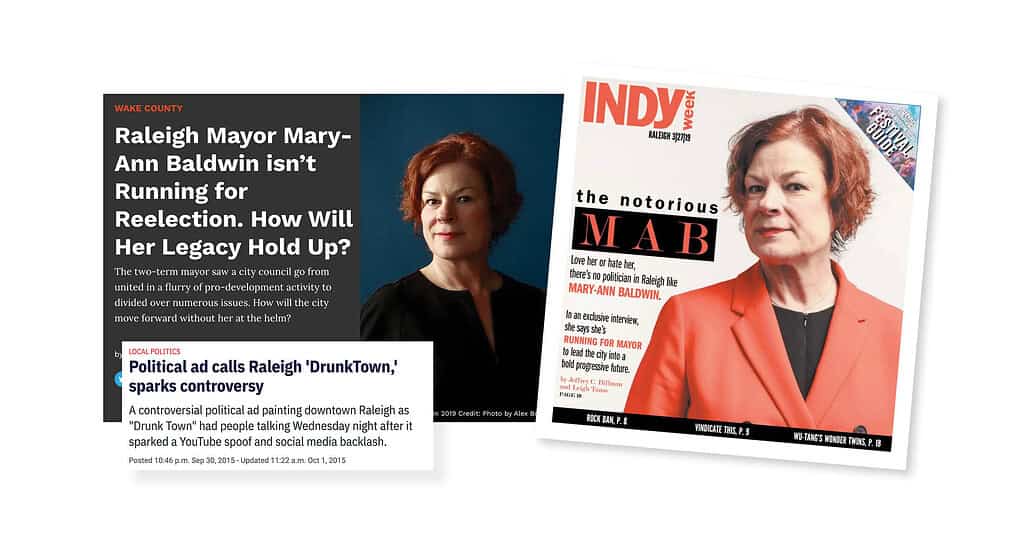
Dubbed “Notorious MAB” by INDY Weekwhen she announced her run for mayor with the intent to “lead the city into a bold progressive future” on the heels of the “Council of No,” Baldwin retorted by proudly—albeit facetiously—splashing the “notorious” moniker across T-shirts. Five years later, the two-peat mayor has boldly fulfilled that promise every day since. And, now, as she’s set to pass the baton as the Cap City’s second-consecutive—and third-ever, behind Nancy McFarland (2011–19) and Isabella Cannon (77–79)—female mayor, she opens up to Raleigh Magazine about her time at the helm.
The blunted “moonshot” mayor began with so much hope. Elected on the heels of her already notorious five-term run as at-large Raleigh City Council member (think “Drunktown,” pro-development, etc.), she famously dreamed 2020 would be Raleigh’s shot for the stars. That is, until a pandemic ~90 days in turned the town—and the world—upside down. A handful of years later, the mayor of COVID, social unrest, development starts and stalls, and Citizen Advisory Council (CAC) conflict cedes a city that looks far different than its prepandemic persona.
And it is arguably the pandemic that has most shaped her public perception. But despite the economic and social upheaval, Baldwin—alongside an initial-term “pro-development” council—made good on plenty.
From the jump, Mary-Ann Baldwin publicly devoted herself to zoning reform and solving what she calls “the missing middle” by allowing Accessory Dwelling Units and increasing housing supply to level the homeownership playing field in response to rapid growth. But that commitment was met with an all-out war from residents wanting to “Save Our Neighborhoods” from an influx of townhomes and duplexes, specifically in Five Points, famously dubbed “ground zero for Raleigh’s housing fight” by Axios. Essentially, the public feared the price of housing volume would come at the cost of character.
“Townhouses are usually somebody’s entree to homeownership,” explains Baldwin of her push. “When I was first elected, you could only build a townhome in 20% of our city. I talked a lot about housing choice. It’s not affordable housing. It’s really about housing affordability and choice—quads, duplexes, etc.”
One of the stats she says she is most proud of is, over the past two years, about one-third of the building permits issued are missing middle. “The whole missing middle—while some people consider it controversial—it’s for the better of our city. And it’s also what you see trending as a way to address the housing shortage in cities across the country,” she maintains. “Bottom line is we don’t have enough supply. … And what I’m proudest of is what we’ve done with affordable housing. It’s been pretty amazing.”
She cites the $80 million affordable housing bond greenlit by voters on her watch, and projects like the ~$1.5 mill Idlewild, city-owned historic land sold for a dollar to make way for the city’s first cottage court permanent affordable housing. “And, just the other day, we approved $5 million for a new program that will help our unsheltered. We’re looking at getting 40 unsheltered families into permanent housing.”
Add to that a handful of historic bonds, including $275 million for parks and rec that paves the way for McFarland’s and mayoral candidate and former Dix Park Conservancy President and CEO Janet Cowell’s Dix vision, and, of course, the now-extended four-year terms and staggered two-year elections.
When it comes to passion, “I’m really focused on sports as an economic driver,” says Baldwin. “There’s been a lot of talk about Major League Baseball coming here. We have one of the best women’s soccer teams in the world, and our men’s soccer team is also great. So how can we leverage that and ensure this opportunity comes together?”
Baldwin reflects on her role in what is the city’s largest economic development project to date via the expansion of Lenovo Center (formerly PNC Arena) and the surrounding Entertainment and Sports District development. “I want to give the state—as well as Wake County—a lot of credit because they really stepped up and partnered to help make this happen,” says Baldwin.
Often compared to Atlanta’s The Battery, which brings in a behemoth ~$3 billion a year, the sports and entertainment buildout is expected to be a boon unlike any other the Cap City has ever seen.
Taken all together, love it or loathe it, Raleigh’s roster with Baldwin at the helm points to progress. “There’s not one thing I could single out,” Baldwin says when asked what stands out during her time as mayor. “I think it’s everything—getting things done is what keeps me going. Part of what makes me notorious is that I do move things forward. I’m not somebody who’s going to sit around—making a difference is what keeps me charged.”
Turning a hundred or so pages, people will remember landing the Omni Raleigh Hotel and securing the Convention Center expansion and renovation. They will remember a government that finally approved BRT and the Civic Tower (unifying the civic entities on one campus) after 10 years of talk, thus serving to ignite a region, improve efficiency, and enable better communication and collaboration.
And in what was easily the most contentious council vote in modern history, we could write a master’s thesis on the differentiator initiating, retaining and relocating Red Hat Amphitheater has been—and thankfully will continue to be—for Downtown, as well as for the city as a whole, both in terms of economic impact and urban appeal for residents and visitors alike.
But people will also remember a pandemic, civil unrest, mask mandates, economic upheaval, her push to disband CACs, and the horrific tragedies that occurred during her tenure: a mass shooting and the death of local 11-year-old Hailey Brooks as a result of a parade tragedy. Still a contentious topic regarding the city’s handling, the 2024 Veterans Day Parade has just been canceled, and the Brooks family is now suing the City of Raleigh.
Pointing more specifically to people’s direct dislike of Baldwin, they will also remember her fingerprints on the skyline. For every pro-development constituent, there are arguably more who have publicly condemned the mayor of having her hands in developers’ pockets—so much so that she stepped down from her day job at Barnhill Contracting Co. due to speculation.
“If we want to continue to be a desirable city, we have to be bold,” says Baldwin. “We’re not going to stop growth—and we can’t just sit back. We have to have a vision for where we’re going. And whoever the next mayor is needs to be able to articulate that vision and get people behind it so we can move forward.”
Beyond her growth mindset, Baldwin’s favor fell drastically in response to the ongoing mask mandate and her handling of the upheaval that all but deemed Downtown unrecognizable after businesses were set aflame and ransacked—and the curfew that could have helped prevent it. While it was then-Raleigh Police Chief Cassandra Deck-Brown who was obliterated for her now infamous quote saying she “would not put officers in harm’s way to protect property and insurance,” many DTR business owners and residents hold Baldwin just as accountable for not stepping in sooner to instill a curfew.
“Bless her little heart. I know she wanted that job [of mayor] for a long time, but she flunked the very first test,” said Clyde Cooper’s BBQ owner Debbie Holt in the aftermath—one of many DTR business owners who didn’t feel protected by the decisions Baldwin made.
“What you learn is there’s always going to be people who are unhappy with the decisions you make,” says Baldwin. “As I’ve said publicly when asked if I regret [not calling a curfew]—absolutely. But I learned a really valuable lesson from that. My gut was telling me to call for a curfew. The bottom line is we didn’t know paid protesters from out of state were coming here. … I was told at the time, if you call for a curfew, we won’t be able to enforce it. And I regret it. But the lesson I learned from it was to always trust your gut. Don’t let that happen again.”
But, as they say, first impressions are everything. For many, the trust lost to that failed first test couldn’t be reconciled. Never mind the devastating scene is one DTR is still recouping from economically and socially to ameliorate public perception and bring Downtown back.
Now, as Raleigh again sits at a crossroads between NIMBYs and YIMBYs; yesterday and tomorrow; growth and conformity; status quo and progress—between then, now and what’s next—a new leader looks to take the helm.
When asked what—or who—needs to be next for Raleigh, Baldwin’s answer is simple. “Janet Cowell is the only candidate with experience—both on the state and local level,” she says, nodding to the vision Cowell has shown in her role at Dix Park, and as a former Raleigh city councilor, state treasurer and state senator. “Other people running have good intentions, but they lack the experience. I firmly believe a city of almost 500,000 people needs an experienced leader who has vision.”
Cowell, she explains, understands we need housing affordability and choice, that transit is crucial to our future, and that parks and recreation are critical to our physical and mental health. “She understands how our state government works and will seek out partnerships that move our city forward—she is the clear choice to be our next mayor of Raleigh,” maintains Baldwin.
Reflecting on her own experience as mayor, she adds: “When I was elected, COVID hit, followed by social unrest. If I had needed to have a learning curve—if I didn’t know the city or budget or staff—combined with a learning curve of holding office, it would have been a disaster. People say to me, you picked a great time to be mayor—and actually I did because that’s where I was supposed to be. I was the person with experience, and if it had been any other way, it could’ve been a disaster.”
It all stacks up to what you could easily call a self-fulfilling prophecy that germinated from that playful, snarky pre-mayoral nickname. When asked if she still embraces “The Notorious MAB,” she talks openly about how women in leadership are perceived—and attacked—across the country, something their male counterparts openly admit they don’t face.
“While I might be notorious, if I were a man, it might be said, ‘Oh, he’s a great leader,’” she postulates. “Misogyny is alive and well in our country, and women are treated very differently than men,” she adds, nodding to infinite messages she’s received calling her every derogatory name you can fathom—and some you can’t.
“So what I would say about ‘notorious’? Hell, yeah, I embrace it,” she admits. “I’m going to own it and go with it. But that also has a lot to do with being a leader. People were ready for change—we want more housing; we want more density. They were tired of the NIMBY and controlled. … The fact is our city is going to change.”
“It is changing. I had an agenda. There were things I wanted to get done. And we’ve done it.”
When asked how she feels about not running again, in a word, “conflicted.” She says getting to this decision was extremely difficult. “After my breast cancer and everything I went through, I was more notorious than ever. It brought out all the strength. And I was like, I’m doing this again.” Then, her husband, Jim, had a heart attack, and she started to reflect on spending time with her family and granddaughter.
And as for what’s next for “The Notorious MAB”—likely something a little less notorious: time to be a wife, a mother, a grandmother, and time to travel, all while fostering her careerlong commitment to affordable housing via her role at Cooper Charitable Foundation.
“I just came to the conclusion that, at this point, some other things are more important,” Baldwin emphasizes.
And starting my new job at Cooper Charitable Foundation has really helped solidify my decision because I recognize I could still work in an area that’s important to me and make a difference. My heart will still be filled.”
So, as her chapter as mayor comes to an end, one thing is for certain—Raleigh will definitely never forget her.
Raleigh ranks as one of the top capitals in the country with people moving here in droves. But with historic property tax hikes and decades-high interest rates, can the people who call Raleigh home still afford to buy in?
2024 came in hot with historic tax hikes. As residents around Raleigh—and Wake County—received their reevaluation letters in the mail, the sticker shock was real. Soaring values across the board present quite a different picture than the prepandemic landscape.
While property tax is now assessed every four years—last Jan. 1, 2020—this year, Wake County wilded out. But the numbers are not arbitrary. According to Wake County Tax Administration, following the culmination of ~two years of work on 425K+ properties, “by law, properties are appraised at ‘fair market value,’ which is the most probable price a property would bring in a competitive and open market.” Translation: They determine the assessed value through a combo of field visits and in-office analysis “by comparing what similar properties are selling for, the cost to replace the property, the potential income generated, the highest and best use of the property, as well as many other factors that may affect value.”
The largest ever, “the increase in values is unprecedented for Wake County” said Wake County Tax Administrator Marcus Kinrade, pointing to the county’s continued growth, and high housing demand vs. limited supply as key factors, “but we’re confident the updated assessed values reflect fair market value.”
Clearly, Raleigh is a hot commodity. But beyond what those rapidly increasing real estate values say about Raleigh’s worth and appeal, there’s the bottom line. New tax values mean new tax bills for residents—and thus an escalated cost of living. But in the face of exorbitant leaps, residents have options. Essentially, silence equals acceptance. Per the administration, “if you accept your updated assessed valuation, no action is required.” But if you don’t, there’s an appeal process for that.
55% | Deer Hill Court | North Raleigh | 2024: $737,565 | Raised from: $475,239
62% Increase | Worth Street | Fayetteville Street District 2024: $690,165 | Raised from: $425,717
Calculating Your Tax Bill
When it comes to calculating your tax bill—hold tight, as that depends on the budget (and the local budgets aren’t expected to be approved until June, in front of the July 1 fiscal new year). Instead of computing the current tax rate, property owners can find an estimate of upcoming tax obligations via the county’s Revenue-Neutral Tax Calculator. And for the curious, its Reevaluation Comparable Sales tool allows you to view a home’s assessed value and compare it to residences in the neighborhood. Plus, check the website for other useful information, including property search, comparable sales, tax portal, the appeals process and more.wake.gov/revaluation
Overall Property Value Increase 53% ↑ for residential 45%↑ for commercial
How to Appeal
If you’re not too keen on your new property tax value, you can challenge it via an appeal. Here’s what you need to know and what to do to carry out the process.
What you need: Real estate ID and access code (contact the tax administration for a new one if you lost yours), as well as a recent appraisal or other relevant info and clarifications on the property’s characteristics
Deadline: March 1
Formal appeal After submitting a formal appeal to the Wake County Board of Equalization and Review either by mail or online at services.wake.gov/taxportal, a letter will be mailed to you with a hearing date at the Wake County Commons Building.
Window: March 2–May 15
Note: You do not have to submit an informal appeal to file a formal one.
Lowest-priced single-family home for sale* $275,000 | 1100 Hadley Road | Southeast Raleigh
GETTING PRICED OUT
Single & owning a house in Raleigh: Virtually impossible
There’s no denying Raleigh’s missing middle is still, well, missing. Affordability has long been a hot topic, but the City of Raleigh is continuing to make strides in the realm of affordable housing. In the 2022–23 fiscal year, COR was able to create and preserve a total of 411 affordable units, with another 2,135 units currently in the development pipeline. But despite these moves to increase affordable housing options, rising housing costs remain a concern.
Per the standard rule of thumb, you should spend 28% or less of your monthly gross income on your mortgage. Making that math, well, math, according to a recent Redfin analysis, Raleighites would need to earn an annual income of $120,000 to afford a median-priced home and live comfortably (a 17.4% jump from last year). To see how that stat stacks up to real Raleigh living, we take a deep dive into how much local essential workers earn vs. the cost of the lowest-priced two-bedroom, two-bathroom home available right now.*
ESSENTIAL WORKERS
In a city where it takes a single person $80K to afford a home, we wanted to know: Can the people who make Raleigh run afford to own a home here?
Wake County teacher: $56,341
RFD firefighter: $46,540
Registered nurse: $60,724
RPDofficer: $50,301
What we found? These Raleighites would not be able to afford a home on their income alone—right in line with the common gripe that you “can’t be single and own a house in Raleigh.”
The ADU Solution
Accessory dwelling units were the buzz word last year—but where do they stand now? To date, 160+ ADU permits have been issued since the city began tracking them in 2020, per recent permit data, with 93 reaching completion status (meaning a certificate of occupancy has been issued and the units can be occupied).
BY THE NUMBERS
247: Total applications submitted since 2020
8: Applications submitted in 2024
46: Completed in 2022
24: Completed in 2023
*As of press time
RENTAL REDUCTION
If you thought Raleigh has seen an influx of apartment buildings, it’s not your imagination. The market is currently absorbing a record number of units, with new deliveries over the trailing 12 months rising nearly 4 times the 10-year historical average, according to Kane Realty Corporation Managing Director of Residential Rob Reid.
Despite the comparable influx of people migrating to the area, the inundation of rentals has resulted in elevated vacancies, meaning—good news for renters—a leveling out or even decrease in rental rates across the board for new leases in existing apartments. In essence, supply vs. demand.
Per commercial real estate information company CoStar, the market is showing a ~6% decrease in rent compared to this time last year. (Note this stat solely applies to new rental agreements, so if you’re renewing, your rates are likely static or even elevated.)
While the exorbitant supply is “putting some temporary downward pressure on both occupancy levels and rent pricing,” maintains Reid, “the demand remains very robust.” And in keeping up with that demand, brand-new boutique apartment buildings—think like recently bowed 400H and Platform—are able to stay competitive with higher rates right out of the gate. That said, compared to competitive markets like Charlotte, Austin, Atlanta and Nashville, the City of Oaks remains relatively affordable.
“Raleigh’s diverse economy and high quality of life make it such an attractive place to live and work,” echoes Reid, “which is evidenced by the amount of new people who continue to move here and help fuel the vibrancy of the residential housing market.”
That affordability gap not only attracts renters, but provides a major growth opportunity for investors. In the near-term, Reid predicts an attractive spring/summer leasing season, with Raleigh being a seasonal market. And, long-term, “when we’re sitting here this time next year looking back at 2024, I think we’re gonna find the average rent year-over-year stayed pretty flat relative to 2023, maybe grew 1–2%,” he says, adding: “We remain incredibly excited and optimistic about the long-term growth of the greater Raleigh area.” … And, naturally, once the market absorbs the stream of new deliveries, both rates and construction are poised to ramp back up.
Property | 1 bed/1 bath
2022 Monthly Price
2023 Monthly Price
2024 Monthly Price
COST DIFFERENCE
Junction Six Forks North Raleigh | 777 sq. ft.
$1,446–$1,548
$1,508–$1,618
↑$62–70
Park Central North Hills | 726 sq. ft.
$2,010
$1,670+
↓$340
Creekside at CrabtreeWest Raleigh | 819 sq. ft.
$1,575–$2,585
$1,383–$1,895
↓$192–690
The LineSmoky Hollow | 729–762 sq. ft.
$2,118+
$1,824+
↓$294
The DillonDTR | 738 sq. ft.
$2,137–$4,825
$1,500–$1,527
↓$637–3,298
Peace Raleigh ApartmentsSmoky Hollow | 810–815 sq. ft.
$1,985+
$2,109+
↑$124
616 at the VillageVillage District | 730 sq. ft.
$1,600+
$1,811+
↑$211
MAA Wade ParkWest Raleigh | 758 sq. ft.
$1,415+
$1,555+
↑$140
Conclave Glenwood Northwest Raleigh | 832 sq. ft.
$1,644
$1,513+
↓$131
Mariners CrossingNorth Raleigh | 823 sq. ft.
$1,269+
$1,289+
↑$20
The Dartmouth North Hills ApartmentsMidtown | 720 sq. ft.
$1,746+
$1,899+
↑$153
712 TuckerGlenwood South | 837–847 sq. ft.
$1,817+
$1,739+
↓$78
Summermill at Falls RiverNortheast Raleigh | 752 sq. ft.
$1,346+
$1,148+
↓$198
The NinetyNineSouth Raleigh | 766 sq. ft.
$1,429+
$1,351
↓$78
The SignalSeaboard Station | 729 sq. ft.
$2,204
$1,764+
↓$440
*Prices and availability as of press time
The Complete Package
When it comes to apartment living, there’s a gift of abundance. And with seemingly limitless residential ops popping up in the City of Oaks, properties must continue to deliver the best new thing to stay competitive. Enter the next on-the-rise need for luxury apartment communities: resident services—think concierge services, private training access, package delivery, nutrition services and more.
“As Raleigh continues to grow into a large destination city, developers and property managers will need to be innovative with new services and amenities focused on the tenant,” says Grubb Ventures President Gordon Grubb, whose portfolio includes de rigueur local developments like Raleigh Iron Works.
This goes hand-in-hand with the appeal of live, work, play communities, another growing trend across the City of Oaks. Iron Works and its apartment building Forge have banked on an amenity-rich community from the get-go with its impressive cadre of the tantalizing trifecta, leaning into work via on-site offices and play with a range of food, bev and retail, plus easy access to amenity-rich Dock 1053 and the greenway.
“Residents from both in town and out of state are looking for walkable communities with the ability to build and network with a mix of offerings at their fingertips,” adds Grubb. “This lifestyle helps reinforce the appeal of Raleigh’s strong community ties and local feel of the small town-turned-big city.” Thus, the amenity race is only at the starting line.
Relocating buyers from other states amounts to ~23% of our buyer population.
“Sellers remain in an advantageous position with significant home appreciation over the past few years, and home equity is strong! A lot of opportunity exists on both sides of the transaction—whether buying or selling. It’s a great time for potential sellers to take advantage of their high-equity position, and buyers are feeling more settled and accepting of rates!”
“An influx of tech-related jobs will likely influence the demand for housing and commercial real estate in the area.”
—Shawn Britt, broker/owner, Realty World-Triangle Living
“With consumers continuing to prioritize outdoor spaces and community experiences, developers are focusing on building homes in walkable neighborhoods with access to parks and green spaces, as well as amenities like pools, fitness centers and more. This trend could also lead to the development of mixed-use communities combining homes with retail, office space and entertainment options.”
—James Flanagan, VP Community Experience, Tri Pointe Homes Raleigh
Memory Lane
Midtown childhood home becomes a memory.
In front of this feature, I had the (mis)fortune of experiencing the market firsthand as my family sold my Midtown childhood home. (If you’ve ever ridden the Super Shot at the Fair you have a sense of my epic expectations for a quick burst of exciting bids—instead it was more like the pirate ship, a swing of emotions and definitely drought.)
Optimistically listing it in August with the expectation of a bidding war, the updated North Hills home instead sat on the market for months before a sudden and finite surge in showings and a super-quick scoop “as is” (read: zero hassle or modification requests—the seller’s dream—s/o City to Coast Realty’s Sarah Hunter, who stepped in and navigated the sale).
This experience is not at all a reflection of the home—or its many peer listings, which encountered a similar fate. It’s a sign instead of a market gone cold thanks to home affordability and decades-high interest rates crippling the cutthroat seller’s market and stirring a short-lived stalemate.
“Many buyers reluctantly paused in fall 2023 as interest rates rose for 20 consecutive months to an ~8% high,” echoes Compass Raleigh Midtown’s Renee Smith. That is, until, finally, Q4 cooling price tags and a dip in mortgage rates caused a sudden surge in showings.
“Our local real estate market has shown an unusually early surge this year,” says Realty World-Triangle Living’s Shawn Britt, “with a noticeable increase in home showings and a resurgence of buyers—likely attributed to the recent drop in interest rates to 6.5%.”
As the 2024 No. 2 performing city behind Austin, Raleigh persists as the place people want to call home. Our house, case in point, ultimately sold to buyers looking to relocate to Raleigh from New York for their forever home. “Raleigh draws 70+ new residents daily” says Hunter—thus indicative of a projected 4% growth in the 2024 Triangle region housing market.
While it’s impossible to know exactly what a year from now will look like—who could’ve dreamed we’d go from yard wars and buying sight unseen to long listings in a blink. And the Midtown abode I called home since 1988 (for a shocking then-sticker price in the north $80Ks) is a harbinger for what we, alongside local experts, predict as another relatively quick swing for a seller’s market to reemerge. And, with that, a bittersweet goodbye to the house that raised me. —Melissa Howsam
How small is affordable in Raleigh? A new law regarding tiny homes could address Raleigh’s affordable housing shortage.
Big houses are big business right now with nary a home to spare—and the housing market is setting price records monthly. Enter the potential game changer: tiny living.
Now, joining the popular pocket-size living craze, the City of Oaks may be seeing more tiny houses, thanks to recommended zoning rule changes that would allow for the construction of tiny homes—meaning sub-600 square feet. (City Council will hear public input on Dec. 7.)
So are tiny homes the future of Raleigh real estate? Well, as these residences are typically half the cost of a standard house—if not more—it would certainly come as good news for those struggling to afford a home in Raleigh’s current market, providing locals with a cheaper (albeit smaller) option when it comes to housing.
But Tiny Homes Raleigh owner Dexter Tillet isn’t convinced. “I don’t think it’s going to be the future,” he says, “but I think there’s going to be space for it. A lot of people really value it. I think it’s just gonna give Raleigh citizens more options, and that’s what we really want.” Tillet adds that, if you look at cities across the country with similar growth as Raleigh—like Portland, Oregon, where he lived for about a year—almost every house has a tiny house addition. It’s just one way in which city officials can handle the density and growth that Raleigh is facing.
Besides price, smaller spaces are also attractive in that many people aren’t looking for huge living spaces right now. During the pandemic, we saw people make a mass exodus for the burbs and bigger spaces—because quarantine and WFH—but since the world has reopened again (pause for applause), we’ve seen a rapid rewind, if not reversal, in that cultural shift. Now sick of their four walls, people want to mix and mingle… and just want a place to lay their heads—and spend their dollars on experiences.
But when it comes to tiny homes, functionality and outdoor space aren’t a compromise—in fact, it’s the most attractive aspect, according to Tillet. These small residences offer a little front yard, a backyard, plumbing and their own HVAC unit. “I think tiny homes give a really good option—especially for multifamily—for a different type of living,” he says.
And tiny living isn’t confined to tiny houses. Take Midtown’s newest development, Raleigh Iron Works, which is offering 430- to 865-square-foot micro, studio and one-bedroom units in its multifamily rental building that put an emphasis on amenities and location rather than square footage—providing yet another option for cheaper, smaller living. The developers say their goal in the design of these efficient floor plans is to provide right-size living to fit the needs of today’s renters.
So what’s next? If City Council approves the tiny homes changes, it would allow these petite pads to be built as standalone buildings or in tiny-home communities with shared open space. “So just like a housing development you would have for a subdivision for a neighborhood, it’s the same thing, but just a smaller footprint and more density,” explains Tillet. “It’s just a lot more people utilizing that land. So I think that’s what we have to do as a growing city, and one of the benefits of living in a tiny home is knowing what you want, knowing what you don’t want and kind of just simplifying your life.” After all, a simple life is a happy life.
$398,500 Median sales price of Wake County real estate
$209 million+ October real estate sales (of transactions worth $30+ million) in Wake County
17th Highest millennial homeownership rate in U.S.
$52,000 Average cost of a tiny home nationally in August
Note: The council held two special meetings in June and July to address Council member Saige Martin’s resignation in late June and to appoint Council member Stormie Forte to represent District D and serve out the remainder of Martin’s term. August 18 was Forte’s first regular meeting.
Council voted to allocate $300,000 to the Downtown Raleigh Alliance to assist in efforts to reactivate downtown following the coronavirus shutdown and civil unrest.
Council approved sending a letter, written by Council member Jonathan Melton, to state lawmakers asking them to grant the city’s police review/advisory board additional oversight authority, including investigatory and disciplinary powers. (Advisory board members were appointed in June and sworn in and trained in August).
Council voted unanimously to designate June 19, or Juneteenth, an official, paid holiday for city employees.
During its evening meeting, the council voted to authorize an $81 million affordable housing bond to appear on the November ballot.
Council voted 6-1 to allow residents to build and rent accessory dwelling units (ADUs), or backyard cottages, on their property, following years of debate. Council member David Cox voted against. Council also voted to allow cottage courts (inward-facing smaller homes) in most residential zoning districts citywide and reduced minimum parking requirements downtown, along transit corridors and for multi-unit residential projects.
August 18 Meeting
The council received an update on downtown’s public safety and economic recovery.
Raleigh police chief Cassandra Deck-Brown presented information on a new unit within the police department to address homelessness and mental health.
Council approved a new definition of micromobility, which covers transit options including electric scooters, in the city code and gave city staff the authority to approve new contracts with micromobility companies. Expect to see more options from electric scooter companies in Raleigh soon.
Council voted to cancel all city events through the end of 2020 due to the COVID-19 pandemic and will only consider allowing permits for special events for groups of 25 people or fewer. The council will hold virtual meetings through the end of the year and city staff will explore ways to make large city events, such as the New Year’s Eve celebration, virtual.
The council announced the Carolina Panthers will donate $150,000 towards building an NFL Play 60 course as part of a new playground and amenities at Barwell Road Park in southeast Raleigh. The total cost of the project is $600,000.