by Jane Porter | Oct 31, 2018 | November 2018, Retreat, Stuff
A sunset over a Mediterranean beach, the ocean meeting the sand, golden light reflected on crystal blue waters. At Vidrio, hundreds of handblown glass discs transport guests from the buzz of Glenwood South to the tranquil shores of Greece, Spain or Italy.
“I wanted to use my experience living in Spain, years ago when I was 19 or 20, as a guide,” says Doug Frates, the glassblower who, together with Vidrio’s interior designer, Giorgios Bakatsias, planned the design for the 30-by-50-foot wall-mounted assemblage, and created more than 700 unique glass pieces at his midwestern studio. It was a process that took more than a year.
“When I lived in Barcelona, especially, there is so much culture and so much romance behind that city,” Frates continues. “I wanted to incorporate that into the theme of the restaurant.”
The installation, a kaleidoscope of glass bowls and orbs fashioned to resemble sea shells and marine plants, is evocative and immersive, unique and breathtakingly beautiful. Reds and yellows, blue and golds, greens and violet tones shimmer over Vidrio’s cavernous dining room, a pleasing contrast to the rope chandeliers and wooden blocks and panelling decor that is reminiscent of a fisherman’s ship.
 Frates—a former U.S. Marine who, after discovering glassblowing at a community college in Tuscon, opened his own studio in 2005—met Bakatsias at the High Point Furniture Market. Frates travelled to Raleigh and pitched his project idea—what would become the largest installation his studio had taken on thus far—to Vidrio’s owners, Lou and Joy Moshakos. After that, Frates says, he was given renderings of the restaurant and an essentially blank canvas to bring his glasswork to an environment that would be built around it.
“One of the benefits of having the renderings beforehand was that we could really, actually blow it out of the water,” Frates says. “I could see the environment and we could bring the glass into the environment.”
Glassblowing, as Frates describes it, is a fast-paced, sometimes stressful form of artistry, due to the high temperatures and the artist’s somewhat limited ability to plan how the final product will look. It requires patience and determination, Frates says; individual glass pieces can take between 45 minutes to three hours to complete.
“It’s unlike any other art form that’s really out there,” Frates says. “We like to let the glass tell us what it wants to do compared to us trying to force it to do something. That seems to be our best approach to it and that is what has gotten us to where we are now.”
“We” is himself and four employees who work at his 12,000 square-foot studio in Springfield, Ohio.

“We like to acquire talented people who understand projects like [Vidrio’s],” Frates says. “It’s funny, some days when we come in, like on a cloudy, gray day, when everybody’s personality is kind of dreary, we’ll make dreary pieces. But when it is sunny and beautiful, we’ll make sunny, beautiful work. That’s the reality of it sometimes.”
This month, Frates will spend an evening at Vidrio sharing his artistry, and some select pieces for sale, with restaurant patrons and fans of his work. Tickets range from $75—$100 for drinks and heavy hors d’oeuvres, and a portion of the sales will benefit the Young Marines, a national organization dedicated to mentoring young people in academic achievement and community service.
You can also find Frates’ work at La Maison in North Hills, or check out his studio online at dougfratesglass.com. For tickets to the Vidrio event on November 20, go to vidrioraleigh.com/blog.

by Addie Ladner | Sep 30, 2018 | Eat, October 2018
Imagine gazing at the face of Audrey Hepburn, Willie Nelson, Bill Murray or Waylon Jennings, glazed onto your plate, halfway through a helping of housemade tagliatelle.
You may have had this experience if you’ve dined recently at the Blount Street restaurant Stanbury. Co-owner Joseph Jeffers commissioned local potter, Liz Kelly, to create dishes emblazoned with the faces of some folks he finds inspiring after learning that Kelly was trained in ceramic decal transferring—a sort of ‘pop’ pottery crafting technique that allows artisans to source vintage designs and incorporate them into their pieces. Kelly has used the technique to transform most of Stanbury’s plateware into pieces as unique as the items on the restaurant’s menu (roasted bone marrow, anyone?).

This page: Tagliatelle at Stanbury on Liz Kelly pottery. Photo by Jeff Bramwell.
“We see eye to eye as makers and people who have a lot of personality in our work,” Kelly says of her relationship with the folks at Stanbury. Along with the faces, dishes also host flecks of vintage floral patterns and other rustic, yet edgy, prints. With 17 years of work experience in bars and restaurants, Kelly says it seemed only fitting that her work would end up in eateries. “It was a big part of my personal work history,” she says. “I always loved the idea of fusing pottery with my work in restaurants and bars. It’s a perfect synthesis of the worlds I had.” She adds that Jeffers, who studied art in college, has a strong sense of style that he brings to all the elements of his restaurant.
“It’s not just about the look of the plates, but the feel,” Jeffers says. “The plates, like the restaurant to me, are comfortable. They mean something to me.”
A few other Raleigh restaurateurs and chefs are using their dishware to touch all the senses and to reflect their menus and restaurants’ spirits.
“There’s a definite movement towards artisan ceramics and pottery in restaurants, for a certain niche,” says Mandolin owner and chef Sean Fowler. “We try to not work with just local artisans and farmers, but with local businesses as well, so fostering those relationships is just an extension of what we do.” Fowler sources his dishes to consciously help convey Mandolin’s style and philosophy. “The first way you taste a plate of food is with your eyes,” he says. He hopes Mandolin diners will see its plates, like its menu and ambiance, as refined, classic and a little bit rustic.

Ratatouille Salad at Mandolin on Vietri plates. Photo by Food Seen.
Mandolin’s dishware comes from the Hillsborough, NC-based ceramics dinnerware and decor company Vietri; the dishes are all white and handmade from strong, Italian stoneware. “A lot of our clientele are people who have Vietri in their china cabinets and cupboards at home, so it seemed like a likely partnership,” Fowler says. While he agrees that it’s risky to source this fine Italian ceramic ware for restaurants, Fowler says there’s value in paying more for a plate. “In restaurants, we are admittedly very tough on dishes—it’s high temps and fast paced, so we impart on our staff to try to take care of them.”
Haand, a pottery company out of Burlington, NC, is helping to foster more opportunities for restaurants to use pottery as serving ware. Haand supplies hand-crafted dishes to restaurants all over the world, including several in Raleigh, such as Ashley Christensen’s Death and Taxes. Chris Pence, Haand’s co-founder, describes the company’s style as “farmhouse futuristic,” and says everything at Haand is handmade using traditional craft methods. The company can produce modern, organic products and form a niche in the restaurant scene simultaneously, as Haand pieces are equal parts artisan and durable, able to hold up in strenuous restaurant environments.

Grilled NC fish with mussels at Death and Taxes on Haand pottery. Photo by Kaitlyn Goalen
“Our clay is fully vitrified, meaning the clay is more a glasslike structure, and fired to industrial porcelain, so it’s able to be thin, but strong,” Pence says. Because of this technique, Haand is able to compete with larger, European producers by creating unique artisan pieces that aren’t commodities. If restaurant-goers look closely at the beautiful, glossy dishes at Death and Taxes, they’ll notice bits of ashes from the first firing of the restaurant’s grill infused in the glaze. It’s Haand’s work and an idea Ashley Christensen herself came up with, according to Kaitlyn Goalen, the executive director of AC Restaurants. All the dishes have a literal connection to the grill.
“We were excited to be able to memorialize how this place opened and use the elements of the grill in every concept of the restaurant,” Goalen says. “And North Carolina is so well-known for pottery. It was exciting for us. We wear our love of North Carolina on our sleeve.” ■

by Adrienne Fouts | Sep 7, 2018 | Do, September 2018
Twenty-seven artists, 27 pieces of art, 27 years: Works of Heart returns this month, with some changes, after a six-year hiatus. The art auction is revamping its format, moving to a new venue and scaling down in size, but still has the same goal of benefiting the Alliance of AIDS Services – Carolina (AAS-C). Works of Heart not only raises funds for the services and education that AAS-C provides, but also showcases the strong community of local artists, some of whom have donated to the auction every year since its beginning.
Preview some of the pieces that will be auctioned below, and hear what the artists have to say about their work and why they contribute to Works of Heart.

Kinston Swamp
Kinston Swamp by Lori White
As an environmentalist, Lori White is inspired by the natural world, and it shows in her art. Following a career in environmental science, White started to actively paint again in 2002 and got involved with Works of Heart soon after. This year, she is donating her painting Kinston Swamp, based on an area she stumbled upon along the Neuse River.
“I’ve donated foggy, surreal paintings to Works of Heart before, and this kind of fits in with that genre,” White says. “Using the word ‘swamp’ as a metaphor for something bad is not good because swamps are really essential for habitat and biological diversity. They get a bad rap and don’t deserve it.”
Sense of Gratitude by Grace Li Wang
“Gratified and blissful” are the emotions Grace Li Wang felt as she created Sense of Gratitude, her vibrant submission to this year’s Works of Heart and part of her art book, Radiance in Nature. “I just feel that radiance is what we’re about as humankind,” Wang says. “We receive the sun’s radiance as we go through life.”
Wang has participated in Works of Heart for over a dozen years, donating every year since she first discovered the auction. “Works of Heart is all local, so that makes it hard to do from scratch every time,” Wang says. “It’s a labor of love for a great cause and a great way for the artists to get exposure.”

Daybreak
Daybreak by Yuko Nogami Taylor
For Yuko Taylor’s first year as a Works of Heart contributor, she is donating Daybreak, a piece that was recently exhibited in the residence of the Japanese Chair of the World Bank in Washington, D.C. Taylor says she is excited to be part of an auction that is supported by, and supportive of, local artists.
“As it is important for me to be connected with locals and communities,
I pick three strong art contributions for great causes every year,” Taylor says. “HIV/AIDS relief has been something I wanted to support. Personally, I want the subtle strength and elegance of this work to speak strongly to our humanity and for this cause.”

by Jane Porter | Jul 16, 2018 | Eat, July 2018 / August 2018
A squiggly line of green acrylic paint is a chili pepper in “Chiles en Nogada.” Sand is a hamburger bun in “Royale Burger au Poivre Ailoi et Gruyere.” Blue and white seashells rise up from a canvas soup in “Zuppa Di Pesce,” nestled among more sand and paint, graphite and coffee beans.
In a series of paintings currently on display at The Block Gallery, Raleigh-based artist Georges Le Chevallier takes inspiration—and materials—from the culinary world to deconstruct and reimagine some well-loved dishes from nine of Raleigh’s top chefs. It’s an exhibit born of an existential dilemma Le Chevallier experienced around five years ago, as well as a tribute to the deep and diverse talents comprising Raleigh’s food scene.
Burnt out by the frenetic pace of life in an overly connected world, and the pressure to be in constant communication with others via technology, Le Chevallier stopped looking at art and, for a spell, even stopped painting. Instead, he contemplated shibui, a Japanese term that refers to a simple, understated sense of aesthetic beauty. At the same time, Le Chevallier, a former employee of the fine dining industry, rediscovered a love for food.

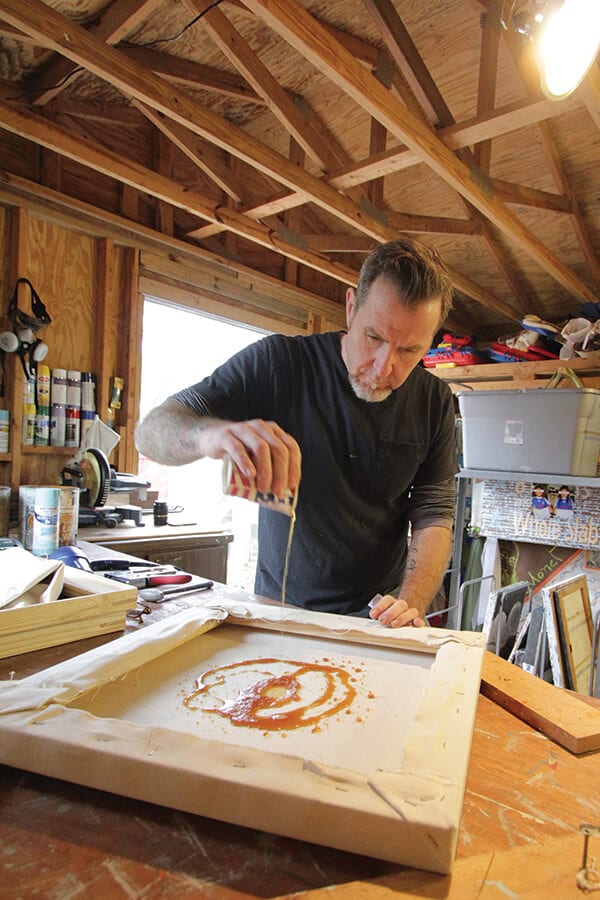
Georges Le Chevallier creating in the studio.
“I started reading about food, watching documentaries about food, and I’d see a lot of similarities in painting and food,” Le Chevallier says. “Shibui is a way of deconstructing, taking out what’s not essential. This led to me painting these minimalist, more simple paintings.”
With this new series, Le Chevallier explains, he wanted to capture chefs’ personal connections to the food they make for others to enjoy.
For “Jamaican Curry Goat,” for instance, Le Chevallier approached Oro’s executive chef Chris Hylton, who told a story of making the dish in his home country of Jamaica for the first time, hoping to impress his grandmother. Hylton recalled his grandmother tasting the curry and telling him how much she enjoyed it. And, for “Dahi Puri,” Garland Chef Cheetie Kumar talked about eating the chaat snack with her family growing up in India, but only on special occasions—they bought the dish from street vendors, and her parents worried about whether the food had been safely prepared.
“These chefs are human beings and they are inspired by food and, yet, we don’t usually talk about what inspires them,” Le Chevallier observes. “We always talk about their backgrounds, restaurants, work, but we don’t go into the essential. I wanted to touch something more personal.”
The nine paintings are unique in that, in an artistic turn on the tradition of molecular gastronomy, they incorporate ingredients from the individual dishes that inspired them. “Rice Congee” uses rice and green tea; “Salade Frisee aux Lardon avec un Oeuf Dur” uses olive oil and grapefruit juice and “Chilled Espresso with Ginger Beer and Rosemary-Grapefruit Bitters” uses coffee beans and raspberries.

“Royale Burger au Poivre Ailoi et Gruyere”
“Olive oil was not too great as a stain,” Le Chevallier says. “But the green tea was amazing, I loved the green tea. It made this beautiful green.”
Le Chevallier, who spent his youth between France and Puerto Rico, and has lived in Los Angeles and New York City, moved to Raleigh with his wife, Carrie, 18 years ago. He marvels at how much the city has grown, and at how diverse and vibrant its food scene has become.
“We have chefs from Colombia, Laos, India, Jamaica, France, Italy, it’s amazing,” Le Chevallier says. “When I started this project, I didn’t realize how many quality chefs we have from different parts of the world. We are really lucky for that.”
The Block Gallery is located on the first and second floors of the Raleigh Municipal Building. The exhibit is on display through August 24.

by Jane Porter | May 31, 2018 | Eat, June 2018
Baseball cap-wearing basketballs and fedora-clad pyramids intermingle with wide-eyed, fuzzy-edged monsters on a colorful new mural on the wall of Trophy on Morgan.
The monsters, creations of the Brooklyn-based artist, illustrator and graphic designer Kevin Lyons, are painted in regional colors: Duke and Tarheel blues, Wolfpack red, even Shaw University’s distinctive burgundy. In place of teeth inside some of the monsters’ mouths, painted in white block letters, are the names of several of North Carolina’s legendary jazz and hip-hop artists: Nina Simone, Thelonious Monk, Betty Davis, John Coltrane, Rapsody, King Mez, J. Cole, Ninth Wonder.
It’s a curated list of the greats, retro and modern, whose music Lyons keeps in his personal collection.

Images from Trophy Brewing’s new mural by Kevin Lyons decorate their beer cans.
“There are a lot of references to my interpretation of Raleigh, or Carolina in general,” Lyons says of the new mural. “So the Triangle is represented, and all of North Carolina is represented in terms of the musicians.”
Three years ago, Lyons came to Raleigh to paint a different mural on Trophy’s wall for the Truth Initiative, a national anti-smoking organization. The playful, black-and-white original was a little sun-worn and weathered, so Lyons, in partnership with Jed Gant and the Raleigh Murals Project, returned last month to paint a mural on the same east-facing wall—only this one’s bigger, brighter and a bit more personal.
“This was done purely for love, no commercial gain,” Lyons says. “It was purely because Jed and his team are really dedicated to beautifying Raleigh, to putting more murals here, to bringing in artists from outside and giving people content and things to enjoy.”
The original mural proved a popular spot for Raleighites and travelers to visit and capture on Instagram, providing local color and no doubt driving traffic to Trophy.
“It’s amazing for us,” says David Meeker, one of the popular brewery’s co-owners, of Lyons’s Raleigh return. “We got an international mural artist at a reasonable price—for free, basically—to redo the mural, just because he wants to.”
To celebrate, Trophy launched the Morgan Monsters New England IPA, a citrusy, hop-forward brew that Meeker describes as “beautiful,” and perfect to enjoy during the warm summer months. Look for cans of the limited-release beer with Lyons’s signature monsters on their labels.
Lyons, who has painted murals all over the world and worked with brands including Nike, Vans, DC and Urban Outfitters, recently completed a similar homage to local jazz musicians in Detroit. He says Raleigh’s mural is the second run in what could become a national mural miniseries, combining music and touches of local flair. For Raleigh and Trophy, that means music with a side of pizza, beer and college sports.
“Raleigh is a really interesting town,” Lyons says. “There’s basketball, everything runs around that, but there’s also great music and entertainment, shops and food, the college logos you can’t escape seeing. And I do these pyramids in all my work, they’re a staple, and I thought, ‘They work for the Triangle.’”
“I overthink everything,” he adds. “Nothing doesn’t have meaning.”