First look: Raleigh punches above its weight with the state’s largest, most tech-savvy convention center.
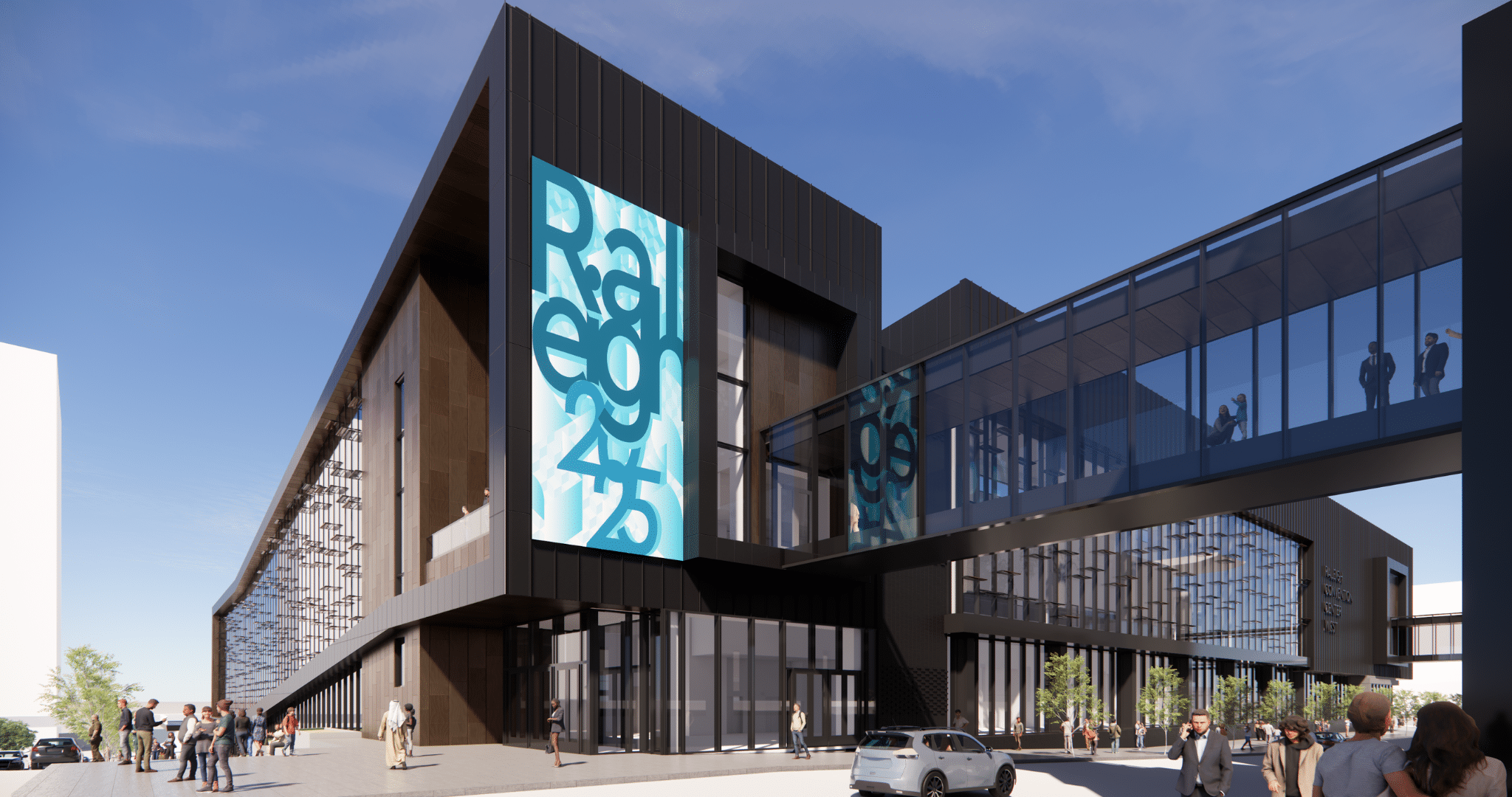
THE CITY’S long-term vision for a next-gen Raleigh Convention Center is finally taking shape. Once Red Hat Amphitheater relocates and expands in the coming year, the venue will gain nearly 300K square feet via a second building rising where the current amp sits at South McDowell and Lenoir.
The new space’s mod exterior—inspired by community input to feel like a “cousin” rather than a “sister” to the original—pairs dark, sleek angular lines with expansive windows that flood the interior with natural light. Connecting the two structures are two second-floor glass walkways crossing over South McDowell—perpendicular to the iconic shimmer wall across the way.
Adding tech flair to the building’s Southeast and Northwest corners, two Times Square-esque LED screens will spotlight upcoming performances and events—adding a dose of urban energy to the DTR skyline. Across Lenoir, a striking LED hand sculpture will display artist names and showtimes on its wrist, first debuting at the current Red Hat Amp before moving to the new site.
Beneath the LED display at Dawson and Lenoir, native gardens repping NC’s coastal, piedmont and mountain regions will give guests a literal breath of fresh air between sessions. “It’s a chance for people to get to see more of North Carolina in an abbreviated little pocket,” muses Executive Director Kerry Painter. Even the loading dock will be cleverly tucked behind the gardens.
For those concerned about parking and traffic, don’t fret: The deck at South and McDowell will remain and traffic flow won’t change. And, surrounded by hotels, the space also keeps things walkable for out-of-towners.
Design Architect: TVS; Architect of Record: Ratio
Inside, the venue touts a 48,700-square-foot flex space—divisible for everything from luncheons to volleyball tournaments—plus an upscale 18,100-square-foot ballroom and 13 new meeting rooms, elevating Raleigh’s hosting abilities for larger expos.
Altogether, the expansion answers the call to draw new and larger marquee moments while giving returning summits room to grow. When completed in 2029, Raleigh will boast the largest convention center in the state—topping Charlotte at 798K square feet.
“We punch over our weight,” says Painter. “People love coming here to exchange knowledge from around the world. We have a lot of intellectual capacity: It lives here; it does business here; it builds here; and it makes people pay attention to us. Everyone in our industry is like, ‘Yep, there they go again.’” The market asked—and Raleigh is delivering.
Here are the highlights of City Council’s last meeting for over a month.
Raleigh’s City Council needs an occasional break too—but before they were able to get away, they had a hefty agenda stacked for July 1, the last session until Aug. 19… and a lot went down. Here are some of the biggest highlights.
With no ability to overcome the huge budget deficit the project faced, City Council canceled the Six Forks Road Improvement Project. The initial plans included a six-lane road with a median and bike and pedestrian paths with a budget of $60.1M.
After the cost escalated to $93.5M, Council found no feasible way to move forward. Opting to keep the money in the district, the project’s budget will now go toward closing the sidewalk gap in front of Carroll Middle School and funding design of the Midtown multi-modal bridge, followed by completing the Lake Wheeler Road and Barbell Road projects, and lastly, improving Old Wake Forest Road. $9.3M had already been spent on over a decade of work surrounding Six Forks.
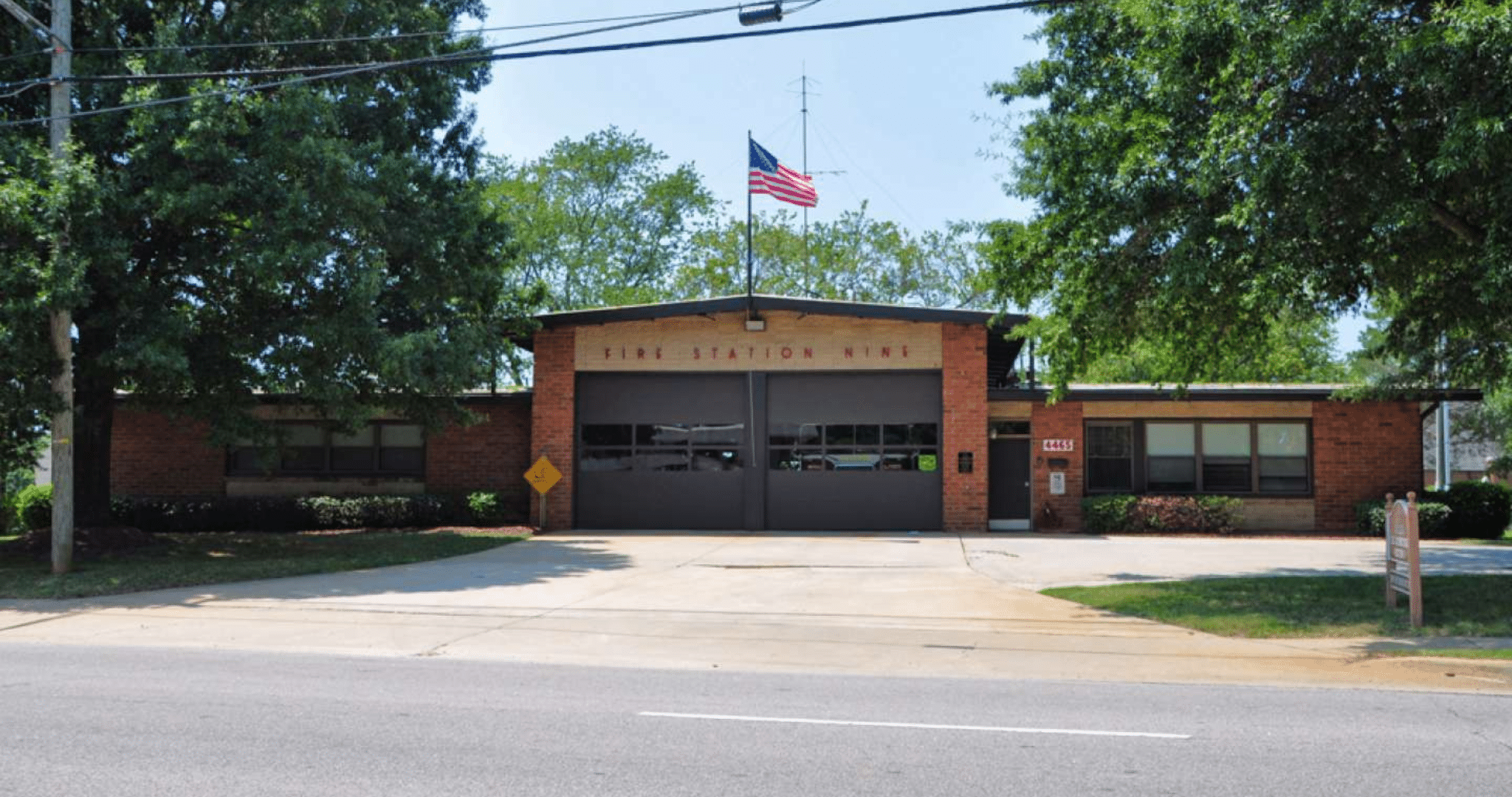
RFD revealed only 54% of units made the first due NFPA target time—or arrived within 240 seconds to 90% of incidents—in 2024. Performance was highest in DTR (81%) and lowest near Station 23 in Northwest Raleigh (31%). To combat this low stat, station replacements and relocations were recommended to City Council, plus four new stations, more ladder trucks and strong recruiting strategies.
Newsworthy Notes
Red Hat Amphitheater is working toward a final design with utility work already underway, with the aim for a 2027 opening.
The Convention Center expansion is in the design phase with an anticipated 2029 opening.
Updated terms surrounding the Convention Center Hotel (Omni Hotel & Resorts) include additional rooms, a room block agreement of 50 years, a projection completion guarantee, and a land sale to yield property tax.
The new City Hall is 25% complete at Floor 8, with a final completion aimed for March 2027.
Fire Station No.1 is in its concept design phase with an amendment forthcoming for a safety-themed playground.
The Chavis-Dix Strollway honoring and uplifting the Fourth Ward is in the final design process with a detailed project design expected summer 2026.
Design is underway for pedestrian safety improvements for Downtown and Martin Luther King Jr. Boulevard.
If you ask Mayor Mary-Ann Baldwin, she’ll tell you, “We have a lot left to do.” She adds: “This council was elected to make change. And it takes more than two years to make change.” At the spring 2021 City Council Retreat, Baldwin laid out the five things our rapidly growing Cap City really needs to focus on for the next 20 years. Here’s her hot list in her own words and the questions Council must answer.
1. Dix Park
“How do we take this land we bought and turn it into that destination park we envisioned and hoped it would be five, 10, 15, 20 years from now?
2. PNC Arena
“What is its future? Where will the Hurricanes play? But it’s not just for the Hurricanes—PNC is also a space for NC State and Raleigh’s live music scene.”
3. Soccer Stadium
“I really see soccer as something that is inspirational and aspirational. We have the best women’s soccer team in the world right here—that’s something to celebrate. We also have the largest youth soccer program in the country, so this makes a lot of sense.
“Soccer is an international sport. When I went to the 919 to MLS at City Market, there were people there, from 8 months to 80 years old—every color, shape and size, speaking many languages. Soccer can bring people together. It’s about community-building. We can do this.
“If you’re talking about putting it in Downtown South, the big question is: How do we pay for it? But it could be that amphitheater like Red Hat that’s surrounded by amenities where people can walk or get on a BRT Line and be in the middle of downtown in five minutes. It gives options.”
4. Expansion of the Convention Center
“Red Hat was built to be a temporary structure. We’ve seen how it works. But as they say, we need heads in beds. Conventions do that. Now will conventions come back like they once were? We don’t know, but we have to think—again, 20 years out—what does that Convention Center look like, and how do we get that done?”
5. Civic Campus
(The new building that will house our employees). “Right now, we have employees strewn all over the city and in different places Downtown. So we’re spending money on leases—and people are not working together; there’s not as much efficiency. And, quite frankly, the Municipal Building is old, tired and dumpy. This is our growing capital city—one of the fastest growing cities in the country—and that’s how we’re running our government? So getting that Civic Campus complete—but more than that. We’re going to take some of the property around the block and start putting other uses there, which will help also build our tax base and add more uses around Nash Square. So that’s a big thing to think about. The other thing is: OK, if we are going to do this, how are we going to pay for it? So we need to convene a group of smart people who can figure this out [via a viability study].”
“There are things we still have left to do that are important to the future of our city. Government is a process—there’s a public engagement process that needs to take time. I believe we’re on the right track. We are providing leadership in areas where others have failed. We wanted to get not only the [Affordable] Housing Bond done—which we accomplished (thank you to the voters—72%)—but we want to get this Parks Bond done.”
City leaders have said it’s badly needed and, last month, Raleigh’s City Council took steps toward making it a reality: An anchor hotel located just steps away from the Raleigh Convention Center.
Council members voted unanimously to seek out teams interested in redeveloping two Fayetteville Street parking lots into two mixed-use towers, including an upscale, full service, national brand hotel with 500 rooms and meeting space. The second tower will serve as a headquarters site for the convention center incorporating offices, ground level retail, residential units and “other creative ideas,” with below-grade parking underneath Fayetteville Street.
City officials will receive ideas from interested developers for the 2.5 acre site by the end of March.
“I want to emphasize that we are looking for great design,” said Mayor Mary-Ann Baldwin during the January council meeting where city officials introduced the project. “[The city owns] these sites so we have some say and I hope [interested developers] set the bar especially high. This is our waterfront property and we want [it] to reflect great design. People are coming here from all over the world. That is what they’re going to see, so let’s make it all it can be.”
Council member Nicole Stewart said she is looking forward to seeing a residential component in the mixed-use tower, as that part of downtown “is a little unbalanced right now, it gets pretty quiet at night,” and that she hopes the city can prioritize local partners for the project. Council member David Cox added that he would like to see affordable housing included.
Downtown Raleigh attracted 3.4 million visitors in 2018, an increase of 47 percent over 2007. Last year, Raleigh and Wake County approved $14 million from hospitality tax revenue to buy land near the convention center for future use and committed $5 million in 2021 to improve and optimize the center. The city and county have also planned a $230 million convention center expansion in the next decade.
Note: pertains to hotel, office, multifamily, properties over 100k sq. ft. Also shown are select publicly-owned buildings. Photo source: JLL, CoStar, Google Maps
1. Duke Energy Center For the Performing Arts 2. 1,030-space parking deck 3. 175-room Residence Inn 4. 6,000-seat Red Hat Amphitheater 5. Raleigh Convention Center 6. 401-room Marriott 7. Charter Square | 243k sq. ft. Class A office 8. 622-space below-grade parking deck 9. FNB Tower | new multifamily/closest office tower 10. 992-space parking deck 11. The L Apartments | 83-unit multifamily 12. 500-space parking deck 13. Two Hannover Square/BB&T | 437k sq. ft. Class A office 14. 353-room Sheraton 15. The Sir Walter | 140-unit multifamily 16. One City Plaza | 373k sq. ft. Class B office 17. One Progress Plaza | 455k sq. ft. Class B office 18. 1,000-space parking deck 19. Red Hat Tower | 366k sq. ft. Class A office 20. Palladium Plaza | 65-unit multifamily 21. Capital Bank Plaza | 168k sq. ft. Class A office 22. The Edison Lofts | 223-unit multifamily 23. 715-space parking deck
Raleigh’s tourism office has a plan to attract 5 million more yearly visitors by 2028—but the city needs to be strategic in how it will accommodate them.
On a recent weekend, when bluegrass lovers poured into downtown Raleigh from all over the Southeast, and alumni and football fans traveled in for the Wolfpack’s first home game of the season, the occupancy rate for the market’s 16,000 hotel rooms ran somewhere around 93 percent. That’s a lot of visitors, and a lot of new money flowing into the city. So, it’s little wonder that, when it comes to new hotel construction, the free market free-for-all is alive and kicking in Raleigh and Wake County.
Between now and the end of 2022, more than 10 different limited-service, boutique and extended stay hotels could open to vacationers, business travelers and convention goers in and around downtown Raleigh alone, adding hundreds of rooms to the area’s overall stock and helping to achieve a countywide goal of attracting 21.7 million yearly visitors by 2028. In just the past month, Guest House, a boutique hotel on South Bloodworth Street, and Revisn, an extended stay hotel in Glenwood South, opened their doors. Dozens more hotel proposals are in the pipeline, both for downtown and for other regional clusters in the city and county, such as North Hills, Brier Creek, Cary and Morrisville.
But, in order to support one of the city’s key facilities, the Raleigh Convention Center (RCC), and to keep Raleigh competitive with other cities with similar assets, city and county officials and planners need to think carefully about taking Raleigh to the next level in terms of how it will accommodate all these new visitors that it plans to attract. In other words, even the hundreds of new hotel rooms spread out all over the city, county and downtown might not meet the area’s actual demands.
“We’ve got to be strategic and comprehensive about our next series of builds,” says Loren Gold, the executive vice president of the Greater Raleigh Convention and Visitors Bureau (GRCVB). “It’s got to be a proactive strategy, we cannot sit around waiting for people to show up in the market going ‘I want to build a hotel.’ We’ve got to say, ‘We want this, let’s go get it.’”
In the last year, the GRCVB led a major study, known as Destination 2028, in order to set long-term goals for tourism in Raleigh and Wake. The plan, which was guided by a steering committee of prominent locals from the public and private sector and grounded in research from real estate services consulting company JLL, found that, organically, the county could attain 18 million visitors per year by 2028, up from 16.5 million in 2017. But, with
enhanced tourism infrastructure, including potential upgrades to the RCC, or a new sports complex—Major League Soccer, anyone?—the area could attract an additional three million visitors across convention, meetings, sports and leisure tourism.
To reach 21.7 million visitors by 2028, the plan posits ten key recommendations, including building a multi-use indoor sports complex, as well as an MLS stadium somewhere within the county; developing the Blue Ridge Corridor into “a sports, entertainment, arts, scientific, medical and agricultural campus;” offering more signature events and festivals, and offering unique visitor experiences (at Dix Park, for instance); capitalizing on a regional interest in e-sports and gaming; and increasing international visitation from Canada, Europe, China and India.
The plan’s first recommendation, though, is to enhance the $221 million RCC, the city’s and county’s largest asset funded with interlocal tax dollars (that is, lodging and prepared food revenues) through renovation and expansion, or to add another full-service, 400-plus room hotel within walking distance.
“We’re not anti-125-room hotels,” says Gold of the glut of lifestyle, boutique or smaller, limited-service hotels that predominate in the Raleigh market and cater largely to the city’s business travelers who comprise about 10 percent of the area’s annual visitors (see above). “Those are our key partners, but we have to be very diligent about where we build, why we build and what market we’re going after.”
The market that will take Raleigh to the next level, stakeholders say, is comprised of people visiting the city for meetings, trade shows, conferences and other convention business, a group that already accounts for one-fifth of all visitors’ reasons for coming.
“Having a third full-service hotel near the Convention Center, in addition to the Sheraton and the Marriott, would be of great benefit in terms of attracting larger conventions,” says Charles Meeker, the former mayor of Raleigh who pushed for building the RCC during his tenure and who serves on the committee in charge of implementing Destination 2028. “Right now, we simply do not have adequate hotel space nearby. The convention business is now bouncing back after being significantly hurt by House Bill 2, so we’re seeing a situation where, as the [interlocal tax dollars] are allocated, this facility has an interest in being at the top of the list for consideration.”
Destination 2028 lays out three scenarios by which the city and county can spend interlocal tax dollars to beef up business at the RCC. These include suggestions to use current space at the Convention Center more efficiently, to expand the building—it needs another ballroom-sized space—and to add the aforementioned hotel. The most aggressive scenario, which combines renovating the RCC and adding the full-service hotel package, could more than double the current number of hotel rooms occupied per night, per year, from today’s rate of 72,448 to 175,746.
This combined renovation-hotel package scenario would mean not only more revenue for the Convention Center and more efficient use of its facilities, but it’s a more attractive option to event planners who want to bring large groups to the city for meetings, conventions and trade shows, and want to accommodate them as close to the RCC as possible. It would also make Raleigh more competitive with peer cities, including Boston, Austin, Richmond, Charlotte and Greensboro, in attracting new events and retaining current business.
“Now, if you’re bringing a 5,000-person conference to Raleigh, you’re going to need more than the two major downtown hotels, and you’ll be spread out, adding transportation to the Convention Center [as a consideration],” says Angela Caraway, a meetings and event planner at the Caraway Management Group who served on the steering committee for Destination 2028. “We as planners do not want to have multiple hotels we have to manage because it adds another layer of responsibility in contracting. If we keep [the number of hotel contracts] to a minimum, absolutely, I know many planners would sign up on that right away.”
It will take a measure of political will from elected officials on Raleigh’s city council, especially, to support expanding the RCC and recruiting a full-service hotel developer. There are also some practical considerations that must be accounted for, including where the RCC can grow, physically, and where a new full service hotel can be erected (the Budget Car Rental lot and the Red Hat amphitheater property have been floated, as the amphitheater is likely to relocate to Dix Park).
“[The city] put $15 million into the meeting rooms, the public spaces, so with the Convention Center, the city does typically drive it, rather than the county,” says Meeker. “I haven’t talked to the current council members, but in the past, the council was always very supportive of the Convention Center for spending funds on new projects.”
Last month, the council heard a presentation on this very topic. It’s a good thing, too, because the ball needs to start rolling sooner rather than later.
“We have to start having the dialogue now, and look on the horizon of when we want to have this all done by,” says Gold of the GRCVB. “The good news is we have this plan and the hope is people take the time to read it, build the correct framework and put it in the correct context.”
Caraway says she sees a lot of positives in moving forward with enhancing the RCC and adding another full service hotel nearby.
“Obviously, it would help with economic empowerment, with additional jobs,” Caraway says. “We would be able to attract new business and retain conventions that have grown and cannot stay in the current sized center. To add to that, Raleigh has a lot to offer and what makes Raleigh special are the people, the businesses, the start-ups, the locals. When you add that to having adequate convention and meeting space, it brings so much more value to the package of selling this destination.”
Both Infographics Source: DK Shifflet for the Greater Raleigh CVB (2017, 2018) 2014-2016 (excluding day-trippers and international visitors) Courtesy of Visit Raleigh.






 “We’re not anti-125-room hotels,” says Gold of the glut of lifestyle, boutique or smaller, limited-service hotels that predominate in the Raleigh market and cater largely to the city’s business travelers who comprise about 10 percent of the area’s annual visitors (see above). “Those are our key partners, but we have to be very diligent about where we build, why we build and what market we’re going after.”
 It will take a measure of political will from elected officials on Raleigh’s city council, especially, to support expanding the RCC and recruiting a full-service hotel developer. There are also some practical considerations that must be accounted for, including where the RCC can grow, physically, and where a new full service hotel can be erected (the Budget Car Rental lot and the Red Hat amphitheater property have been floated, as the amphitheater is likely to relocate to Dix Park).