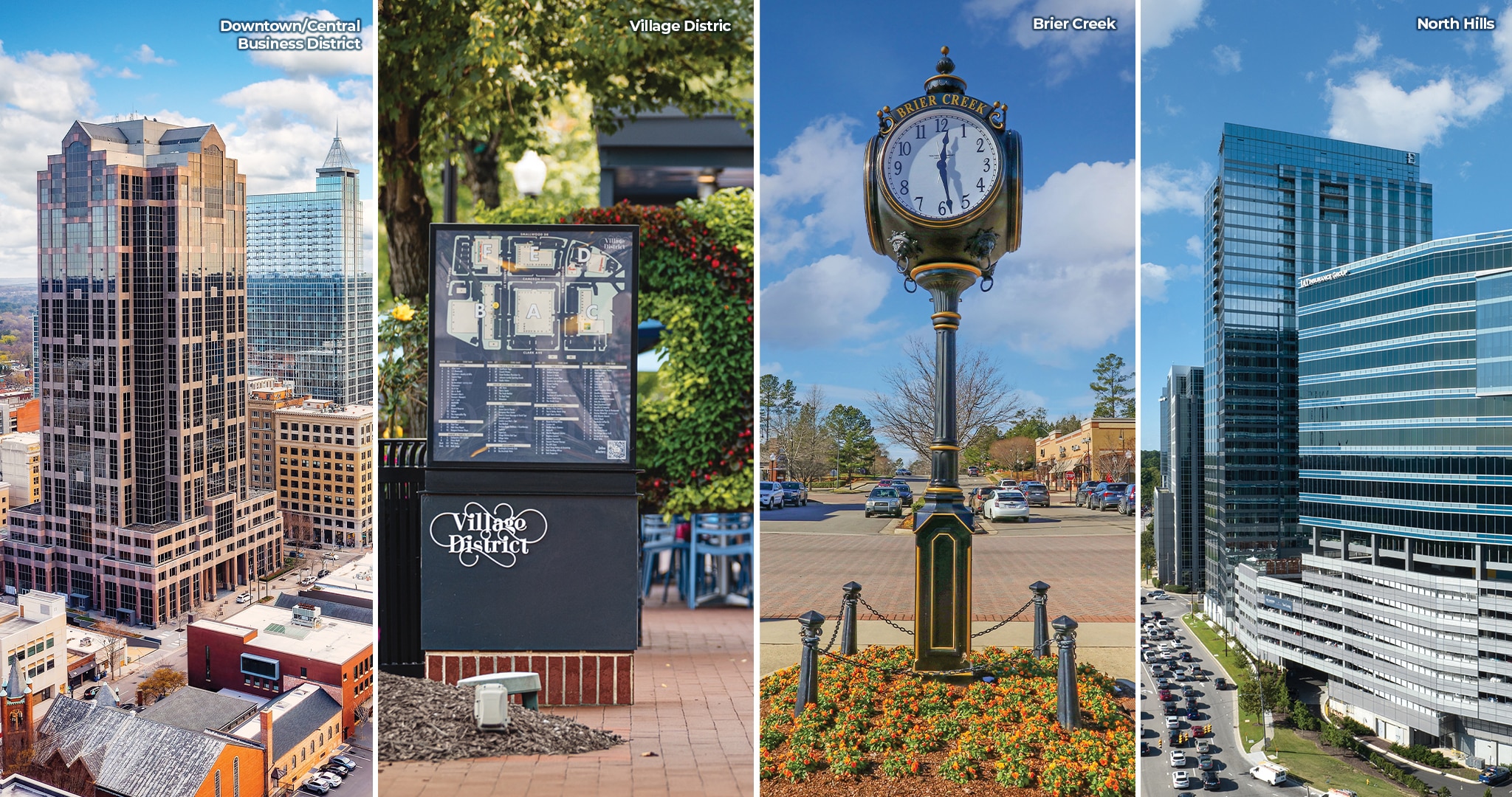
The secret sauce to a great city could rest in the Power of 10.
Think big. Think 10. Raleigh’s future isn’t just about streetscapes and skyscrapers—it’s about crafting places people actually want to be. And that doesn’t just happen. Enter the “Power of 10,” a simple yet transformative concept: Every city needs at least 10 destinations, and each destination needs at least 10 things to do.
Originated by the Project for Public Spaces (PPS), the framework reveals why cities like New York and Atlanta lure people in—and keep them coming back. Such is the philosophy behind Raleigh’s 2009 Comprehensive Plan, which directed 60% to 70% of new growth to eight growth centers focused along key urban and transit arteries like the Beltline and 540—think Midtown, West Raleigh and Village District—plus 15 multimodal corridors, extending the Power of 10 principle to shape a vibrant and connected city.
As former COR Chief Planning Officer and current City Council Member Mitchell Silver puts it: “If I come Downtown—as a senior couple, a single, a family—what are the options? You have restaurants—then what do you do? Places like New York… there’s so much to do, probably like a power of 100. That’s what makes those places exciting—people come back again and again. That’s the goal.”
Building on that foundation, new potential pockets now emerge as the Comprehensive Plan 2030 gears up to shape the city’s next chapter through 2050.
Placemaking in Action
As aspirational as it is practical, Raleigh’s growth framework already reflects this principle. The point isn’t just garden variety shopping, dining or strolling, notes Silver. The real magic is layering elements—rest, play, art, music, food, history, connection—so people linger, explore and return.
As such, applying the Power of 10 isn’t just theoretical. Standalone attractions like museums or parks serve as a great draw, but deliver “the power of two, maybe three, at best,” says Silver. “People come, look, maybe hit up the gift shop—and leave. The real challenge: What can you build around the museum or park?” The telltale sign—are there people there? And do they stay there?
He nods to Nash Square—lonely trees, empty walkways and angled parking that could morph into a vibrant hub where people actually want to linger. Even the strongest attractors can stumble without a complementary cast. Take Wilson’s Whirligig Park—a momentary magnet that, on its own, risks being forgettable, explains Silver. But with the upcoming Carolina sports and entertainment stadium and planned ~50-acre live-work-play mixed-use project, that fleeting draw evolves into a full, thriving ecosystem.
Looking to 2050
Given Raleigh’s demographic shift, the urgency for this approach grows sharper. The city is young: ~60% under age 40, and ~80% under 55. Yet, Silver warns, “the [older] minority is trying to drive planning decisions. We need young people to speak up.” Future growth hinges on creating these multidimensional hubs—places where people don’t just pass through but stay, engage and thrive.
Layer on a looming constraint: Raleigh is projected to run out of developable land within 20 years. Yet, the simple reality remains—people are coming. The city’s population boomeranged ~50%, adding roughly 200K residents in the last 20 years. “I called it Mayberry the Metro,” says Silver of the now more than 65 people relocating to Wake County every day. So it’s not a question of if—but how we manage it.
By honing in on our people-centered placemaking pockets—through public spaces, new mixed-use developments and urban design innovations—Raleigh can scale up its Power of 10. And in doing so—from blueprint to buzzworthy—transform a city of streets into a city of destinations.
Urban Growth Centers – 2009 Comprehensive Plan
Brier Creek
Crabtree
Downtown/Central Business District
Midtown/North Hills
New Bern/WakeMed
NE/Triangle Town Center
Village District/University area
West Raleigh
Potential Pockets for Urban Growth: 2030–2050
Capital Boulevard
City Market
City Plaza
Downtown South
Moore Square
Triangle Town Center (reimagined)
WakeMed Corridor (BRT)
Warehouse District
Emerged Naturally – Raleigh Iron Works
Raleigh Iron Works
A game changer for East Raleigh—and key connector between Downtown and Midtown—Raleigh Iron Works is a work-stay-play hub on the former Peden Steel site. Breaking ground in fall 2021, Phase One boasts 200+ apartments, buzzy retail, and ambitious public art and maker/pop-up programming, anchored by standout F&B spots from Brodeto and Little Rey to St. Pierre and Ponysaurus Brewing—and, yes, that trademark slide bringing a playful touch that’s core Raleigh.
Treat yo’self this fall atDTR’s The Self Care Marketplace, a one-stop shop with everything you didn’t know you needed until you walk in—think all things self care, from candles, plants and soap to wellness classes and beyond. @theselfcaremarketplacenc
Prepare to get ~lit~ via McCormick Gifts + Candle Studio, now open at Crabtree, complete with candle-making experiences and custom gifts. @mccormickcreation
Sleigh bells ring. … Following the September closure of Village District’s Antique Emporium, downstairs neighbor Cheshire Cat will be moving in this month with a year-round Christmas-themed room (!). @cheshirecatgallery
Raleigh has officially joined the “proper-length shorts revolution.” Find Chubbies’ signature bright and bold short-shorts unfurled at its first NC store at Crabtree. @chubbies
Looking to avoid those cold-weather blues? Beem Light Sauna will soon bow in Glenwood South, specializing in light therapy for those wanting to live a radiantly healthy life. So *hot*! @beem.raleigh.nc
There’s no such thing as too much bling. Ranch 🤝 rodeo styles descend on Fenton this fall c/o Texas-based top jewelry retailer Kendra Scott. @kendrascott
Ready to ~change~ the way you think about style, Copper Penny reps its curated collection of designer threads with an edgy mix of sweet and heat—NTM shoes and accessories—in its new Village District digs. @copperpennyraleigh
What good fortune! A little slice of Asia is hitting Hillsborough Street early next year as Ebisu Life Store serves up everything from stationery and snacks to skincare and stylings for home—all imported from Japan. @ebisulifestore_nc
We’re all ears! New kid on the Village District block Rowan taps an *ear-resistible* piercing experience by licensed nurses—with hypoallergenic jewelry to boot. @heyrowan
SPONSORED CONTENT: Tuft & Needle is reshaping how we think about sleep, mattresses and shopping.
By Misty Milioto
When JT Marino and Daehee Park founded Tuft & Needle in 2012, it was to fill a much-needed gap in the mattress industry. Rather than using confusing buzzwords, pushy salespeople and backward policies, the duo set out to offer quality craftsmanship, top-notch value and an easy shopping experience.
In 2018, the company merged with Serta Simmons Bedding—the world’s leading mattress manufacturer—to bring the customer experience to the forefront of every mattress purchase. Marino and Park, who previously worked as software engineers, have now grown the company to a team of more than 150 people working to deliver premium sleep products at an honest price, all with excellent customer service that is unmatched in the industry—and a commitment to giving back to the community.
In addition to sourcing the ideal breathable fabric, Tuft & Needle uses proprietary foam that is freshly poured and cut specifically for its mattresses. The company also sews and puts the finishing touches on every mattress, compresses them for delivery and then ships directly to customers. Choose from the T&N Original Mattress (which contours to your body with bounce-back support), the Hybrid Mattress (which combines T&N AdaptiveÒ foam and springs for support with a little bounce) or spring for the 2021 No. 1 in Best Mattresses by U.S. News & World Report with the Mint Mattress (offering personalized support plus heat regulation, designed with two sleepers in mind).
Tuft & Needle also offers bedding (think mattress toppers, down pillows and linen sheets) and furniture (such as bed frames, nightstands and dog beds). And a nod to the company’s commitment to customer satisfaction—and confidence—is its 100-night trial period, hassle-free limited warranty, quick and simple financing, free shipping and returns, and award-winning customer service.
While mattresses are the company’s backbone, social responsibility is its heartbeat. Since the Tuft & Needle’s birth, employees have volunteered to donate more than 2,500 hours to help set up beds, sanitize bedding, provide meals, build housing and much more for those in need. And more than 575 schools have partnered in the Tuft & Needle Gives Back Program, where each school received 25% of the proceeds from every mattress ordered by parents, teachers, families and friends of the school. Tuft & Needle has also pioneered a return policy in the industry where mattresses are donated to charity partners nationwide, and the company has partnered with those charity organizations on other initiatives that align with its brand values. In total, Tuft & Needle has donated more than $13 million in mattresses back to the community. Tuft & Needle, Crabtree, 4325 Glenwood Ave., Ste. 2093, 919.343.0002, tuftandneedle.com
The relationship between a tenant and their commercial property management company can be complex in the best of times, but mix in a historic pandemic and enter a whole new level of complexity.
COVID-19 has undeniably pushed businesses to the brink—rendering them in desperate need of rent relief (not to mention copious amounts of hand sanitizer and masks). For local major shopping centers North Hills, Village District (formerly Cameron Village) and Crabtree Valley Mall, each property management company has approached rent relief and lease renewals on an individual basis. For some, the relationships deepened; for others, it was severed.
North Hills At Quail Ridge Books in North Hills, there were a few details from the onset of the pandemic that became game-changers. Amazon stopped shipping nonessential items, and Quail Ridge offered free shipping for its books and curbside pickup—garnering a whopping 3,000% surge in online sales. Additionally, its property management company, Kane Realty Corporation, stepped in and was flexible with its rent terms, offering a cushion of support while Quail Ridge waited for its PPP loan to come through. Quail Ridge Books manager Jason Jefferies credits this flexibility as crucial for the bookstore’s survival, as it allowed them to prioritize safety over commerce, giving them the ability to successfully navigate the past year-plus.
Stacey Buescher, director of operations for Kane Realty, found herself unexpectedly thrust into this new world as well. “It was a hope and a prayer,” she says about the early days of the pandemic. As a working mom of two, Buescher juggled everyone’s needs in a delicate balancing act that, in the beginning, looked more like triage. When the CDC released its COVID-safe recommendations, Kane Realty went to work to implement them. Hand-sanitizing stations went up; signage was ordered; air filters were upgraded; and foot-pulls were installed on the bathroom doors. Sinks that weren’t already touchless were replaced with touch-free ones, and—once the chill set in—outdoor heaters were sourced. The parking lot was also renumbered to ease customer curbside and pickup orders.
For Buescher, it was crucial to make sure people would still be able to shop at North Hills in a safe way to enable retailer survival. “At Christmas, I told my tenants, if y’all want me to dress as an elf and stand in front of your store, I will do it,” says Buescher. Now, over a year out from the start of the health crisis, it looks like life—and a sense of normalcy—is returning to North Hills.
Crabtree Valley Mall At Crabtree Valley Mall, Marketing and Business Development Director Melissa Timney says the five-year projected decrease in retail played out in rapid speed over a mere six months, resulting in a need for multichannel sales approaches (e.g. digital, social media, by phone, in-person) for national and small business tenants alike.
Timney and her team worked closely with stores at the mall to offer more contactless ways for customers to shop and expanded e-commerce options, including curbside pickup. Now, Timney says, they’re seeing stores invest in digital initiatives and place a bigger focus on personalization with sales and in-store specials, including VIP experiences during less busy times of the day. And to expedite the safe return of in-person shopping, Crabtree adjusted floor plans to make it easier for guests to maintain a safe social distance.
“Overall, we’ve seen stores at Crabtree meet customers where they are comfortable, with the understanding that this pandemic will pass,” says Timney. “With vaccines becoming more widely available, we are already seeing the positive effects at Crabtree, and that’s a good sign.” “It’s been an important reminder to—even during difficult global times—stay in a creative mindset, be nimble, and keep it fun to find joy in every day,” she adds. “It’s how we move forward.” And it’s safe to say that we’re all ready to move forward now.
Cameron Village For Village District, owned and operated by Regency Centers, the year has no doubt been a tumultuous one, dealing not only with pandemic-related closures, but also a historic name change.
While most tenants don’t want to talk about the specifics of their relief, (understandable given they are constantly in negotiations with their commercial property management companies and dependent on them for their spaces), with rent relief being negotiated on an individual level, it is difficult to pinpoint where talks fall through.
For Cheshire Cat Antique Gallery in Village District, the first month of the pandemic was difficult, to say the least. “I hate to say it,” says June Hastings, dealer and manager of the art gallery, “but we were pretty much left on our own with this. After we asked, Village District allowed us a month’s stay on rent, but, while we were hoping they would forgive the month, we had to pay it back in increments.” For their part, Cheshire Cat shifted to selling its wares online and forgave a month’s rent for all 100-plus vendors.
Village District’s Crunch Fitness is proud they were able to keep its management staff paid throughout the pandemic; however, being closed for seven months impacted them severely. “At the time, we were hoping that it would just be a month. … It turned into months upon months,” reflects Crunch Fitness manager Emily Muirbrook. “For us, we did not receive any support as far as our lease.”
Seeing the writing on the wall, mainstay K&W Cafeteria closed down its super-popular Village District location, recognizing that, for its core customer base, dining out would not look the same for a long time. “We had a long and productive relationship with Regency,” K&W’s Dax Allred shares, noting that, at the time, it was early enough in the pandemic that they hadn’t had conversations with Regency Centers about rent relief.
On the other end of the spectrum, decadelong tenant Cantina 18 was able to find a way to partner with Regency Centers to help its business survive, expanding its outdoor space and awning, and installing permanent heating fixtures. This is not to say Cantina’s year wasn’t full of struggle. “I worked in New York City when 9/11 hit and parlayed that experience,” says owner Jason Smith. When restrictions were implemented last March, “we closed for only one day,” adds Smith, “then reopened for curbside,” but staff had to be reduced down to 20 to 25% percent.
While the full effect is yet to be seen, some pandemic trends will stay with us. “Many trends for 2021 are going to be a direct result of how businesses had to stay operational during the pandemic,” says Eric Davidson, senior manager of communications at Regency Centers. “Digital efforts are going to still be extremely important to reaching a customer, as is prioritizing health and safety. We’ve actually seen a lot of continued momentum for merchants and physical retail space.”
Ultimately, the pandemic has been a learning experience for everyone… all of us forced to blindly navigate through the federal and local governments’ guidelines—though perhaps no one understands what it has meant to pivot and scrap to survive more than small business owners, forced to find ways to operate, pay their staff, and dealwith rent and leasing issues while their storefronts were closed. Let’s just hope that we all learned a thing or two and—in the horrific event that something like this happens again—we’ll be more prepared.