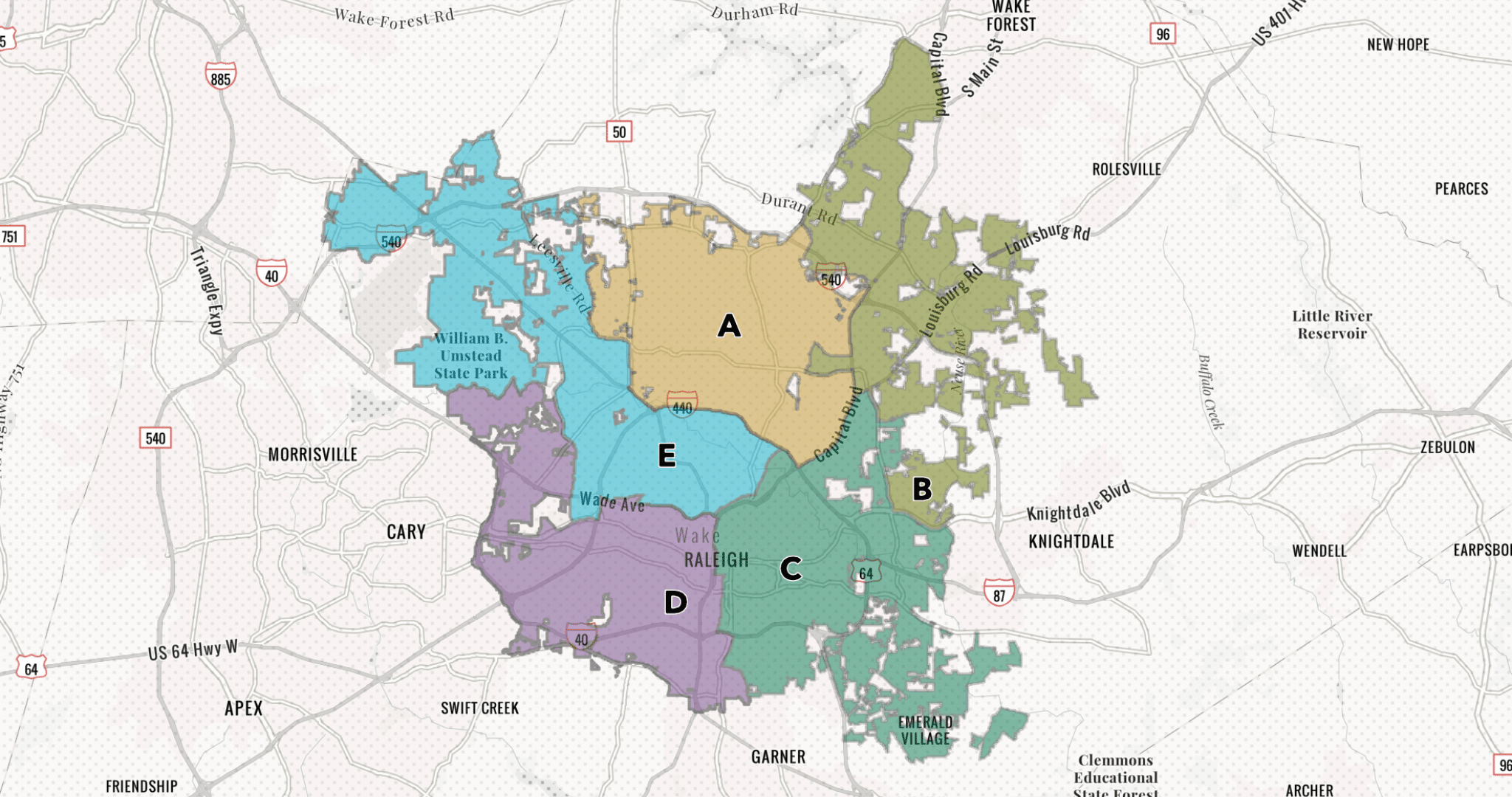
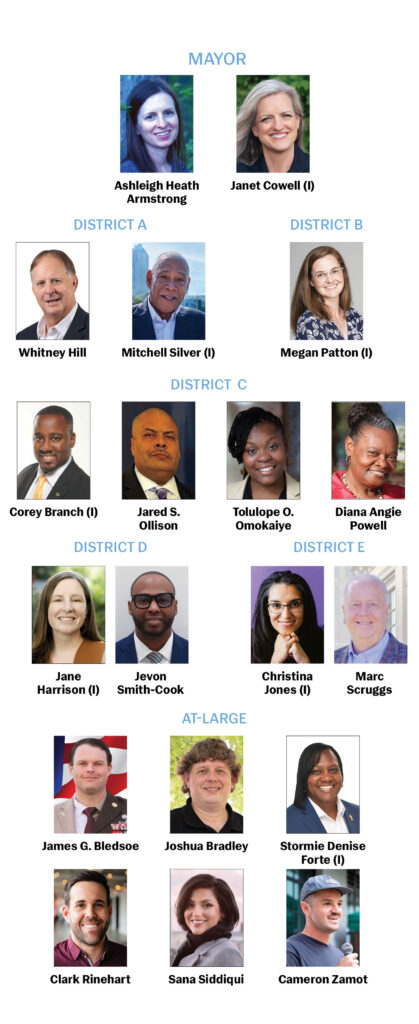
’Tis the season, Raleigh. The election filing period for local races closed Dec. 19—meaning it’s officially time to get acquainted with the field and what’s at stake.
This year, Raleighites will head to the polls for municipal elections twice: the Statewide Partisan Primary + first-ever nonpartisan City of Raleigh Primary Election March 3, and the General Election + City of Raleigh Municipal Election Nov. 3 (with a second primary May 12, as necessary).
Only mayoral and district contests with more than two candidates will be included on the March ballot. For at-large, a primary comes into play with more than four candidates. As such, District C and at-large contests will be included in the upcoming primary.
Another major shift: Raleigh is moving to four-year staggered terms for mayor and city council. This year, the mayor, one at-large seat and Districts A and B will be elected to four-year terms. The remaining at-large seat and Districts C, D and E will be elected to two-year terms—then move to four-year cycles in 2028. To maintain staggered terms, half of the City Council seats will expire every two years. The longer, staggered terms allow for greater continuity and stability in leadership, District B council member Megan Patton tells RM.
As the field takes shape, brush up on your vision for the city—and decide who’s best equipped to lead it. See you at the polls, Raleigh.
A new city council is being sworn in Dec. 5 at Union Station, including four new faces: Mary Black, Megan Patton, Jane Harrison and Christina Jones. Many have described this council as divided—and reelected Mayor Mary-Ann Baldwin as having to govern a council pitted against her. But, for her part, the mayor is optimistic. “People always want to paint negative pictures,” said Baldwin in a conversation with us one week post-election.
“This is the most diverse council in the history of Raleigh—and probably the youngest,” she said. “So I’m thinking, ‘I can’t wait to hear new ideas and these perspectives.’ And we have to respect that and all work together.” During and since the election, the council has been cast by nearly everyone as anti-growth vs. pro-growth. But the mayor doesn’t see it that way. “They actually are not anti-growth. They fall across lines of smart growth, and I think we share common values,” she said, including affordable housing, transit, small business and climate change, to name a few.
In talking to new council members, Baldwin says she thinks there could actually be a lot of unity and consensus within city council, which begins with building relationships and trust, listening to one another, and a willingness to compromise. Bottom line: “The campaign is over,” said Baldwin. “Now we govern. It’s not about activism. It’s about doing what’s best for our community.”
Are CACs the most divisive issue?
A hot-button issue leading up to the election and now anticipated to be one of the most divisive issues facing council are Citizen Advisory Councils (or CACs). If you aren’t familiar, you’re not alone. According to a city survey, more than 90% of residents had never heard of or been to a CAC—meaning this is a “hot-button issue” for a select few. That said, reinstating or revamping these advisory councils was also the central issue fueling some candidates to throw their hat in the ring for city council.
In short, CACs were intended to be nonpartisan advisory boards representing different geographical regions of the city, comprised of nonelected citizens. These councils routinely held meetings as a way of dispersing information and gathering public input. The CACs were disbanded without public input or notice in early 2020, a move for which Mayor Baldwin took much ire in the media. But, she says, her goal was to actually make community engagement more inclusive—not eliminate community engagement altogether. “My feeling is that CACs were exclusive, not inclusive, and we’re looking at ways to make community engagement inclusive.”
For their part, new District E Council Member Christina Jones served as former chairperson of the Raleigh Citizen Advisory Council. And new District D Council Member Jane Harrison reestablished the West Raleigh Community Advocacy Council and has vocally advocated for reestablishing robust community engagement. “Economic development should be community-centered, and city decisions must recognize the voices of the most affected groups, including historically marginalized communities and neighbors adjacent to a development,” Harrison told Raleigh Magazine. “We need forums like CACs and neighborhood associations to convene across the city, sharing information and developing leadership capacity to bring the best ideas forward.”
We asked Baldwin for her take on the return of CACs, and she nodded to the active community engagement board that council has asked to come up with ideas to move things forward. “I would like to see that community engagement board do its work and let us listen to them about what they think is needed,” she said. “And I hope we allow the community engagement board to do its work.”
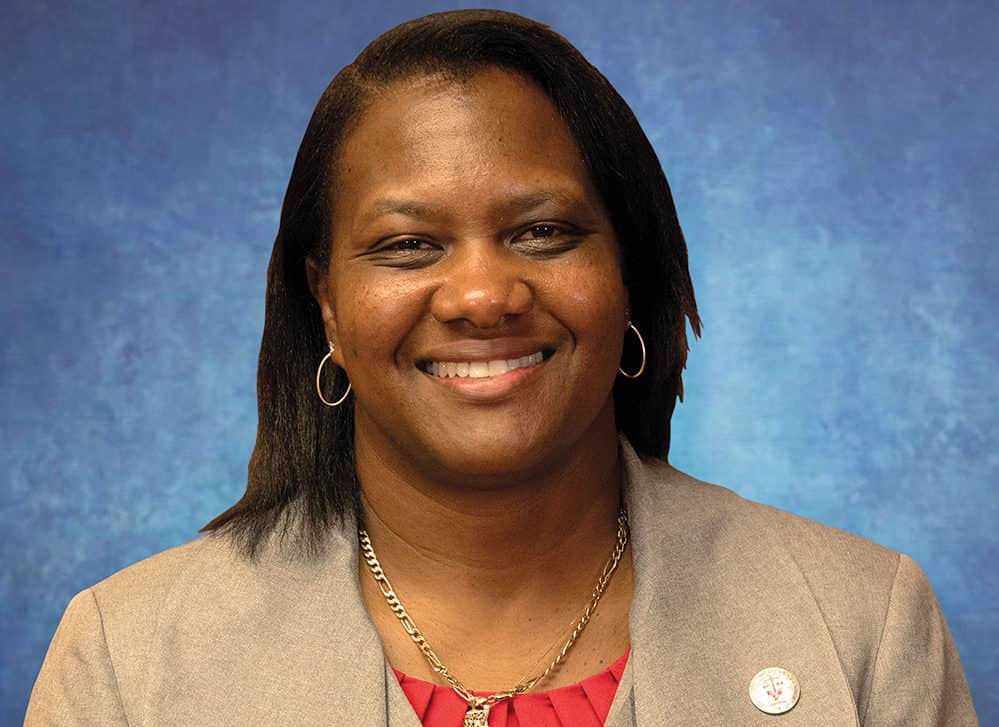
Raleigh’s City Council selected Stormie Forte from a pool of more than 50 applicants, and five finalists, to replace Saige Martin as the city’s District D representative after Martin stepped down due to sexual misconduct allegations. Forte, a Raleigh native, attorney and the first Black woman to serve on the council, was sworn into office in July. We spoke to Forte about District D, which covers southwest Raleigh including parts of downtown, and how she plans to tackle some of the biggest issues currently facing the city.
What is the most important issue in District D currently?
Development. District D has probably the most development projects in the works, and likely the most prospective projects. There is a lot going on.
Downtown South is one large project that’s proposed. It has its supporters but some residents worry about impacts on nearby neighborhoods, including gentrification, and on the environment. What are your thoughts?
With these large developments, the more engagement the city tries to have with residents, as well as with the folks who want to make contributions in the form of development, the better. There are ongoing conversations related to how to deal with traffic issues and how to deal with some of the surrounding communities. Looking at what the viability is going to be for the surrounding communities and surrounding neighborhoods will be very important.
You’ve spoken about building bridges between the city government and residents. Why is there a need to do that and what are the best ways to achieve it?
A lot of folks are protective of the community and the current composition of their neighborhood in terms of types of housing and felt they could share concerns through the CACs [local citizen advisory groups]. Now, they feel they are not necessarily being heard. Groups continue to meet as neighborhood associations and I have attended those meetings virtually and answered questions. Residents have invited me to walk the neighborhoods with them. Then, there are folks who have projects and want to talk about that they want to do, so I talk with them as well. I want to hear all sides and be aware of information from city staff. I intend to make decisions and vote based on information from everyone. I will not be able make everyone happy but I want to create a good balance. I will review everything that comes to the council table on a case by case basis and do what I feel is in the best interest of the district and the city.
What do you hope will come out of the community engagement study that consultant Mickey Fearn is currently conducting?
Transparency, making sure the taxpayers and citizens feel processes are inclusive and their voices are heard. I hope the outcome will be one where you would have more participation by folks who are not currently engaged in what is happening.
How do you think the council should address policing? Your predecessor was vocal about defunding the police. You personally have suggested creating an ombudsman program for police accountability.
There is a challenge in folks understanding what the meaning of “defunding” the police is. For some, the perception is the police department would be disbanded. That is not what activists and grassroots folks are advocating for. It is more along the lines of the reallocation of resources and talking to folks in the community. Police officers don’t want to be social workers, they don’t want to be psychologists, and the overwhelming majority of officers believe it is their mission to protect and serve. So, if there is a mechanism to give the police department some relief through setting up new channels to respond to different types of situations, I would be supportive. I would support a resource for the community to report things they felt needed to be addressed in the police department and also a mechanism for folks within the department—law enforcement officers, administrative staff or whomever—where, if there are things they want brought to the attention of city leadership without feeling repercussions, they would have a way.
You’ve floated the idea of using smaller city buses on less frequented routes rather than having large buses drive around empty. What are your other thoughts on tackling Raleigh transit?
My position is evolving but thinking about, ‘How do we make it more enticing to use public transportation to get to different places within the Triangle?’ Is there a way to make it easier to get from place to place? If you want to be able to attract an Amazon or Apple headquarters, having a good inventory of affordable housing, as well as a great transportation system, will attract business. You don’t necessarily want large buses moving through the city at non-peak hours, so if we can get smaller buses and shorter routes in place, have more express routes, that will help make sure people get from point A to point B more efficiently and be more attractive to people who utilize the buses.
What will you be looking for in city manager candidates?
Someone with a good amount of experience dealing with a municipality the size of Raleigh, or maybe larger, and with the challenges we will be facing. There is an affordable housing bond being proposed, so experience with expanding housing in the area. Certainly the challenges with the community as it relates to dealing with the police department. We need a person who has the skillset to navigate the city’s challenges but also to guide the city through opportunities.
Q & A by Jane Porter; edited for length and clarity.
Updated: In a 6-1 vote this afternoon, the Raleigh City Council appointed Stormie Forte as District D’s new representative. Forte will be the first Black woman to serve on the council.
WEB EXCLUSIVE When you take fundraising and campaigning out of the equation, it turns out that there’s quite a bit of interest from the city’s residents in serving on the Raleigh City Council.
Current members of the council received more than 50 applications from District D residents seeking to be the new councilor for the district covering southwest Raleigh, following Saige Martin’s resignation in June. Over the weekend, council members voted to narrow the list down to five preferred candidates, and on Sunday, those candidates participated in a virtual forum where they answered questions submitted by the public on topics ranging from COVID-19 to affordable housing to transportation to police accountability.
At 4 p.m. this afternoon, the council will hold a virtual meeting to select and appoint the person, out of the 54 total applicants, who will represent District D for the next year and a half. If a candidate receives five or more emailed votes from council members on the first ballot, they will be appointed to fill the seat; anyone who receives a vote on the first ballot will be eligible to appear on the second or third ballot, if needed, until there is a five-vote consensus.
The Five District D Candidates Selected to Participate in the Candidates Forum
Carmen Cauthen
Carmen Wimberley Cauthen, 60, a Raleigh native and retired administrative clerk for the NC General Assembly
Stormie Forte
Stormie Denise Forte, 49, a Raleigh native, attorney and volunteer with the Raleigh-Wake Citizens Association and Wake County Voter Education Coalition
Jennifer Katherine Peeler Truman, 30, an apprentice with Matthew Konar Architect, former secretary of the Southwest CAC and District D Facebook group administrator
Six New Proposals We Heard From Candidates Participating in Sunday’s Virtual Forum
On new measures the city can take to prevent or reduce the spread of coronavirus if the numbers begin to surge again:
From candidate Stormie Forte:
City officials should work with the state and county to establish more testing sites throughout Raleigh and create a database to track cases of coronavirus that emerge in businesses and retailers.
“One of the main concerns I have seen from folks is access to testing, particularly folks who can’t afford to pay $200 as a co-payment for their doctor. It’s important to have people tested so you can do contact tracing… I would also urge state officials to start a database with retailers and other places where they have had COVID outbreaks.”
On specific policy proposals to improve affordable housing, economic development and public transportation:
From candidate Stormie Forte:
Work with city staff and transportation committees to streamline the public transportation process so that large city buses aren’t driving around the city empty or mostly empty of passengers.
“I see these really large city buses moving around the city, and oftentimes they are practically empty…Is there a way we can bring smaller buses onto the line and have more expanded reach and have those as feeder systems into the larger buses that move around the city so we don’t have so many larger buses operating empty with fewer routes?”
From candidate Jenn Truman:
Provide grants to small businesses to open along transit corridors, creating walkable, mixed use neighborhoods, and make small changes in the city’s zoning codes to make opening a small business easier.
“We have a lot of plans around transit corridors but… it is critical we build affordable housing near transit. …That density makes our transit successful and makes our small businesses successful because it provides the kind of place where we need mixed use.”
On reforming law enforcement operations:
From candidate Jane Harrison:
Look at diverting 911 calls from police to unarmed social service providers, such as mental health specialists, potentially modeled after the CAHOOTS program in Eugene, Oregon.
“Is it possible to look at other models where they have taken some of their 911 calls and diverted them from the police to social service providers who can really address the issues at hand?”
From candidate Stormie Forte:
Create an ombudsman’s program within RPD for police oversight.
“[An ombudsman’s program] would create a mechanism for fellow members of the law enforcement department to have a way to go in and report incidences related to their colleagues in a safe manner and in a manner that they will feel protected to share that information and have that disseminated going forward disseminated without fearing repercussions.”
On a vision for Raleigh’s future given current economic shortfalls:
From candidate Todd Kennedy:
Develop a “Resilient Raleigh” plan for future crises.
“We can start chronicling the lessons learned [from COVID] thus far and start preparing for the next pandemic and we can combine that with other natural and manmade hazards, like climate change, to really prepare Raleigh for the future.”
WEB EXCLUSIVEThe District D seat on Raleigh’s City Council has been open since June 26, when first-term Councilor Saige Martin resigned following a report detailing several alleged incidents of sexual misconduct against him.
Now, the council is tasked with selecting someone to replace Martin who will represent the district, which encompasses southwest Raleigh, including NC State University, and parts of downtown, for the next year and a half.
Starting July 1, District D residents interested in filling the vacancy, who are at least 21 years old and registered to vote in Wake County, have been submitting applications outlining their qualifications and interest in serving on the council. The city is collecting their resumes and publishing them on its website and applicants have until this Friday (July 9) at 4 p.m. to submit an application for consideration.
On Sunday (July 12) at 3 p.m., the council will select five applicants to participate in a virtual candidates forum. Members of the public may submit questions for the candidates to answer during the forum before 4 p.m. Friday.
A petition is circulating for Kay Crowder, who represented District D since 2014 before losing reelection to Martin last year, to fill the vacant seat. Crowder said she is interested in serving out the remainder of Martin’s term and her supporters argue the council is in need of a member with past experience in governing the city.
But it is unlikely the council will appoint Crowder. Mayor Mary-Ann Baldwin and Councilors Jonathan Martin and Nicole Stewart said they would like to see more diversity on the council and that they want underrepresented voices to have a place at the table.
We have the legal duty to appoint the next District D council member. And I think we have a moral duty to identify voices that are lacking at the table and provide access. Please help us identify a diverse pool of qualified candidates. #ralpolhttps://t.co/y3eZ4G7G8G
I have always been focused on bringing under-represented and diverse voices to the decision-making table. I am committed to finding an individual to appoint who represents voices who have been missing. 2/3
Council will likely appoint a candidate to represent District D next week. To apply as a candidate for District D online, click here. To submit a question for the candidate forum this Sunday, click here. To learn about the candidates who have applied so far, click here.