A Dix Park landmark gets a new round of hospitality.
Dix Park has always been home to golden-hour strolls, tail-wagging laps around the dog park and miles on the greenway—but now, there’s a new reason to linger. Enter Flowers Cottage, the park’s freshly reimagined historic gem, which reopened its doors in August for double-duty service as Cottage Coffee and Park Bar.
Photo by Mark Terry
Behind the counter are two familiar faces in Raleigh’s booming hospitality scene, Jeff Clarke and Justin Pasfield, the duo behind some of the city’s most beloved neighborhood haunts: Person Street Bar, Natural Science and Big Cat.
The pair landed the project in 2024 after winning a bid from the City of Raleigh, then worked with the city and Dix Park Conservancy to bring this vision to life. And while the setting may be new, the ethos isn’t: For Clarke and Pasfield, Flowers Cottage is another extension of the neighborhood-first hospitality that has long defined their spots.
Photo by Mark Terry
“In all the projects we work on, we’re always focused on community and gathering,” says Pasfield, “and this is the ultimate place to do that because it’s a perfect space for people of all different backgrounds.”
The renovated space splits the difference between cafe and cocktail hour: Cottage Coffee occupies the upstairs, slinging locally roasted coffee, tea, soft-serve and baked goods, while Park Bar operates below on an expanded back deck, offering craft beer, wine and nonalcoholic options with a front-row seat to the Downtown Raleigh skyline.
“We’ve been longtime fans of Dix Park,” muses Pasfield, “and for us to have a chance to do a small business inside the park was obviously a really exciting opportunity to connect with the city.”
Whether stopping in after a run, seeking out Thomas Dambo’s whimsical troll sculptures with a side of sips or simply looking for a spot to linger in nature, Cottage Coffee and Park Bar’s invitation is simple: Pull up a seat, sip and stay awhile.
The Oakline could turn the journey between Downtown and Dix Park into a destination of its own.
From trolleys to aerial cable cars, Raleigh’s seen a wide range of ideas to link Downtown with Dix Park. Now, one pitch is outshining the rest: The Oakline—an elevated path for pedestrians and bikers—that could finally bridge the gap.
The two destinations sit a mere three-quarters of a mile from each other—basically a jaunt from Capitol Square to the Warehouse District—yet they feel miles apart. That’s largely thanks to uneven terrain, multilane roads, railroad crossings and sprawling intersections.
“We’ve got a 300-acre park, and we’ve got a vibrant Downtown—becoming more vibrant by the day,” Wake County Open Space & Parks Advisory Committee board member Sig Hutchinson tells RM. “The barriers include three of the busiest streets in the city, a railroad line and 50 feet of elevation.”
SfL+a Architects, Surface 678 and Preston Montague
Ideas for linking Downtown to Dix with a safer, bolder and more accessible connector have been floated for years—gondolas, trolleys, BRT and so on. The Oakline could overcome those obstacles and be the path to a solution.
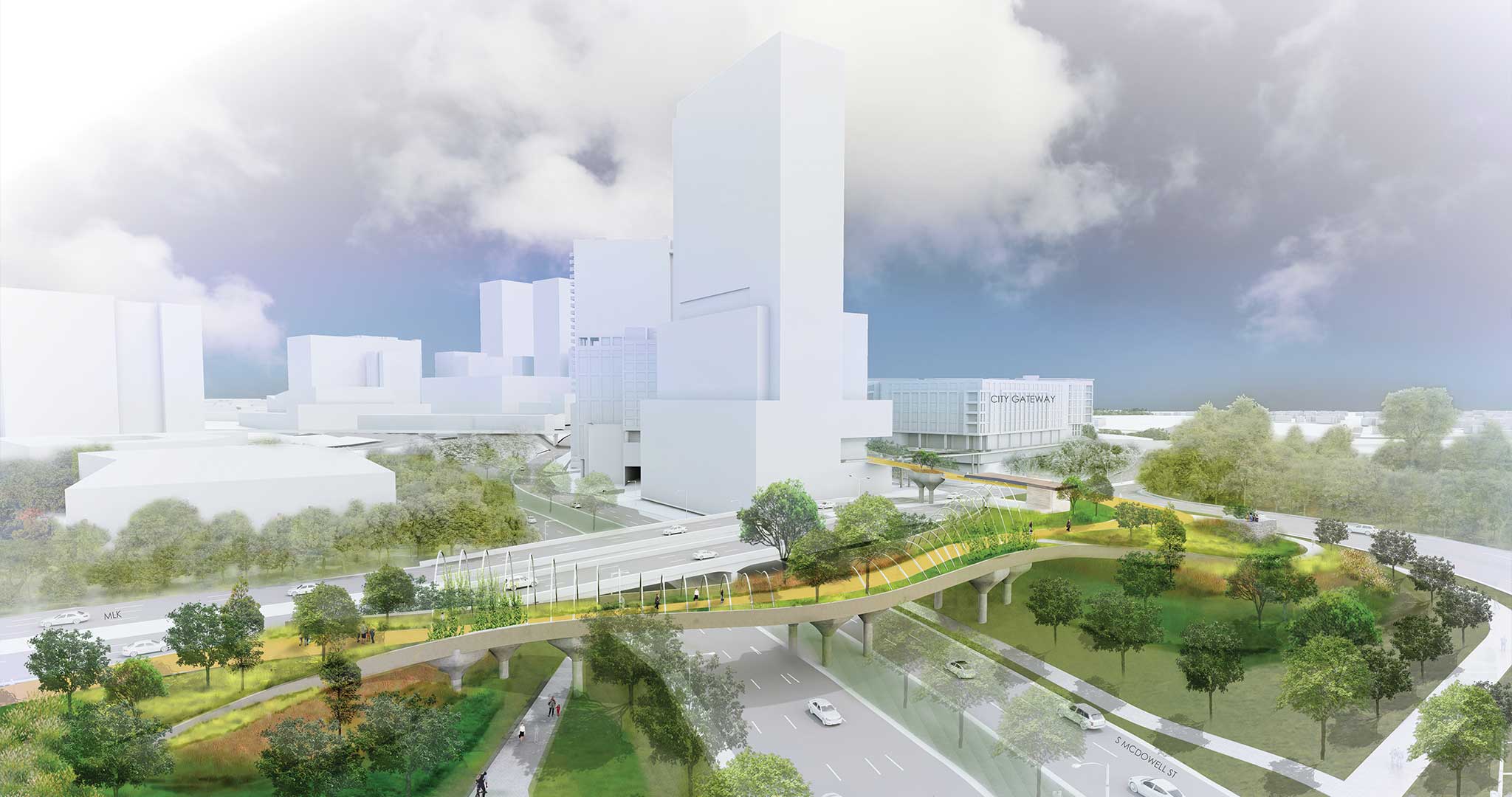
Proposed by SfL+a Architects, the group behind the mixed-use City Gateway project coming out of the ground at the corner of McDowell Street and Martin Luther King Jr. Boulevard—alongside Surface 678 and Preston Montague Studio—the elevated path would stay relatively level the entire route and hurdle the uneven topography between the two crucial Oak City attractions.
And, most significantly, The Oakline would be an attraction in itself. The proposed plan wouldn’t just provide a safer connection, but would allow Dix Park to spill into Downtown—meaning getting to the park will feel like being at the park. Public art, local history, intentional overlooks and lush canopy trees would extend that destination vibe—with shade to boot.
As proposed, The Oakline would begin at the Martin Marietta Center for Performing Arts, jump the rail line and continue through City Gateway before hurdling MLK Jr. Boulevard, McDowell and South Saunders streets, ultimately leading to Dix in a 16-minute jaunt—and for those on wheels, six.
“One of the really strong suits of the current pathway is it’s half in private developments and half in the public realm,” says SfL+a Architects’ Barry Buckman. Unlike some big pie-in-the-sky infrastructure idea, much of the route already runs through compatible private projects like Salisbury Square or Rockway, or falls into NCDOT Right of Way—meaning pieces of The Oakline could piggyback on projects already underway, including BRT, adds Surface 678 landscape architect Charles Bradley.
City Gateway, Salisbury Square and Rockway could also help build out portions along private property, notes Buckman.
SfL+a Architects, Surface 678 and Preston Montague
The developments the route will snake through are not only compatible, but complementary, adds Buckman, nodding to its connections beyond Dix and Downtown, with easy access to neighboring F&B concepts, retail and gathering spots upping the area’s overall walkability.
But none of the hype—or hope—means The Oakline is a done deal. City officials, project architects and Downtown Raleigh Alliance hope to collectively push the project forward this fall to nail down design, cost and potential funding sources.
“There’s financial stacks that can make this a reality,” maintains Hutchinson, pointing to transportation funding. “Paint a picture of what people want, and they’re going to figure out a way to pay for it.”
Early enthusiasm is high. “When I saw this proposal, [I thought] they cracked the code,” says City Council member Mitchell Silver. “They actually figured it out.”
And the ambition extends beyond cracking Raleigh’s decades-old connectivity problem. “It will really become an iconic gateway into Downtown,” says Bradley. “There will be trees marching across the road, and there’s something really magical when you’re driving under oak trees into the City of Oaks.”
More than a route from Downtown to Dix, The Oakline would become Raleigh’s new front—and a calling card for the City of Oaks.
Another Path A path from DTR to Dix is already approved and in the works: The Chavis-Dix Strollway, a cultural trail linking Dix Park and John Chavis Memorial Park while celebrating historically Black neighborhoods in the area. The two paths follow different routes—the strollway will run along South Street through South Saunders Street.
“You can’t have enough good connections to get to Dix Park,” says Buckman. “There will be some amazing work celebrating the history of the Fourth Ward community throughout the Strollway, and we strive to have The Oakline celebrate that history as well.” The Chavis-Dix Strollway project is in planning stages and is backed by $3 million in federal funding secured by Congresswoman Deborah Ross.
Downtown Raleigh Alliance has a new vision for the paused circulator: Link Marbles, the state museums and Dix Park to turn scattered destinations into one family-friendly Downtown experience.
Downtown Raleigh’s museums and attractions are a major draw—but they’re also scattered across a footprint that can be difficult to navigate on foot for families with littles or visitors unfamiliar with the grid.
Now, a defunct city route could be the difference between a visitor frequenting one or two spots and spending a full day in the city core, says Downtown Raleigh Alliance President and CEO Bill King.
The timing offers a rare opening to rethink the R-Line. Launched in 2009, the Downtown circulator was paused in August for up to 18 months, giving the city a chance to reconsider what—and whom—the next iteration should connect.
King expanded on that vision at the recent State of Downtown event: Connect those attractions with a route that lets families park once and spend a full day exploring. Together, he suggested, they could offer a family itinerary that outshines others across the region.
“When you build these experiences all up together,” says King, “they become a lot more powerful than they are individually.” The connector could make it easier for families across the region to plan a day—or even a weekend—of Downtown activities, he adds.
A museum visit wouldn’t have to be the day’s only stop. With a ride between destinations, it could be the start of a much bigger outing.
For King, that could mean thinking about the R-Line less as a way to simply move people around Downtown and more as the thread that ties some of its biggest family attractions together. The destinations are already here. The opportunity is making them feel like one experience.
Boylan Heights is getting a luxury upgrade. Enter Rosewood, a mixed-use lifestyle community by Blue Heron and NC-based Cline that broke ground this summer between the historic neighborhood and Dix Park. Spanning two buildings, the high-end project will pair 269 rental residences with retail, a central public plaza and resort-style amenities—from a rooftop terrace to a sauna and cold plunge suite and even a concealed speakeasy tucked within. But Rosewood isn’t just bringing the luxe life to one of Raleigh’s fastest-growing pockets. Once complete, the project will help stitch together Downtown, Dix Park and the city’s ever-expanding greenway network—putting residents within steps of some of Raleigh’s biggest draws.
What to expect from the highly anticipated Cottage Coffee and Park Bar at Dix Park when it opens later this month.
Everyday magic. It’s a tall ask of a small house, but that’s exactly what the team behind the highly anticipated Cottage Coffee and Park Bar at Dix Park—expected to open this month within the century-old Flowers Cottage—wants you to feel with every visit.
“It’s a really amazing opportunity to build something special,” says Meredith Kirkpatrick, partner at Maurer Architecture, whose firm led the redesign of the cottage—also noting the untapped potential of opening the building’s doors to the public for the first time.
The design brief for the project was summed up in a single question, according to Kirkpatrick: “What does it want to be?” The answer? Inviting—a place for everyone in a park for everyone.
The cottage’s new design builds upon what’s already there—and the fond memories many Raleighites have of it. Kirkpatrick herself has an annual family expedition to a famously prolific fig tree in the side yard, while Dix Park VP of Operations Nick Smith—who represented the landlord—recalls planning a joyous toddler birthday party at Flowers Field.
Mark Terry
Mark Terry
Mark Terry
Mark Terry
Mark Terry
Mark Terry
First and foremost, the reinvented cottage draws visitors in with a classic Southern front porch featuring a pair of cafe chairs—an ideal perch for taking a load off amid the park’s natural surrounds. Off to one side, a sprawling flagstone patio surrounded by a 25- to 45-person amphitheater was added to accommodate additional seating.
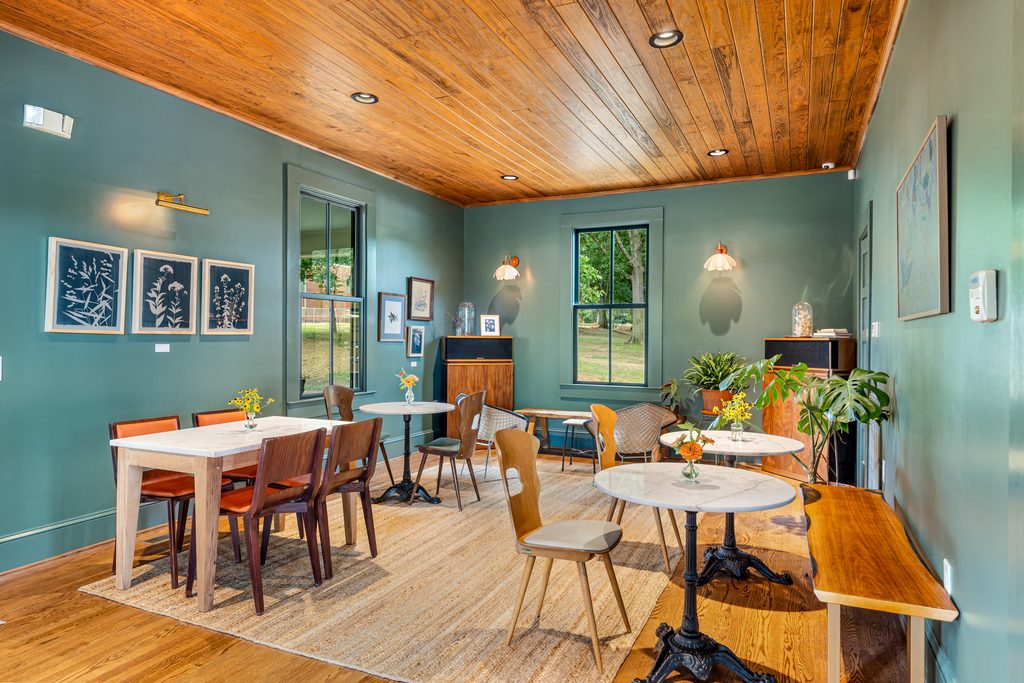
The back of the cottage houses a new outdoor bar, as well as a sprawling covered deck doubled in size during the reno. Inside hosts the cafe—which offers coffee, matcha and housemade sodas by day and beer/wine in the evening, plus snacks and soft-serve on tap—and a cozy lounge built for lingering.
Restrooms have also been added within both the cottage and a new shipping container building nestled in the oaks as you walk east to the sunflower fields.
Speaking of those oaks, the environmental stewardship of the grove of mature trees surrounding the cottage is an element of the transformation that could easily be undervalued, but Smith emphasizes “the experience would be drastically changed if we were not able to preserve and protect these trees.” Their shade cools visitors off by 10–15 degrees—offering a cool respite on a hot day.
At their best, design and construction create a mutually beneficial relationship with the environment. For this project in particular, the building is better because it’s in the park, the park is better because of the building—and people are better because of both. Whether you visit on a rainy Tuesday or a perfect summer Saturday, take a moment to pause and drink it all in… along with your favorite bev, naturally.