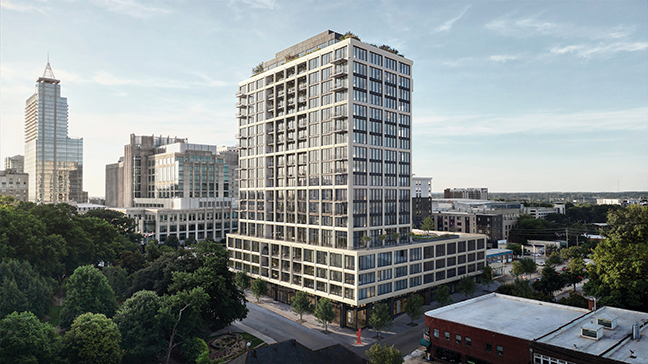
Raleigh’s building boom is kicking it into high gear. Beyond the projects already reshaping the skyline, another wave of towers, hotels and mixed-use developments is permitted, planned and primed to break ground. Here’s what’s rising next—and how it could reshape the city.
By Melissa Howsam & Lauren Kruchten
“Buildings don’t create great cities—people do.” Highwoods Properties SVP Skip Hill’s mic drop statement isn’t just lip service.
Today’s most ambitious projects increasingly reflect that principle. It’s no longer enough to plop down an office tower or apartment building and call it a day. The new playbook layers places to live and work with restaurants, recreation, gathering spaces, greenways and connections designed to make entire districts useful, accessible—and somewhere people actually want to be.
Just three decades ago, Downtown Raleigh was a very different place—and it showed. Storefronts sat empty. Fayetteville Street’s pedestrian mall was failing. “Everything was brown,” recalls DECO’s Pam Blondin. “The old Civic Center looked like a prison.” Come 5 o’clock, everyone bolted—and even The News & Observer was considering leaving Downtown amid a dearth of investment.
What followed wasn’t one silver-bullet project, but a series of big bets: Fayetteville Street reopened. The Civic Center came down. A new convention center went up. Then came housing, restaurants, public spaces and destinations that gave people a reason not only to come Downtown—but to stick around. Three decades later, DTR is hardly the place that emptied out at quitting time.
And Downtown was just the beginning. Beyond the cranes and projects already reshaping the city, another wave of residential towers, hotels, mixed-use developments and entirely new districts is permitted, planned or preparing to break ground.
From Downtown and Midtown to West Raleigh and beyond, billions in investment are laying the groundwork for a larger, denser and more destination-driven Raleigh.
But citywide, bigger buildings and taller skylines are only part of the story. For decades, developers, restaurateurs, small business owners and residents have worked to create “a place where people don’t just pass through—they belong,” says Neetzan Zimmerman, co-owner of The Newsagent’s. Increasingly, the projects coming next are being designed with that same bigger-picture thinking—connecting not only uses, but neighborhoods, destinations and people.
Because, as Hill put it another way, “real estate is not the story—people are.” That’s the opportunity as Raleigh’s next chapter rises: not simply to make room for more residents, businesses and visitors, but to build a bigger city that works better for the people already here—and gives everyone else a reason to come.
Here’s what’s rising next.
Bloom Images
One Nash Square
Now selling • 20 stories • 82 residences
Downtown Raleigh’s condo market is heating up. Sales officially launched over the summer at One Nash Square, DTR’s newest condo development aptly situated across from its namesake green space on West Martin Street.
The 20-story tower from NYC-based Alchemy Properties is making a play in a market that remains relatively untapped in Raleigh’s core: luxury for-sale housing. Its one- to four-bedroom layouts give buyers the chance to put down actual Downtown roots—rather than rent them—while delivering the lifestyle and amenities expected at an $800K+ starting price.
And Alchemy is betting Raleigh is ready. Pointing to Downtown’s increasingly walkable environment and the next generation of residents looking to transition from renting to owning, “We think the timing is right,” says Alchemy’s Brian Ray. “It’s always tough to be the first in the market, but we think it’s just the right time for us.”
Designed by Morris Adjmi Architects, living spaces lean light and airy via open floor plans, 10- to 12-foot ceilings, oversize windows, terraces and balconies, with engineered oak flooring offering a subtle nod to the City of Oaks.
Beyond residents’ walls, an extensive amenities program enhances the luxe lifestyle: An outdoor saltwater pool and state-of-the-art fitness center with spa facilities bring the wellness factor, while a resident’s lounge, golf simulator and private dining add spaces to gather. Even four-legged occupants get in on the action via an outdoor dog run and pet spa.
Ground-floor retail and on-site parking further reinforce the ease of DTR living—adding another piece to a Downtown increasingly built not just for people to visit, work and rent, but to own a piece of it.
Cline
Rosewood
In progress, opening 2028 • 8 stories • 269 units • 5.5K SF retail
The last piece of the puzzle connecting the greenway to Downtown is taking shape. Occupying a uniquely complex site at DTR’s southern edge between the historic character of Boylan Heights, the evolving South Saunders corridor and Dix Park, Rosewood isn’t just bridging distinct parts of Raleigh architecturally, socially and physically—it’s building a community around that connection.
Developed by Blue Heron Asset Management and designed by Cline, the residential project comprises two podium buildings with parking tucked beneath, intentionally stepping down in scale with Boylan Heights.
Rather than mimic the industrial ethos of the nearby Warehouse District, the design leans into Raleigh’s brick architectural roots, layering warm wood accents, arched elements and contemporary detailing to create something new that still feels at home in its storied surroundings.
But perhaps Rosewood’s most consequential connection happens outside its walls. The project will help complete the missing link between the future Lake Wheeler Road section of the greenway and Downtown, creating a pedestrian connection through the site to Dix Park and into the city’s growing trail and greenway network—with the greenway connection slated to come online alongside the development.
Outside, the living experience gets decidedly more playful, as the two buildings frame a central outdoor amenity space flanked by private terraces from select premium residences. Up top, a lounge and terrace take in South Saunders views—while a hidden speakeasy is tucked discreetly behind an entrance designed to look like any other residence. A dedicated wellness suite puts me-time front of mind via a sauna and cold plunge, with South Street-facing retail bringing another layer of lifestyle to a project designed not simply to sit between neighborhoods—but to stitch them together.
Turnbridge Equities
Highline Glenwood
Under construction, opening 2028 • 37 stories • 306 units • 7.5K SF retail • 50K SF office/commercial
Raleigh is officially growing up—way up. Currently rising in Glenwood South, Highline Glenwood will claim the title of the city’s tallest tower at 37 stories when it opens in 2028, redefining not only the Downtown skyline, but the scale of a district long dominated by renovated homes-turned-businesses, low-slung bars and restaurants, and comparatively modest apartment buildings.
But for Jason Davis, managing director of developer Turnbridge Equities, it’s not just about height. “It’s about offering a distinctive living experience in the heart of Downtown,” he says.
Spanning an entire city block, the mixed-use high-rise pairs that vertical future with a piece of Raleigh’s past, preserving historic DTR landmark The Creamery building as part of the development—while marking a turning point for the strip, which until now has been predominantly characterized by its industrial lore.
And Highline is going big on more than height: A ninth-floor outdoor terrace packs a pool, cabanas, padel court, firepits and lounge areas—complemented by a Trackman golf simulator; a fitness and wellness center with cold plunge, sauna and recovery amenities; and coworking suites. Raising the city’s bar, a 37th-floor indoor/outdoor sky lounge—and upper-floor balconies—serves up sweeping unobstructed vistas of the urban core from DTR to North Hills.
“This project offers an unmatched perspective,” says Davis. “As one of the fastest-growing cities in the country, Raleigh deserves a development that reflects its energy and vision.” Back on the ground, retail fronts a landscaped public plaza, bringing some of the development—and activity—to the street rather than keeping it all up in the clouds.
And Highline is only the beginning. Turnbridge plans to next develop 404 Glenwood at The Creamery, adding up to 280K square feet of Class A office space and 41,400 square feet of retail and dining—signaling Glenwood South’s vertical evolution is just getting off the ground.
More than just another residential tower, The Exchange’s Life Time Living project redefines the category of luxe living in Raleigh—not just in size, but ambition. Slated to break ground this month, the two-in-one project pairs a boutique apartment tower with Life Time Athletic’s sprawling athletic country club, while The Exchange’s East Park retail plaza is set to deliver alongside it, marking the development’s next phase of activation.
Calling Life Time Athletic Club a gym would be selling it wildly short. Designed for residents and members alike, the club layers cardio equipment, free weights, resistance training and personal training with dedicated Pilates, yoga, cycling and barre classes, plus a coworking lounge, child care and all-day, open-to-the-public Life Time Cafe.
Resort-inspired amenities carry over to the residential side, where luxury apartments with best-in-class finishes—including 10 penthouses—are complemented by a loaded amenity floor featuring a clubroom, billiards and shuffleboard room, sports and golf simulator, grills, firepits, cornhole. Then there’s the whopping 39K SF Life Time Rooftop Beach Resort and Bistro, and up top, 19th-floor Sky Lounge with fireplace, and cocktail bar and rooftop terrace—all adding to the hotel-meets-private-club feel.
“We’re confident this development will be a transformative addition to Midtown Raleigh,” says Dewitt Carolinas President Steven Beattie, “setting a new standard for living, wellness and community.”
Kane Realty
North Hills Innovation District
Under development • Four residential buildings • 250-key hotel • Office tower
If you thought North Hills’ expansion was over, just wait. After acquiring an additional 28 acres earlier this year, Kane Realty is primed for a new series of projects at the North Hills Innovation District—the next phase of the 20-plus-year evolution of its 130-acre mixed-use development in Midtown.
Set to expand the district’s footprint to Wake Forest Road, the next era builds upon Kane’s original vision of intersecting the natural and urban worlds while adding housing, hospitality, office, retail, open space and new connections to the surrounding community. “This next phase of NHID extends our vision of a place where people can work, live and connect,” says Kane Realty Managing Director of Development Drew Yates.
As part of that effort, Kane is extending a greenway connection that will ultimately tie into Raleigh’s larger trail network. With the initial segment from St. Albans Drive to Hardimont Road now open, the next phase of the boardwalk-esque pedestrian bridge will connect St. Albans Lofts to the currently under-construction residential Tributary before eventually extending to the planned multimodal bridge over I-440.
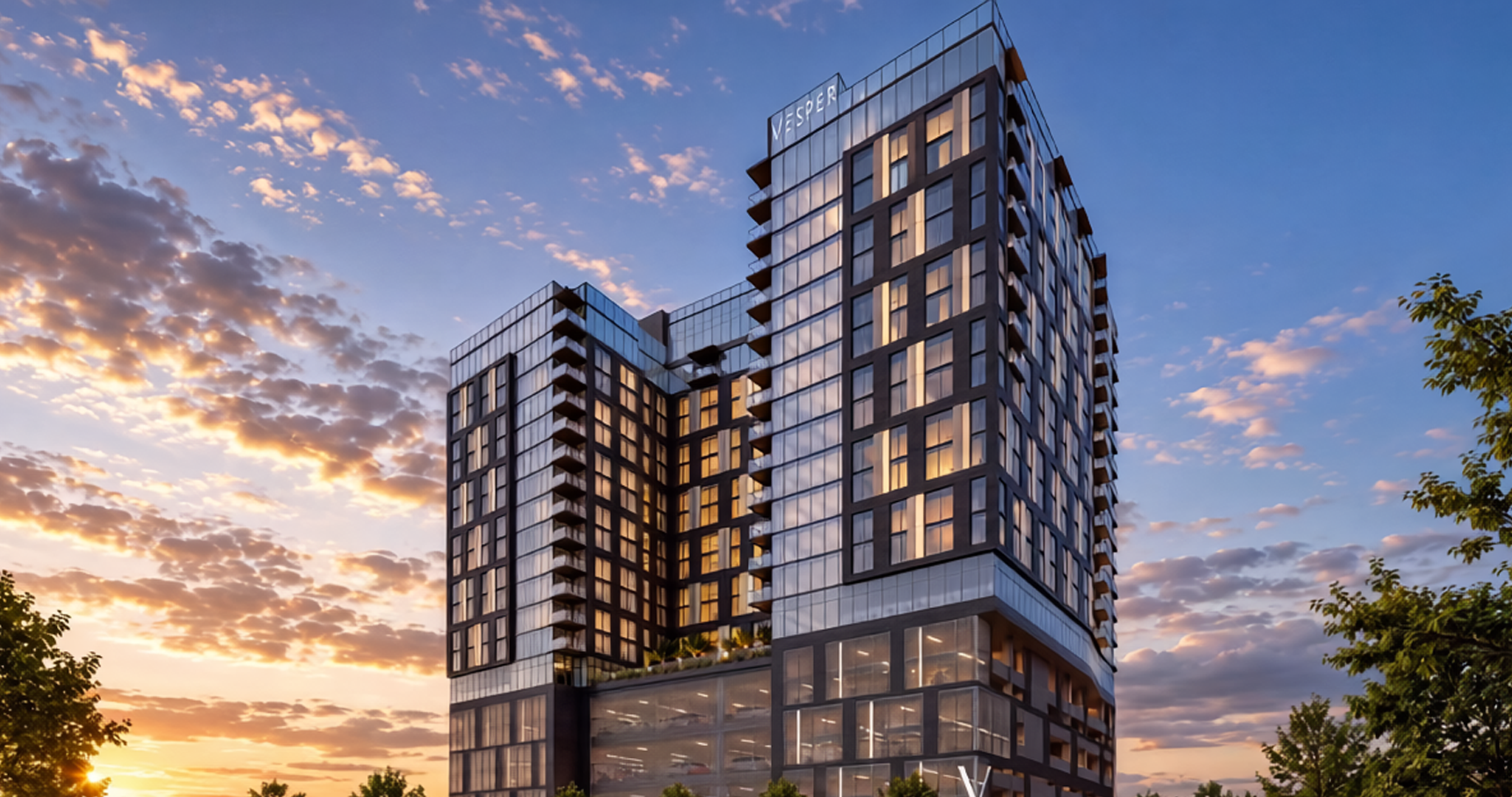
And that’s only the beginning. Future phases call for high-rise residential tower Vesper, midrise apartment building Merit, as well as Veranda—North Hills’ first active-adult community—plus an upscale hotel, office tower, freestanding retail, sports courts, nature trails, park spaces and amenitized walking paths. Across the residential projects, Kane is leaning heavily into wellness and outdoor living, from rooftop pools, terraces and fitness lawns to cryotherapy, infrared saunas and dedicated recovery spaces.
“The market is telling us there’s demand for housing at every stage of life,” says Yates, “and by delivering that within an urban, nature-forward setting, we’re not just meeting Raleigh’s needs today—we’re building a stronger, more resilient community.”
Still to come: a planned office tower and upscale hotel with up to 250 rooms, a cafe, rooftop dining and bar, event spaces and pool—further extending a district that increasingly functions as a destination unto itself.
Taken together, the projects make one thing clear: North Hills is nowhere near finished.
Tributary
Under construction, opening 2028 • Six stories • 332 units • 6K SF retail
Currently under construction, midrise Tributary will deliver a dynamic living component alongside a decidedly modern amenity mix, complete with digital content creation studio, elevated wellness center with hot/cold contrast therapy, and ground-floor retail.
Kane Realty
Kane Realty
Merit
Development begins 2027, arriving 2029 • Seven stories • 387 units • 10K SF retail
Sustainability and wellness take center stage at seven-story Merit, pairing lifestyle-focused residences and 10K SF of neighborhood-serving retail with a robust amenity lineup spanning a saltwater pool, multisport simulator and indoor-outdoor fitness space to cryotherapy, infrared sauna and meditation room. A rooftop canopy lounge adds another elevated gathering spot overlooking the growing district.
Veranda
Development begins 2027, arriving 2029 • 207 active-adult units
Catering to a different stage of life, Veranda marks North Hills’ first active-adult community, bringing 207 residences and an expansive, service-oriented amenity program spanning a game room and demonstration kitchen to a resort-style pool and sundeck, outdoor kitchen, wellness suite and Maker’s Space—raising the bar on active-adult living in the market.
Kane Realty
Vesper
Construction begins 2027, opening 2029 • 20 stories • 346 units
Adding to the city’s second skyline, Vesper delivers top-of-market amenities leaning into indoor/outdoor entertainment—think a rooftop heated saltwater pool with social terraces; a glass-wrapped rooftop clubroom with a fireplace, entertainment kitchen and lounge; and a sky yard boasting outdoor grills, a fitness lawn and putting green, firepits, and TV. Wellness gets equal billing via a massive fitness center with skyline views, recovery room, infrared sauna, steam room, treatment room and meditation lounge.
Kane Realty
North Hills Park District
Delivering summer 2027 • 20 stories • 362 units • 20 penthouses • 9K SF retail
Stacking up well against North Hills’ roster of high-rises is the Park District’s newest addition, situated nearby such popular spots as Cucciolo Terrazza, Tamasha, Vita Vite and Midtown Yoga. Rising 20 stories, The Strand introduces 362 modern residences—including 20 distinctive penthouses—along with a dedicated arrival and ride-share area.
A hospitality-inspired lobby welcomes residents with a comfortable lounge area, fireplace and full-service concierge, while a slate of boutique amenities delivering unique high-end elements sets it apart from the district’s current apartment-building lineup. Balancing entertainment, wellness and community, offerings range from a sixth-level clubroom with game tables and billiards, a resort-style saltwater pool with cabanas, and garden terraces with intimate conversation enclaves to an indoor/outdoor fitness studio and bike room with rentable bicycles and e-bikes.
The cherry on top? A Reserve Clubroom boasting an entertainment kitchen and dining space, lounge and terrace for taking in sweeping views of both North Hills and Downtown—while The Indigo Room serves up a private speakeasy exclusive to penthouse residents.
On the public-facing side, The Strand delivers ample ground-level retail alongside a welcoming promenade with generous sidewalks encouraging outdoor dining, strolling and activity throughout the day—further stitching the new tower into the burgeoning activity throughout North Hills.
Cline
Eastside
Construction begins this fall, opening 2028 • 20 acres • 250K+ SF mixed-use • Direct connectivity to 500K+ SF retail
What looks like a basic brick building we’ve all breezed by thousands of times is about to become one of Raleigh’s next big developments—and a case study in moving the city forward without bulldozing its past.
Enter Eastside, the transformation of the long-abandoned former Colonial Stores distribution warehouse at 2233 Capital Boulevard. Backing up to Raleigh Iron Works and stretching toward Salvage Yard, the massive pedestrian-oriented adaptive-reuse project from Beacon Partners and Cline will carve the sprawling industrial building into a new mixed-use destination for offices, retail, restaurants, recreation and gathering—while engineering new pedestrian connections across the corridor and adjacent to Raleigh’s extensive greenway trail network.
Rather than raze the warehouse, the team plans to retain the majority of its brick bones, punching in windows and selectively removing portions—including the southern end to make way for a multifamily component—to carve its enormous footprint into more usable, inviting spaces. At least two F&B concepts are envisioned alongside fitness and activity-based retailers, while a former rail spur lends itself to a string of pocket parks and outdoor spaces designed to bring some of the site back to the public.
For Cline, which plans to relocate its own HQ to the site and invest in the project, preserving that identity is the point. “There’s history to it and a story to it,” says Cline Design Director Dan Rider, “and as long-term investors in the city, it’s important for us to acknowledge and be part of that.” While nearby RIW leans into steel and its industrial roots, Eastside takes its cues from Raleigh’s brick architectural vernacular—straddling the line between making the old warehouse recognizable and giving it an unmistakably contemporary second life.
And the location may be as consequential as the building itself. Capital Boulevard has long functioned as Raleigh’s northern gateway without exactly looking the part. With Iron Works, Salvage Yard and new housing already pushing DTR’s perceived borders outward, Eastside answers a yearslong call to turn this overlooked stretch into an entrance worthy of a growing cap city.
Kane Realty
Downtown South
Construction starting 2026 • 350 units
After years of starts, stops and big promises, Downtown South may finally be moving from blueprint to reality. Originally unveiled in 2019, the $2+ billion mixed-use development spearheaded by Kane Realty founder John Kane and North Carolina FC and North Carolina Courage owner Steve Malik encompasses roughly 140 acres along the southern edge of DTR. The goal: transforming a largely industrial corridor into a dense, walkable urban district blending residential, office, retail, hospitality, entertainment and public green space.
Now, Kane has filed plans for the first piece: 350 apartments across eight three- to four-story buildings on 11 acres, with construction targeted to begin by year-end. It’s a modest start, but a meaningful one. Long term, Downtown South is still envisioned as a new southern gateway to DTR, layering additional housing, a hotel and a concert venue.
The secret sauce to a great city could rest in the Power of 10.
Think big. Think 10. Raleigh’s future isn’t just about streetscapes and skyscrapers—it’s about crafting places people actually want to be. And that doesn’t just happen. Enter the “Power of 10,” a simple yet transformative concept: Every city needs at least 10 destinations, and each destination needs at least 10 things to do.
Originated by the Project for Public Spaces (PPS), the framework reveals why cities like New York and Atlanta lure people in—and keep them coming back. Such is the philosophy behind Raleigh’s 2009 Comprehensive Plan, which directed 60% to 70% of new growth to eight growth centers focused along key urban and transit arteries like the Beltline and 540—think Midtown, West Raleigh and Village District—plus 15 multimodal corridors, extending the Power of 10 principle to shape a vibrant and connected city.
As former COR Chief Planning Officer and current City Council Member Mitchell Silver puts it: “If I come Downtown—as a senior couple, a single, a family—what are the options? You have restaurants—then what do you do? Places like New York… there’s so much to do, probably like a power of 100. That’s what makes those places exciting—people come back again and again. That’s the goal.”
Building on that foundation, new potential pockets now emerge as the Comprehensive Plan 2030 gears up to shape the city’s next chapter through 2050.
Placemaking in Action
As aspirational as it is practical, Raleigh’s growth framework already reflects this principle. The point isn’t just garden variety shopping, dining or strolling, notes Silver. The real magic is layering elements—rest, play, art, music, food, history, connection—so people linger, explore and return.
As such, applying the Power of 10 isn’t just theoretical. Standalone attractions like museums or parks serve as a great draw, but deliver “the power of two, maybe three, at best,” says Silver. “People come, look, maybe hit up the gift shop—and leave. The real challenge: What can you build around the museum or park?” The telltale sign—are there people there? And do they stay there?
He nods to Nash Square—lonely trees, empty walkways and angled parking that could morph into a vibrant hub where people actually want to linger. Even the strongest attractors can stumble without a complementary cast. Take Wilson’s Whirligig Park—a momentary magnet that, on its own, risks being forgettable, explains Silver. But with the upcoming Carolina sports and entertainment stadium and planned ~50-acre live-work-play mixed-use project, that fleeting draw evolves into a full, thriving ecosystem.
Looking to 2050
Given Raleigh’s demographic shift, the urgency for this approach grows sharper. The city is young: ~60% under age 40, and ~80% under 55. Yet, Silver warns, “the [older] minority is trying to drive planning decisions. We need young people to speak up.” Future growth hinges on creating these multidimensional hubs—places where people don’t just pass through but stay, engage and thrive.
Layer on a looming constraint: Raleigh is projected to run out of developable land within 20 years. Yet, the simple reality remains—people are coming. The city’s population boomeranged ~50%, adding roughly 200K residents in the last 20 years. “I called it Mayberry the Metro,” says Silver of the now more than 65 people relocating to Wake County every day. So it’s not a question of if—but how we manage it.
By honing in on our people-centered placemaking pockets—through public spaces, new mixed-use developments and urban design innovations—Raleigh can scale up its Power of 10. And in doing so—from blueprint to buzzworthy—transform a city of streets into a city of destinations.
Urban Growth Centers – 2009 Comprehensive Plan
Brier Creek
Crabtree
Downtown/Central Business District
Midtown/North Hills
New Bern/WakeMed
NE/Triangle Town Center
Village District/University area
West Raleigh
Potential Pockets for Urban Growth: 2030–2050
Capital Boulevard
City Market
City Plaza
Downtown South
Moore Square
Triangle Town Center (reimagined)
WakeMed Corridor (BRT)
Warehouse District
Emerged Naturally – Raleigh Iron Works
Raleigh Iron Works
A game changer for East Raleigh—and key connector between Downtown and Midtown—Raleigh Iron Works is a work-stay-play hub on the former Peden Steel site. Breaking ground in fall 2021, Phase One boasts 200+ apartments, buzzy retail, and ambitious public art and maker/pop-up programming, anchored by standout F&B spots from Brodeto and Little Rey to St. Pierre and Ponysaurus Brewing—and, yes, that trademark slide bringing a playful touch that’s core Raleigh.
Voohoo? Adding a dose of brewery magic to Fayetteville Street, enter Voodoo Brewing Company. Building on its hops hex—including a popular Asheville locale—the artisan-style beer brewers will soon be bringing their “beers for any vibe” to the lower level of the FNB Tower at 501 Fayetteville St. across from Sir Walter Coffee. Stay tuned! voodoobrewery.com
At a time when in-real-life socializing is surging, longtime City Club Raleigh has made the tough decision to shutter for good after 45 years as a beacon of community and connection in the Cap City at the conclusion of its current lease Dec. 31, with a Farewell Holiday Party and a final NYE Early Dinner scheduled for Dec. 20 and Dec. 31, respectively.
Positioned proudly on the penthouse levels of 150 Fayetteville (aka the former Wells Fargo Capitol Center) for more than a decade, CCR has made an indelible impact—not to mention created infinite memories via meals, events, unions, receptions, celebrations, gatherings and beyond.
Now, the Triangle’s largest law firm and longtime 150 Fayetteville tenant Smith Anderson has doubled down on Downtown by reupping its five-floor lease (save a half-floor they are relinquishing) while garnering the two top floors and signage rights of the iconic 30-story tower.
“We want to help Downtown continue to revitalize post-pandemic,” says Smith Anderson Managing Partner Byron Kirkland, “and as one of the largest private employers in the Downtown area, we are excited that we can play a significant role in doing that.”
About far more than office space, the lease extension is a boost for the city core via a block of Main Street—and a tower—that are already big talkers of late with openings of 150 Fayetteville ground-floor Birdie’s Barroom and Kitchen, as well as adjacent Diced, and soon bowing Insomnia Cookies and PrimoHoagies.
“Keeping Smith Anderson is a massive win for Downtown’s continued upward trajectory,” says Downtown Raleigh Alliance President and CEO Bill King, “as we add a flurry of new storefront businesses and build momentum for North Carolina’s Main Street. Not only are we keeping a major employer in the heart of Downtown, but we are keeping a company that consistently has participated and led in efforts to elevate Downtown Raleigh.”
“Smith Anderson’s reinvestment in downtown Raleigh shows the confidence one of our city’s long-standing business leaders has in keeping our urban core thriving,” Raleigh MayorJanet Cowell said. “Downtown’s success depends on everyone working together – the city, businesses, institutions and the community.”
Having called Fayetteville Street home for over a century, Smith Anderson will begin renovations to all seven of its floors this March, with a completion slated for mid-2026. Expect the reno to significantly modernize the space, establishing a striking two-story window topping the tower in the firm’s lobby and serving stunning skyline views, as well as huddle rooms, hoteling/flex offices, wellness areas on each floor, elevated tech, expanded conference room areas and a leveled-up firm cafe.
“We were deliberate in making the move ourselves Downtown in 2022 to 150 Fayetteville Street,” says Ted Klinck, president and CEO of Highwoods Properties, which owns 150 Fayetteville. … “We believe Fayetteville Street is North Carolina’s Main Street, and we very much appreciate the opportunity to serve as Smith Anderson’s workplace partner. In partnership with the city and the Downtown Raleigh Alliance, we’re committed to making Downtown the most commuteworthy Best Business District we can.”
Having already received recognition for its business savvy, “North Carolina is one of the best states to do business in the country,” acknowledges Kirkland. “Raleigh is one of the best places to do business in North Carolina, and Raleigh deserves a resilient and lively Downtown. We’re thrilled to be part of that vision.”
And that commitment, says King, “is a critical step in bringing Downtown back.”
Whatever you may think of Mayor Mary-Ann Baldwin, you likely think something—strongly. We look back at the “notorious” city leader’s provocative tenure.
Love her or loathe her, the one thing everyone can agree on is Mary-Ann Baldwin has struck a chord in Raleigh. And she loves it.
Dubbed “Notorious MAB” by INDY Weekwhen she announced her run for mayor with the intent to “lead the city into a bold progressive future” on the heels of the “Council of No,” Baldwin retorted by proudly—albeit facetiously—splashing the “notorious” moniker across T-shirts. Five years later, the two-peat mayor has boldly fulfilled that promise every day since. And, now, as she’s set to pass the baton as the Cap City’s second-consecutive—and third-ever, behind Nancy McFarland (2011–19) and Isabella Cannon (77–79)—female mayor, she opens up to Raleigh Magazine about her time at the helm.
The blunted “moonshot” mayor began with so much hope. Elected on the heels of her already notorious five-term run as at-large Raleigh City Council member (think “Drunktown,” pro-development, etc.), she famously dreamed 2020 would be Raleigh’s shot for the stars. That is, until a pandemic ~90 days in turned the town—and the world—upside down. A handful of years later, the mayor of COVID, social unrest, development starts and stalls, and Citizen Advisory Council (CAC) conflict cedes a city that looks far different than its prepandemic persona.
And it is arguably the pandemic that has most shaped her public perception. But despite the economic and social upheaval, Baldwin—alongside an initial-term “pro-development” council—made good on plenty.
From the jump, Mary-Ann Baldwin publicly devoted herself to zoning reform and solving what she calls “the missing middle” by allowing Accessory Dwelling Units and increasing housing supply to level the homeownership playing field in response to rapid growth. But that commitment was met with an all-out war from residents wanting to “Save Our Neighborhoods” from an influx of townhomes and duplexes, specifically in Five Points, famously dubbed “ground zero for Raleigh’s housing fight” by Axios. Essentially, the public feared the price of housing volume would come at the cost of character.
“Townhouses are usually somebody’s entree to homeownership,” explains Baldwin of her push. “When I was first elected, you could only build a townhome in 20% of our city. I talked a lot about housing choice. It’s not affordable housing. It’s really about housing affordability and choice—quads, duplexes, etc.”
One of the stats she says she is most proud of is, over the past two years, about one-third of the building permits issued are missing middle. “The whole missing middle—while some people consider it controversial—it’s for the better of our city. And it’s also what you see trending as a way to address the housing shortage in cities across the country,” she maintains. “Bottom line is we don’t have enough supply. … And what I’m proudest of is what we’ve done with affordable housing. It’s been pretty amazing.”
She cites the $80 million affordable housing bond greenlit by voters on her watch, and projects like the ~$1.5 mill Idlewild, city-owned historic land sold for a dollar to make way for the city’s first cottage court permanent affordable housing. “And, just the other day, we approved $5 million for a new program that will help our unsheltered. We’re looking at getting 40 unsheltered families into permanent housing.”
Add to that a handful of historic bonds, including $275 million for parks and rec that paves the way for McFarland’s and mayoral candidate and former Dix Park Conservancy President and CEO Janet Cowell’s Dix vision, and, of course, the now-extended four-year terms and staggered two-year elections.
When it comes to passion, “I’m really focused on sports as an economic driver,” says Baldwin. “There’s been a lot of talk about Major League Baseball coming here. We have one of the best women’s soccer teams in the world, and our men’s soccer team is also great. So how can we leverage that and ensure this opportunity comes together?”
Baldwin reflects on her role in what is the city’s largest economic development project to date via the expansion of Lenovo Center (formerly PNC Arena) and the surrounding Entertainment and Sports District development. “I want to give the state—as well as Wake County—a lot of credit because they really stepped up and partnered to help make this happen,” says Baldwin.
Often compared to Atlanta’s The Battery, which brings in a behemoth ~$3 billion a year, the sports and entertainment buildout is expected to be a boon unlike any other the Cap City has ever seen.
Taken all together, love it or loathe it, Raleigh’s roster with Baldwin at the helm points to progress. “There’s not one thing I could single out,” Baldwin says when asked what stands out during her time as mayor. “I think it’s everything—getting things done is what keeps me going. Part of what makes me notorious is that I do move things forward. I’m not somebody who’s going to sit around—making a difference is what keeps me charged.”
Turning a hundred or so pages, people will remember landing the Omni Raleigh Hotel and securing the Convention Center expansion and renovation. They will remember a government that finally approved BRT and the Civic Tower (unifying the civic entities on one campus) after 10 years of talk, thus serving to ignite a region, improve efficiency, and enable better communication and collaboration.
And in what was easily the most contentious council vote in modern history, we could write a master’s thesis on the differentiator initiating, retaining and relocating Red Hat Amphitheater has been—and thankfully will continue to be—for Downtown, as well as for the city as a whole, both in terms of economic impact and urban appeal for residents and visitors alike.
But people will also remember a pandemic, civil unrest, mask mandates, economic upheaval, her push to disband CACs, and the horrific tragedies that occurred during her tenure: a mass shooting and the death of local 11-year-old Hailey Brooks as a result of a parade tragedy. Still a contentious topic regarding the city’s handling, the 2024 Veterans Day Parade has just been canceled, and the Brooks family is now suing the City of Raleigh.
Pointing more specifically to people’s direct dislike of Baldwin, they will also remember her fingerprints on the skyline. For every pro-development constituent, there are arguably more who have publicly condemned the mayor of having her hands in developers’ pockets—so much so that she stepped down from her day job at Barnhill Contracting Co. due to speculation.
“If we want to continue to be a desirable city, we have to be bold,” says Baldwin. “We’re not going to stop growth—and we can’t just sit back. We have to have a vision for where we’re going. And whoever the next mayor is needs to be able to articulate that vision and get people behind it so we can move forward.”
Beyond her growth mindset, Baldwin’s favor fell drastically in response to the ongoing mask mandate and her handling of the upheaval that all but deemed Downtown unrecognizable after businesses were set aflame and ransacked—and the curfew that could have helped prevent it. While it was then-Raleigh Police Chief Cassandra Deck-Brown who was obliterated for her now infamous quote saying she “would not put officers in harm’s way to protect property and insurance,” many DTR business owners and residents hold Baldwin just as accountable for not stepping in sooner to instill a curfew.
“Bless her little heart. I know she wanted that job [of mayor] for a long time, but she flunked the very first test,” said Clyde Cooper’s BBQ owner Debbie Holt in the aftermath—one of many DTR business owners who didn’t feel protected by the decisions Baldwin made.
“What you learn is there’s always going to be people who are unhappy with the decisions you make,” says Baldwin. “As I’ve said publicly when asked if I regret [not calling a curfew]—absolutely. But I learned a really valuable lesson from that. My gut was telling me to call for a curfew. The bottom line is we didn’t know paid protesters from out of state were coming here. … I was told at the time, if you call for a curfew, we won’t be able to enforce it. And I regret it. But the lesson I learned from it was to always trust your gut. Don’t let that happen again.”
But, as they say, first impressions are everything. For many, the trust lost to that failed first test couldn’t be reconciled. Never mind the devastating scene is one DTR is still recouping from economically and socially to ameliorate public perception and bring Downtown back.
Now, as Raleigh again sits at a crossroads between NIMBYs and YIMBYs; yesterday and tomorrow; growth and conformity; status quo and progress—between then, now and what’s next—a new leader looks to take the helm.
When asked what—or who—needs to be next for Raleigh, Baldwin’s answer is simple. “Janet Cowell is the only candidate with experience—both on the state and local level,” she says, nodding to the vision Cowell has shown in her role at Dix Park, and as a former Raleigh city councilor, state treasurer and state senator. “Other people running have good intentions, but they lack the experience. I firmly believe a city of almost 500,000 people needs an experienced leader who has vision.”
Cowell, she explains, understands we need housing affordability and choice, that transit is crucial to our future, and that parks and recreation are critical to our physical and mental health. “She understands how our state government works and will seek out partnerships that move our city forward—she is the clear choice to be our next mayor of Raleigh,” maintains Baldwin.
Reflecting on her own experience as mayor, she adds: “When I was elected, COVID hit, followed by social unrest. If I had needed to have a learning curve—if I didn’t know the city or budget or staff—combined with a learning curve of holding office, it would have been a disaster. People say to me, you picked a great time to be mayor—and actually I did because that’s where I was supposed to be. I was the person with experience, and if it had been any other way, it could’ve been a disaster.”
It all stacks up to what you could easily call a self-fulfilling prophecy that germinated from that playful, snarky pre-mayoral nickname. When asked if she still embraces “The Notorious MAB,” she talks openly about how women in leadership are perceived—and attacked—across the country, something their male counterparts openly admit they don’t face.
“While I might be notorious, if I were a man, it might be said, ‘Oh, he’s a great leader,’” she postulates. “Misogyny is alive and well in our country, and women are treated very differently than men,” she adds, nodding to infinite messages she’s received calling her every derogatory name you can fathom—and some you can’t.
“So what I would say about ‘notorious’? Hell, yeah, I embrace it,” she admits. “I’m going to own it and go with it. But that also has a lot to do with being a leader. People were ready for change—we want more housing; we want more density. They were tired of the NIMBY and controlled. … The fact is our city is going to change.”
“It is changing. I had an agenda. There were things I wanted to get done. And we’ve done it.”
When asked how she feels about not running again, in a word, “conflicted.” She says getting to this decision was extremely difficult. “After my breast cancer and everything I went through, I was more notorious than ever. It brought out all the strength. And I was like, I’m doing this again.” Then, her husband, Jim, had a heart attack, and she started to reflect on spending time with her family and granddaughter.
And as for what’s next for “The Notorious MAB”—likely something a little less notorious: time to be a wife, a mother, a grandmother, and time to travel, all while fostering her careerlong commitment to affordable housing via her role at Cooper Charitable Foundation.
“I just came to the conclusion that, at this point, some other things are more important,” Baldwin emphasizes.
And starting my new job at Cooper Charitable Foundation has really helped solidify my decision because I recognize I could still work in an area that’s important to me and make a difference. My heart will still be filled.”
So, as her chapter as mayor comes to an end, one thing is for certain—Raleigh will definitely never forget her.