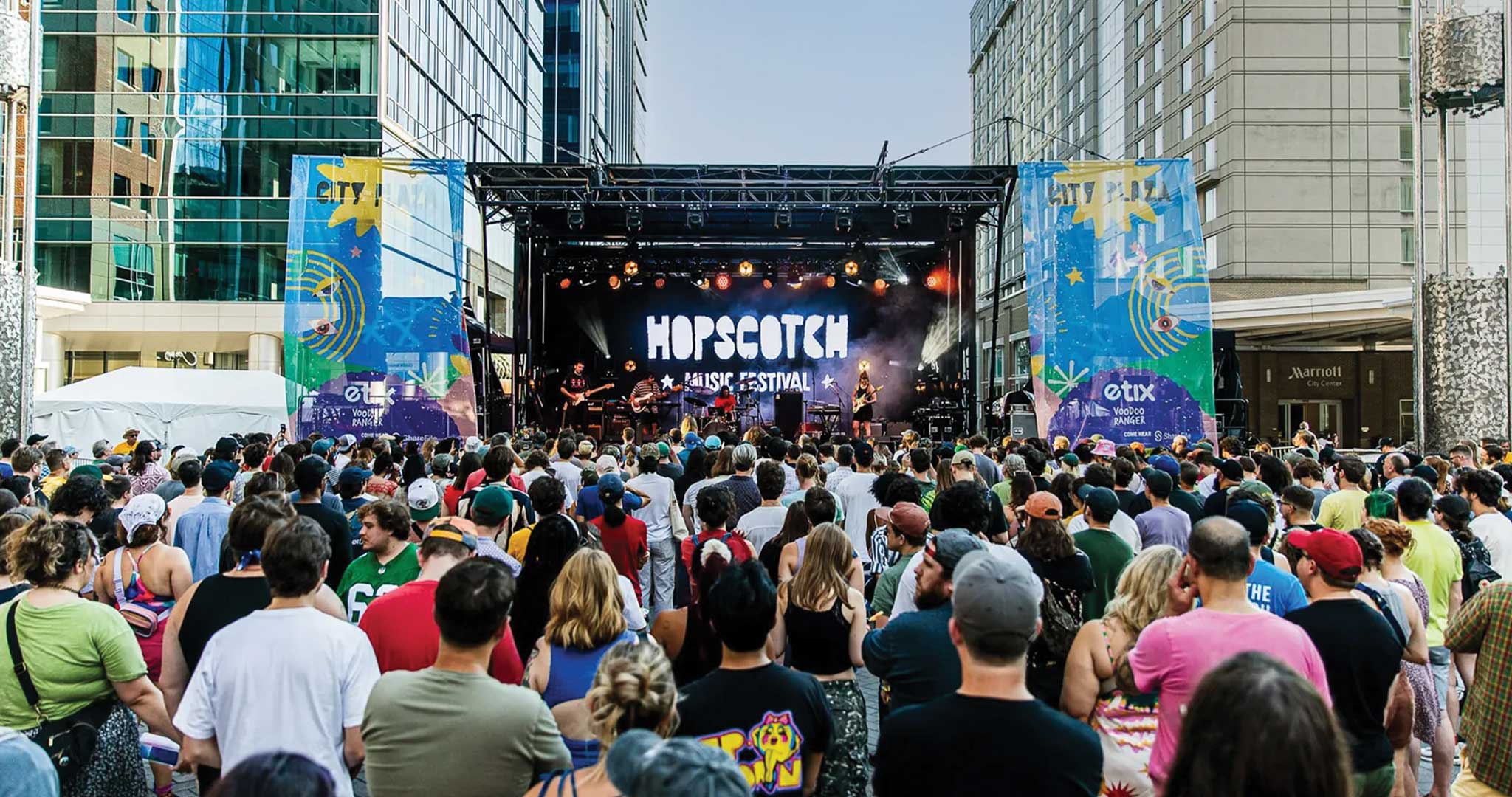
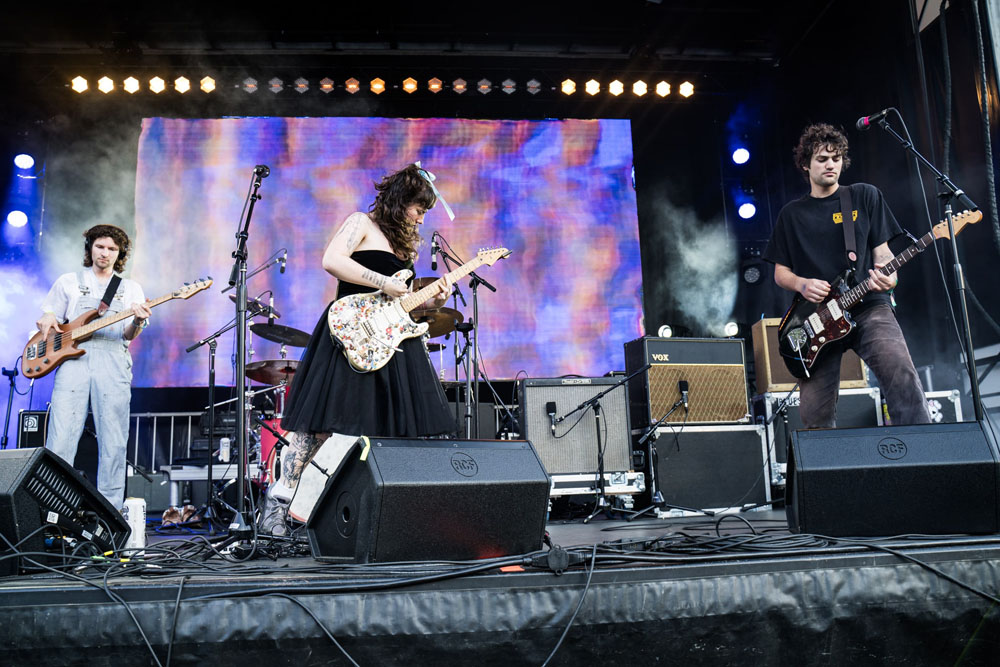
This was originally going to be a very different story. For months, rumors ran rampant that Raleigh’s flagship indie music fest Hopscotch Music Festival might not return—met with radio silence from organizers.
Sources told RM the fest’s owners, local ticketing company Etix, were undecided about its 2026 run and were unresponsive to repeated requests to comment. Typically tickets are available in early December, but sales still hadn’t launched. With less than six months to go before its typical September mic drop, there was no confirmation in sight. Then, on March 13, Raleigh got its answer: Hopscotch is back for 2026. And the collective sigh of relief wasn’t irrational.
In recent years, Raleigh has watched major festivals come and go. Dreamville announced its fifth year would be its last. While IBMA Bluegrass Live! was never intended to be permanent, the city submitted a new contract and the fest declined to renew, ending its Raleigh run. Despite their departures, the impact of both still ripples through Raleigh—and their finales weren’t tied to a lack of support.
After IBMA Bluegrass Live! organizers opted to “try something new,” former collaborator PineCone quickly launched the parallel Raleigh Wide Open fest without missing a beat. And while the City of Raleigh promised a successor to Dreamville’s fifth and final—with J. Cole‘s “hands all over it”—they have yet to deliver, though sources suggest a 2027 spring fest is up for consideration.
But even when departures aren’t spurred by a lack of community, the pattern raises a bigger question: Can Raleigh sustain a music festival long-term?
The answer is complicated. For starters, this isn’t just a Raleigh problem. “If Hopscotch goes away, it won’t be alone,” says Dave Rose, founder of Deep South Entertainment and an informal advisor during the early years of Hopscotch. Across the country, festivals are facing rising costs, tighter margins and increasingly high-risk economics.
While festivals are a labor of love, says PineCone Executive Director David Brower, they’re also famously “a good way to lose money very slowly.” Unlike a venue or brick-and-mortar business, festivals reset every year—raising and spending millions in a matter of months.
“In reality, you’re starting from square one every single year,” says Brower. “You raise all the money you need, then spend all the money you got.” From artist fees (which often spike for festival appearances) to temporary infrastructure—stages, sound, security, bathrooms—and the staff to keep things on track, the costs stack up fast.
While fests offer more bang for your buck than a single concert, betting on audiences to show up for a full lineup—not just one headliner—is a far riskier play. Add in premium artist pricing, says Rose—and the likelihood they won’t return to the same market for a year unless the demand is sky high—and margins tighten quickly.
Rodney Boles
As Brower puts it, “festivals curate a village that only lasts for three days, and then work the entire next year to create the community again.”
In Raleigh, some say those challenges are compounded locally. A former longtime Hopscotch employee told RM that permitting and policing costs have increased—off-duty police officers starting at $35/hour, with additional charges for structures and pyrotechnics—while city support has allegedly become less consistent, adding pressure to an already precarious model.
Still, the payoff can be massive. “We don’t have many events Downtown that use our storefront businesses as event spaces—but Hopscotch does,” remarks DRA President Bill King. “A lot of businesses do really well.” Thanks to its unique format, Hopscotch draws ~25,000 people annually, funneling foot traffic directly into Downtown locales in a way few events can.
“It’s our biggest weekend of the year by far,” says Slim’s owner Bill Johnson. “This festival is unique because it pushes people inside the bars—we pretty much have a full house from noon till 2am.”
But beyond economics, there’s cultural capital. “It’s not exactly a Top 40 festival,” says King, nodding to the cool factor. “Headliners tend to be more indie, and it’s a nice blend of out-of-market and in-market shows.” For more than a decade, Hopscotch has been scouting and booking indie acts just before their big break—elevating NC artists and cementing its place as a defining part of Raleigh’s music identity. Which is why the stakes feel so high.
“We are above average as compared to the rest of the country, but we could still do better to nurture festivals,” Rose maintains.
The bottom line: Raleigh needs to nurture events like Hopscotch—for its own sake. Festivals don’t just happen. They require sustained investment and coordination—plus the community needs to show out and secure tickets. And while Raleigh has proven it can host fests, keeping them is the real challenge.
Just one month out from what would have been the sixth session of Dreamville Festival, the chatter is reaching a fever pitch: Did the Dreamville dream die?
After announcing the OG April fest—which helped reignite Dix Park and put Raleigh on the global rap map—had hit snooze for good, Live Nation and Dreamville promised a new four-year fest under the label would rise in 2026, J. Cole included, headlining or not.
Now, just a month shy of D-day with no announcement in sight (as of press time), the mic has gone cold—and we’re all waiting for the “climb back.”
A new four-year music festival is coming to Dix Park.
While this year’s Dreamville Festival may have marked the end of an era, the music will live on. On the eve of the fifth and final fest, city officials and Dreamville organizers confirmed a new four-year music festival is officially in the works. Same vibes, new chapter.
“We will continue on the same path that’s been successful for us,” said City Manager Marchell Adams-David when asked about the yet-to-be-named festival’s genre. And, whether or not he headlines, J. Cole will remain involved.
“It might not have a Dreamville name on it, but we will be back with this feel,” the rapper and Fayetteville native told the crowd during his headlining performance on the final day of Dreamville Fest. “… to me, this feels like a cookout, a family reunion. There’s so much love with this.”
Dreamville has truly lived up to its name, generating $10.5 million per day for the city last year alone—and the hope is the next act will be just as much of a hit. “The dream has become a reality,” said Adams-David. And Raleigh is going to keep on dreaming big.
The latest local news nuggets you need to know now.
WHAT’S HOT
It’s a dream come true…? Per N&O, the City of Raleigh and Live Nation are in talks to continue hosting a music festival at Dix Park following the fifth and final installment of Dreamville Fest—potentially under the same name.
RDU is taking flight! Five airlines are introducing 14 new routes beginning April 11, including nonstop flights to Bermuda, Kansas City, Dallas, Detroit, Nassau and more.
Call it a glow-up—Raleigh Fire Department’s Station 7 closed March 31 for renovations, including improvements like new windows, bathrooms, showers, flooring and LED lighting.
With its 7.8 million square feet of industrial space currently in development, Raleigh was named No. 12 among markets with the most industrial real estate under construction at the beginning of 2025, with current inventory expected to expand by 6.5%.
“Bigger Play, Brighter Futures.” Marbles Kids Museum launched the public phase of its first-ever Capital Campaign, which will fund the completion of a two-story addition feat. a new one-of-a-kind exhibit, a classroom for educational programming and a rooftop playscape—plus the beautification of the Blount Street exterior façade.
Always standing on business. … Raleigh ranked in the top 10 best cities for young entrepreneurs, determined by such factors as coworking affordability, wage and tax data, internet infrastructure, cost of living, and personal income.
Pay up! A recently released study evaluating tolls as part of the Capital Boulevard Improvement Project recommends easing traffic congestion by removing stoplights and creating highway interchanges, with upgrades beginning in 2027.
RDU Airport’s consolidated rental car facility is in a (traffic) jam, as the plan is being ditched due to rising costs. Other options are being explored.
RIP. Former Harlem Globetrotter, actor and tallest man in America George Bell—standing at 7’6’’—passed away in Durham at the age of 67.
The U.S. Department of Agriculture is canceling $500 million in food deliveries for food banks and pantries across the country, resulting in a decrease of such nutritious items like chicken, eggs, milk and cheese.
WHAT’S NOT
The Bathroom Bill is back. NC Republican senators have introduced a bill similar to 2016’s HB2 dubbed the Women’s Safety and Protection Act that bans transgender people from using a bathroom affiliated with their gender identity at facilities like schools, prisons and more.
As the fifth and final Dreamville Festival has been put to bed, we recap the good, bad and dreamy moments of this year’s fest. And stay tuned for the new four-year music fest under the Dreamville label coming to Dix Park next year.
BEST
Weather This year’s fest was definitely the warmest and sunniest, complete with a chill breeze and partly cloudy skies to provide some relief from the heat. Even nighttime temps didn’t fall below 70—a plus compared to previous years’ nippy evening weather (not having to carry around a jacket all day? Big win)—but rain did start to fall Sunday at the end of the night. It was hot during peak daytime though, but luckily with Dreamville’s many shaded areas, there were plenty of spots to escape the heat.
Liquor Pop-Ups No one pulled out the stops more than this year’s liquor partners. Patrón set up a literal house in the middle of the festival pouring drinks in the brand’s signature tequila bottles, while Hennessy featured an energetic DJ set by Mannie Fresh and guest bartender appearance from Normani. And, as always, Casa Bacardi offered a tropical oasis to enjoy refreshing ’tails and make a wish in the branded fountain.
Art There were oodles of photo ops at this year’s fest, including a plethora of backdrops by local artists—showing that Dreamville Fest is more than just a music fest. Interactive structures also abounded, including a rainbow-hued string display that moved with the wind, neon rainbow setups, an inflatable flower installation, sunflower benches and much more.
NC Apparel North Carolina represent! Artists repped local sports with fashionable ’fits—from Lil Wayne’s branded Canes jersey to Ludacris’ UNC Tar Heels getup.
Throwback Artists While we love the top artists in today’s rap/hip-hop game (GloRilla ATE), it was a delight to see early aughts faves like Ludacris and Wale take the stage. Luda got the crowd hype with fan-favorites, even playing “Move Bitch” twice for an abundant crowd that belted along the lyrics both times.
Stage Visuals Dreamville really upped the ante with the stage visuals this year. Think raging flames setting the scene for 21 Savage; a smokeshow during Lil Wayne’s headlining performance, plus supercool graphics for his gaggle of coperformers (Hot Boys & Big Tymers, Birdman, Juvenile, etc.); an endearing animation behind Earthgang; lightning effects and strobe lights showcasing Erykah Badu; and *lit* light shows during the evening acts. And we’d be remiss not to mention J. Cole’s two-story home setup, where he kicked off the show upstairs sitting at a desk, working his way down to the first-floor couch.
Safety Precautions Walk anywhere on the grounds and there’s likely a medical tent in sight, a great comfort in the case of an injury, dehydration or other medical emergency—even a Narcan tent as a fail-safe. Water stations were also scattered throughout, in addition to Electrolit samples near the entrance. And staff were quick to rescue patrons in need during sets (s/o crowd members who waved their phone flashlights to gain attention).
WORST
Sound Issues Despite two entire days of live music, J. Cole’s mic failed during the opening of his final headlining performance, a major flop. Erykah Badu’s mic also went out while she was on stage with him—and Earthgang’s sound system was having issues at the start of their set. Luckily, Cole noticed his vocals weren’t projecting and restarted his first song for the enormous crowd to hear, and Earthgang’s DJ stopped the set to figure out the issue before the duo came on.
Huge Crowds With 52,000+ people in attendance each day, Dreamville sold out once again—and it showed. Sunday was especially packed, with clusters of festivalgoers descending on Dix, making it hard to maneuver throughout the grounds. Toes were stepped on and several folks had to be escorted out of the throngs during individual sets (though alcohol and other substances could definitely be in play). During his Sunday set, even J. Cole paused to take it all in—marveling at how far the crowd stretched.
Long Lines Perhaps inevitable when it comes to a festival of this size and scale, lines for merch and some bars and some food vendors stretched endlessly. Hands down, the GA merch tent was the roughest scene, with throngs of festivalgoers snaking through the grounds to snag a hoodie or T-shirt—barricades had to be brought in on day 2 to help. Even in the VIP area, we waited ~20 minutes for an order of fries—but, worth it (!).
Poor Service After five years, we thought Dreamville had finally figured out the shotty service situation. Saturday we were able to text/call/post to social media with minimal delay, but Sunday harkened back to the dead bars of years’ past, getting worse as the day went on. By the evening, we were unable to text or make calls, and Instagram wouldn’t update.