The Tipsy Gypsy

The Tipsy Gypsy

Raleigh’s first mobile bar for hire is hitting the streets and looking for a party. Esmeralda, the vintage 1962 Shasta camper, is the culmination of a two-year project for Tipsy Gypsy Caravan owner Cami Bell. “I saw a similar camper bar at a clambake a few years ago; it was the cutest thing I’d ever seen,” says Bell. “I immediately knew I wanted to build one.” After fi nding the camper she needed, Bell enlisted the help of Lori Langdon from Indigo, a Raleigh interior design fi rm, and Foundation Bar Manager Kyle Hankin to create a beautiful and functional mobile bar.

The bar is ideal for private events and weddings—guests rent the caravan, including the bartender, ice and glassware. Bell hosts a tasting party to pick cocktails for the event beforehand and the client provides the alcohol and mixers. “Cocktails, wine and beer are carefully paired with your food and style, and Esmeralda will be dressed out to match,” says Bell. ”We can do anything and go anywhere with alcohol or not in the Raleigh area.”

The Mighty Microgreen

The Mighty Microgreen

Microgreens take root in the City of Oaks.

AS THE PLANT-BASED diet trend gains traction, greens are commanding more real estate on restaurant menus and plates, but there’s a tiny yet mighty green that’s vying for more of the spot- light: the microgreen. Not to be confused with sprouts, microgreens are the fi rst true leaves of a vegetable or herb. Often used to give plates a pop of color, some of Raleigh’s top chefs are giving microgreens their due, treating the intensely- fl avored leaves and stems as a stand-alone ingredient that enhance dishes’ fl avors and textures. Locally, it’s all thanks to Tami Purdue.

Purdue, who traded in her career in intellectual property to grow microgreens out of an abandoned shipping container, is the founder of Sweet Peas Urban Gardens, which grows more than 55 varieties of microgreens. It’s not as crazy as it sounds. Through her volunteer work with Inter-Faith Food Shuttle, Purdue learned how to grow microgreens at a workshop led by urban agriculture pioneer Will Allen. Allen promoted microgreens as both a solution to food insecurity as well as a small farm business model, with the caveat that, to be profitable, growers had to sell to chefs. Purdue was so inspired that she immediately drafted a business plan and planted her first microgreen: arugula. During the summer of 2014, Purdue experimented with growing diff erent varieties while analyzing small farm business plans. By the end of the season, she gave up her day job to become a microgreen farmer.

Purdue continued growing microgreens out of her Raleigh residence and brought her fi rst harvest—arugula, pea shoots, a spicy mix with radish, arugula and mustard greens, a mild mix with broccoli, cabbage and kohlrabi, and micro cilantro and basil—to the Wake Forest Farmers Market. Chef Lotah Fields from Farm Table Kitchen & Bar was so ec- static to fi nd microgreens that he bought everything. “That’s what got me inspired that I could do this and that there was a little bit of a market for it,” Purdue says.

INDOOR GROWING SPACES

18 Seaboard’s ribeye with Agrodolce, collard spatial, squid ink aioli and Sweet Pea’s sunflower shoots.

Over the next year, Purdue sold to more restaurants through Raleigh City Farm, where she met Ben Greene, a NC State University graduate whose master’s degree thesis and subsequent business, the Farmery, developed indoor farming technology that converted abandoned shipping containers into indoor growing spaces. “I said, ‘I want one,’” says Purdue. “I looked at the data about how much could be grown in it and it was fi ve times what we were growing in my house.”

The 40-foot grow box’s efficient space and controlled environment allowed Purdue to consistently produce fresh microgreens, much to the delight of local chefs. Her prime location just outside downtown meant that chefs could easily pick up—or sometimes literally pick—their orders. Though Purdue had to relocate to Hillsborough late last year, she will return to Raleigh with two additional grow box installations, one at the Transfer Co. food hall, opening this summer, and one at Rebus Works, where she also sells at their Saturday market. While Purdue has seen more interest in microgreens among consumers—likely due to their purported health benefi ts, as a recent study shows that microgreens pack four to 40 times more nutrients than their fully-grown counterparts— chefs remain her best customers.

RESTAURANT REQUESTS

Four years later, Farm Table Kitchen & Bar is still a loyal customer. Chef Jerome Zimmer uses microgreens to add dimension to everything from fi sh to roasted vegetables, and even had Purdue specially grow micro caraway for a recent Triangle Wine Experience dinner. Its toasty rye notes complemented the rye bread served with a pork pâté and pulled together a branzino dish plated

Farm Table’s Salmon Piperade with onions, peppers, roasted tomato, grilled fennel, chorizo, melted leeks and herbs

with a Russian dressing. Another custom request came from chef Patrick Colley at Caroli- na Country Club, who used slightly bitter pumpkin microgreens to balance the sweetness of a butternut squash bisque. “They [also have] a very thick leaf so they added a subtle texture to the soup along with the pumpkin seeds,” Colley says. “I know this may sound a little strange, but I also felt like they added a certain element of umami to the dish.”

Instead of topping Pharmacy Café’s grilled halloumi sandwich with ho-hum mesclun, chef Patrick Cowden pulls in Sweet Peas’ spicy mix, a blend of cilantro, radish, arugula and mustard microgreens with nuanced peper notes. Bowden has also experimented with microgreens in vinaigrettes, where micro herbs like sorrel yield a bright, refined flavor without the astringency. At Raleigh institution Vinnie’s Steak House, chef Tom Armstrong incorporates microgreens into weekly specials and is particularly into micro herbs. “Right now, we’

Olive tapenade, pickled red onion, slow roasted tomato, lemon-rosemary aioli & spicy mixed greens on baguette

re doing beef carpaccio and we’re using chervil on that,” he says. “I thought about doing fried parsley leaves, but micro chervil has a fresher, cleaner flavor. It’s like a better version of parsley. It brings a mild herbaceousness to the other flavors, like capers, horseradish and egg yolk.” And, at 18 Seaboard, chef Jake Wood also uses microgreens to elevate meaty fare, relying on micro garlic to deliver a pronounced chive flavor and snappy texture to beef carpaccio, and nutty-sweet sunflower shoots to offset the richness of a rib eye. Purdue enjoys working with chefs and seeing her microgreens shine in their creations, but as part of her mission to spread the microgreens love, Purdue donates Sweet Peas’ market leftovers to A Place at the Table, a pay-what-you-can café where chef Aaron Stienessen uses sunflower shoots and pea shoots to deliver fresh crunch to sandwiches and salads.

Finding Its Footing

Finding Its Footing

In the last six months, Vidrio has tweaked its menu and found a chef for the long haul.

HUNDREDS OF HANDBLOWN glass orbs cover the dining room wall in colors ranging from ocean blues to clay-pot terra-cottas that suggest a Santorini sunset. Afternoon light floods 16,000 square feet of space on two levels, while rope chandeliers and fishermen’s crates conjure the accoutrements of a ship.

It’s easy to be enchanted by Vidrio, the year-old Mediterranean restaurant on Glenwood South that feels more like an Adriatic beach retreat than a family-style restaurant in downtown Raleigh. But for all its beauty—and its widely praised Mediterranean cuisine to match—the latest local addition to LM Restaurant’s portfolio saw its share of early struggles. “In the very beginning, we had a lot of issues,” says Lou Moshakos,the founder and CEO of the Raleigh-based hospitality group. Other brands under the LM umbrella include Taverna Agora, Carolina Ale House and Bluewater and Oceanic in Wilmington. “In the last six months, we have come a long way. I really believe it. The guys have done a fantastic job.”

The guys include Jay Spungin, Vidrio’s general manager, and Aaron Whitcombe, its third—and hopefully final—executive chef. Since the fall, when Whitcombe came on board in early September, the pair have worked consistently to recruit and retain top-notch talent, as well as to tweak an ambitious menu to be more in line with Raleigh market customers’ expectations. Now, Vidrio is reaping the rewards, having booked nearly 500 private events at its upstairs event space and racking up five-star reviews on Yelp and social media, which Moshakos says he monitors daily.

Moshakos, who came to the U.S. in 1978, was born in raised in Glykovrisi, a small village in the Southern Peloponnese. Grecian traditions of long, wine-soaked meals spent sharing plates of food and relishing the company of family and friends informed Moshakos’ vision for Vidrio, which takes its name from the Spanish word for glass. Dishes inspired from regions all over the Mediterranean are served family-style and brought out to tables in the dining room or to the bar as they’re ready, in a continuous stream. Guests can order bottles of wine and cocktails, or choose wines by the glass from close to 50 different taps in order to experience a variety that’s unrivaled locally. It’s an untraditional style of service that Moshakos says gives guests lots of flexibility. “That was the key right from the start, to give that flexibility,” he says. “You want to come in alone and have a couple of drinks and a snack; you have that flexibility. You want to sit down at the bar and have two or three plates, you can do that, or come in with a group of 10, 20, 50, 200…500.” Whitcombe, the chef, says guests seem to appreciate Vidrio’s shared small plate and family-style dining method, though the restaurant has made some tweaks to the concept to better connect with customers. For instance, Vidrio started out selling a large, hand-cut, grass-fed steak at a steakhouse price but found that guests wanted something different; now, smaller, less expensive cuts of steak appear on the menu. “Diners have the opportunity to taste and experience more food and experience wine from around the world,” Whitcombe says. “In addition, the menu is set up that if a guest wants a more traditional style dining experience, they can have it without losing the identity of Vidrio.” The restaurant’s biggest growing pain has been finding good people for its staff of more than 50. It’s a problem that, in a tight labor market that hasn’t quite reached the big city levels of places like New York, Miami and Chicago to draw talent from, many Raleigh restaurants continue to grapple with. But Vidrio is beginning to see improvements.

Lou Moshakos and daughter, Amber, who has just been named President of LM Restaurants

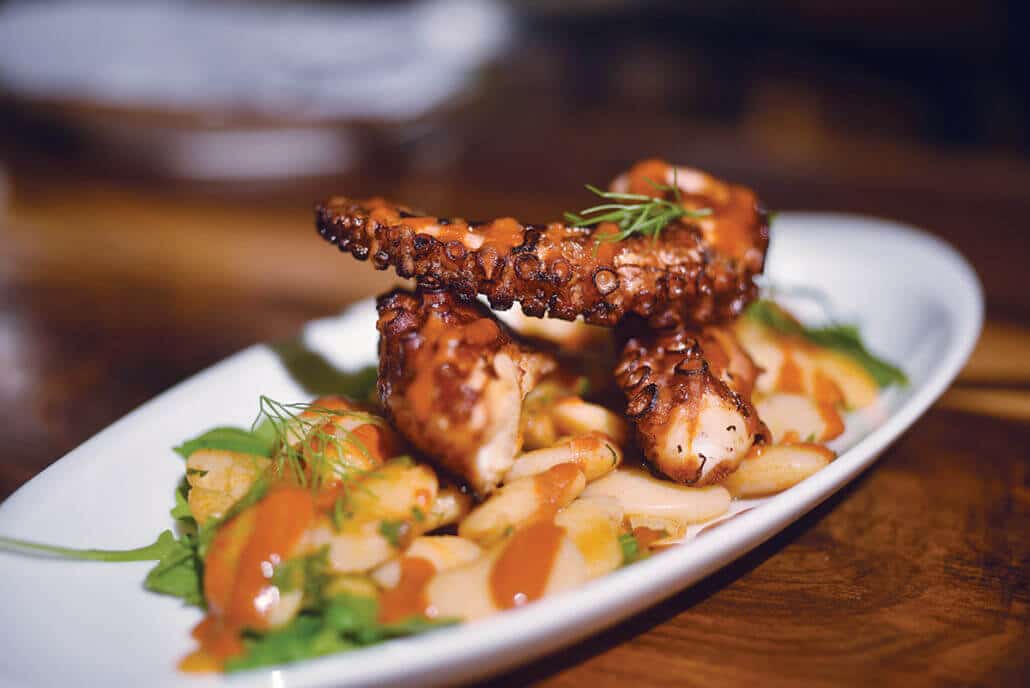
“I’ve felt the shift now that we’re out in the marketplace a bit, now that we’re considered one of the better places in town, we are seeing people come to us,” says Spungin, the general manager. “Where we were having to search out so much in the beginning, now people are starting to come to us. That’s something we want, that we’ll rely on, having great peer groups of people who already work with us and want other professionals they know to come work with them.” If one thing has always been consistent at Vidrio, it’s been delicious, locally sourced, seasonally suitable and superbly prepared food. The restaurant is renowned among seafood lovers for its tender charred octopus, Branzini ceviche and woodfired prawns. It’s celebrated for its tasty Italian-inspired dishes, including a creamy agnolotti.

Guests rave about Vidrio’s Moroccan beef skewers with harissa Greek yogurt, its flatbreads, charcuterie and its green chickpea hummus. For Vidrio’s menu, no detail is too small, with food cooked in olive oil imported from Moshakos’ hometown in Greece. This spring, expect new menu items that reflect Whitcombe’s varied style and extensive experience in Mediterranean cooking, and that strengthen Vidrio’s concept of sharing and social dining. “It’s an experience we want to bring to our guests and their families,” says Moshakos. “When you go to Greece, it’s hours-long meals. We mingle, it ties everyone together. Put the cellphone away, and enjoy each others’ company.”

Dining with the Wolfs

Dining with the Wolfs

Capital Club 16 is a labor of love and a peek into the past


Passing through the curtained vestibule of Capital Club 16 is like stepping back in time to yesteryear, a golden age, the good old days. Soaring ceilings, dark wood, antique paintings and expansive windows lend the space on the ground floor of the historic, Art Deco-style Capital Club building a classic feel; it’s a timelessness that’s reflected in the restaurant’s menu, which brims with hearty but refined fare.

Owners Jake and Shannon Wolf opened the downtown eatery the better part of a decade ago with an old-fashioned aesthetic and a perennial desire to feed their community.

“Building something from the ground up, having it be worth its weight and creating an energy, creating a vibe, creating a place where people can come hang on a special occasion…and seeing it take off and become what it’s become, is rewarding,” says Jake Wolf, who is also the executive chef.

Photo by Jason Wolonick

Guests come for the food, a mix of traditional American and European dishes with a German influence, and often leave as friends.

“We’ve met so many people who came in as customers and now they’re good friends of ours,” says Shannon Wolf, who runs the back end and plans the restaurant’s many events.

This summer, the co-working community HQ Raleigh expanded into the Capital Club building’s top five floors, giving the space a makeover and a shot of enthusiasm with HQ members adding to Capital Club 16’s already lively business.

“We’re excited that the building has this new life and energy,” Shannon says. “You can tell that they all love being here.”

Jake and Shannon first met growing up together in Southern Pines. They went their separate ways, he to culinary school at The Culinary Institute of America at Hyde Park, and she to the University of North Carolina at Chapel Hill and then to Furman University in South Carolina before earning a master’s degree in writing from the University of North Carolina at Charlotte.

Photo by Jason Wolonick

Ten years later, they reconnected. By then, Jake was an experienced chef with stints in Atlanta, Telluride, Boston, and at a destination hotel in Schwendi, Germany. Shannon was living in New York City, working as a writer and producer on shows for networks, including Oxygen, Discovery and CBS. Jake moved to the Big Apple to be with Shannon, but when she became pregnant with their son, they moved back to North Carolina with their dog Tiny, a Brussels Griffon they call the “queen of the house.” They decided to open their own place.

“We looked at other areas, other towns, but we really liked the energy here in Raleigh,” Jake says. “There was a lot of restaurant activity going on (at the time) and we liked downtown.”

The couple’s restaurant vision shifted as they toured various listings but when they viewed the space at the corner of Martin and Salisbury Streets, they knew exactly what they wanted Capital Club 16 to be.

“We just fell in love with it,” says Jake. “We were still living in New York when we signed the lease so then we had a really fun time going around New York City trying to figure out some decor items that would fit in this place.”

They chose furnishings with history: Art Deco chairs from the now defunct Horn and Hardart automat, a restaurant with banks of coin-operated compartments filled with single-serve sandwiches and pies; tables built from salvaged North Carolina-milled heart pine lumber; a bar top crafted of wood once used to build docks along the Neuse River; and a bar and backbar made from reclaimed wood from the famous Lüchow’s Restaurant, a onetime mainstay in New York City that remained open for a century.

The couple decorated the walls sparingly, with family paintings and meaningful mementos, and they carried the heirloom idea through to the menu. The kitchen offers legacy recipes, such as Jake’s grandmother’s sausage gravy—a popular dish for Sunday brunch—as well as sausages and dumplings he learned to make in Germany.

The menu also offers seasonal and locally-sourced produce from area farms, including Raleigh City Farm, Laurel Branch Gardens and Farmers’ Collective, plus regionally-raised meats, sausages from Weeping Radish and Carolina coast seafood from Locals Seafood.

Photo by Jason Wolonick

Dishes are eclectic, with a mix of carnivore and vegetarian fare. Items like the Farmer’s Veggie and Rice Bowl and The Sparrow sandwich with Carolina Moon brie, provolone, spinach, apples, caramelized onion and sunflower seeds share billing with the Bavarian Sausage Platter and the Rahmschnitzel. The brunch menu boasts favorites like the Steak and Eggs, a full English breakfast and Challah Bread French Toast with bourbon syrup and a cheese grit cake.

Capital Club’s drink menu is well-curated, with local and European beers, wines and classic cocktails, including the Old Fashioned and the Dark and Stormy. It’s no wonder the restaurant hops on the weekends, with busy dinners and bustling Saturday and Sunday brunches.

“What we do here is what we would do at home, what we’ve always done,” says Jake. “It’s a very comfortable feel, a culmination of different places that I’ve cooked and the food that I like to eat, and the food that Shannon likes to eat…We’re very happy here, and it’s a fun thing to be able to work for yourself and with your partner, and I wouldn’t want to change any of it.” ■

Sushi For Good

Sushi For Good

It may sound like a dream come true… and it sort of is! Cowfish Sushi Burger Bar is introducing sushi for a good cause benefitting the Ronald McDonald House of Durham and Wake until March 31.

Every time you order “The Roll That Love Built,” $2 goes to helping keep families close to their children while they are in the hospital.

“We wanted The Roll That Love Built to be extra-special,” said The Cowfish Director of Marketing and Guest Relations Jennifer Brantley. “Our goal was to make this roll stand out. We hope all our sushi-loving guests will order TRTLB, as we’ve been calling it, before the end of March – and that they’ll love it so much the first time, they’ll return and order it again. When it’s gone, it’s gone for good.

The TRTLB is created with crispy shrimp tempura and kani wrapped in seaweed and rice, topped with raw tuna, hamachi (Japanese amberjack), eel sauce and tobiko (flying fish roe).
thecowfish.com