Dix Park is a destination meant to be biked—here, tips on how + where to explore.
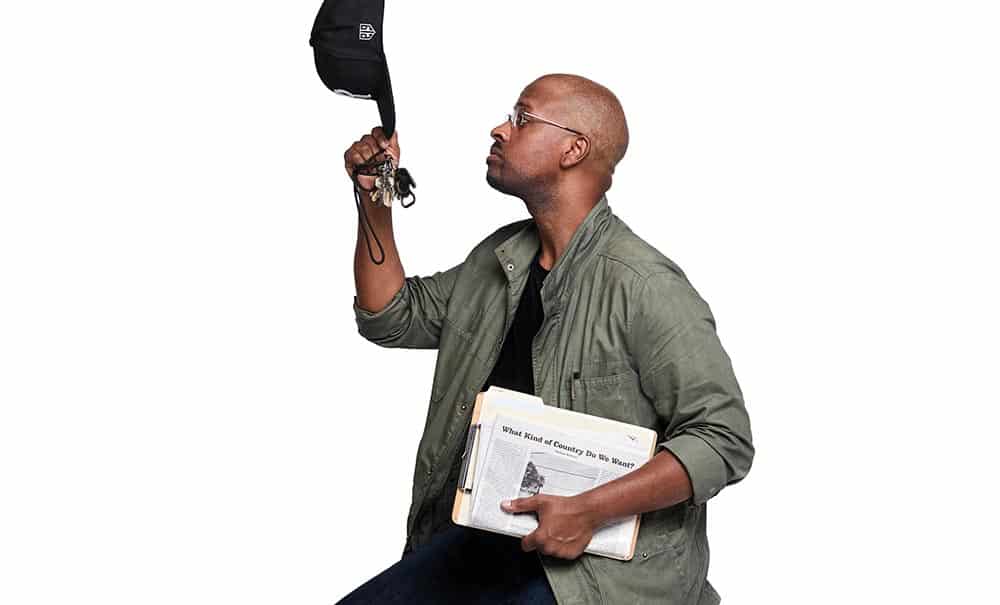
If you’re not biking to Dix Park, you’re doing it wrong. And man-about-town Nick Neptune agrees. As director of outreach for the Dix Park Conservancy, board chair and president of Oaks & Spokes Raleigh’s bicycling and sustainable transportation advocacy nonprofit), and commissioner and vice chairman of the City of Raleigh’s Bicycle and Pedestrian Advisory Commission, Neptune’s biggest passions are Dix Park and biking. He also works with the City of Raleigh, donors and volunteers to ensure Dix continues to thrive as a remarkable space for all, no matter how you get there.
Here, the passionate pedaler merges his two callings, showcasing Dix Park as a biking destination and providing a plethora of reasons to roll up to the 308-acre campus on DTR’s western edge.
How accessible is Dix Park by bike from all directions?
Dix Park currently benefits from connectivity around its northern and eastern edges courtesy of Raleigh’s Capital Area Greenway system, and, specifically, the Rocky Branch Trail—which has access to Pullen Park, Boylan Heights and a number of shops and spaces along Downtown Raleigh’s southernmost edge. To the west, Dix Park is buffered by NC State’s Centennial Campus, including the Centennial Bikeway Connector running along the perimeter.
At the southernmost edge along Lake Wheeler Road—from the State Farmers Market to the intersection at South Saunders—the city is leading a massive improvement project including the addition of sidewalks, shared paths and bike-only facilities. Various other features like roundabouts and raised medians will help slow vehicular traffic, with construction slated to begin in spring 2025.
Fave pit stops on these different routes?
Between Boylan Heights and the southernmost edge of Downtown Raleigh, favorites include:
Rebus Works for cafe selects and grocery options 🛒
Tell us about the NCMA to Dix Park bike connection and why it’s important?
It’s just over 5 miles and about a 35-minute bike ride spanning Rocky Branch Greenway and Reedy Creek Trail. NTM biking is affordable, healthy and sustainable, thus, ensuring and improving bicycle connectivity between NCMA and Dix Park is as much about reinvesting in our collective civic health and social cohesion as it is about simply sharing the joys, pleasures and benefits of art and the natural environment.
Nick Neptune
Any updates on the connection between Chavis Park and Dix Park?
The Chavis-Dix Strollway, a vastly improved multimodal, people-oriented corridor connecting two significant Raleigh landscapes, is also intended to contribute to a citywide bike system as a safe connection for cyclists traveling east to west through this area along the southern edge of Downtown.
The project design will be influenced by a current study of the overall mobility and active transportation networks of Downtown Raleigh, along with the planned expansion of the Raleigh Convention Center. Following the final recommendations of the Downtown Mobility Study (expected spring 2025), more progress can be anticipated.
Note: Anyone interested in participating in Raleigh Transportation’s Downtown Mobility Study should join the first touchpoint and public engagement session May 29 at Raleigh Union Station from 4–7pm.
How do you recommend first-timers spend their initial visit to Dix Park?
Starting in June, stop by the Gatekeeper’s Cottage to get oriented via maps, program guides and helpful staff. The cottage is also one of three historic buildings on campus undergoing a $5 million preservation and restoration project being led by the Dix Park Conservancy, in partnership with the City of Raleigh, with financial support from the State Employees’ Credit Union and Foundation.
The Chapel (open weekends; features an ornate mural in the lobby illustrating the landscape’s past, present and future by NC artist Christopher Holt; public restrooms available)
Many longtime visitors to Dix Park continue to be surprised by our Hammock Groves tucked away in the trees in three serene locations across the park. Another little-known treat for veteran visitors would be the celebrated garden in the back of The Chapel. Maintained by a dedicated group of volunteers, the garden has been a beloved and calming space for many since its original planting in the late 1950s. To boot, The Dix Park Conservancy, in partnership with the City of Raleigh, is spearheading an update and renovation later this year to transform this space into a fully modern Healing Garden.
Bicycling in Raleigh has come a long way—with miles still to travel.
Riding in Raleigh can feel a little more pedal and gulp meets chain reaction and a little less woke spokes. Sure, the cap city is by no means a “bike city,” but cycling has long been gaining traction—and all the while Raleigh has been playing catchup to keep riders safe so they can cycle in stride. While the City of Oaks remains largely car-dependent, improved bike infrastructure—not to mention emerging district connections—continues to enhance resident mobility. And whether you cycle or not, as road warriors, it’s an issue that affects all of us daily—as the road is a shared space cyclists have had to make up plenty of ground on, with miles left to go.
The City of Raleigh has made strides for rides by adding approximately 53 miles of in-street bike infrastructure in the last five years alone. These efforts, in addition to a slew of other cycle infrastructure, have landed Raleigh in a unique position to have zero cyclist deaths in four out of the last five years, at a time when cyclist crashes are climbing across the state and nationwide. In NC, Charlotte claimed the No. 12 most dangerous U.S. city for cyclists in 2022 with 26.7 fatalities per 10K commuters annually, while the state saw 20.8 fatalities per 10K bike commuters. Exactly zero of those came on Raleigh’s city streets.
But our fair city still has a long way to go—especially when compared to the five U.S. cities (Austin, Denver, New Orleans, Pittsburgh and Providence) that hit the ground running with an unprecedented 335 miles of bike lanes built out in 24 months. Never mind what they’re doing in Europe.
BIKE RELATED INCIDENTS 2018–2022 • Deaths 1 (0 in 2022) • Disabling injuries 17 (3 in 2022) • Evident injuries 124 (23 in 2022) • Possible injuries 90 (11 in 2022) • No injuries 49 (13 in 2022)
*Data provided by Raleigh Police Department for City of Raleigh
As the city continues to play catchup to keep riders safe so they can cycle in stride, we take a look at where Raleigh stands.
Why Raleigh Wants to Be Biker-Friendly
“Biking in the City of Raleigh should be safe and accessible for all ages and abilities,” says Barbara Godwin, MPA, City of Raleigh Transportation Department micromobility coordinator. As the city continues to grow at warp speed, we’ll “continue to expand connectivity across the biking network, with safety and accessibility as the main priorities,” she adds.
Expanding Streets for All
In its efforts to make streets fit not just for cars, but for pedestrians and cyclists too, the city is paving the way for a functional and inclusive environment through its Complete Streets network. As part of the strategy, all street projects—think new construction, reconstruction, retrofits, repaving, rehabilitation or changes in pavement marking—undergo improvements to bike safety (conventional bike lanes, separated bike lanes, bike parking, etc.), in addition to other pedestrian safety improvements and transit infrastructure.
Cycology 101
To help minimize cost, the City of Raleigh and DOT use road-improvement projects (like resurfacing) as a strategy to integrate bike lanes and “update street configurations to match the Comprehensive Plan and the BikeRaleigh Plan,” says Godwin. Roads with poor pavement condition are resurfaced on an annual basis as part of the City’s Annual Resurfacing Program.
Why It Matters
Pedestrian and cycle traffic are essential in furthering the city’s attractiveness—not to mention its commitment to environmental stewardship, economic strength and social integrity. These biking infrastructures are just one step in the right direction for Raleigh to become a more bike-friendly city that all residents and visitors can enjoy regardless of whether they have a motor vehicle or not.
Bike Lane Breakdown
In 2022, the City of Raleigh added 10.3 more miles of bike infrastructure, according to the City of Raleigh Transportation Department, compared to 5.9 miles in 2018. As of today, DTR houses 11 miles of existing bike infrastructure.
Sore Spots
Perceived as a rolling threat by some, adding bike lanes to an existing street takes space, obviously, which can supplant parking spots businesses rely on for easy customer access. One such case, a proposal for bike lanes on already parking-sparse Person Street has seen quite a bit of pushback.
Who Pays for This?
Major street improvement projects are included in the City’s Capital Improvement Program Budget, says Godwin. A 10-year financial plan, the CIP analyzes major facility needs, projects fiscal resources, establishes priorities, and develops schedules for the acquisition and construction of capital facilities.
Streets Slated for Improvement This Year
Upward of 50 street sections are slated to be resurfaced in 2023 as of now, as part of the City’s Annual Resurfacing Program. Of these, bike lane improvements and extensions are on deck for Oberlin Road (between Roberts Street and Glenwood Avenue, slated for fall completion) and Dunn Road (between Falls of Neuse Road and Falls Landing Drive).
Project Priorities
Projects are prioritized based on connectivity across the larger bike network via the BikeRaleigh Plan, in conjunction with larger capital projects and those routine maintenance projects (think resurfacing).
Bikeable Midtown
The City of Raleigh is also working to make Midtown more walkable—and bikeable—via the Walkable Midtown plan. Part of the plan includes a greenway connection and pedestrian bridge across the Beltline and a “Midtown Ring” full of protected spaces that also connects major Midtown destinations to nearby neighborhoods.
Bicycle Superhighway
In addition to plans for an improved network of bike lanes throughout Raleigh, the city is designing a 17-mile Triangle Bikeway from Raleigh to RTP. The “bicycle superhighway” will be located along I-40 and the NC54 corridor, and connect Raleigh, Cary, Morrisville, RTP, Durham and Chapel Hill.
Total Miles of Bike Infrastructure Completed Each Year
2018: 5.9 miles
2019:8.7 miles
2020: 8.4 miles
2021:19.8 miles
2022: 10.3 miles
Pedaling Partnership
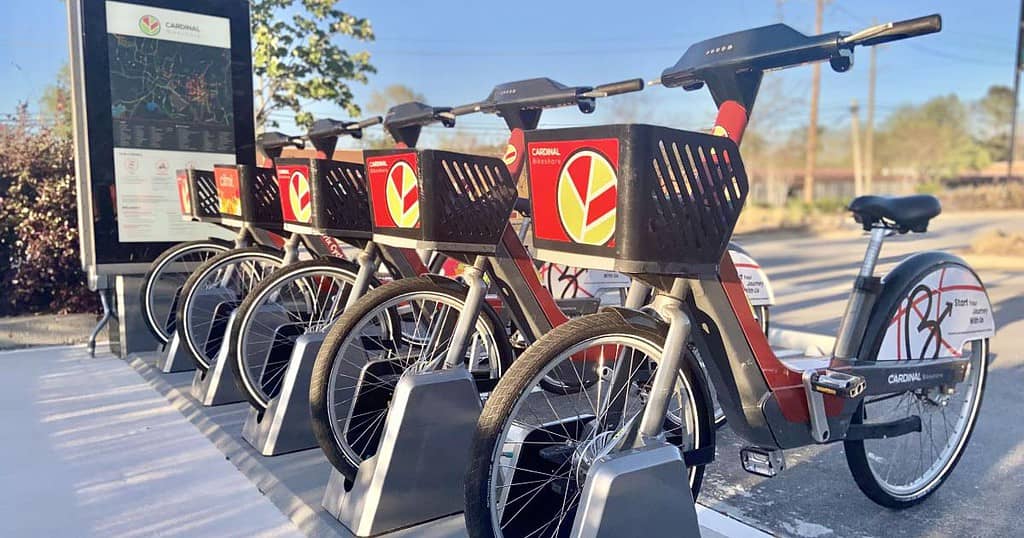
No bike? No problem. Make your way around DTR via Raleigh’s bikeshare program, Cardinal Bikeshare (formerly Citrix Cycle), a partnership between the city and Corps Logistics LLC. The program temporarily paused in April for operations and maintenance of the system, but is targeted to reopen May 16, after which users will receive 60 days of free rides (!). There are currently 32 stations spread out around the Downtown core and Hillsborough Street. Kicking bikesharing further into gear, each Cardinal bike feats. an adjustable seat, basket, bell, and front and rear lights that automatically light up when you start pedaling. To boot, two-thirds of the fleet are electric-assist bikes, making getting up those hills a breeze. Ride like the wind! (photo courtesy of Visit Raleigh)
Greenway Connectivity
Raleigh currently has 117 miles of greenway trails within its Capital Area Greenway System—112 of which are physically connected throughout the city—which links locally to adjacent communities including Clayton, Knightdale, Wake Forest and Cary. The system also provides access to longer distance trails, giving Raleighites and visitors alike the opp to explore the state and Eastern Seaboard.
Neuse River Trail: 28 miles; part of the Mountains to Sea Trail which spans 1,175 miles from the Great Smoky Mountains to the Outer Banks in NC
East Coast Greenway: 3,000 miles from Maine to Florida; utilizes segments of the Reedy Creek Trail, Rocky Branch Trail, and portions of the Walnut Creek Trail and Neuse River Trail
Big Branch Trail: Proposed 4 miles; funded through the Parks Bond; will connect Crabtree Creek Trail to Sandy Forks Road
Rolling Back in History
Rolling way back, the City first studied bike-related issues in efforts to advance cycling in the ’60s via City Council-appointed bicycle committees. From there, the Raleigh Bicycle and Bikeway Ordinance of 1974 was the first organized endeavor to generate policies and systems for designing and building bicycle facilities, with bicycle plans then produced in 1979, 1983 and 1991 (though the ’83 plan was not adopted).
Fast-forward to 2008, the City of Raleigh and the North Carolina Department of Transportation Division of Bicycle and Pedestrian Transportation began to establish a citywide comprehensive bicycle plan—a long overdue update to the 1991 version, especially given the city’s rapid growth and the likewise burgeoning interest in bike-friendly cities and their advantages (think gas prices, ecoliving, fitness fads).
In 2009, the City of Raleigh and NCDOT doubled down on upping Raleigh’s bike-friendly factor via the addition of bike commuting lanes Downtown and connected greenways across the city—and beyond. At the time, Raleigh had a mere 4 miles of commuter bike facilities. Laying the groundwork for the infrastructure we see still rolling out today, enter City of Raleigh’s 2009 Bicycle Transportation Plan, which outlined ways to increase mode share and safety for bicyclists in one of the fastest-growing cities in the country. From there, the still-active-today all-volunteer advisory board Bicycle and Pedestrian Advisory Commission was a recommendation of the BTP, says BPAC chair Nick Neptune, which focuses on implementation of relevant programs, policies, regulations and funding, as well as provides leadership and guidance on all things pedal and foot.
In 2012, local bicycle advocacy group Oaks & Spokes was born with an MO of “making the City of Oaks the City of Spokes” and since has made much headway on raising awareness by “building bike culture and advocating on behalf of our community.”
Fast-forward again to 2016, by which time Raleigh had rolled out some ~70 miles of commuter bike lanes, and the city adopted the 10-year BikeRaleigh plan—which was reprioritized in 2020—further emphasizing the city’s goal of “expanding Raleigh’s bikeway network and improving safety, comfort, convenience and accessibility for bicyclists of all ages and abilities,” according to the plan.
Cycle-Paths: Bike Popularity
39: Raleigh’s bike score out of 100, making it “somewhat bikeable”
Cycling infrastructure ups safety for all commuters. Across the country—and world—modern bike measures on roadways are assisting cyclists in navigating the streets.
Bike Signals: Curbing any confusion on when cyclists should stop and go at intersections, increasingly cities (think Austin, DC, Denver) use bicycle traffic lights with green-yellow-red bicycle stenciled lenses.
Bike Boulevards: In addition to lanes, intersection treatments, signals and cycle tracks, the National Association of City Transportation Officials’ Urban Bikeway Design Guide names bicycle boulevards among its innovative solutions, aka giving cyclists travel priority on low-traffic streets and discouraging through-trips by cars.
Underwater Bike Garage: Growing bike-dependent cities need somewhere to put all those bikes. So, across the pond, they’re going underground—even underwater (!). At the start of this year, the Netherlands debuted a massive underwater bike storage facility at Amsterdam Centraal Station. The first-of-its-kind structure took four years to build and holds ~7,000 bikes (and zero cars!). It even connects directly to the city’s metro and railway system. Also in the Netherlands is the world’s largest underground bicycle parking garage, clocking in at three stories with 12,600+ bike parking spaces.
The Green Wave: To curb cyclist injury and death and crashes in general, cities are joining the global “green wave”—aka retiming traffic lights so cyclists can literally roll through—to prioritize riders on two wheels and make city streets safer for all bikes. Also allowing motorists and cyclists alike to predict speed, the efforts, though, don’t come without pushback. In New York, drivers complain the move worsens traffic—and in Baltimore, a recent $4.5 million study to retime traffic lights is under fire.
New Radar Tech: No more running red lights. In 2018, Salt Lake City implemented 10 new traffic signals sensitive enough to be triggered by cyclists, allowing them the ease of not having to wait for a car to trigger a green light.
Raleigh Bike Lane Cheat Sheet
Sharrows: Sharing is caring. These street markings resembling a bicycle and two chevrons indicate where cyclists should position themselves to be visible to cars on the street—in turn reminding motorists to look out for bikes.
Buffered Bike Lanes: Demarcated by painted buffer lines between the bike lane and general travel lane or parked cars, these also signal motorists to share the road—and help cyclists avoid collisions with opening car doors.
Separated Bike Lanes (aka Cycle Tracks): In a culture all about setting barriers, bike lanes are no exception. Adding a huge safety net to the standard bike lane are cycle tracks, complete with some sort of physical barrier—curbs, concrete, planters, even parked cars. The move is a boon for all motorists. Raleigh implemented a trio of these in 2020 via flexible delineators on Crabtree Boulevard (between high-traffic corridor North Raleigh and Capital boulevards), and sections of Morgan Street (between Dawson Street and New Bern Avenue) and Lineberry Drive (between Sierra and Trailwood drives)—which rolled out safer and speedier rides for all road warriors. Upcoming streets under consideration for cycle tracks include:
South State Street, between Peterson Street and Bunche Drive
Faircloth Road, between Wade Avenue and Clark Avenue/Hillsborough Street
West Street, between North and Peace Street
Bike Safety Stats—How Raleigh, NC cities and the state stack up
NC ranks 42 out of 50 in safety (20.8 fatalities per 10K commuters)
Raleigh notably ranked 10th safest city for cyclists in 2021
NC ranks 45 out of 50 in ridership (.18% of commuters biking to work)
NC ranks 10 out of 50 in spending ($4.32 per capita FHWA spending on biking and walking)
120 inspiring speaker talks. 24K cups of joe. 7K+ community members… the perf equation for infinite reasons to celebrate what has been 10 years since the ever-inspirational CreativeMornings Raleigh chapter was founded and hosted by Matt Tomasulo in 2012, followed by Taylor Medlin, Jonathan Opp and Vaishali Patel. Today, the “world’s largest face-to-face community” is hosted locally by Alysse Campbell and sees community creatives gather monthly in 225 cities across 67 countries worldwide for inspiring and empowering talks to galvanize entrepreneurs doing good work. To cheers 10 years, the local chapter held a 10-year anniversary bash at The Factory—and we fete their fine community impact by taking a look at some of our fave CreativeMorning words of wisdom.
“Stop following your dreams. … What I want you guys to do is develop your dreams. Build your dreams. Don’t follow them. Work on them.”
—Tobias Rose, principal and creative director, Kompleks Creative, @tobias_rose
“I encourage you to recalibrate and find that compass. Allow it to guide you toward your [younger 5- or 50-year-old version’s] dream.”
—Joshua Gunn, hip-hop artist; entrepreneur; community organizer; VP, Greater Durham Chamber of Commerce, @jgunnisbetter
“We think of roots as where we come from… but really roots are the things that connect us to something that then fills us up and makes us our best selves.”
“There’s something to be said for… actually engaging with the community you want to benefit.”
—Nick Neptune, director of outreach and community engagement, Dorothea Dix Park Conservancy, @nick.neptune
“So often we want to look for the answer outside of ourselves. We hope we can buy something or someone will tell us… the magic words we need to hear in order to be self-satisfied. But all of that is going to come from within ourselves and it all starts with the intention to be ourselves.”
Nicholaus M. Neptune is an artist, educator, entrepreneur and community advocate currently serving as the managing director of Transfer Company Food Hall, Ballroom and Work Hall, a former partner and co-founder of Raleigh’s shared creative studio The Assembly and owner behind the music, entertainment and consulting firm Good Times Assurance Company.
For more than 15 years, Neptune’s work has been defined by the constant celebration, building and strengthening of community and culture through music, art, food and play. In 2020, Raleigh Magazine recognized his longtime community work by including him in our “30 in their 30s” feature as one who’s working “hard for positive change … to make life better for everyone in the city.”
Neptune currently serves as an appointed commissioner with the City of Raleigh’s Bicycle and Pedestrian Advisory Commission and is a board member with the Wake Tech Community College Foundation.
This September, he begins coursework in an executive program in social innovation and design, a joint program organized by the University of Pennsylvania’s Weitzman School of Design and its School of Social Policy and Practice.
Photo by Joshua Steadman
Where’s your hometown: Winston-Salem. Home to the University of North Carolina School of the Arts (where my youngest sister is currently pursuing a degree in filmmaking and animation), Winston-Salem State University, Wake Forest University and Forsyth Tech Community College. Winston-Salem has enjoyed a renaissance in its downtown food, beverage, music and arts scene over the last 15 years; there’s always something new to see when I return home to visit with family.
What neighborhood do you live in today: As of this writing, I’m in the middle of moving ever closer to downtown – truth be told, I’m grateful to have never lived more than 10 minutes from downtown over the last 10 years, including in Five Points, near NC State and more recently in Longview Gardens and Olde East Raleigh.
What do you love most about Raleigh: Our people, our talent, our drive – there’s this undercurrent of recognition that we’re living through a once-in-a-lifetime opportunity to shape the growth and trajectory of our city. It’s truly remarkable and a privilege to be a part of this community at this time.
What book are you currently reading: Currently, I’m working through “The Geography of Opportunity,” a collection of policy papers on housing choice, affordability, racial equity and metropolitan growth and development, featuring contributions from economists, urban planners, civil rights attorneys, and, more broadly, individuals committed to expanding opportunity for populations historically denied it and improving outcomes in education, employment, safety and health for the same populations for generations to come. I’m also revisiting Christina Greene’s “Our Separate Ways” (an in-depth study of African American women and their role in sustaining the Black Freedom Movement from the 1940s through 1970s in Durham).
What are you currently listening to: Given our current times, a lot of live albums including James Brown’s “Say It Live and Loud: Live in Dallas 08.26.68,” Aretha Franklin’s “Aretha Live at Fillmore West,” The Rolling Stones’ “Get Yer Ya-Ya’s Out! The Rolling Stones in Concert” (also featuring B.B. King and Ike & Tina Turner live at Madison Square Garden), and, more recently, Sylvan Esso’s “WITH” live album. In terms of podcasts, The Daily and Still Processing from The New York Times, Podcast Raleigh with Ashton Mae Smith and Hayes Permar and WNYC’s On the Media. All are favorites and regular listens.
What’s your style mantra: Define who you want to be – despite society’s expectations – then dress accordingly.
Who are your style influencers: Architect Jordan Ryland, clothier Victor Lytvinenko and the designers Gino Reyes, Steven Smith and Judah Oechsle—all local gentlemen and friends whom I have a great deal of respect and appreciation for as it relates to their values, personal aesthetics and style. The floral designers Nikelle Orellana-Reyes, Hannah Ross Clarke, Deana Nguyen, and the recording artists Kate Rhudy and Zen Stewart are local women for whom I would say the same—impeccable tastes and values to match.
Favorite clothing labels: In an alternate universe, one where I had access to limitless resources, I’d likely wear Raf Simons, Calvin Klein, Raleigh Denim, Adidas, Champion, Patagonia and Marine Layer every day.
Boxers vs briefs: The truth is that “boxer briefs” are perfect for capturing the best of both worlds.
Local go-to shop: Though I don’t actually go shopping very much—because, again, I don’t live in an alternate universe with limitless resources—whenever I do, I deeply appreciate the selection found at Unlikely Professionals, Edge of Urge, Father & Son, Raleigh Denim and Vert & Vogue in Durham.
Where was your last great lunch: Well, it should go without saying that I’ve enjoyed countless great lunches at Transfer Company Food Hall, but when I get off campus for lunch, I can typically be found picking up (or dining outside) A Place at the Table, State of Beer, Beasley’s Chicken & Honey, lucettegrace, Capital Club 16 and Tazza Kitchen at Cameron Village.
What’s your go-to, sure thing piece in your closet: Currently, a faded green utility jacket by the San Francisco-based Marine Layer. I should mention, beyond the clean, coastal aesthetics of their clothing, I’m particularly appreciative of their commitment to sustainability.
Favorite piece of jewelry: A gold necklace my father wore throughout his 20 years of service in the U.S. Army. He gave it to me before I left for college (for good luck, as it was given to him before joining the Army) and I’ve worn it ever since.
Where are you dreaming about traveling: At the moment, given how long it’s been, I’d love to visit my family in Winston-Salem. Otherwise, I’d love to travel through South America and Africa.
How do you stay fit: I’m generally able to walk or bike wherever I need to go downtown day to day, so that’s incredibly helpful. That said, once I’ve restored some balance to my work/life schedule, I’d like to re-introduce more running, volleyball, 4-square and ultimate frisbee.
Favorite cocktail/drink: Coffee to start the day. A Greyhound or Paloma at brunch (preferably captain’s strength); whiskey in the evening (or an Admiral’s Nightcap at Transfer Co., which is generally whatever Courtney Fugate or Zach Neuman’s interpretation happens to be on any given weekend evening).