by Melissa Howsam | Apr 29, 2026 | Buzz, May 2026
Austin grew fast—now it’s recalibrating. Here’s what Raleigh can take from it.
Austin did everything right—until it didn’t: the boom, the cranes, the companies, the people.
Then came the traffic outpacing infrastructure, housing many can’t afford, and a city so under construction it’s, as one Raleighite who recently visited tells RM, “a chaotic mess—every street torn up, cranes everywhere… for two years now.” So goes the cautionary tale.
Even a recent Austin Monthly cover story questioned the trade-offs of that transformation: “Our funky small town has transformed into a mighty metropolis with high-rises, Michelin-starred cuisine, and international appeal. Is that a good thing?”
While it’s not a perfect “apples-to-apples” comparison, says Raleigh Economic Development Director Kyle Touchstone, the parallels are hard to ignore. As Raleigh sits just a few steps behind on a similar trajectory, the question isn’t how to grow—it’s how to avoid fallout. Sometimes the clearest roadmap forward comes from watching where others went off track. On the heels of his return to Austin this spring—part intel, part SXSW—we tapped Touchstone for his key takeaways.
Infrastructure Can’t Lag
Austin didn’t stall because people stopped coming—it stalled because the city couldn’t keep up with those who did. As growth accelerated, infrastructure lagged—roads, transit and long-range planning all playing catch-up to a population that had already arrived. The challenge, says Touchstone, is timing. “Building infrastructure to keep up with population growth… is always a tricky balancing act.” But waiting until the need is obvious is already too late. Raleigh, though, still has a window. With the S-Line and broader transit planning, the region is attempting to build ahead of demand—not behind it.
Be Intentional
In many ways, boldness is what built Austin. A familiar playbook is unfolding in Raleigh, with sound investments being designed to anchor the city’s next phase—think world-class Dix Park, Red Hat Amphitheater, the Raleigh Convention Center expansion and the incoming Omni Hotel. “Austin has been bold,” nods Touchstone—“and Raleigh can be too.” “I don’t think Raleigh is on the path to being Anytown, USA,” he adds. “We’re on a path to being a bigger, bolder and better Raleigh.” The Cap City is no longer planning for who she might become—she’s actively becoming it. And the decisions being made now—density, transit, affordability, design—will determine whether that growth feels cohesive or chaotic. Ultimately, growth is inevitable—keeping it intentional is critical.
Affordability Is Everything
Fast growth doesn’t just drive demand—it drives prices. And in Austin, that shift happened quickly. As housing costs climbed, affordability became less of a challenge to manage and more of a defining issue for who could stay, who could move in and how the city functioned. “Making sure Raleigh is safe and affordable is always on my mind,” says Touchstone, pointing to the need for a steady pipeline of housing at all levels—supported by faster, more flexible development and permitting. Affordability isn’t something to fix later—it’s the factor that shapes everything.
Keep the Cool Factor
Austin still has its edge—but it looks different than it used to. It hasn’t lost its identity—“the heart of Texas is still ‘weird,’ and they own it,” Touchstone emphasizes—but in pockets like Rainey Street, an iconic strip of bungalow bars and patios now dotted with high-rises, the shift is visible. That tension is inevitable: “Rapid growth forces cities to be creative about growth, investments and maintaining identities,” he says. Raleigh is already having the same conversation around how to add density without losing the personality that made people want to move here in the first place. “No doubt growth changes a city,” adds Touchstone. “Austin has seen it; we’ve seen it.” The challenge is deciding what’s worth keeping before it’s gone.
More Isn’t Better
In a boom cycle, more can feel like the answer—units, towers, development—and Austin shows the risk in that angle. As supply surged, the balance got harder to maintain—creating pressure points around vacancy, pricing swings, and how much is too much, too fast. The goal, says Touchstone, is ensuring “ample housing supply… supported by timely permitting” across income levels. But scale without calibration is where things get wobbly. Raleigh is still in her build era—but the lesson is in the pacing: not just how much goes up, but how quickly and for whom.

by Heidi Reid | Oct 1, 2024 | Buzz, October 2024
There’s no doubt Raleigh is a growing city, with new developments popping up seemingly on the daily. While many worry our “boring” city (incorporated 1792) is losing her identity, legacy lives on everywhere you look—from carefully preserved buildings dating back to the American Revolution to districts honoring historic namesakes. Think you know the Cap City’s character? Let’s trip back in time and find out. No Googling!
1. Red Hat Amphitheater was almost named for what adult beverage brand, before the NC Alcoholic Beverage Control Commission denied the request to opt for a more PG namesake?
a. Coors Light
b. Bud Light
c. Pabst Blue Ribbon
d. Sierra Nevada
2. Which (allegedly haunted) Raleigh building was initially meant to be a tomb for the wife of former Gov. Montfort Stokes, but was repurposed after it was constructed at the wrong scale?
a. Mordecai House
b. NC Legislative Building
c. The Capitol Building
d. NC Museum of Art
3. Welcome to the gun show. After the OG Raleigh Iron Works went bankrupt, it was acquired by Peden Steel Company and moved to Atlantic Avenue. The business went on to build what product for the U.S. military during World War II?
a. Shell casings
b. Barges
c. Aircraft parts
d. Bunkers
4. In 1914, Clyde Alvin Dillon Sr. founded Dillon Supply Co. on West Martin Street. While Junior devoted his whole career working at the family biz, what was his side hustle? West Martin Street
a. Announcing for NC State’s basketball and football teams
b. Teaching at Broughton
c. Preaching at Edenton Street United Methodist Church
d. Bartending in the Village District
5. Alexa, queue “I’m Still Standing” by Elton John. Which Raleigh bar has been “a Raleigh tradition since 1951,” making it the oldest bar in the City of Oaks?
a. Mitch’s Tavern
b. The Cardinal
c. The Raleigh Times
d. Players Retreat
6. The almost-150-year-old Victorian-era house that serves as home to Second Empire Restaurant and Tavern is named after which NC confederate officer and which former Raleigh mayor?
a. Braxton Bragg and William H. Harrison
b. D.H. Hill and Basil C. Manly
c. John Wetmore Hinsdale and William H. Dodd
d. Dorsey Pender and William White
7. Bottoms up! Before settling in at its current Glenwood Avenue location, cocktail bar Dram & Draught got its start in a stand-alone Hillsborough Street building that formerly housed what?
a. A Dillon Supply Co. shop
b. Piggly Wiggly
c. The NC Legislative Building
d. TAO Auto Shop
8. The DTR Holiday Inn—known for its unique cylinder shape—won the title of Raleigh’s tallest building when it was built in 1969. Which DTR tower stole the title in 1977? (Hint: It’s currently Raleigh’s sixth tallest tower.)
a. One Hanover Square
b. Wake County Public Safety Center
c. One Progress Plaza
d. 333 Fayetteville Street
9. Erected in 1769, the Joel Lane House is the oldest house in Wake County. Which governing body did owner and “Father of Raleigh” Joel Lane not participate in?
a. Continental Congress
b. General Assembly
c. State Senate
d. Fayetteville Constitutional Convention
Answers:
- B; 2. C; 3. B; 4. A; 5. D; 6. C; 7. D; 8. C; 9. A.

by Heidi Reid | Oct 1, 2024 | Buzz, October 2024
With Election Day in sight, Raleigh candidates share their take on top local issues.
It’s officially that time of year again—time to vote for the leaders of our city.
Historically, Raleigh isn’t known to exactly race to the ballot box for municipal elections, but—in case you missed it—we should. The so-what factor for local elections really comes down to the direct impact the mayor and city council has on our day-to-day lives: development and infrastructure, affordable housing, public transportation and so on. Dig the accelerated development? Hate it? Guess what—it’s these very people who will be making decisions on those exact topics over the next several years.
Now on the heels of electing Raleigh’s youngest and most diverse council in our city’s history—and after two years of many deadlocked votes and stalled efforts—all eyes are on this year’s race. After incumbent Corey Branch swapped his mayoral campaign for a last-minute bid for District C, you’ll see a bunch of familiar names on the ballot as all current council members (minus Mayor Baldwin) aim to hold their seats.
But the seasoned incumbents aren’t stopping a wide range of first-timers and other familiar faces from throwing their hats in the ring in hopes of bringing their visions for the city to fruition. So if you want a say in the management and development of your city, it’s time to get registered (you have until Friday, Oct. 11) and pick which candidates best align with your vision for the City of Oaks. As we say, if you want to use your voice to complain, use it first to vote.
As Nov. 5 grows closer, here’s a snapshot of who’s running—and their takes on this election season’s hottest issues. We’ll see you at the polls, Raleigh.
Janet Cowell
Are you supportive of Raleigh continuing to develop towers, buildings and infrastructure?Yes, Raleigh will continue to grow. Our task is to pursue thoughtful growth with community benefits to make Raleigh a city that works for everyone.
Would you support a 15% RPD raise to make Raleigh competitive with surrounding areas?
Yes, I support competitive pay for Raleigh police and other first responders.
Would you support requiring affordable housing components in all future residential development?
No, because while increasing affordable housing is a goal I wholeheartedly support, mandating affordable housing is not legal under current NC law. We can use tools like tax increment grants and financing to increase revenue that can be used to subsidize affordable units, better utilize government-owned land for housing, and pursue other creative approaches.
Are you in favor of a light rail or another expansion of mass transit?
Yes, I favor expansion of transit including Bus Rapid Transit, rail and investments in our airport.
Paul Fitts
Are you supportive of Raleigh continuing to develop towers, buildings and infrastructure?We need to target underutilized properties and existing infrastructure for the purpose of building up. It doesn’t have to be massive, but we have a need for more 24/7 living inside the city to stem our economic shift and balance our nontaxable burdens.
Would you support a 15% RPD raise to make Raleigh competitive with surrounding areas?
If the Democrat-controlled council hadn’t focused on one park for 10 years, they could have noticed that our police department needs more people. Are they underpaid? Absolutely. Are they overworked and underpaid? Absolutely. It’s not just about pay—they need help. They need relief. They need someone who will watch their backs. It’s interesting that when I announced I was running, I said ‘Raleigh needs 400 more cops’ and now the [Police Benevolent Association] says we need the same number. Our public safety members are stretched too thin and it boggles our current council on why officers leave for other agencies.
If you were presently on Raleigh City Council, would you support requiring affordable housing components in all future development?
Econ 101: You can’t make housing ‘affordable’ until you make housing available. The council hasn’t even attempted to approach the state for underutilized properties for repurposing. It will be a priority for me, and, truthfully, I’ve already had favorable discussions with ranking members of our General Assembly to get it done. I look forward to making these properties breathe new life into our city.
Are you in favor of a light rail or another expansion of mass transit?
No light rail, our bus system is underutilized as it is. I’d rather incorporate and subsidize ride-share companies for point-to-point transit. As I stated in 2017 regarding light rail, using a light rail is a 19th century answer for a 21st century workforce issue. Telecommuting is the future of work transit. Low and behold, I looked like Nostradamus when the pandemic hit. And now since our workforce has shifted, we need to make up for our economic shortfalls by having people live in areas where workers aren’t coming back—hence using state property to become owner-occupied housing.
Eugene Myrick
Are you supportive of Raleigh continuing to develop towers, buildings and infrastructure?
I am not in favor of building towers because they often cause increased strain on infrastructure. Our focus should be on responsible, community-centered development that preserves the integrity of our neighborhoods and ensures sustainable growth for all Raleigh residents. I believe that growth is essential for Raleigh’s future, but it must be responsible growth that truly benefits our community. I am supportive of continued development as long as it aligns with the needs and desires of our residents. However, I am also committed to ensuring that this development is done thoughtfully and with careful consideration of its impact. To achieve this, I would suggest site visits for every rezoning case. This allows for a thorough understanding of the specific area, its current dynamics and the potential effects of new development. By seeing the sites firsthand, we can make more informed decisions that respect the character of our neighborhoods while promoting smart growth.
Would you support a 15% RPD raise to make Raleigh competitive with surrounding areas?
The RPD should definitely receive a pay increase to ensure their compensation is competitive with surrounding areas. A 15% increase would not only help in retaining and attracting quality officers, but also demonstrate our commitment to those who protect and serve our community. Additionally, the ACORN (Acute Crisis Outreach and Response Network) unit is a critical necessity, as it alleviates the workload on officers by providing individuals in mental crises with qualified assistance. This combined approach will enhance public safety while addressing the diverse needs of our community effectively. Moreover, competitive pay is a key factor in retaining experienced officers who know our city and understand the unique needs of our neighborhoods. By investing in our police force, we invest in the safety and security of Raleigh, ensuring that we continue to build a city where everyone feels protected and valued. Balancing growth with competitive pay for our officers ensures we maintain a strong and effective force to support our community. This raise is a necessary step toward achieving that goal.
Would you support requiring affordable housing components in all future residential development?
Yes, if I were presently on Raleigh City Council I would support requiring affordable housing components in all future residential development. However, it’s essential to redefine what ‘affordable’ truly means for our community. Instead of relying solely on the Area Median Income (AMI) as the standard, I propose using the Neighborhood Median Income (NMI) to set affordability guidelines. This approach ensures that housing remains accessible to residents based on the income levels specific to their neighborhoods, creating more equitable and realistic pricing structures. Furthermore, I believe the city should actively use city-owned land to develop affordable housing. By leveraging these public assets, we can ensure development serves the broader community and addresses the pressing need for affordable housing. This strategic use of land will allow us to build more inclusive neighborhoods and create opportunities for all Raleigh residents to thrive, including our civil servants, teachers and low-wage earners. Through these combined efforts, we can promote responsible growth that genuinely meets the needs of our diverse population.
Are you in favor of a light rail or another expansion of mass transit?
I am in favor of expanding mass transit in Raleigh, but I believe we must approach it thoughtfully and prioritize immediate improvements to our existing bus system first. Enhancing our current bus transit by keeping pay and benefits competitive for drivers, increasing the frequency of bus services, and ensuring that all bus stops are equipped with shelters are essential steps to better serve our community now. While a light rail system or other forms of mass transit could be valuable long-term solutions, we must first address the pressing needs of our current transit infrastructure. By improving the reliability and accessibility of our bus system, we can build a strong foundation for any future expansions. In considering light rail or other mass transit options, we must ensure that such developments are equitable, environmentally sustainable and beneficial to all residents, particularly those in underserved communities. The expansion of mass transit should enhance connectivity without displacing residents or contributing to gentrification. In summary, I support the exploration of light rail and other mass transit expansions, but I firmly believe that we must first invest in and improve our existing bus system to ensure it meets the needs of all Raleigh residents.
Terrance Ruth
Would you support requiring affordable housing components in all future residential development?
Affordability has to remain at the top of everyone’s policy platform. We are in a housing stock deficit. The only way we can address this deficit is by increased home production. I believe Raleigh’s growth and development must be balanced with the needs and concerns of our community. The top concern for residents is affordability. Once a city becomes unaffordable, it is difficult to become affordable again. While infrastructure and new buildings can bring economic opportunities, we must also ensure that development is inclusive and considers the long-term impact on all residents, particularly those in historically marginalized communities. The pace of development should be guided by our capacity to maintain affordability, protect our environment and enhance the quality of life for everyone. We are experiencing housing insecurity in our city and it is impacting how secure residents feel about the future of our city. I created a podcast called Illogical by Truth, which covers this topic.
Would you support a 15% RPD raise to make Raleigh competitive with surrounding areas?
Police officers cannot afford to live in Raleigh. Actually, 15% would still be insufficient. A report showed that a single individual needs $100K in salary. Affordability has to remain at the top of everyone’s policy platform. We are in a housing stock deficit and it is making it hard for the city to care for its employees. We are experiencing housing insecurity in our city and it is impacting how secure residents feel about the future of our city. Public safety is crucial, and we must ensure that Raleigh is competitive in attracting and retaining skilled officers. However, any increase in police pay should be part of a broader conversation about how we allocate resources to public safety, including investment in community-based approaches, mental health services and programs that address the root causes of crime. I would support a pay raise if it aligns with a comprehensive plan that ensures all aspects of public safety are adequately funded and prioritized. We can afford to keep a low retention rate for officers. We train officers and then lose them to surrounding municipalities due in part to pay and low rates of crime.
Would you support requiring affordable housing components in all future residential development?
I strongly support the inclusion of affordable housing components in all future developments. Affordable housing is critical to ensuring that Raleigh remains a city where people of all income levels can live and thrive. We need policies that not only require affordable housing but also ensure that these units are truly accessible to those who need them most. Our AMI for affordable housing is a range from $80K to $0 in salaries that qualify for affordable housing. We need to build at all income levels so those with spending flexibility do not purchase the naturally occurring affordable housing. In the county, we are 65,000 units in deficit and that is roughly worth 3.2 billion dollars. We are experiencing housing insecurity in our city and it is impacting how secure residents feel about the future of our city. I created a podcast called Illogical by Truth, which covers this topic.
Are you in favor of a light rail or another expansion of mass transit?
I am in favor of expanding mass transit, including the potential development of a light rail system. Effective public transit is essential for reducing traffic congestion, promoting environmental sustainability and ensuring equitable access to all parts of the city. Any expansion should be thoughtfully planned to serve our growing population and connect communities that have historically been underserved by public transportation. The more we can become a municipality that is less car dependent the more we can improve the quality of life of residents. I want to secure Raleigh in 2024.
James Shaughnessy IV
Are you supportive of Raleigh continuing to develop towers, buildings and infrastructure?
Yes, I support continued development. Previous administrations dropped the ball on development and planning. Now, we find ourselves playing catch-up. Increasing the availability of housing is essential for creating a more competitive market, which in turn drives down costs and makes Raleigh more accessible for everyone. Properly managed development is crucial for accommodating our newcomers, but most importantly our current residents.
Would you support a 15% RPD raise to make Raleigh competitive with surrounding areas?
Yes, I support a 15% pay increase for the Raleigh Police Department to ensure we remain competitive with surrounding areas. I would even go further to make it significantly higher than surrounding areas. Additionally, it’s important that senior officers have the opportunity to reach the top of their pay tier based on merit and experience. We are a capital city and therefore should be attracting the most talent. We should set the standard for the state and not lose our officers to smaller departments because of paltry pay. By investing in our law enforcement officers, we not only improve their morale and retention but also enhance the safety and security of our community.
Would you support requiring affordable housing components in all future residential development?
I would not require affordable housing in all future developments, but I do believe it should be included where it makes sense. Blanket requirements can sometimes stifle development and lead to unintended consequences. Instead, we should take a targeted approach, ensuring affordable housing is incorporated in areas where it can have the most impact and where it aligns with broader community planning goals.
Are you in favor of a light rail or another expansion of mass transit?
Light Rail: No. Expansion of mass transit: Yes. Currently, the number of transit riders in Raleigh does not justify the massive investment required for a light rail system. Additionally, light rail would require collaboration with other municipalities and substantial funding from them, making it an impractical option at this time. However, I fully support expanding, adapting and improving our existing mass transit options. By enhancing what we already have, we can encourage more ridership and demonstrate that public transit is a viable and valuable option for our community.
Mary Black
Are you supportive of Raleigh continuing to develop towers, buildings and infrastructure?
Regarding Raleigh’s development, I support a balanced approach. It’s essential to continue developing the city’s infrastructure, but this development must be smart, equitable and aligned with community needs. We should prioritize projects that address affordable housing, sustainable transportation and community amenities, rather than allowing unchecked growth that could lead to gentrification or environmental harm. We need to be mindful of the pace and scale of development to ensure it benefits all Raleigh residents and doesn’t exacerbate existing inequalities. Equitable development goes beyond just building towers or not. That’s why I support flexible rent assistance, enhanced landlord incentives, move-in support, targeted permanent housing placement for the unsheltered, and improved coordinated entry systems. I also believe it is necessary to implement a displacement preference policy to stabilize low-income tenants and prioritize those experiencing homelessness, directly addressing rising encampments and shelter strain.
Would you support a 15% RPD raise to make Raleigh competitive with surrounding areas?
I support ensuring fair compensation for all city workers and believe any pay increases should be part of a broader conversation about community safety and worker rights across all city departments. Additionally, it’s important to prioritize pay increases for all safety and operations workers, not just to make Raleigh competitive, but to ensure that these essential workers have the option to live in the city they serve. By addressing pay and benefits comprehensively, including protections like those in a Workers Bill of Rights, we can create a more equitable and sustainable approach to compensation that benefits the entire community.
Would you support requiring affordable housing components in all future residential development?
I support requiring affordable housing components in all future residential developments. This approach is essential for addressing the housing crisis and ensuring Raleigh remains accessible to people of all income levels. Integrating affordable housing into new developments helps prevent the displacement of low-income residents and fosters inclusive communities. Moreover, it’s crucial to pair this with robust tenant protections. This includes advocating for just-cause eviction protections, strengthening tenant rights against arbitrary rent increases, and enhancing enforcement of housing regulations. Providing legal aid and educational resources for tenants, promoting transparency in rent practices, and collaborating with advocacy groups to address systemic housing challenges are also important. By ensuring affordable housing and tenant rights are prioritized together, we can create a more equitable and supportive housing environment for all residents.
Are you in favor of a light rail or another expansion of mass transit?
Yes, I am in favor of expanding mass transit, including the development of a light rail system. This expansion is vital for reducing traffic congestion; lowering carbon emissions; and ensuring equitable access to jobs, education and services. I am particularly enthusiastic about the potential impact of projects like the S-Line Raleigh to Richmond (R2R), which will enhance regional connectivity. Furthermore, I emphasize the importance of equitable development in the implementation of Bus Rapid Transit (BRT) in Raleigh. The Wake County Transit Plan’s focus on building BRT corridors presents a significant opportunity to improve public transportation efficiency and support vibrant, walkable communities around these routes. It is crucial that we design these expansions with a focus on accessibility, affordability and environmental sustainability to ensure all residents benefit from the improvements.
Whitney Hill
Are you supportive of Raleigh continuing to develop towers, buildings and infrastructure?
Yes. Build, build, build! [On] all levels and a temporary hold on tearing down affordable housing until we get caught up.
Would you support a 15% RPD raise to make Raleigh competitive with surrounding areas?
Yes. I believe Raleigh police have the toughest job in the Wake County area and should make top pay; however, we need to get them there with a progressive plan over a few years. Training new officers and having them leave for other cities is a waste of money and a brain drain.
Would you support requiring affordable housing components in all future residential development?
No. I am not so sure this is a really great approach; however, I do feel we need to develop some policies to ensure we are building at all levels. The city has a tremendous amount of power with zoning to deal with builders to make this happen. Time also to stop slowing walking zoning changes and continually punt them to the next year.
Are you in favor of a light rail or another expansion of mass transit?
Not sure. We are in the telecommute age. A major share of the professional population stays at home to work at least some days. The proposed plan will not include the airport. Is anyone going to ride this or are the taxpayers going to have to pick up the tab for a white elephant that will be a homeless hotel?
Mitchell Silver
Are you supportive of Raleigh continuing to develop towers, buildings and infrastructure?
Raleigh is growing, and we can’t pump the brakes on that. Refusing to accommodate and plan responsibly for growth is not sustainable or reasonable. As a professional planner, I’ve seen where that approach leads to unaffordable housing, gentrification and displacement, and increased inequity. As Raleigh’s Planning Director from 2005 to 2014, I led the 2030 Comprehensive Plan that identified eight growth centers connected by twelve multimodal transit corridors. This created a predictable blueprint for where Raleigh can accommodate additional density and protect existing neighborhoods. As a member of City Council, my priority will be ensuring Raleigh grows in the right places, with a focus on equity and sustainability.
Would you support a 15% RPD raise to make Raleigh competitive with surrounding areas?
Yes, Raleigh must have salaries that are competitive with surrounding areas and guarantee a living wage that ensures all first responders can live and raise a family here. Raleigh should lead the way on equitable pay and benefits, not simply trying to keep up with other municipalities.
Would you support requiring affordable housing components in all future residential development?
State law makes it challenging to enact effective inclusionary zoning policies. I support increased advocacy at the General Assembly to allow Raleigh and cities across the state to have the freedom to enact their own housing policies. There are essential steps we can take now to build more affordable housing. Based on my 40 years of urban planning experience, I would work to increase the affordable housing supply and preserve existing affordable housing by advocating for affordable housing bonds, working with the Raleigh Housing Authority and other affordable housing providers to increase the affordable housing supply, creating community land trusts, streamlining the approval and permitting process to keep development costs practical, supporting higher density development in the right places, and supporting density bonuses.
Are you in favor of a light rail or another expansion of mass transit?
Yes
Jennifer McCollum
Are you supportive of Raleigh continuing to develop towers, buildings and infrastructure?
Yes, I am supportive of continuing to develop buildings and infrastructure for Raleigh. Currently, we have 50+ people moving to Raleigh daily. We must have a plan to house these individuals and families along with our current citizens in need of a home.
Would you support a 15% RPD raise to make Raleigh competitive with surrounding areas?
Yes, I am in support of increasing RPD salaries at least 15% to be competitive with surrounding areas. RPD should be able to afford to live in the city they protect.
Would you support requiring affordable housing components in all future residential development?
What I believe Raleigh future developments require most is a partnership between the city and builders. A synergistic approach, in conjunction with reduced regulatory barriers, will streamline the process of building affordable housing. This strategy leads to lower cost and increases the opportunity for more Raleigh citizens to be homeowners.
Are you in favor of a light rail or another expansion of mass transit?
No, I am not in favor of a light rail or another expansion of mass transit.
Megan Patton
Are you supportive of Raleigh continuing to develop towers, buildings and infrastructure?
Yes, towers have their place in urban centers. Certainly having a thriving downtown benefits residents all across the city, not only through providing jobs and walkable amenities but also by cross-subsidizing taxes for more suburban areas. Instructure can mean many things—from building police and fire stations to replacing water mains to resurfacing roads and building new ones. These investments sometimes come through private development and other times through city projects. I support well-defined plans that make sure we are budgeting for and replacing infrastructure before it fails, not after. I also support the continual refinement of our process for determining which investments are required through development activity versus which warrant a city project so we can meet the needs of our growing city.
Would you support a 15% RPD raise to make Raleigh competitive with surrounding areas?
In the most recent budget cycle, we successfully delivered 10% raises to officers up to the management ranks. We also earmarked roughly $11M to implement the results of our ongoing pay study. I wholeheartedly support making sure all our city employees are compensated competitively. I also support being creative with our benefits to meet each department’s unique needs—for administrative employees that might be flexible hybrid work, while for RPD officers, it might be take-home cars. I want Raleigh to be a great place to work for all employees and I’m committed to supporting policies that make it a reality.
Would you support requiring affordable housing components in all future residential development?
Yes, I certainly welcome the opportunity to add more tools to our toolbox as we work to ensure folks at all income levels can live and thrive in Raleigh. As with all policies though, the devil is in the details. Absolute mandates aren’t always the best fit for dynamic situations with an array of contributing factors. For instance, is the family building a granny flat in their backyard going to be required to rent it out rather than using it for, say, Granny? I would want to brainstorm with professionals: How many units before the requirement kicks in, what level of affordability, for how long, etc. We must absolutely ensure that there are affordable housing options across our city, and we need to invest the time and effort to make sure we get it right for all Raleigh residents.
Are you in favor of a light rail or another expansion of mass transit?
Yes to transit! Bus Rapid Transit, like the system we’ve been working to scale in Raleigh, is really gaining traction across the country due to its relative ease of installation and adaptability as a city evolves. I would support the acceleration of our existing plans and work to provide more frequency on our fixed route lines along high-ridership routes. Light rail has been explored for Raleigh and was found to be too expensive. We’ve also seen some cities that invested in light rail have struggled to evolve their systems with the changing remote-work landscape. Ultimately, I want a livable planet for my daughter, my neighbors’ kids and generations to come. Transportation is one of our highest carbon emitters. If every Raleighite can begin to replace even one weekly car trip with a bus ride, we can have a measurable positive impact on the climate.
Corey Branch
Are you supportive of Raleigh continuing to develop towers, buildings and infrastructure?
Yes, I support continued development to increase density in strategically selected areas that can accommodate growth. Some examples of such locations include the Tower Shopping Center off New Bern Avenue and I-440, the former DMV site with about 12 stories, Downtown, Downtown South, Brier Creek within airport height limits, and other urban mixed-use settings.
Would you support a 15% RPD raise to make Raleigh competitive with surrounding areas?
Yes, I support a 15% pay increase to ensure Raleigh’s police officers are competitively compensated compared to surrounding areas. While keeping a balanced budget in mind, I also emphasize the importance of competitive benefits, because Raleigh’s health coverage reduces out-of-pocket costs for our officers. We’ve already implemented a 10.3% average increase and are awaiting further data from our pay study to guide us forward.
Would you support requiring affordable housing components in all future residential development?
Yes, I would support the inclusion of affordable housing components in future residential developments. I’m committed to collaborating with the community, city staff and developers to explore the most effective options for integrating affordable housing, as well as methods of instituting those options in District C and throughout the city.
Are you in favor of a light rail or another expansion of mass transit?
Yes, I fully support expanding mass transit options, including the development of a regional rail system. While light rail without state support is cost-prohibitive, I am committed to working with federal and state transportation departments, GoTriangle, and regional municipalities to create a comprehensive transit system, enhanced by improved bus connectivity.
DaQuanta Copeland
Are you supportive of Raleigh continuing to develop towers, buildings and infrastructure?No, I’m supportive of developing mixed-income housing options to address the housing crisis instead of developing options most current residents will never enter in.
Would you support a 15% RPD raise to make Raleigh competitive with surrounding areas?
Yes
Would you support requiring affordable housing components in all future residential development?
No, council doesn’t have the ability to require affordable housing components in development, but I would advocate to incentivize developers to add affordable housing components in their projects.
Are you in favor of a light rail or another expansion of mass transit?
Yes, I support providing connective transportation options for all residents.
Tomara DeCosta
Would you support a 15% RPD raise to make Raleigh competitive with surrounding areas?
Yes, I am wholeheartedly in support of initiatives aimed at improving our city and making it a vibrant, desirable place to live and work.
Would you support a 15% RPD raise to make Raleigh competitive with surrounding areas?
Yes. I would propose a 20% salary increase to retain current officers and attract new talent.
Would you support requiring affordable housing components in all future residential development?
No. Residential developers should not be mandated to include affordable housing components, regardless of building height. It is important to ensure that higher-income applicants are not discriminated against, while also avoiding unfair advantages for lower-income applicants.
Are you in favor of a light rail or another expansion of mass transit?
A light rail system would be a great addition for the city; however, I would reassess the $3 billion initial cost and the $42 million annual maintenance expense. I am against Bus Rapid Transit in Raleigh.
Daniel Grant-King
NO ANSWER AS OF PRESS TIME
Jared Ollison
Are you supportive of Raleigh continuing to develop towers, buildings and infrastructure?
No. I would not consider myself supportive of building tall towers. I do, however, support investing in our general infrastructure. I think it is now time to restore the city we have, and then focus on measured growth that includes protecting all of Raleigh’s citizens.
Would you support a 15% RPD raise to make Raleigh competitive with surrounding areas?
Yes. The safety of our great city must be a top priority. In order to recruit and retain professional law enforcement officers, we need to focus on providing them with comparable pay and benefits commensurate with surrounding areas.
Would you support requiring affordable housing components in all future residential development?
Yes. I would support affordable housing components in all future residential developments that are supported by any public funds, to include tax incentives.
Are you in favor of a light rail or another expansion of mass transit?
Yes. I am in favor of light rail and mass transit expansion so long as it does not disenfranchise already vulnerable communities.
Tolulope Omokaiye
Are you supportive of Raleigh continuing to develop towers, buildings and infrastructure?
I am for Raleigh building buildings that are useful to the community and infrastructure that smartly supports the growth we are experiencing and want to see. I am not for building towers just for the sake of ‘development,’ especially if it will lead to displacement and does not help solve our housing crisis.
Would you support a 15% RPD raise to make Raleigh competitive with surrounding areas?
I would support raising RPD’s salary to help fill the shortage and retain officers in the city.
Would you support requiring affordable housing components in all future residential development?
I am not presently on the Council, but I do support affordability requirements that can actually help fill the needs. I am not for requirements that only scratch the surface like 10 or 20 units out of 200.
Are you in favor of a light rail or another expansion of mass transit?
I am in favor of well-planned mass transit expansions done equitably and sustainably.
Portia Rochelle
Are you supportive of Raleigh continuing to develop towers, buildings and infrastructure?
Yes, supportive of current development.
Would you support a 15% RPD raise to make Raleigh competitive with surrounding areas?
Yes, it would prevent the City spending funds on training and police leaving to gain a competitive advantage.
Would you support requiring affordable housing components in all future residential development?
Yes!
Are you in favor of a light rail or another expansion of mass transit?
I am in favor of a light rail.
Jane Harrison
Are you supportive of Raleigh continuing to develop towers, buildings and infrastructure?
In evaluating development proposals, I examine the City’s comprehensive plan and community area plans. I analyze staff reports on infrastructure concerns. I also assess opportunities for public benefits like affordable housing, greenway connections and green stormwater management. And I consider perspectives from impacted neighbors.
Growth adds to our tax base which allows the City to pay for improvements, from sidewalk repairs to parks to new sports and entertainment venues. Growth also puts a strain on resources, and the City must reinvest in infrastructure and amenities for Raleigh residents to continue a high quality of life. It’s important to evaluate each development plan on its own merit. I do not apply a one-size-fits-all approach.
Would you support a 15% RPD raise to make Raleigh competitive with surrounding areas?
In the last budget, City Council approved a 10.3% salary increase for public safety employees. We also launched an alternative crisis response program to hire social workers in multiple departments and provide resources to those in need—for example folks experiencing homelessness or mental health issues. We need to fully fund holistic public safety programs and ensure salaries are competitive with surrounding areas to increase recruitment and retention.
Would you support requiring affordable housing components in all future residential development?
As the city grows, we can’t leave people behind. I support initiatives to help residents stay in their homes, as well as new developments that provide affordable housing. At every Raleigh City Council meeting, we approve funds and policies to increase the availability of affordable housing and preserve affordable housing for low- and moderate-income residents. The City of Raleigh is purchasing property like the DMV site on New Bern Avenue to convert into income-restricted housing. We also provide funds to subsidize affordable housing projects and reduce rents in partnership with nonprofit housing developers. In June, City Council approved a new program to provide direct rental assistance for individuals experiencing homelessness. The idea is to get people into apartments and bypass shelter beds completely.
Are you in favor of a light rail or another expansion of mass transit?
Reliable public transit is critical. Light rail is not currently feasible in Raleigh but Bus Rapid Transit has great potential to expand mass transit. We must increase frequent bus service (every 15 minutes) and add shelters, seating and ADA-compliant landing pads to bus stops. GoRaleigh and regional transit systems like GoTriangle have millions of dedicated riders who depend on their services to reach work and home in a timely fashion and travel throughout our communities. I am dedicated to increasing frequent service, and building out Bus Rapid Transit and rail options like the S-line.
John Cerqueira
Are you supportive of Raleigh continuing to develop towers, buildings and infrastructure?
I support continued investment in our built environment with higher density development most specifically in our downtown where density is most appropriate and sustainable. This investment will drive toward a downtown we can enjoy and be proud of while supporting economic activity and associated tax revenue that can fund needs throughout the rest of our city, including subsidies for affordable housing, outreach and support for chronically unhoused citizens, and increased pay for our city staff—particularly first responders and investments in our parks and greenways.
Would you support a 15% RPD raise to make Raleigh competitive with surrounding areas?
Yes, with roughly 100 vacancies on our police force we must do whatever we can to ensure that police officers are well paid to attract and retain officers so our citizens’ fundamental need to feel safe is satisfied. Beyond that, I would like to see increased investment in equipment and training.
Would you support requiring affordable housing components in all future residential development?
Requiring affordable housing in residential development is currently not allowed by NC state law. However, I am supportive of offering incentives to developers to make offering income restricted units at a lower price easier. Beyond that, I would also like to see the city engage developers who know how to create a critical mass of affordable units and do so profitably with a more in-depth familiarity of Tax Increment Financing and efficient building practices.
Are you in favor of a light rail or another expansion of mass transit? Yes, although we may have missed our window on light rail, I am excited to see the expansion and, hopefully, accelerated completion of Bus Rapid Transit.
Christina Jones
Are you supportive of Raleigh continuing to develop towers, buildings and infrastructure?
I believe development must include improvement to our infrastructure. We are seeing a lot of stormwater capacity concerns inside the beltline due to infill development and that needs to be addressed.
Would you support a 15% RPD raise to make Raleigh competitive with surrounding areas?
Many first responders received a 10% pay increase in this year’s budget, which was twice as much as they received the year before. We will see the results of our compensation study and adjust pay rates accordingly.
Would you support requiring affordable housing components in all future residential development?
Yes. If the state legislature would allow for inclusionary zoning, I would support that.
Are you in favor of a light rail or another expansion of mass transit?
I am in favor of accomplishing BRT so we can set the foundation for a growing transit system in Raleigh.
James Bledsoe
Are you supportive of Raleigh continuing to develop towers, buildings and infrastructure?Yes. I want development of housing and infrastructure. We need more housing, the infrastructure, to support it, etc. However, we need to stop throwing money into glamor projects and conserving Dix Park. We are never going to get a return of investment on it and we need to pay off our $2 billion in debt and pay our first responders.
Would you support a 15% RPD raise to make Raleigh competitive with surrounding areas?
Yes. RPD is one of the worst paid [law enforcement] agencies in NC. For decades, RPD has been asking for a time in grade and time in service pay scale and a good wage. Cutting the overpaid city manager’s salary, reducing drastically underperforming new departments, and cutting a lot of ‘investment’ spending will allow us to pay that wage without raising taxes. Crime is at historic highs—we need quality and well-paid officers to combat the 20 murders, 150 rapes and 50 cases of human trafficking so those numbers decrease in future years.
Would you support requiring affordable housing components in all future residential development?
No. I won’t force builders to slow their development at the behest of council. We need housing and ownership in Raleigh and council is slowing that progress.
Are you in favor of a light rail or another expansion of mass transit?
No. Let’s see how BRT handles its current route and if it is successful, then we can expand it.
Joshua Bradley
Are you supportive of Raleigh continuing to develop towers, buildings and infrastructure?
I would pump the brakes on luxury development until the needs of workers and other folks making less than 50% of the [area median income] are taken care of. Housing for workers, the poor and the unhoused should be the first priority of the city government.
Would you support a 15% RPD raise to make Raleigh competitive with surrounding areas?
I would consider paying police more if they did not carry lethal weapons. I would consider paying a bonus for every year that there were no police killings of unarmed civilians. I believe that all city workers should be paid at least $26 an hour. I do not believe the police should have better pay or benefits than the fire workers, sanitation workers or other city workers.
Would you support requiring affordable housing components in all future residential development?
Yes, 100%
Are you in favor of a light rail or another expansion of mass transit?
As long as the zoning associated with it does not gentrify the surrounding areas and push out working people. The rezoning around the Bus Rapid Transit line is an engine of gentrification. If the city effectively zones out the people who use mass transit, then it is a waste of money.
Reeves Peeler
Are you supportive of Raleigh continuing to develop towers, buildings and infrastructure?
Yes. Raleigh should keep developing and we should continue to build infrastructure and more affordable housing. Raleigh should have a clear vision for what we want to develop and we should stick to our vision—which is housing that is affordable to lower incomes (such as teachers, nurses, city employees, service industry), more walking/biking friendly, and aligning with an expanding public transit system.
Would you support a 15% RPD raise to make Raleigh competitive with surrounding areas?
Yes, but only if we raised wages for all first responders at the same rate. Our firefighters operate at the same or sometimes an even bigger deficit in pay to surrounding neighbors than the police do, plus are extremely understaffed.
Would you support requiring affordable housing components in all future residential development?
Absolutely, yes. There is no excuse for us not having done this many years ago. We have a massive affordable housing deficit and we are one of the only cities of our size nationally to not do this.
Are you in favor of a light rail or another expansion of mass transit?
Definitely, yes. We should be heavily investing in mass public transit and we are decades late on having a regional system across the Triangle.
Robert Steele
Are you supportive of Raleigh continuing to develop towers, buildings and infrastructure?
I consider myself to be supportive of continuing to develop, but it has to be done in a way that is responsible. Adding density to the city without proper forethought into the impacts to traffic, water quality, tree canopy cover and overall quality of life is reckless and irresponsible.
Would you support a 15% RPD raise to make Raleigh competitive with surrounding areas?
I would support a 15% pay increase for RPD, yes, though I would prefer to see a 20% increase. RPD continues to have staffing issues due to loss of officers to other departments, which prevents us from building a proactive, community-focused department. A 20% increase would not just make RPD competitive, but make them desired.
Would you support requiring affordable housing components in all future residential development?
Yes, I would support affordable housing requirements in all future developments. To not do so is to intentionally force a segment of the population out of the city, which is discriminatory at best.
Are you in favor of a light rail or another expansion of mass transit?
I am in favor of further expansion of mass transit. As Raleigh did not grow over the last 40 years with the idea of mass transit in mind, it will take extensive thought into how to do it without it causing more problems than it solves, but mass transit is a necessary part of living in a city.
Stormie Forte
Are you supportive of Raleigh continuing to develop towers, buildings and infrastructure?
I support continuing development in the City of Raleigh. To address the shortage of affordable housing in Wake County, we need to add 60,000 units. Wake County has approximately 55 people on average moving here daily, with half residing in Raleigh. The City of Raleigh is frequently in the top 10 of positive lists, which attracts Fortune 500 companies and generates interest in the MLB coming to the area. While we are making room for new folks, we also need to implement strategies for people who are already here and in need of housing.
Would you support a 15% RPD raise to make Raleigh competitive with surrounding areas?
In the City of Raleigh budget this year, RPD allocated a 10% pay increase. Keeping good law enforcement officers is a priority and we want to continue to provide a competitive salary compared to other municipalities.
Would you support requiring affordable housing components in all future residential development?
If the General Assembly passed a law allowing/requiring affordable housing in future residential developments, I would support it. We are facing a major shortage of affordable housing in the City of Raleigh and any available methods that increase housing stock should be utilized.
Are you in favor of a light rail or another expansion of mass transit?
I am in favor of expanding public transit. There are a lot of people moving into the City of Raleigh that are coming from areas where there was an expansive mass transit system utilizing rail and buses. As our population grows we need to make sure public transportation is reliable and efficient.
Jonathan Melton
Are you supportive of Raleigh continuing to develop towers, buildings and infrastructure?Yes, people are moving here and we need to make space in areas with existing employment and retail. Placing density in our urban cores, like Downtown, and along transit corridors increases our tax revenue, which supports city services like police, fire and parks, and is less strain on our infrastructure and better for the environment than sprawl.
Would you support a 15% RPD raise to make Raleigh competitive with surrounding areas?
Yes, we need a fully staffed and well-compensated police department, so our officers can live in the communities they serve and better address issues of public safety. I also support our efforts to separately fund and create an Alternative Response Unit to address other community needs.
Would you support requiring affordable housing components in all future residential development?
Yes, however, it is important to note that, to date, zoning conditions requiring affordable units in new residential developments have produced zero affordable units—even when they’re offered voluntarily, they’re not getting built. The affordable units being constructed by the private sector are all being produced through our affordable housing incentives and density bonuses. If we are given additional authority by the legislature, we would need to create a program that actually produces affordability, like we’ve done with the frequent transit development option under the missing middle policies.
Are you in favor of a light rail or another expansion of mass transit?
Yes, we are building Bus Rapid Transit in Raleigh, which looks and feels like light rail. We have four routes planned, with the first route under construction on New Bern Avenue. We also already have Amtrak service that connects the region, and more regional rail is needed with more frequency and additional service. We need to become less car dependent and provide better options.
by Heidi Reid | Mar 28, 2024 | April 2024, Buzz
The race for Raleigh’s next mayor is already hot.
Election year is upon us, and it’s a big one for local politics. While we don’t cast our ballots for mayor until Nov. 5, the race is already well underway, with six hopefuls spanning diverse demographics declaring candidacy to date (candidates can officially file July 1).
Hot topics driving the voter conversation this year include Downtown safety, rezoning, affordable housing, the RPD shortage, transportation, infrastructure and sustainability. So, naturally, 2024’s candidates are ignited by a deep desire to effect change in Raleigh.
“Things in the city have gotten personal,” first-time candidate Janet Cowell confided to Raleigh Magazine in an exclusive interview. “There seems to be a lot of personal acrimony and division, between citizens, [and between] citizens and Council—a lot of animosity. The whole tenor of the actions seems tense, and it’s making it difficult to get work done. There is a lot of power in reflective listening and making people feel heard.”
Second-time mayoral candidate Dr. Terrance Ruth has thrown his hat back in the ring to address what he sees as the city’s pressing challenges and opportunities. “We need to pivot and make different decisions,” he told RM. “We’re experiencing growing pains of all the significant—good, but significant—growth our city has seen. There’s growing food insecurity, financial insecurity and home insecurity to change.”
For her part, Mayor Mary-Ann Baldwin remains undeclared as she prioritizes governing. “We have to focus on governing and making decisions—and keep politics out of it as long as possible,” Baldwin told RM, also intimating to expect her announcement in April. Even before Baldwin’s decision, the race for the seat is hotly contested. And for these candidates—and our city—much is on the line. And, clearly, it’s personal.
As this race should be for each of us. Ultimately, local elections are just as important, if not more important, than national elections, as local officials directly affect our day-to-day lives—from how we live to what the city we live in looks like to how safe it is. And this year’s decision will directly impact our trajectory for years to come.
Corey Branch*
*Withdrew from the race July 17
“I feel ready; I feel now is the time,” says the District C city councilman of nine years. The Raleigh native is campaigning on an array of specific “deliverables,” such as securing funding for 2,000+ affordable housing units, widening Rock Quarry Road and providing residents free mental health services.
Janet Cowell
“We need authentic relationships because that’s what the fabric of local politics is,” says the former state treasurer and Raleigh councilwoman and current Dix Park Conservancy CEO of her run. Cowell has already picked up endorsements from former Mayors Nancy McFarlane and Charles Meeker, and is campaigning on protecting the environment, diversifying housing options, increasing public safety and engaging the public in things such as rezoning for new infrastructure.
Dr. Terrance Ruth
“We’re living in a time that requires a different way of thinking to deal with the growing challenges—challenges our city hasn’t seen in years,” says the second-time mayoral candidate. A NCSU professor and former president of the Justice Love Foundation, Ruth’s candidacy is anchored in three core principles: security, representation and change—emphasizing the need for authentic leadership and innovative solutions.
Paul Fitts
This self-proclaimed conservative candidate plans to crack down on crime and hopes to hire an additional 400 police officers. And this isn’t the first time the sole partisan candidate had his name on the ballot—the mortgage broker previously ran against then-mayor Nancy McFarlane in 2017.
Delmonte Crawford
The Civil Rights activist aims to end gentrification, provide affordable housing and win reparations for Black Foundational Americans (aka Freedmen) via his For the People platform.
James Shaughnessy IV
This William Peace University pre-law student has his sights set on building additional accessible housing options, reducing the budget, revitalizing mental health and updating public transportation.
In or Out?
Mary-Ann Baldwin (I)
Although she held fundraising events late last year, Baldwin hasn’t officially announced her candidacy for what would be her third term. In 2022, she campaigned on making Raleigh an inclusive and equitable city while pushing for affordable housing, sustainable transportation and quality jobs—along with investing in city green spaces.
by Heidi Reid | Feb 22, 2024 | Buzz, February 2024
Six Forks Road is getting a face-lift.
If you’ve ever been stuck in traffic on Six Forks Road at 5pm on a weekday, celebration is in order. After years of planning and speculation, Raleigh City Council voted unanimously Feb. 20 to widen the stretch between Rowan Street and Millbrook Road.
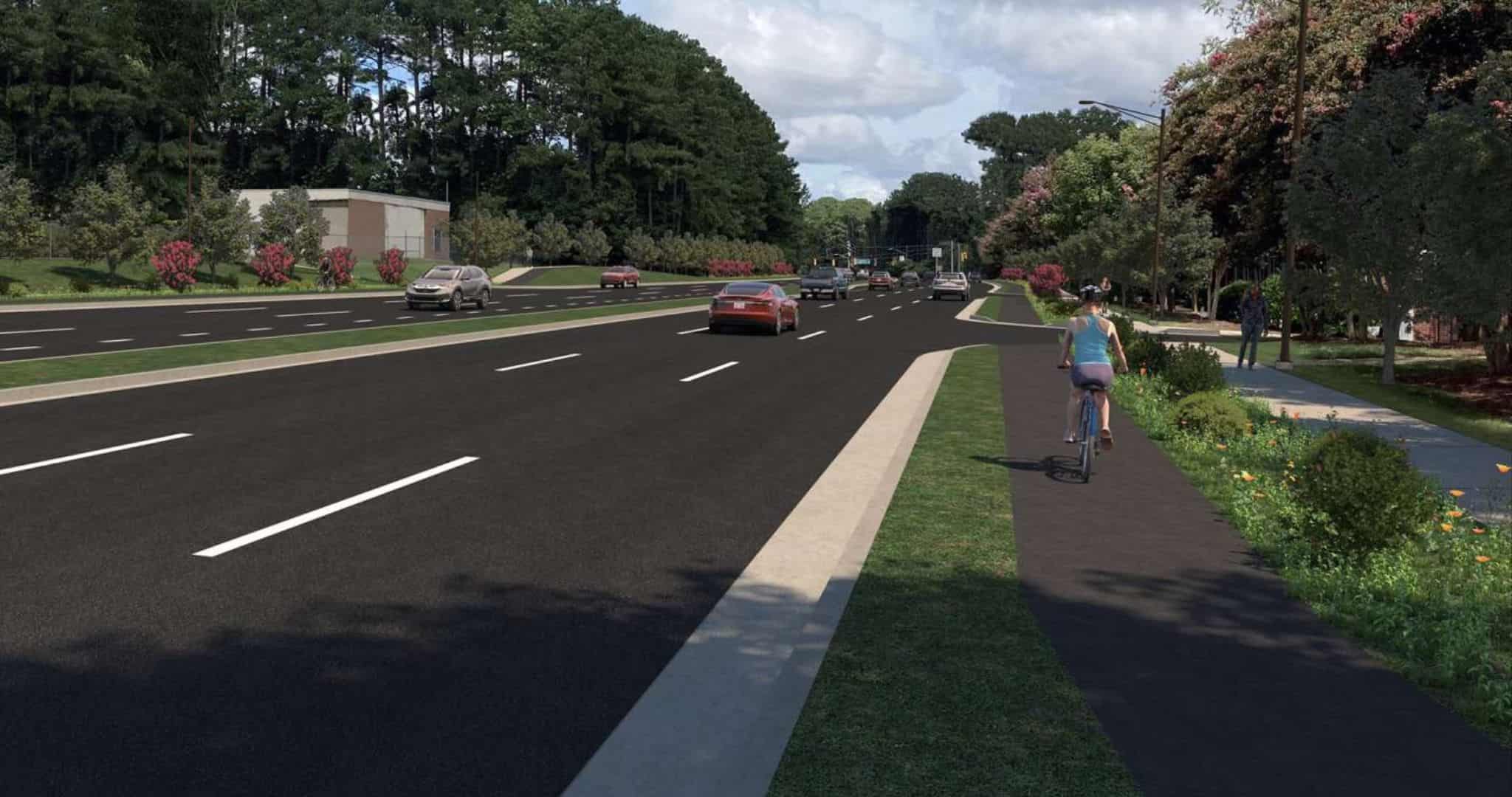
The current four-lane road will be expanded to six lanes, with the addition of a median and a combined walking and biking path. The initial project—the first transportation bond for which was approved in 2013—was slated to update a 2-mile span of Six Forks, but the approved plan was slashed by ~50% to keep within the city’s budget.
The future design of the improvement plan is a boon for more than just motorists, as pedestrians, cyclists, transit users and emergency vehicles will all reap the benefits. Rather than having separate sidewalks and bike paths as initially planned, the updated plan opts for a multiuse path to accommodate both. To wit, the path will be situated 8 feet from the road to ensure the safety of pedestrians and bikers while also leaving space for utility poles and trees.
Adapted due to rising costs, the project has already spent $3.8 million toward planning and design, with a total price tag clocking in at $56.1 million. Now that the next phase is in motion, Raleighites with businesses, churches and homes lining Six Forks have answers as to what might happen to their properties after years of uncertainty.
That said, Midtown traffic may get worse before it gets better. The project is scheduled to begin construction in late 2025 after obtaining approval from the NC Department of Transportation and will take two years to complete. Until then, it may be time to opt for an alternative route.



