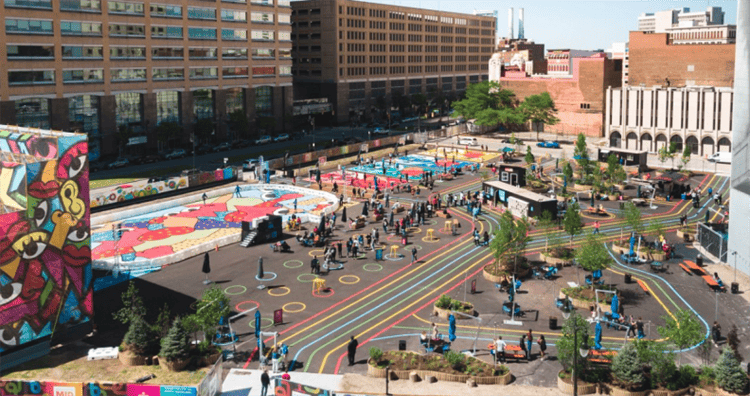
Parking problems no more. In October, City Council implemented free 2-hour Downtown parkingin certain city-owned decks beginning Nov. 15. Exorbitant parking prices have previously left locals and visitors alike reeling, and although DTR’s popularity peaked this summer, better parking accessibility is a key factor needed to keep foot traffic coming. So, don’t be afraid to book that dinner reservation or buy those concert tickets—parking’s on Raleigh.
🚗 Municipal Building Deck 🚗 Wilmington Street Station Deck 🚗 Moore Square Deck 🚗 Blount Street Deck 🚗 City Center Deck
Red Hat Amphitheater could permanently close to save a single DTR block that sees hardly any traffic.
The future of Downtown Raleigh is at stake—and Red Hat Amphitheater sits at the center of it all.
While Red Hat was initially intended to be a temporary venue, the City has long planned to move and update the amphitheater to sustain the amount of traffic it attracts. The planned expansion would accommodate ~1,000 more seats and a larger loading dock and backstage area, as well as increased concessions—and the only “cost” of that expansion is the closure of one block of South Street—a road that sees just one-third of the traffic it was built for.
The proposed update has been in the works since city leaders agreed to shift Red Hat slightly southward in order to expand the Raleigh Convention Center. Now, as pushback mounts for the street closure, Red Hat’s—and Downtown’s—future is hanging in the balance. And if City Council doesn’t pass the proposed plans to expand it, Red Hat will be demolished for good—along with the millions of dollars in economic impact it brings, and the future viability of many DTR businesses.
“Red Hat is the one thing that brings people Downtown in large numbers consistently through the summer months,” emphasizes Crank Arm Brewing owner Adam Eckhardt. “If the amphitheater does not open in the current proposed location in Downtown Raleigh, many small businesses will close.”
Thus, major city players and business owners are vying for Red Hat’s survival for good reason. In 2023 alone, the amphitheater generated ~$17.5 million in economic impact from its 26 shows. This year, show offerings have more than doubled with a record-breaking 51 shows, yielding comparably greater financial impact with them. The absence of Red Hat would directly affect the shops, restaurants and bars who rely on foot traffic from locals and visitors alike attending those concerts all days of the week.
For her part, mayoral candidate Janet Cowell, also the CEO of the Dix Park Conservancy, has expressed concerns about the expansion because of the partial closure of South Street and how it would affect connections between Downtown and Dix Park. But some have expressed concerns that her push against Red Hat is centered around advocating for the proposed outdoor amphitheater at Dix Park, which is a “potential alternative to Downtown’s Red Hat Amphitheater,” according to the park’s master plan.
“The consequences for Red Hat Amphitheater leaving downtown would be devastating to many small businesses owners who rely on crowds pre- and post-shows all summer long. Our city leaders would be wise to reconsider the thought of moving something that creates such a large financial impact to small business owners, many of which won’t make it with a loss of that magnitude.” —Matt Coleman, owner, The Davie
However, it’s clear an amphitheater at Dix wouldn’t have the same economic impact for any district, much less Downtown—especially given the much-denounced lack of connectivity between DTR and Dix—and Raleigh already has a similar venue to the would-be Dix Park amphitheater (Coastal Credit Union Music Park at Walnut Creek), in addition to one in Cary (Koka Booth Amphitheatre).
“Many of our small businesses rely on [Red Hat] to get them through slower summer months and see their sales more than double on a concert evening versus a non-show night,” says Downtown Raleigh Alliance President/CEO Bill King. “Placing the amphitheater in the heart of Downtown has demonstrated how much more economic impact is possible for venues when they are surrounded by small businesses for patrons to visit before and after shows.”
Plus, Live Nation, Red Hat’s booking manager, isn’t going to wait around for a Dix Park amphitheater to get off the ground—meaning if Red Hat goes, many artists won’t make stops in Raleigh at all. Read: If Downtown doesn’t have an amphitheater to accommodate 7,500 guests, other cities will garner the economic benefit. “Live Nation… will skip us for Charlotte and Wilmington,” maintains Eckhardt. “Durham may even build an amphitheater of this size to accommodate.” So, not just a loss for Downtown, but for the city as whole.
Red Hat’s fate adds to a long list of concerns about the current state of Downtown Raleigh already being raised by local business owners. And potentially demolishing one of DTR’s only entertainment draws isn’t sitting well with those trying to up the district’s allure to save their businesses—and their livelihood.
“Red Hat Amphitheater is a fun draw for Downtown. The Canes are at PNC; DPAC and the Bulls are in Durham—so it’s really our only entertainment draw Downtown,” says Meeker. “A lot of our employees at our restaurants are young, 20–35 years old and have no kids yet, and the thing you hear constantly is that Raleigh is a boring place to be young. We need to change that, not lean into that. I hope Red Hat Amphitheater comes back bigger and better than ever, even if that means adjusting South Street.”
How to Help Save Red Hat Right now it’s unclear if Raleigh City Council has the votes necessary to save Red Hat. If the proposed plans don’t pass by majority, Red Hat Amphitheater would be demolished for good. You can help save Red Hat—as well as multiple DTR businesses and Downtown’s livelihood—by reaching out to your city council member at emails listed below. Find your district here.
Raleighties make plans to nudge DTR in the right direction.
It’s clear Downtown Raleigh is changing—whether you think it’s for the better or worse—and Raleighites are rolling up their sleeves to ensure NC’s crown jewel is moving in the right direction. To wit, city leaders and a swath of small business owners and residents met at Crank Arm Brewing’s recent Revive & Thrive public panel to workshop plans to up the area’s allure for businesses and patrons alike.
Out the gate, parking is a major deterrent for would-be Downtowners—but attendees were astounded to find there are already some 7,000 free evening and weekend parking spots in DTR (see “Parking Problems”). Though much more can be done to improve parking access, including a consideration for the first two hours free.
Beyond parking, viability and safety concerns were also assuaged. Despite rumblings that DTR is losing its cool factor, 1.5 million unique patrons frequented and 14 new businesses bowed last year alone, with many more in progress—not to mention the 4,500 new residents expected to move into the 3,000 units hitting the market in the next year. Moreover, after a last-summer surge, major crimes are down by 22% in DTR and 50% in Moore Square—and trending further downward. Still, many residents and business owners are hoping for better reinforcements than statistics when looking to the future.
“I’ve seen a focus on Downtown since last year—because we did see trend lines going in the wrong direction, and now with that focus, trends are going in the right direction,” said Councilwoman Dr. Jane Harrison during the panel discussion. Here, the city’s top talking points for reviving Downtown.
Continuing to promote safety: Crime rates may be down, but the job is far from done. “In terms of public safety, we have to have holistic solutions for people in need,” said Harrison. “We are putting together an alternative crisis response unit for folks struggling with homelessness, substance abuse. … We have a duty to help them.”
Accessible transportation: According to Harrison, DTR doesn’t necessarily need more activities or festivals, but better ways to get to them. “I want to be able to get where I want to go easily and safely, and how we get around here is still a quagmire,” she maintained. “I am making a choice between Cary, Durham and Downtown, and how [I] get there motivates my choice.” City Council is also currently deciding if parking in city decks will be free for the first two hours on weekdays.
Spotlight culture and entrepreneurship: Upgrading spaces with public art, shedding light on local musicians and performers, and circumventing barriers for first-time business owners emphasize diversified offerings. More murals, a block party and even a residency for international musicians was thrown in the ring.
Public realm maintenance: “If the experience is poor, people will respond by not coming back,” emphasized Downtown Raleigh Alliance CEO and President Bill King. Public spaces—from trash cans and playgrounds to shade structures and plazas—could be more inviting and better maintained.
Anyone around in the ’80s may remember a rumpled-trench-coated dog whose business it was to remind us that crime is everyone’s business—and that police can’t fight crime alone. Now, with the marked decline in Downtown crime as the result of a vast community effort, McGruff’s message is more prescient than ever.
In November, we reported DTR crime had increased 60% over the previous eight months as compared to the year prior. Now, incidents running the gamut from aggravated assault to lesser (albeit annoying) evils like harassing phone calls, are improving across many categories. From September to February, drug violations—which accounted for a whopping 30% of all crimes reported—saw a steady decline, ultimately down 55% over the six-month span.
Thanks to extensive unified community efforts, weapons violations also declined a mammoth 73%. And, ultimately, total February crime incidents were almost half of those in September Downtown—including in the “disorderly” dubbed Glenwood South District, where RPD has been focusing much of its enforcement and prevention efforts.
While RPD’s response has been swift and effective, the department credits business and residential partners with whom they work closely for the cooling crime. “Our numbers continue to trend in the right direction thanks to the partnerships made with Downtown Raleigh Alliance and others,” maintains RPD Public Information Officer Lt. Jason Borneo.
For its part, DRA worked to provide private security services, as well as advocate for increased RPD presence and for the City to hire private security in the transit center, says DRA President and CEO Bill King. “All of these efforts have had a meaningful impact as evidenced by the crime data,” he adds. “Having said that, we cannot take our foot off the gas or let the City do so, as there is still a lot of work to be done to fortify these improvements in safety and make even more.”
RPD also worked with local businesses to roll out the CONNECTRALEIGH public safety program in an effort to enable Raleighites to help protect the community by increasing real-time data for guided emergency responses via fususCORE cameras.
Ultimately, Downtown safety is the most vital element to keep businesses progressing—which is why many local owners are happy to be involved in the conversation and efforts, including owner Matt Coleman of popular Blount Street bar The Davie.
“RPD has made tremendous efforts to help solve the growing issue of crime in the Fayetteville Street/Moore Square District after hearing our concerns last September,” says Coleman. “The numbers definitely show a decrease in crime, and we are seeing an increased police presence since then. My only hope is [RPD] continues to apply pressure, as crime tends to escalate during warmer weather, and summer is rapidly approaching.”
Borneo agrees, but ensures RPD is ready. “As the warmer months approach, we anticipate changes in crime trends,” he says. “RPD is always prepared to respond regardless of season—and we are prepared to respond accordingly to those trends. … We rely on our community to actively contribute to public safety, and we are fortunate that so many people have embraced the ‘it takes a village’ approach.”
Fortune no doubt favors the brave—and these efforts are no doubt valiant—but we can’t rest on our laurels. There is still work to be done, and we have to remain diligent and keep our communal foot on the gas. We’ll circle back after the thaw with what we hope is more good news for DTR.
A newly released 10-point action plan sets to bring vibrancy back to Fayetteville Street.
Things are finally looking up for Fayetteville Street. While the once-vibrant sector had arguably lost some of its luster, Downtown Raleigh Alliance and the City of Raleigh recently released the first set of recommendations from their ongoing Downtown Raleigh Economic Development Strategy in an effort to revitalize North Carolina’s Main Street.
The “Activating Fayetteville Street” report developed by the Interface Studio-led consultant team features 10 recommendations for making the corridor more attractive, competitive and connected based on local need and other city attractions. Taken together, these “10 big ideas” could mark the biggest shift to the district in 15 years.
“Fayetteville Street and our central business district are part of the face of our Downtown, city and state,” says DRA President and CEO Bill King. “So elevating this area is critical to how Raleigh is experienced and perceived.”
Setting a new course for the heart of Downtown, the goal of the recommendations is to breathe new life into the area from the NC State Capitol to Martin Marietta—from highlighting Black-owned businesses and adding more housing on and around Fayetteville Street to connecting main attractions via a family-friendly route and more.
“The intention is to implement as much as possible, but realistically I expect some will still have to evolve or adjust as things change,” says King. That said, look for the streetscape design update to begin immediately, as well as changes to City Plaza, parking fees and many of the placemaking/public art aspects. “We have steps outlined for the first 100 days and first year to drive progress,” he maintains—progress that will only proliferate as Interface continues to seek ways to maximize Downtown’s strengths. Here, the takeaways we think will have the biggest impact on our city.
Courtesy of Google Maps
Courtesy of Monroe Street Midway
Defining the Districts
“Art pulls a community together,” as would a designated Arts and Entertainment District in the lower area, which would also serve to attract local and national establishments and entertainment ops while further fostering Fayetteville Street’s identity. The abandoned parking lot at the northwest corner of South and Wilmington streets serves as a primo spot for “play, small business opportunities and entertainment options,” according to the report.
Courtesy of Interface Studio
Courtesy of Interface Studio
Bright Streetscapes
Famously supersized, Fayetteville Street’s sidewalks have never lived up to their full potential. Swapping current antiquated planters, benches and newspaper corrals for designated zones for outdoor dining would serve as a smart solution, which would free up space for walking, furniture and activity (think outdoor vending, workspaces, lawn games and temporary stages). Meanwhile, added greenery and lighting on significant buildings, trees and sidewalks would bolster literal vibrancy, wayfinding and safety.
Photo by Patti McConville, Alamy Stock
Utter Relief
The lack of public-access relief stations in DTR has long posed a problem. Taking a cue from Portland, relief could be on the way in the form of new self-cleaning public bathrooms + increasing hours and maintenance for free bathrooms in public buildings. Answering the call for another shortage would include improved parking signage, increased time allowances on parking apps and first-two-hours-free parking in City-owned garages.
Rendering by Interface Studio
Photo by Kebony
Courtesy of DRA
Leveraging Public Spaces
“On the playground is where I spend most of my days…” That’s the hope—by activating the oft-underutilized street into a full-blown 16- to 18-hour veritable playground via inviting well-lit passageways bustling with outdoor dining, vendor stalls, recreation, public art and more. This also goes for positioning City Plaza as “Downtown’s front porch” and establishing a visitor center.
Courtesy of Interface Studio
Photo by blazeCLT
Downtown Connector
Bold connections generate growth. Thus, a Chavis-Dix Strollway could be implemented to connect DTR to Dix Park and the Rocky Branch Trail, with a South Park Heritage Walk bridging the gap from DTR to Chavis Park and other East Raleigh destinations.
Human Touch Group Pavillion by Partyk Lewinski
Lucky Plaza by Choo Yut Shing
Marketing Main Street
Raleigh’s “Main Street” needs to assert its identity. Period. Engaging public space design and street activity via mobile retail carts, food trucks and permanent stalls in dead zones would increase foot traffic—as would the creation of a Downtown gift card program.