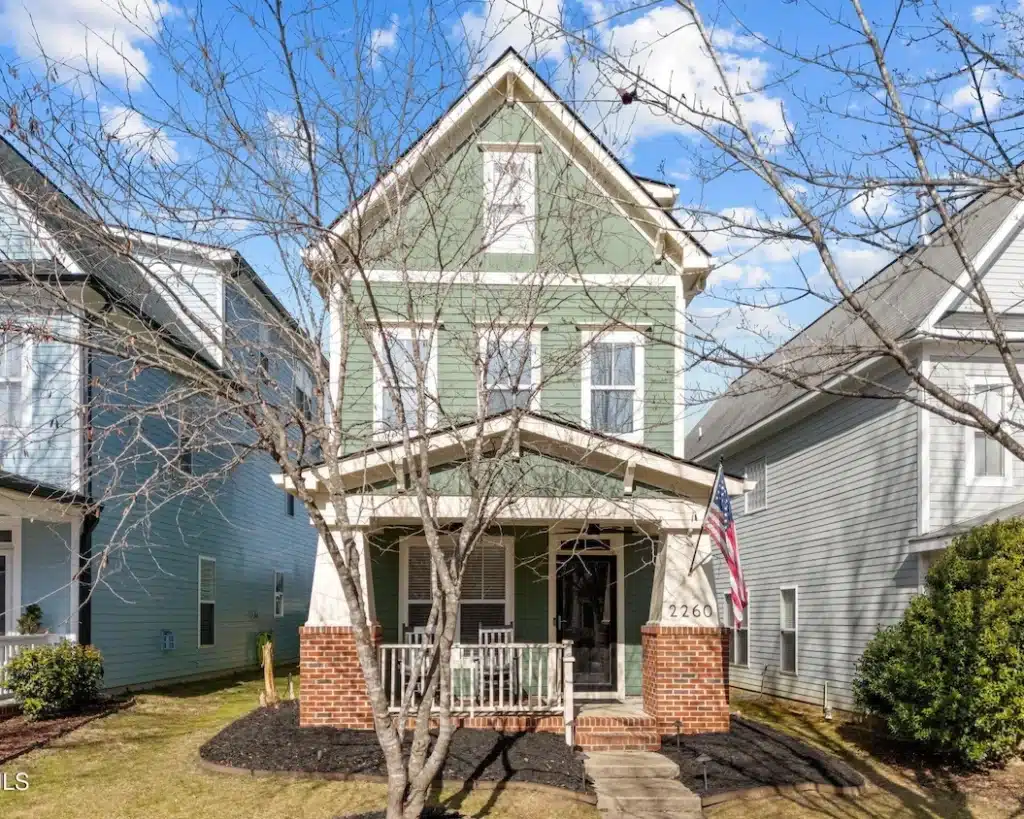
2025 Raleigh Housing Market: If you want a house, buy it now—it will never be cheaper to buy in Raleigh than right now.
Holding out for better interest rates or a steal? As the saying goes—real estate waits for no one. Just like you wouldn’t skip dinner waiting for a steak to go on sale, you shouldn’t starve yourself out of homeownership.
“As I’ve always said, the best time to buy a home is 10 years ago; the next best time is now,” explains local market expert and Realtor/broker Brian Pate of eponymous Pate Realty Group and Brian Pate Seminars. “Buyers and sellers who’re trying to time the market will lose. The best theory to go by is to buy the house if you want one.”
Essentially, if you hit pause for the possible better interest rates, the home price tag may go up, explains Pate. You can’t refinance a home price, but you can refinance a better rate down the line. “If the interest rate goes up,” he adds, “the bank is stuck with a rate that is advantageous to the homeowner.
“We lost homes with offers $100K+ over ask and $50K+ hard money at contract signing,” one Raleighite ruefully recalls of the 2023 market-buying experience.
According to Pate—who also serves as a pro instructor, speaker, trainer and coach—local agents are indicating that business is picking up, with more sellers and buyers entering the market. So waiting for rates to drop another 1/4 point, while admirable, is signing up for bidding wars and sticker shock. Never mind waiting for a rate to drop is not unlike texting your ex. It’s not getting better—and it’s time to move on. Imagine telling your grandkids you passed on a $350K house because 6% felt steep.
The takeaway: “Time in the market always beats timing the market,” urges Pate. “Very few people hit it perfectly.”
After years of scarce real estate offerings, the home supply is bouncing back. Here, find the city’s most desirable location flexes across North Raleigh, Midtown and Downtown ZIP codes—from the most space for your cash to median marvels with max appeal.
Most House for Your Money: Most square foot per dollar
Courtesy of Doorify MLS
DOWNTOWN 27604 | 717 Penn Road $1.5M 5,467 sq. ft. $274/sq. ft.
Locals often recall those glorious 3% interest rates fondly, but perhaps forget the “golden handcuffs” of skyrocketing asks, price battles and buying-sight-unseen buyer frenzy. Rewinding before these housing hunger games, the reality is Raleigh was actually underpriced in 2019 against comp cities (think Charlotte, Tampa, Orlando, etc.). Fast-forward to the ballooning market mayhem and, for a time, owning in Raleigh felt for many out of reach, especially given the record low inventory resulting in bidding wars, buying sight-unseen and Raleighites forking over their 401(k)s in due diligence just for the privilege of bidding—and often losing it all.
That is, until now. Steadily increasing inventory paired with interest rates—not to mention Raleighites paying “normal” due diligence more like it’s a deposit and less like ransom (meaning closer to the standard ~$2K (give or take) than upward of $175K and beyond)—signifies a market on the rebound, and others are taking notice. By the end of last year the City of Oaks had racked up a plethora of additional annual accolades, from the No. 5 fastest-growing housing market to the No. 6 best place to live to the No. 2 best-performing city.
2019
Avg. Sold Price: $315,693 Avg. Days on Market: 24
2020
Avg. Sold Price: $336,857 Avg. Days on Market: 20
2021
Avg. Sold Price: $395,116 Avg. Days on Market: 10
2022
Avg. Sold Price: $463,430 Avg. Days on Market: 12
2023
Avg. Sold Price: $479,343 Avg. Days on Market: 18
2024
Avg. Sold Price: $495,853 Avg. Days on Market: 21
January 2025
Avg. Sold Price: $563,231 Avg. Days on Market: 46
Rental Rebound
Mira photo courtesy of Spandrel Development
After a blissful period of reduced rates, Raleigh’s apartment rental market is stabilizing, with the current average one-bedroom going for $1,370/month, compared to $1,270 last year. Why the shift?
Increased interest rates and inflation are delaying Raleighites from home buying—meanwhile, the rental market is hot. Despite elevated vacancy rates (think ~7.1% at the start of 2025) due to the recent influx in apartments, the market is in an adjustment period—and net absorption, aka the total amount of space leased minus the amount of space vacated, is expected to set an annual record this year.
As such, apartment demand remains high, and those new units are slowly but surely being absorbed by an increased population, expected to stimulate a more balanced market. The takeaway? 2025 may be a tough year for renters who’ve grown accustomed to competitive renter-friendly rates.
20% of Raleigh renters are spending more than half their income on renting an apartment or house, compared to the overall U.S. average of ~25.6%. —U.S. Census
Maeve gym rendering by LCP Media, courtesy of Maeve
A podcast studio. A fully equipped coworking space. A pet spa. A game pavilion. These luxury apartment amenities are becoming de rigueur in a competitive market that will stop at nothing to entice renters—but they come with a price tag.
You don’t have to think too far back to remember a time when an apartment complex’s biggest draw was a well-equipped gym or heated pool. Now, new buildings are raising the bar LeBron James-height with state-of-the-art community offerings—think resort-style pools and daily wine + beer stations (!).
This “amenities arms race” of sorts makes for a competitive market for communities to stand out and attract residents seeking a luxe lifestyle. Locally, we’re certainly seeing an influx of apartment complexes, with 2,230 DTR residential units under construction last year alone and an additional 7,781 planned or proposed, according to Downtown Raleigh Alliance.
While an older apartment complex may not charge an amenities fee for a standard on-site pool and measly stocked gym, newer boutique residences tend to tack on a swath of additional fees, from a substantial offering-dependent amenity charge to a la carte service fees for trash valet, pest control, parking, pet fees, select utilities, and a packages locker. All told, residents may pay anywhere from $30 to $200 per month on top of rent.
The result—sheer sticker shock. Upon starting the apartment-hunting search, renters typically just see base rents, only to discover those extra costs when the rental process actually begins. All the while, 5 to 9% of total rent can be attributed to amenities.
In the end, renters get what they pay for—just not, at times, what they initially bargained on. And some are willing to fork over hundreds of dollars a month for, say, a sky lounge with impeccable panoramic views of the city.
Peace Apartments Monthly Breakdown 2 bed/2 bath
Rent: Avg. $2,200 Parking: $160 Service & amenities (trash/recycling, pest control, and upkeep of amenity spaces like the gym and pool): $45 Water admin fee: $4.76 Water: Avg. ~$7 Sewer: Avg. ~$9
Small Living, Big Spaces
Forge microunit photo by Cat Wilborne Photography, courtesy of Forge at Raleigh Iron Works
If it feels like Raleigh apartments are getting smaller, you’re right. In fact, according to a recent study, new units have shrunk by an average of ~9 square feet compared to a decade ago, with the standard one-bedroom currently around 946 square feet. And local developers are leaning in, jumping on the microliving bandwagon—serving up studios typically between 200 and 400 square feet.
The niche residential arrangement is a small solution (literally) to a bigger housing problem—read: a competitive market with expensive rental rates. Naturally, smaller units equate to lower rental prices, a big pull for those who would rather spend money on experiences and other everyday activities than where they’re resting their head at night.
“Efficiently sized apartments are becoming more popular in the multifamily space,” says Chris Garrard, director of property management at Grubb Ventures, the local developer behind RIW. “With a host of high-design amenities at your fingertips, many renters don’t feel the need to maintain and upkeep 900+ square feet of space.”
Raleigh businessman David Smoot is buying in on the same idea via a planned five-story apartment building on Hillsborough Street that would house about 100 160-square-foot units at ~$1,000/month each. Located between NC State and Downtown—around the corner from West Morgan Street hot spots like Gussie’s and The Bend—the project would be a big attraction for students and those looking to live near DTR for less. Demolition for the existing duplex on the site has been approved, but it doesn’t appear any other movement has been made.
If the development continues as planned, it would join other existing local microunits like those at Pullen Station Lofts (252 square feet at $950/month) and Atlas Durham (387 to 433 square feet starting at $1,200/month). With affordability at the top of everyone’s mind, the small trend may just be a big solution.
A district-by-district reveal of projects coming out of the ground.
Raleigh’s skyline is not only changing—but expanding. A number of highly anticipated developments are either coming out of the ground or inching close to completion, positioned to reshape the City of Oaks as we know it. Adding to the city’s allure with myriad new-to-the-market offerings, these projects cover all pockets of Raleigh, including emerging districts like Park District, named for its proximity to Dorothea Dix Park; West End, to the west of Downtown; and Blue Ridge Corridor, redefining West Raleigh. Here, we break down the developments that have begun construction in each area of the city, with updates on noteworthy features and projected deliveries. Change is coming, Raleigh.
WEST END DISTRICT
Image by Steelblue
319 W. Lenoir St.
Building on the expansion efforts for the Raleigh Convention Center, which also includes the shifting of Red Hat Amphitheater, is a new currently unnamed residential/retail project at 319 W. Lenoir St. Topping out in December, the mixed-use tower just a block away from the Convention Center will change the DTR skyline and add yet another exciting component to the already-changing area.
The project by developer Capital Square and JDAVIS Architects will provide 30,000 square feet of amenity space for residents of its studio and one-, two- and three-bedroom units who “will enjoy the vibrant social lifestyle provided by the nearby galleries, art studios, restaurants and the city’s largest park,” says Capital Square Co-CEO Whit Huffman.
Perhaps standing out the most of those luxe amenities is the resort-style pool deck with cabanas, an indoor/outdoor lounge and entertainment spaces; and a sky lounge with a private dining room and outdoor patio serving impeccable views of Downtown. Meanwhile, the public will be able to enjoy a pocket park and ground-floor retail.
“We couldn’t be more excited to develop this luxury mixed-use apartment property that will transform the surrounding neighborhood,” adds Huffman—ultimately “bringing vitality and elegance to Downtown Raleigh.” capitalsq.com
Phased opening: Spring 2025
Specs: ~10.5K sq. ft. retail, 297 residential units
Noteworthy features:
Spacious double-height resident lobby
~3,500-sq.-ft. fitness club with spa locker rooms
Coworking lounge with study cubicles and conference facilities
Kane Realty Corporation helped establish West End as an emerging district with the announcement of its mixed-use development Platform in 2021—now, they’re cashing in on their investment in the up-and-coming neighborhood, with residents beginning to move in this month.
Platform isn’t just designed with residents in mind—but the surrounding community as well. “The intentional part of the design was to really think differently about retail,” says Kane Director of Design Josie Reeves—which was made to complement the neighborhood with inviting and active retail spaces well-suited for hyperlocal food and beverage purveyors, upstart concepts, creative offices, service providers, and makers.
The building’s distinctive layout features a shared interior courtyard for residents and retail/flex office partners. Retail tenants will also have access to a large front patio, side patios and a shared outdoor space in the back. An additional docklike structure off the shops at Dupont Circle will also boast a raised area for seating.
“It should feel really active and like an invitation to the neighborhood to enjoy the semipublic spaces we created,” adds Reeves. Think of it as similar to Smoky Hollow, where both residents and visitors can move freely throughout the open hollow’s retail tenants. Platform will also feature a fully integrated parking deck.
Further banking on the area, Kane is set to break ground on Phase 2 of the project, Oldham & Worth, by the end of the year. The five-story residential building with ground-floor retail offers a mix of studios and one-, two- and three-bedroom units—in addition to an indoor/outdoor fitness center, coworking spaces and a conference room.
Both projects join a bevy of thriving existing local businesses in the area, from Boulted Bread to Sam Jones BBQ to Vault Craft Beer. “There’s a long history of makers and artists who have called the West End home for a long time,” says Reeves. And now, a new era ushers in. platformraleigh.com
Phased opening: Residential move-ins beginning Oct. 1; full completion 2024
Specs: ~29,500 sq. ft. retail, 694 residential units
Noteworthy features: • Shared central courtyard, expansive pool deck with grilling stations and fire pits, wellness center with group fitness area, creative workroom space, resident clubroom with cafe bar-style dining area • Fitness lawn with resort-style sundeck at Oldham & Worth
PARK DISTRICT
The Weld
Helping define the new district is The Weld, SLI Capital and Mack Real Estate’s most recently announced property. Named for its proximity to Dorothea Dix Park, the emerging district connects the past and the future—with the $700 million mixed-use project serving as the front door… and a direct connection from the park to Downtown.
The first phase of the groundbreaking development will consist of two 20-story apartment buildings across 3.5 acres at the intersection of Lake Wheeler Road and Hammell Drive, set to be completed by summer 2025. Thanks to the sleek, glass-fronted spaces, residents will have impeccable park views, not to mention central greenspace and ground-level restaurant and retail space for gathering.
“The Weld is a truly pivotal site for Dix Park and will be transformative for the city,” says SLI Capital CEO and managing partner Bryan Kane. “In addition, we are collaborating with the Dix Park Conservancy to identify other meaningful ways to support the park’s development.”
The project team’s goal is ultimately to create a vibrant new neighborhood in a burgeoning green urban environment, according to Mack Real Estate Group CEO Richard Mack. Historically industrial in nature, the district has already begun a transformation to a mix of local businesses, with The Weld only adding to its appeal as the next “it” DTR destination for Raleigh residents and visitors—further building on the excitement of Dix Park’s transformation into a true attraction for the city. slicap.com
Phased opening: First move-ins June 2025
Current status: Pre-leasing beginning this fall
Specs: 9,632 sq. ft. food- and beverage-focused retail space, 675 residential units
Rockway Raleigh
Formerly dubbed Park City South, Kane Realty Corp.’s new vision for Rockway Raleigh will add to the city’s emerging Park District by connecting our booming Downtown to an outdoor social destination along the greenway. The best of both worlds, the project is set to merge the convenience of urban living with the calm and connectedness of nature via its innovative design encouraging walkability and featuring myriad outdoor activations.
Naturally, outdoor dining will have a large presence in the trail-oriented development’s food- and beverage-centered retail space—in addition to creative- and service-based businesses mixed in. The alfresco opportunities will be positioned along South Saunders Street and directly on the Rocky Branch Greenway trail.
In terms of the “live” aspect, the first phase of apartments, dubbed Rockway Residences, will feature six residential levels over ground-floor retail. The second phase will deliver The Heath, an apartment building with sprawling street-level retail space. And as with any Kane development, the amenities are stacked—from a rooftop lounge, pool and fitness center to bicycle storage to a tranquil internal courtyard. Plans for a second additional residential building in Phase 2 are currently underway.
With this true urban infill project, Kane hopes to seamlessly blend peak live, work and play spaces in a natural environment neighboring one of the most exciting park projects in the country. kanerealtycorp.com
Phased opening: Mid-2024 Specs: Phase I: 18K sq. ft. retail/flex office space, 335 residential units Phase II: 7K sq. ft. retail, 350 residential units
Noteworthy features: • Enhanced sidewalks and landscape design to promote neighborhood walkability • Raised patios allowing outdoor dining on the Rocky Branch Creek Greenway
Standing out from the majority of high-rise projects slated for Downtown, Mira Raleigh is one of few competitive midrise developments advancing in the market, offering more economical rental rates.
“We continue to be very pleased with the progress in developing Mira Raleigh and in seeing our vision for this new community taking shape,” says Spandrel Development Principal and co-founder Emanuel Neuman. “Despite being several months away from launching our pre-leasing campaign, we’re already generating tremendous interest from prospective tenants.”
While not as tall as other new and planned developments in DTR, its seven-stories don’t fall flat on a desirable mix of studio and one- and two-bedroom living spaces and resort-style amenities. Not to mention unmatched skyline views, up to 12-foot ceilings, floor-to-ceiling windows and expansive terraces.
Mira Raleigh is just one of the planned projects for the otherwise underdeveloped area near Fayetteville Street, the Warehouse District and fellow emerging district West End. But the apartment complex could be the linchpin for future projects. miraraleigh.com
Phased opening: Beginning Q1 2024 Current status: Pre-leasing beginning January 2024 Specs: 2,600 sq. ft. shared office space, 288 residential units
Noteworthy features: • Hospitality-inspired lobby/lounge + sky lounge with skyline views • Commercial-grade coworking facility • Club room with chef’s kitchen and bar area
WAREHOUSE DISTRICT
Tempo by Hilton Raleigh Downtown
It’s Tempo time. Elevating Raleigh’s luxe lodgings, Tempo by Hilton Raleigh Downtown is the brand’s first foray in North Carolina—and only the second U.S. outpost. Primely positioned at South McDowell and West Davie streets, Hilton’s newest and most innovative lifestyle brand’s upcoming locale “places our guests in the heart of the action with walkability to numerous offices, restaurants, shops and more,” says Seraj Patel, VP of Greensboro-based CN Hotels, which owns the property.
Appealing to myriad travelers, the sweet sojourn serves a duo of choice digs to relax and recharge via the dual-brand concept across hotel rooms equipped with all you need to power up, prep for your day, power down and recharge—think oversize bath suite featuring Apotheke amenities and mirrors with built-in Bluetooth speakers. Or for the suite life, extended-stayers can partake in livable amenities like full in-room kitchens.
A shared grand lobby grounds the 13-story building featuring flexible event space and state-of-the-art fitness center. And an intentional lean into healthy living, the high-end hotel will also offer wellness-focused guest rooms, allowing patrons to get their fitness fix while on the go.
The hotel’s palatable food and beverage offerings will include ground-floor signature lobby cafe Fuel Bar and 14th-floor Urban Oak, serving up a sophisticated experience with sweeping views, gourmet tapas, distinctively crafted beverages, modern decor and live music.
“As excited as we are to provide a hospitable and unique hotel experience to guests traveling to Raleigh, we are just as excited to introduce Urban Oak, the tallest rooftop lounge and bar experience, to guests and locals alike,” says Patel. “We’re passionate about embracing and infusing the culture of Raleigh in all aspects of the property. Raleigh has a thriving downtown art scene we are excited to support and highlight by bringing in local artists to curate various pieces that will be displayed throughout the hotel.”
Slated completion: Q1 2024 Current status: Broke ground fall 2021 Specs: 126 rooms, 134 suites with full kitchens
Noteworthy features:
Peloton-equipped wellness-focused guestrooms with Theragun Elite and Therabody Wave Rollers
Signature Fuel cafe and bar
Urban Oak: Triangle’s tallest rooftop bar and restaurant
IRON DISTRICT
Raleigh Iron Works
While Raleigh Iron Works has already welcomed both residents and visitors, its 19 acres of mixed-use development is just getting started. Beyond the draw of such buzzy tenants as Eastcut Sandwich Bar, Andia’s Ice Cream and FX Fitness, Raleigh Magazine recently revealed RIW’s latest F&B occupant, Little Rey, a Tex-Mex-inspired concept by celeb chef Ford Fry, bowing in 2024.
Beyond top-notch tenants and on-site apartment building Forge (slated to be fully complete by October), RIW recently launched a public arts program dubbed The Collision Project, which connects creatives to art opportunities at the joint Jamestown and Grubb Ventures property in an effort to add vibrancy to the industrial-esque development. Initial art installations include three murals from multidisciplinary artist Gabriel Eng-Goetz; graffiti artist Morgan “MCK” Cook; and, most recently, highly regarded painter and muralist Taylor White—the former mural spanning seven stories and serving as a beacon to the development.
Rounding out the development’s creative offerings are “whitebox” spaces, aka empty units available to makers, creators and doers “with the intention to make art and creative works more accessible to the public,” says Grubb Ventures Creative and Marketing Coordinator Macey Bryant. The spaces will also play host to pop-ups, with the first featuring Girl Tribe Co. the first weekend in October.
“We want Raleigh Iron Works to be a backdrop and platform for creativity,” says Jamestown President Michael Phillips. Clearly, the developers are forging the way for all types of creatives—from artists to chefs to fitness junkies and all those in between—to get in on the action. raleighironworks.com
Announced tenants: • Little Rey • Brodeto • Jaguar Bolera • Ponysaurus Brewing Co. • Beatniks • YoBa Studio
Current status: Currently leasing office and residential
Specs: 19 acres: 170K sq. ft. office space, ~71K sq. ft. retail, 219 residential units
As Raleigh’s premiere sportstainment hub, Salvage Yard, an adaptive reuse project comprising three reimagined warehouses and totaling 100,000 square feet, is on track to be a major destination for sports lovers and active Raleighites. Over the summer, anchor tenant Triangle Rock Club released a flythrough rendering of its 40,000-square-foot location at Grubb Ventures’ mixed-use development, offering a more in-depth glimpse of the highly anticipated space.
Slated to bow in 2024, TRC Salvage Yard will boast a world-class climbing and fitness experience complete with 100+ climbing lanes, a dedicated yoga studio, a bouldering area with top-out boulders, and ample fitness space—not to mention an expansive 8,000-square-foot-tall wall area featuring a 47-foot clearance.
And leaning into the sportstainment trend sure to be a smash hit comes the latest announcement of Raleigh Iron Works’ first F&B tenant Jaguar Bolera expanding its footprint to include four indoor pickleball courts and one outdoor court at Salvage Yard as well—joining NOCO Beverage, a spacious joint brewery, taproom and coffee bar.
With no shortage of ways to sate every appetite, from bites and bevs to recreation and relaxation—all mere steps from Grubb’s sister development Raleigh Iron Works and Dock 1053—Salvage Yard serves up the next vibrant social destination. Emphasizing active play—as opposed to, say, retail and shopping—makes it a natural addition to the offerings already available in Raleigh’s growing Iron District. grubbventures.com
Phased opening: Starting Q1 2024 Current status: 82.5% leased Specs: 100,000 sq. ft. retail, restaurant and entertainment space
Noteworthy features: • Five pickleball courts • Open-air entries and exposed trusses
Announced tenants: • Jaguar Bolera • NOCO Beverage by Bond Brothers • TRC Salvage Yard
MIDTOWN DISTRICT
North Hills Main District Expansion
The Main District expansion project isn’t just expanding offerings in Midtown, it’s changing the way individuals maneuver the portion of North Hills. The updated infrastructure will give way to new and extended roads, plus additional parking, traffic patterns and general wayfinding that will rewrite navigating North Hills as we know it—and make getting around the Main District more manageable.
A Main Street extension to Lassiter Mill Road will partially open to the public as early as this fall, while a new Center at North Hills Street is underway—connecting Lassiter Street to the Main Street extension—and will open early spring 2024. And already-open Circle Drive will allow access to an expanded subterranean parking deck complete with 1,000 added spaces and new elevators and escalators (there will also be an on-grade ramp going up and down to access the deck). All roads are expected to be fully open and functional by spring 2024.
A new North Hills Concierge Office located off the lobby of 4114 Creative Offices will further assist visitors by offering directions, gift cards/umbrellas and districtwide valet parking.
An additional office tower, One North Hills, will integrate original large-scale art by local artist Corey Mason and finishes featuring reclaimed wood from trees at North Hills—not to mention two outdoor terraces and a noteworthy angled-glass design that hangs over I-440 and “makes you feel like you’re flying in the sky,” says Kane Realty Corp. Director of Design Josie Reeves. “[The office towers] have already really changed the skyline and added some height and a real urban experience to the Main District,” she adds.
And finally delivering the “live” aspect of the Main District is the first residential building in the expansion, Highland North Hills. The 12-story high-rise will tout one-, two-, and three-bedroom apartments; ground-floor retail; an eighth-floor amenity deck with fire pits and primo views; a second-floor pool deck overlooking a new active public plaza; and more.
Perhaps the cherry on top of the whole development, though, is the highly anticipated three-level RH Gallery—the first in the Raleigh market—complete with a rooftop deck/restaurant that’s “sure to be a hit with beautiful sunset views looking over the west side tree line,” Reeves emphasizes.
Kane’s attempts to elevate and refresh the Main District will provide refreshing live, work and play opportunities—not to mention the refined roads and traffic patterns that are bound to take the area to the next level. kanerealtycorp.com
Phased opening: Fall 2023
Current status: 97% leased
Specs: ~347K sq. ft. office space, 100K sq. ft. retail, 287 residential units
Noteworthy features: • 6K-sq.-ft. outdoor terrace at One North Hills • Large central green space with outdoor work environment
Kane Realty Corp.’s North Hills Innovation District is just that—innovative. And the latest announced building for the district is no different. Dubbed Tributary as a nod to its position adjacent to Big Branch Creek, the six-story mixed-use apartment building with ground-floor retail will offer a handful of unique live-work units for businesses and creative professionals who reside above. Residents will also have access to a new greenway extension—plus amenities such as two courtyards, a digital content recording room and an elevated wellness center overlooking the district.
The latest residential building to break ground is St. Albans Loft, which will round out NHID’s five residential offerings (including already-open Vine and Channel House, Tributary, and another yet-to-be-named residential high-rise in the planning stages). Beyond retail spaces, the luxe lodging will tout extensive resident club and entertaining spaces, a Zen courtyard, a resort-style pool courtyard overlooking Big Branch Creek, a club-quality fitness center, remote-work spaces and a private rooftop lounge.
NHID’s unique offerings differentiate this development from the rest of Kane’s portfolio. The freestanding 6,000-square-foot F&B building is designed for a single local purveyor, serving up a spacious open beer garden and ample seating. As for who will tap the space, Kane is “talking to a tenant very seriously” that will be announced soon, according to Kane Director of Design Josie Reeves.
Meanwhile, creatives will delight in Makers Alley, located below Channel House and designed with local retailers, artisans and makers in mind. To date, Dose Yoga is the only announced tenant. Rounding out the one-of-a-kind development, the retail jewel box Pumphouse will house a single tenant adjacent to Tower 5, NHID’s 17-story-high office tower.
“We’ve had luck all around North Hills having a handful of buildings smaller in scale to complement the larger urban buildings we have,” says Reeves. Dog parks, public art, plug-and-play opportunities for outdoor music, and other ways to gather will further complement the urban oasis.
And like its Midtown Main District neighbor, a new road network connecting directly to Wake Forest Road, Hardimont Road and North Hills will link each of the buildings and spaces at NHID, including a network of pedestrian bridges and landings within the district.
When visualizing the development as a whole, Reeves says, “We’ve made a conservative effort to ask ourselves: ‘What is innovative? How do we pull together this collection of big thinkers and people who are creating new ways for us to eat and have drinks and gather and create content?’ … We’re having a lot of fun thinking through an interesting and diverse collection of makers, artisans, chefs and thought leaders, and bringing them together in this collaborative environment.” kanerealtycorp.com
Phased Opening: Next Phase II projects delivering 2024 Specs: 33 acres: 700K sq. ft. office space, 60K sq. ft. retail, 1,500 residential units
Noteworthy features:
Microretail spaces [350–900 sq. ft] for small local purveyors
100-foot-high “Three-Pointer at the Buzzer by the Creek” mural by Jeremiah Britton and Joe Geis of Also Dept. at Channel House
New Capital Area Greenway system connections
The Exchange Raleigh
The Exchange Raleigh is poised to elevate not just Midtown, but all of Raleigh when its highly anticipated 1000 Social begins to deliver in the second quarter of 2024—making up one half of the project’s state-of-the-art WELL-certified twin office towers.
Already 50% pre-leased, the mixed-use development’s first deliverable will be anchored by two dining concepts that will only serve to bolster the City of Oaks’ food and beverage offerings: a marquis restaurant and coffee shop/cafe space.
The restaurant is designed to accommodate a large open bar and abundant outdoor seating overlooking the 4-acre park, according to Dewitt Carolinas Communications Director Jenni Soccorso. The developers are in talks with several chefs and operators to bring a high-end, chef-driven eatery to the space. (Stay tuned for updates.)
Meanwhile, the cafe will serve as an all-day amenity for office tenants, residents and the larger community that will be accessible from the lobby of 1000 Social and open onto a spacious patio, playing into the development’s emphasis on outdoor spaces.
Like with most developments cropping up in the City of Oaks recently, restaurants, coffee shops, bars and the like are a significant anchor (notably, we saw it play out at Fenton)—and those who live, work and play at the highly anticipated development by Dewitt Carolinas can be rest assured the dining and drinking scene will deliver.
While we wait, one thing is certain: The Exchange is a game-changer for Raleigh, poised to attract not just Raleighites, but people from all over the state—and country. And it’s only the beginning for what the future of our city could look like. theexchangeraleigh.com
Phased opening: Starting Q2 2024 Current status: 1000 Social 50% pre-leased Specs: 990K sq. ft. office space, ~1,275 residential units, 125K sq. ft. retail + dining, 300 hotel rooms
Noteworthy features: • 4-acre park with water feature • 20K sq. ft. amenity deck for Birchwood, one of the residential units • Plan for trails to connect to Greenway
CRABTREE CORRIDOR
Glenlake
Inspiration meets innovation at the intersection where Creedmoor becomes Edwards Mill Road. Ideally located, West Raleigh’s newest office tower, GlenLake Three, alongside brand-new food and beverage-focused Retail Row, are primely positioned as the final pièces de résistance to the longstanding GlenLake development.
Designed with people’s well-being in mind, the additions promise to bolster the seven-building office community’s vast walkable outdoor spaces and plazas, serving as an antidote to the typical hustle-and-bustle office park vibe. “It’s like a work retreat,” says Highwoods Properties senior VP Skip Hill of the campus’ mod Zen approach. “It’s just a nice place to be able to enjoy working and get away from the helter-skelter of the world and focus on what you need to do.”
Serving up 205,000 square feet of Class A office space, the seven-story streetfront glass and steel-edifice tower leans into the serene, alfresco feel of the campus via 360-degrees of wall-to-wall floor-to-ceiling windows, flex work space, fitness and food selects, and more.
Fueling the hustle while intentionally playing into the parklike setting, Retail Row—situated adjacent to the new tower—will dish as many as five “festive” concepts, says Hill, including abundant outdoor seating. Expect at least one of the concepts to be a cafe with a local coffee partner—and for two of the restaurant spaces, Highwoods is in talks with both a regional group and a local group looking to expand.
“We’ve now incorporated retail into the property that we feel is important for the live-work-play aspect of the park,” says Hill. Extending the play portion beyond Retail Row, plans are in motion to activate the triangular grassy area mid-development with another restaurant-brewery—with site plans and ideas on the table with a duo of diverse prospects, one local and one “local elsewhere but new to Raleigh,” says Hill.
The half-dozen or so concepts serve to activate the Crabtree corridor at large while also further establishing West Raleigh as the next “it” destination—and GlenLake as the gateway to the burgeoning PNC entertainment district emerging just down Edwards Mill Road. highwoods.com
Opening: This fall Current status: 25% pre-leased Specs: 205K Class A office space, 13K-sq.-ft. Retail Row
Noteworthy features: • Indoor/outdoor workplace, event/flex work space, shaded outdoor function space, fitness center • Four-story free parking deck • Outdoor Wi-Fi
Announced tenants: • McKim & Creed HQ • TEKsystems
BLUE RIDGE CORRIDOR
DHHS Phase 1
The future of Raleigh’s next destination district is well underway. Comprising the triangular area from Blue Ridge to Western to Edwards Mill, the Blue Ridge Corridor is an urban hotbed of development with 32 projects completed since 2016, a half-dozen major projects currently under construction and over a dozen in the planning stages.
Already housing an embarrassment of riches that attract people from across the state and beyond (think stadium, fairgrounds, museum), the district is primed to level up its live-work-play persona via a $2.7 billion development pipeline billed as “the next North Hills.”
For starters, the massive NC Department of Health & Human Services is relocating its HQ from Dix Park to Blue Ridge Road, slated for a 2025 completion. The transformational building is part of a three-phase project serving up enormous impact to the area, with Highwoods Properties at the helm of Phase II and III in a public/private partnership with the city—the former slated for DHHS overflow and additional office space, with talks now underway on how the latter will shape up (think mixed-use office, residential and highly amenable retail—but, really, the sky’s the limit, one source close the project tells us.)
These projects come together to craft a complete community across as many as four branded districts—including the PNC sports and entertainment district—where “within a 15-minute bubble, you can work, shop, live, exercise, have fun—with everything you need at your fingertips,” says Jeff Murison, executive director of the Blue Ridge Corridor Alliance (BRCA).
“This is a very robust, healthy pipeline of development projects that add to the energy of the corridor,” adds Murison. “There’s a lot of opportunity for this to be a high-achieving area.”
BRC Noteworthy features: • $1 billion+ in transit investments, plus Triangle Bikeway connecting NCMA to Chapel Hill • Ramada by Wyndham will be demolished and replaced with 370-unit apartment complex Aura Blue Ridge by Dallas-based Trinsic Residential Group
PNC Sports & Entertainment District
Adding to the buzzy Blue Ridge Corridor is of course the score of upgrades coming to PNC, a game-changer for fans, spectators and locals alike. In August, Carolina Hurricanes owner Tom Dundon was given the go-ahead to build a sports and entertainment district around the arena, including a sportsbook, activated outdoor areas, lounge areas, loge boxes and more—not to mention additional office and residential as part of the mixed-use development. In essence, the kind of attractions that will bring you to the arena even if you don’t have tickets, or there’s no event at all.
“Our development is going to create great synergy,” says the Centennial Authority Executive Director Jeff Merritt—“a great ‘Welcome to Raleigh’ moment,” nodding to the thoroughfare that is Wade Avenue. “The sportsbook will happen fast—maybe a year,” he adds, noting summer 2025 and ’26 will be big for the district. pncarena.com
From shrinking spaces and listings to rising rents—the squeeze is real.
Less for Your Money?
What a difference a year makes. While people continue to flock south—and to Raleigh in particular—for the region’s relative affordability, ironically, surging demand (and mortgage rates) has meant a skyrocketing housing market.
The result?
Many longtime locals can no longer afford to live at “home.” With the U.S. population center trending south this decade, according to a recent AP report, the region added a whopping 1.3 million new residents in 2022, with North Carolina not surprisingly trending among states for the biggest growth—behind only Texas and Florida.
Raleigh is the #1 Hottest Real Estate Market in the U.S.
Feel like you’re in a fever dream? You’re not. The cost of real estate in Raleigh has skyrocketed. We scoured citywide listings to show the seismic jump in housing costs across ZIP codes.
$2,245 Median-priced home mortgage payment Raleigh-Cary from late November 2021–late November 2022
$1,325 Nov. 2020–Nov. 2021
AFFORDABILITY
While Raleigh grapples with a shifting skyline and growth for the good (attracting big business,huge events, hospitality titans and the like), the city is also facing mounting concerns with housing affordability—not to mention cost of living, crime and transit woes (see p. 24). As the third-fastest growing county in the U.S., Wake County has work to do. No one is denying affordability as a huge issue—from Wake County Board of Commissioners Chair Sig Hutchinson to Mayor Mary-Ann Baldwin, city and county leaders have acknowledged the crisis and emphasized the need for a solution. Case in point, Baldwin believes housing is a right—not a privilege—and recently revealed the city is just under 70% on its way toward its goal of 5,700 affordable housing units by 2026. “We are on track to meet our goal,” says Baldwin. “However, increases in labor and supply costs, as well as interest rates, have and will continue to present challenges. City Council has approved additional funding for communities in the development pipeline and will continue to be aggressive in meeting our goals.” But while leaders grapple with affordability and the missing middle (see below), in the meantime, demand has outweighed supply—and suburban flight is real. While home prices did dip to end 2022 after a record peak last summer, sky-high 7% interest rates kept mortgages still out of reach. We take a look at what house you get for your money across Raleigh right now—and how that once median ~$300K single-family home suddenly feels out of reach.
Least Expensive Single-Family Home: Northeast Raleigh 7805 Wakebrook Drive 27616 $290K 2023 YEAR BUILT 1953
THE MISSING MIDDLE
Raleigh is growing—but is an entire population being left out of that growth? Yes, we’re referring to the “missing middle,” a hot-button term referring to “housing types between detached single-family homes and large apartment buildings, including duplexes, triplexes, townhouses and small apartments,” as defined by the City of Raleigh. Before 2021, many of these housing types were prohibited in select Raleigh neighborhoods, sparking heated conversations, but, despite text changes to Raleigh’s Unified Development Ordinance (UDO) in 2021 and 2022, affordable housing options for low- to middle-income residents are still, well, missing (a quick Zillow search for homes at $300,000 will garner just over 100 listings).
To be fair, the city is taking strides to mitigate the issue and provide more options for those stuck in the in-between. For instance, off Edwards Mill Road, a single home is being broken up into four more affordable ones; and a home in the Hayes Barton area is being knocked down to make way for 17 proposed high-end townhomes. But these projects are getting major pushback as residents fight to reverse the rezoning. In Hayes Barton, residents are frustrated and have gone as far as to say these townhomes would destroy the character of their community. Clearly we need a solution to meet in the middle on the missing middle…
Tiny Homes Raleigh, The Hannah, 320 sq. ft.
Are ADUs a Solution?
A prime example of missing middle housing are accessory dwelling units (ADUs)—which were approved by Raleigh City Council in 2020. These typically 450- to 800-square-foot single-unit homes (think around the same size as a studio or one-bedroom apartment) are located on the same lot as a principal dwelling—either detached, attached or internal. And the City of Raleigh is making it easier than ever for residents to build ADUs on their properties with its ADU Fast Track program, which offers a gallery of plans already reviewed for building code compliance (permits, however, must still be individually submitted). Naturally, because these units are small and on an existing property, they’re way more affordable than building or buying a standard home—and in some cases cheaper than renting as well.
RISING RENT
What happened to supply & demand?
Rental prices in Raleigh are—to put it frankly—absurd as of late. And, despite more and more apartment complexes popping up in the area, renting in the City of Oaks remains incredibly expensive. As a matter of fact, rent is rising faster in Raleigh than any other major metropolitan area. We saw a 22.5% YoY increase in January—and Raleigh topped the list for median rent for the third month in a row. So, clearly, the whole supply and demand balance is out of whack here. Case in point: A recent Zillow report found that it would take four full-time minimum wage incomes ($7.25/hour) to afford rent on a typical one-bedroom in Raleigh.
The math… just doesn’t add up. Not to mention most apartments in the area require applicants to make 3 times the rental rate, or be incredibly close to it. So, if the rent is $2,000/month, you must make $6,000/month, which adds up to $72,000—while the average household income in Raleigh is only around $60K.
In essence, gone are the days when renting an apartment was more affordable than paying a mortgage on a home. As a result, many renters are being pushed into a “rent trap” in which they’re unable to save for a down payment on a home because all their money is going toward rent (roughly a quarter of NC renters pay more than 30% of their income in rent).
As one of the top five places to live in the U.S. according to Bankrate, Raleigh is only expected to continue growing in popularity—and population—making real estate likely more sparse and more competitive.
Tiny house interior, living in small spaces.
MICROLIVING
Does size really matter?
You might be wondering who the hell wants to live in a 160-square-foot apartment (aka microapartment)—not to mention for a relatively hefty $1,000 a month. With the announcement of local David Smoot’s plans for 100 single-occupancy 160-square-foot microunits on Hillsborough Street in January, it seems microapartments are the next big—ahem—thing in local real estate.
Clearly, microliving is about to take off. Why? Well, for starters, there’s a whole population of people who are rarely home and don’t feel the need to pay for a 600-plus-square-foot space when they really just need a shower and a place to rest their head. Case in point, Grubb Ventures and Jamestown specifically developed their soon-to-open 430-square-foot microunits at Forge at Raleigh Iron Works with those denizens in mind. Leaning into the lifestyle, they round out the development with a plethora of amenities that encourage residents to be out of the house.
The other driving factor for the microunit trend is price point. While maybe 600SF for $1,000 a month would be more appealing for some, that option just doesn’t exist in Raleigh anymore (see our “missing middle” section). So, this is what it’s come to: a closet, more or less, for four figures.
RIW Micro Units (Grubb Ventures)
The Signal—Seaboard Station (Courtesy of Hoffman & Associates)
9Coolest Big-City Amenities Coming to Raleigh
Conference room that doubles as a podcast recording studio (Forge at RIW)
Chef-inspired outdoor kitchen with grilling stations (Conclave Glenwood)
Two-story fitness center outfitted with a private training room, multiuse studio, Peloton bikes, Echelon smart touchless mirrors, weight training equipment and more (The Signal)
Indoor pet park and spa (The Residences)
Indoor/outdoor rooftop lounge with panoramic city views (The Eastern)
Luxor package room and locker system with climate control modules for perishables such as food and flower deliveries (The Residences)
Saltwater pool designed with an industrial flair including an interior window feature (Forge at RIW)
A dedicated wine lounge outfitted with a striking fireplace, warming drawer, wine refrigerator and TV alongside seating for an elevated retreat or entertaining space (The Signal)
A fully outfitted game and entertainment space with shuffleboard and multiscreen video wall for gaming or game day (The Signal)
The Residences (Grubb Ventures)
Parking Problems
As Raleigh grows, so too do parking woes. And, as long has been a problem in major metropolises, parking spots will not be plentiful enough to meet resident needs—and will come at a cost. We see this playing out in brand-new luxury builds like The Signal at Seaboard Station, which will offer the opportunity to secure a garage parking space for an additional fee. Residents may have access to additional spaces based on availability.
Defining Luxury
The term “luxury” is thrown around a lot these days—perhaps devaluing the term and blurring the line between such posh penthouses as the Eastern vs. say apartment complexes being built along Duraleigh Road (or all over town). True luxury—in such spaces as The Signal or The Residences—is defined by incredible design, best-in-class finishes (think Quartz Carrara Notte countertops and hotel-style backlit vanity mirrors), high-touch hospitality-level services and expansive avant-garde unparalleled amenities (see our list) intended to provide residents with seamless living.
Rent At A Glance
Finding an apartment in Raleigh in 2022—especially an affordable one—was no easy task. According to RentCafe, as more and more people relocated to our fine city, rental prices skyrocketed and landed the Triangle in the “competitive market” category. And it’s not just Downtown—rent in Raleigh is expensive, period. Though, yes, being in DTR will definitely cost you more. Today, it’s almost impossible to find an apartment for less than $1,000/month—including studios—with the average one-bedroom clocking in at $1,357 as of February 2023. Here, we take a look at different rental properties throughout the city and how they stack up.